

There are four situations where smart glasses certification checklist work can be skipped entirely, and they have more in common with each other than they first appear: in every one of them, no product is placed on a market that requires the documentation. That is the whole test. If the product is sold into a market that attaches requirements to it, the work cannot be skipped — it can only be scoped, sequenced and paid for. What follows is the four-situation test, the three situations where skipping is not available, and a fifteen-minute check a buyer can run before committing budget to the work.
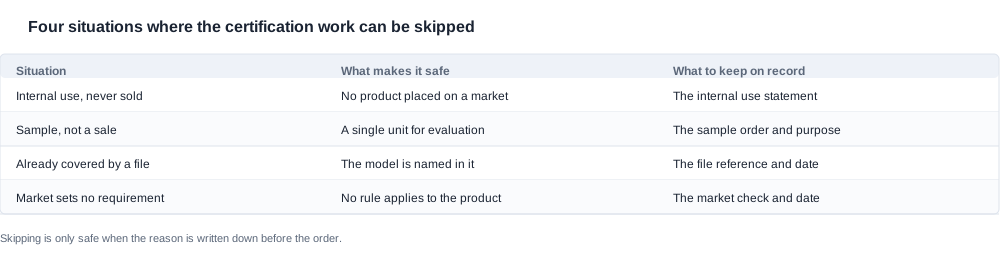
Smart glasses certification checklist work can be skipped in exactly four situations
The reader and the question underneath
The reader is a brand-side procurement lead, a channel buyer or an importer who has been told that a product needs certification work, and who is trying to work out whether that is true for their programme. It is frequently not true. Certification work is one of the largest discretionary line items in a launch budget, and it is often carried into a programme by assumption rather than by requirement.
The assumption has a mechanism. A product that contains a battery and a radio is a regulated object in most markets, and a supplier who mentions compliance in a conversation creates the impression that a specific obligation has already been identified. Often no such identification has happened. Nobody has established which markets the product will be sold into, or what those markets require for this category of product, or whether the requirement attaches to the specific model or to the programme as a whole.
So the question underneath is not "do I need CE" or "do I need FCC". It is: which markets am I placing this product into, and does any of them attach a requirement to this product category?
Why this question cannot be answered from the catalogue
Our catalogue publishes no per-model certification row for any of its twenty-eight models. It contains a company-level export certification page, which carries design patent certificates, and it does not contain the text of CE, FCC or RoHS anywhere at all.
That silence is the reason this article exists and the reason a buyer has to do the work themselves. There is no catalogue page to check. The decision has to be made against the destination market's published rules, which is a different kind of research and takes an afternoon rather than a minute.
The framing is worth stating carefully, because it is easily misread in the supplier's favour. The catalogue's silence does not mean the products lack documentation. It means the documentation position is not published, so it has to be requested. What a catalogue can never do is tell a buyer whether a requirement exists for a market, because that depends on where the product is going and how it is being sold — not on what the product is.
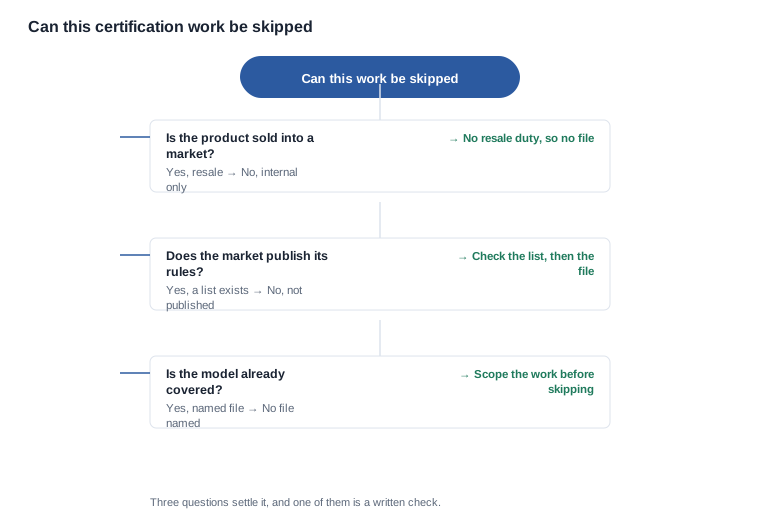

Why skipping is a decision rather than an omission
The two failure modes are not symmetric
There are two ways to get this wrong, and they cost very different amounts.
Skipping when a requirement exists is the expensive error. The discovery usually happens at the border or at the point of sale rather than in the buyer's office, and the costs are unrecoverable: the consignment, the rework, the relabelling, the delay, and in some cases the inability to place the product on a market at all for a period of time that a launch plan cannot absorb.
Not skipping when no requirement exists is the cheaper error, but it is not free. The buyer pays for a file, waits weeks for it, carries the schedule risk of a dependency that was never necessary, and sometimes structures a launch date around a constraint that did not exist. This is the error most buyers make without noticing, because nobody complains about a deadline that was self-imposed.
The asymmetry matters for how a buyer should behave. The cost of asking one more question is low; the cost of guessing wrong in either direction is high and asymmetric. So the right posture is not "skip by default" — it is "skip only after you can point at the rule that says it is not needed".
A skip is a recorded decision, not an absence
There is a difference between a decision to skip and simply not doing the work. The first is defensible in a dispute, in an audit and in a review; the second is indistinguishable from an oversight.
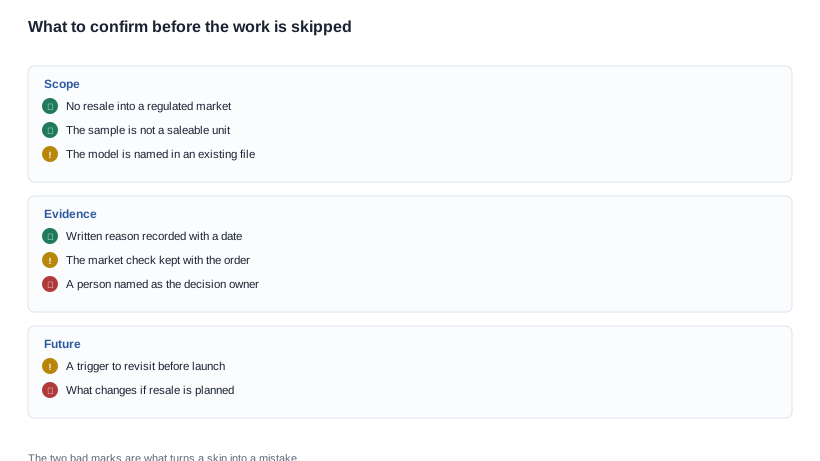
A defensible skip has four things: a written statement of why no requirement applies, the date it was made, the name of the person who made it, and a trigger that says what would cause the decision to be revisited. The fourth is the one people skip, and it is the one that matters — because the reason a requirement did not apply is usually a fact about the plan, and the plan changes. A programme that was internal-only becomes a retail programme, a sample becomes a production unit, a market is added, a product description changes, a claim appears on the packaging.
The certification checklist is the fuller version of this, and the point of recording a skip is that it costs about ten minutes at the start and about a month at the end.
What a skip does not let you skip
Even where the certification work itself does not apply, three things do. They are cheap and they are what turns a skip into a plan.
The claim check. Whether the product may be described in a particular way is a separate question from whether the product needs a file. A product may be sold without documentation and still not be permitted to make a particular claim about what it does.
The market list. The decision to skip is per market. A programme aimed at one market in year one and three markets in year two needs the decision recorded per market, with the trigger on the ones that were not in scope.
The supplier question. Even when a skip is correct, the buyer should still know what documentation the supplier holds for the model, because the answer determines what happens when the trigger fires. A buyer who skipped the work without asking will have to start the work from nothing later, rather than from a file reference.
The four situations, and what each one assumes
One: the product is for internal use and is never sold
What it is. The units stay inside the organisation — a demonstration model, a development unit, a gift to a partner that is not a distribution channel. Nothing is placed on a market.
What it assumes. That the internal use is genuinely internal, and that the units are not supplied to anyone outside the organisation in a way that constitutes placing them on a market. A unit given to a distributor, a retailer, a reviewer or a customer as part of a trial is, in most regulatory frameworks, closer to supply than to internal use, and the distinction is a factual one that should be settled before the skip is recorded.
What to keep on record. The internal use statement, who it is for, and the date it was made.
Two: the unit is a sample for evaluation and is not a saleable unit
What it is. A small quantity of units produced for evaluation, with the purpose stated and no route to a customer.
What it assumes. That the sample genuinely has no commercial route, and that the sample order says so in writing. A sample order that says "sample" in the description but has a price and a delivery address is a sale.
What to keep on record. The sample order, the stated purpose, and the quantity. The supplier verification material covers what to confirm with the supplier about the units you receive.
Three: the exact model is already named in a document the supplier holds
What it is. A file already exists for this model designation — possibly one the supplier produced for an earlier programme, possibly one that covers a different market but the same model.
What it assumes. That the designation on the file is the designation in your order, and that the file covers the market you are shipping into. Both assumptions are common and both are frequently wrong: the file may cover a sibling model, and the file may cover a market whose requirements differ from yours.
What to keep on record. The file reference and the date, plus the check that the designation matches the order. This situation is often mistaken for the second — a buyer who has seen a file assumes the requirement is met, when what has actually been established is that a file exists.
Four: the destination market publishes no requirement for this product category
What it is. The market's published rules do not attach a requirement to this product.
What it assumes. That the market has been checked properly — the product category has been identified correctly, and the rules have been read rather than summarised. Product categories are where this kind of research goes wrong: a product with a radio and a rechargeable battery is frequently assumed to be in scope because of the radio, when the relevant category turns out to be something else.
What to keep on record. The market check itself — which rules were consulted, what category the product was assessed against, and the date. The EU market entry article is the model for how that check should be documented.
The trigger, which is what turns a skip into a plan
Every one of the four situations rests on a fact about the plan rather than about the product, and that is why a skip needs a trigger attached to it. The facts that justified the skip are the facts most likely to change first.
The trigger should be written as an event, not as a date. A date trigger fires whether or not anything relevant has happened, which is how a skip becomes a piece of unpaid work; an event trigger fires when the fact that justified the skip has stopped being true.
In practice the triggers are short and they are recognisable. The programme moves from internal evaluation to a commercial channel. The order quantity moves from sample scale to production scale and the units are resold onward. A market is added to the list. The packaging changes from an evaluation carton to a retail carton with a product description on it. A claim appears in the product listing that was not in the specification. A new model is added to the programme and it is not the model the skip was recorded against.
That last one is the most common trigger and the easiest to miss, because a skip is usually recorded against a model designation while the programme grows around it. A skip that names one model is not a skip for the programme, and it is worth writing it in a way that makes that explicit: what was decided, for which model, on what date, and on what basis.

The three situations where skipping is not available
The product is sold into a market with a radio-equipment requirement
If the product is placed on a market that attaches radio-equipment requirements to it, the work is not optional. The framework for radio equipment in the European Union is the Radio Equipment Directive (EU) 2014/53/EU, and what that framework demands is a technical file and a declaration of conformity rather than a single certificate — which is why the cost is scoped per product family and per market rather than per unit.
The practical point for a buyer is the scoping. A programme that spans three models and two markets may need six scopes, or may need two, and the difference is worth a careful question before the work is commissioned. Ask what is per model and what is per market, and ask for the scope in writing rather than for a single file.
The product is a children's product and the destination market has children's product rules
Our catalogue includes three children's models — the A05 and the A06 children's smart protective glasses and the A07 children's smart audio glasses. Products in that category attract their own requirements in the markets where they are sold: in Europe, standards such as EN 71, and in the United States, ASTM F963 alongside the general requirements for children's products.
This is one of the two situations where skipping is definitively not available, and the reason is that the requirements attach to the product type rather than to the market access decision. A buyer who has correctly established that no radio-equipment file is needed for a specific configuration still cannot skip the children's product requirements for a children's model.
The product makes a claim that pulls it into a product regime
The third case is the one that is easiest to miss, because it is triggered by something written rather than by something built.
Our catalogue includes a bone-conduction model published with an amplification gain of 35 dB. A product in that category is capable of being described in ways that bring it within a device regime — in the United States, hearing-related claims fall under device requirements including 21 CFR 800.30, and a product that is described as addressing hearing loss has brought itself into a regime that a product with no such description has not.
The contract and the packaging point follows directly, and it is the reason this case belongs in a list about skipping certification work rather than only in a list about marketing claims: the claim on the box is what determines the regulatory position, so a buyer who skips the documentation work has also skipped the step that would have surfaced the claim. Where the claim is uncertain, the uncertainty is itself the reason not to skip.
The certification hidden costs article is worth reading alongside this, because the cost of a claim problem is borne at the point of sale.

A fifteen-minute test you can run before starting the work
The test below is designed to be run in a single sitting, before any budget is committed. It has five steps, and each one ends with a yes or a no rather than a judgement.
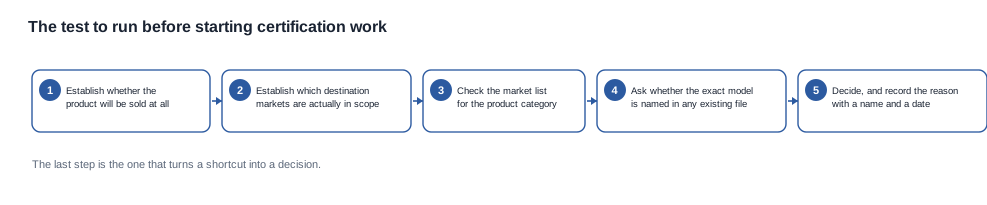
- Establish whether the product will be sold at all. If it will not, situation one applies and the remaining steps are unnecessary.
- Establish which destination markets are actually in scope. Not the ones the programme might reach in three years — the ones this order is for.
- Check the market's published rules against the product category. Identify the category first, then read the rule for that category. This is the step most often skipped, and it is the step that determines everything else.
- Ask whether the exact model is named in any existing document. If it is, situation three may apply, after checking the designation and the market scope on the document.
- Decide, and record the reason with a name and a date, together with the trigger that would cause the decision to be revisited.
What to do with the result
If any of the four situations applies and no exclusion applies, the work is skipped and the reason is recorded. If one of the three exclusions applies, the work is scoped rather than skipped, and the scoping question becomes: what is per model, what is per market, and what is the critical path to the launch date.
If the test returns an unclear answer — and in this category it often does, because the product category is genuinely ambiguous — the answer is not to guess in either direction. The answer is to spend an hour with the supplier asking the factual questions that the catalogue cannot answer: what documentation exists for this model designation, which markets it covers, and what the supplier has run for which configuration. That conversation usually resolves the category question as a side effect.
What we publish about certification, and what we will request on your behalf
We publish no per-model certification row, and we do not claim CE, FCC or RoHS for any model. Our catalogue's text contains none of those markings, and a supplier that presented the catalogue as evidence of certification would be presenting a document that does not make the claim. Our company-level export certification page is a statement about the company, not a matrix of model coverage.
What we will do is tell you what exists for a specific model designation, in writing, and separate it from what does not. For a given configuration and destination market we will state which documents we hold, which model designations they cover, what is covered per product family rather than per model, and what would have to be produced if the scope changed. Where a file does not exist for a designation, we will say that rather than describing a family file as if it covered the model.
And where you have concluded that the work does not apply, we will tell you which documents we would need to produce if that conclusion changes — so the skip is recorded against a known starting point rather than against nothing. We will also tell you what a claim about the product would change, because in this category the product description and the regulatory position are connected, and it is cheaper to know that before the packaging is printed than after.
Tell us the configuration, the destination market and the sales channel, and we will tell you what documentation position applies and what the starting point would be if you need to start.
Related reading
- Certification checklist
- Supplier verification
- EU market entry
- Hidden costs
Tell us the configuration, the destination market and the sales channel, and we will tell you what documentation position actually applies.


