
A smart glasses certification checklist is what buyers most often ask to know about, and the reason is simple: the buying decision is already made and the launch date is already booked, but nobody in the chain can say which document will be produced when a retailer, a marketplace or a customs broker asks. The answer is not a certificate, it is a file with six parts, and the six parts sit with three different parties. This article sets out what each part is, who holds it, how to read one properly, where a request usually dies, and what can and cannot be moved in a commercial negotiation. It also states plainly what this catalogue does and does not publish, because the honest answer is more useful to a buyer than a confident one.
What buyers most often ask to know about smart glasses certification checklist: who holds the evidence
Three questions settled before escalation
Three things settle most smart glasses certification questions before a buyer has to escalate. First, certification is not one document but a set, and the set for a wearable device with a radio and a cell runs to at least six parts: the product test report, the substance declarations, the cell and transport documentation, the declaration of conformity, an ingress report where an ingress claim is made, and the platform or channel listing evidence. Second, those parts are held by three different parties — the manufacturer holds the technical evidence, the trading company holds the commercial relationship, and the importer holds the declaration, because the declaration is the importer's own legal document and does not transfer with the goods. Third, the request has to name the model, the configuration and the destination market, or it will be answered with a company-level brochure that cannot be reconciled against a specific unit.
Who is asking, and what they are trying to close
The reader is a brand-side procurement manager, a channel buyer or an e-commerce seller, and the usual moment is late in a programme. The product has been sampled, the copy has been written, the channel has agreed a listing date, and a question arrives from a platform, a retailer compliance team or a freight forwarder that nobody in the chain can answer. The thing being managed is a launch date and a listing that is already committed to. The cost of not having the file is not a fine in the abstract; it is a delayed listing, a held consignment, or a channel that decides it would rather not carry the product at all.
That is why the request is treated as a risk-management task rather than a paperwork task. The question is not "do we have a certificate" but "which document, held by whom, in what scope, with what validity, and what happens to the listing if the answer is wrong". Each of those five is a separate line in a request.
Why the request is bigger than a single certificate
A single mark on a single document is the easiest thing to ask for and the least useful thing to receive, because the mark says the product was assessed for one market and one configuration. A buyer who receives it and files it still cannot answer the three questions that actually come up: does it cover the variant in the order, does it cover the case that ships in the box, and does it still cover the unit if a component is substituted.
The scope of the request also has to include the things that are not certification marks at all, because they generate the same demands. A retail buyer asking about an ingress claim needs a test report rather than a mark, and in this catalogue only two models publish an ingress marking, the V06 and the S7, so for the rest of the range an ingress claim is either unsupported or must be evidenced separately. A buyer asking about the radio needs the report for the standard that applies to the radio in the unit, and the radio version is published for the audio, sport and headset models but not for the camera models, so for those it has to be requested.
Who actually holds each piece of the file
This is the question that turns a stalled request into a scheduled one. Ask the wrong party and the answer is a polite non-answer that gets logged as a supplier problem rather than as a routing error.
- The manufacturer holds the product test report, the substance declarations, the cell test summary and any ingress report. These are produced from the hardware and are the hardest documents to get right, because they are tied to a specific model designation.
- The trading company holds the commercial record: the quotation, the purchase order, the delivery schedule and the warranty route. It usually does not hold the test reports itself.
- The importer holds the declaration of conformity and the market registration, because a declaration is signed by the party placing the product on the market in that market. No supplier can sign it on the importer's behalf.
- The channel holds its own listing evidence, such as a platform listing record or a channel test report, and it will ask for a reference rather than for the file.
The six documents behind every smart glasses certification request
Documents one to three: the product, the materials and the cell
The first document is the product test report for the exact model and configuration. For a radio product sold into the European market the framework is the Radio Equipment Directive (EU) 2014/53/EU, with the EMC Directive (EU) 2014/32/EU as the separate instrument covering electromagnetic compatibility, and the harmonised standards EN 301 489-17 and EN 301 489-52 relevant to the Bluetooth equipment in this range. The point for a buyer is not to become an expert on the standards; it is to be able to check that the report names the model, names the radio version, and states the markets it was assessed for. A report written for a sibling model with a similar name is the single most common document defect in this category.
The second document is the substance declarations: the Restriction of Hazardous Substances directive (EU) 2011/65/EU and the REACH regulation (EC) No 1907/2006, with the declarations covering the materials actually used in the product rather than a generic statement about the factory. The third is the cell and transport documentation, where the UN38.3 test summary and an IEC 62133-2 type cell safety report are the usual items requested, and where the cell part number matters more than the brand name, because a part number can be checked against the bill of materials and a brand name cannot.
Documents four to six: the declaration, the ingress claim and the platform
The fourth document is the declaration of conformity, and it is the one most often mistakenly expected from a supplier. It is signed by the party responsible for placing the product on the market in the destination, which in most programmes is the importer, and the supplier's role is to supply the technical evidence that the declaration rests on. A buyer who has not assigned that responsibility will discover it at the worst moment, because the declaration cannot be delegated retrospectively and cannot be signed by a party that has not seen the finished unit.
The fifth document is the ingress test report, and it is only relevant where an ingress claim is made. In this catalogue the IP54 marking is published on two models, the V06 and the S7, and nowhere else, so for the remaining models an ingress claim is a marketing decision that needs evidence the catalogue does not contain. The sixth is the platform or channel listing evidence, which is rarely held by the manufacturer at all and is usually generated by the channel's own process once the product is submitted. It is worth asking for early because it has its own lead time and it is usually the last document a channel will accept.
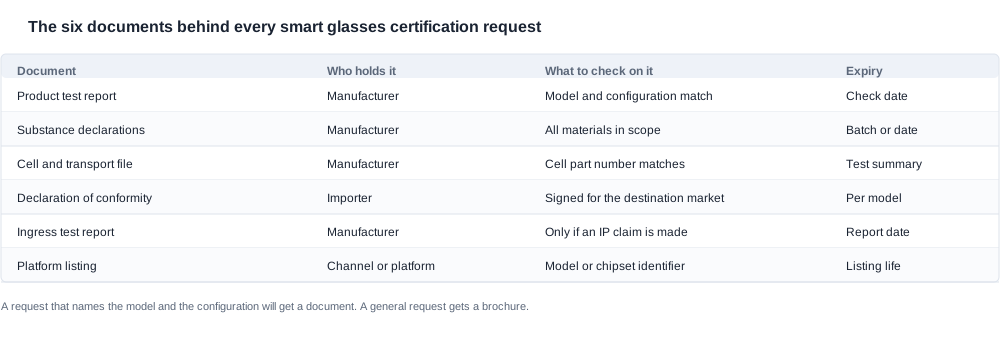
The table lists each document, the party that holds it, what to check on it when it arrives, and the way its validity is expressed. A document that cannot be traced to a holder, a model and a date is not usable in a channel review, whatever it is called.
What this catalogue publishes, and what it does not
This is the part a buyer should know before writing the request, because it determines how much of the list can be answered from the catalogue and how much has to be asked for. The catalogue has a single company-level export-certification page and no per-model certification row for any of the 28 models. The published text of the catalogue does not contain the terms CE, FCC or RoHS in relation to any model, so those cannot be quoted as our certifications, and a supplier reply that includes them should be treated as a general capability statement rather than as model-level evidence.
What the catalogue does publish is specific and useful: the cell capacity, the charge time, the run time, the charging interface or the absence of an interface row, the camera class for the camera models, the Bluetooth version for the models that publish one, and the charging case capacity for the models that publish one. On the radio specifically, the audio models publish version 5.3 or 5.4, the sport and headset models publish 5.4, and the camera models publish no Bluetooth version, so the radio report for a camera model has to be requested rather than assumed.
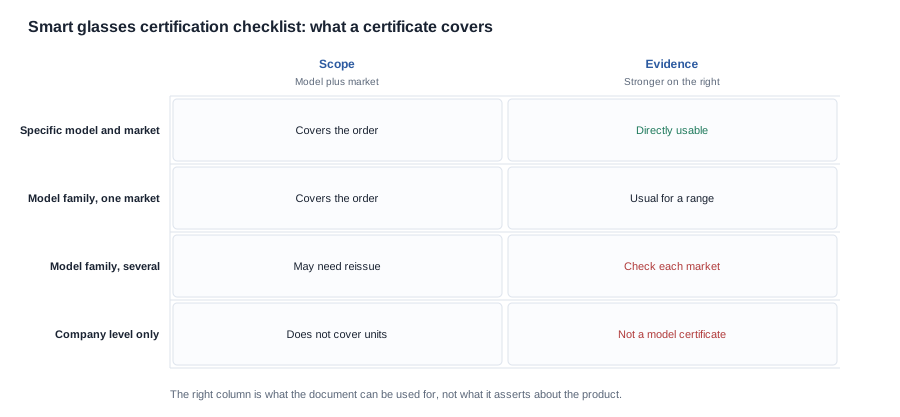
The matrix below turns that into a working rule for the request. The scope of a document decides what it can be used for, and the most common failure is not a bad document but a good document with the wrong scope.
Reading a certificate properly, and the four ways a valid one misleads
The three identifiers to match before anything else
Before any other reading, three identifiers have to be matched between the document and the order. The model designation, including any suffix that changes the hardware, such as the Pro or Utral variants in this range. The configuration, meaning what actually ships in the box, because a configuration that adds a charging case is a different product for several purposes, and a camera model published with a case and a camera model published without a case row are different commercial products even when the device inside is the same. And the destination market, because a document assessed for one market does not cover another and the importer's declaration is market-specific.
If those three match, the document is usable. If any of them does not, the document is not wrong so much as irrelevant, and treating it as relevant is the failure this section is about.
Four ways a valid document misleads
The report written for an earlier build. The test report was produced for the model before a component changed, and the file was never reissued. The signal is a test date that predates the current bill of materials, and the control is to make the cell part number and the model designation controlled items on the purchase order, with any substitution treated as a change that reopens the file.
The company-level statement offered in place of a model document. A statement about the factory's testing capability, or a page showing the company holds certificates for other products, is offered as though it covers the model in the order. The control is a simple scope test: does the document name the model designation of the unit that will be shipped? If it does not, it cannot be filed against that order.
The report for a market that is not the destination market. A document is valid, in its own frame, and simply does not cover the market the goods are going to. The control is to write the destination into the request line rather than asking for a general set of certificates.
The model-level document with the wrong configuration. The report covers the bare device, and the order ships the device with a case. In this catalogue the difference is not hypothetical: the L2 Utral is published with a case at 900 or 1400 mAh, the MT6 with a 1200 mAh folding case, and the V03 Pro has no charging-case row while the V06 and the V03, and the S7 publish no case row at all. Whether a case travels in the box changes the material set, the packing list and, for transport purposes, the battery declaration.
The request checklist, grouped by who answers it
The checklist below is the request in a form that can be sent. Grouping by holder is deliberate: it removes the routing ambiguity that turns a two-day request into a two-week one, and it makes the outstanding items visible to both sides at the same time.
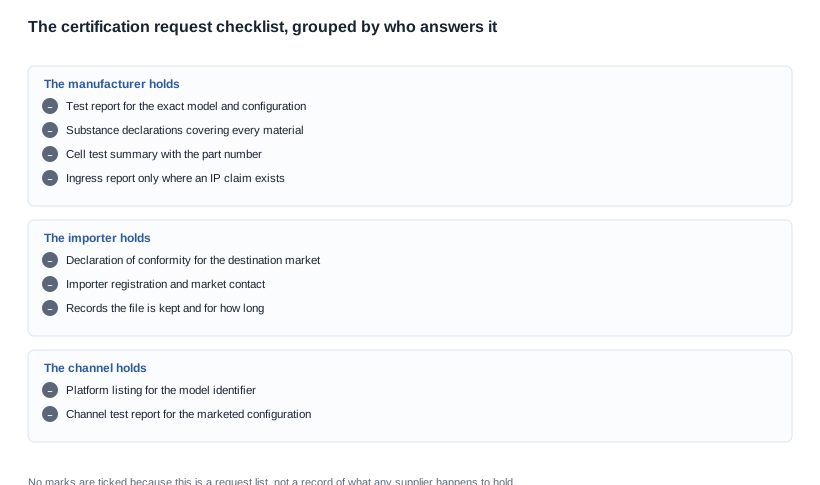
Send it as one document with a date on it, and ask for a reply that states, for each line, whether the document exists for the named model and configuration, who signs it, and when it can be provided. A reply that answers the question in general terms has not answered the question, and the difference is visible in whether the supplier repeats the model designation back.

Where a certification request goes quiet
The five places a request dies
Requests in this category fail in a small number of repeatable ways, and each of them looks like a supplier problem from the buyer's side when it is actually a routing or a scope problem.
The request without a model. A general enquiry for certificates is answered with a company brochure. Nothing is wrong with the supplier; the request was answered correctly and it is useless. The control is to name the model and the configuration in the request line itself.
The answer that arrives without a holder. A document is produced by a party who does not hold it and cannot reissue it. The control is to ask who signs and who owns the underlying test, not only who can send a copy.
The evidence that exists but sits with the wrong party. The technical file belongs to a sub-supplier of the manufacturer, and the manufacturer's own answer is that it is not theirs to give. The control is to ask the manufacturer to confirm the relationship and the route to the sub-supplier, in writing, at the point of quotation rather than at the point of crisis.
The file that is closed when the hardware changes. A substitution after the test was done leaves a valid document attached to a unit it no longer describes. The control is a change clause that reopens the file automatically.
The declaration nobody signed. The importer assumed the supplier would sign, and the supplier assumed the importer would. This one is entirely procedural and entirely preventable by naming the signatory in the purchase order.
The path a certification request actually takes
The flow below is the working sequence, and the point of it is the hand-offs. Each of them has a named owner and a completion test, and a request that has a status at every hand-off is a request that can be chased.

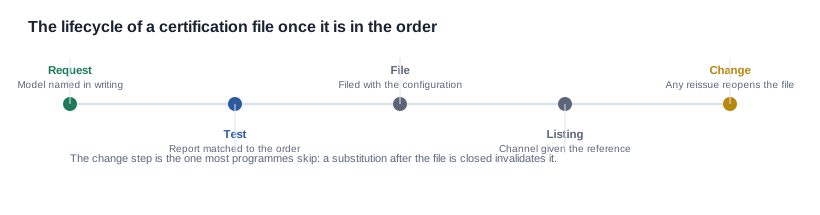
The lifecycle of a file once it is in the order
A file that is closed is not a file that is finished. The last step in the lifecycle is the one most programmes omit, and it is the step that causes the most expensive surprise: a change to the product reopens the file, and if the file has been used to support a live listing, the listing has to be re-substantiated.

The scope you pay for, and the parts that cannot move
What a certificate costs and what it is worth
The cost of compliance work in this category is per model and per market, not per unit, which is why the useful commercial question is not whether the fee can come down but whether the scope is right. A quotation that carries a market the buyer does not need is a cost the buyer chose, and removing it is often easier than arguing about the number. A quotation that carries only one market for a programme that will later sell into three is a cost the buyer has deferred, and deferring it does not remove it.
The value side is more concrete. A model-level document that covers the exact configuration, and can be reissued if the product changes, is worth more to a programme than a cheaper scope that cannot survive a substitution. That is the trade-off to put in front of a supplier: the price of the scope against what happens to the listing when a component changes.
The parts of the commercial position that do not move
The testing, the assessment of a model against a destination market, and the cell qualification are per-model and per-market costs with a fixed character, and a buyer who argues hardest about the fee on these usually wins the small amount and loses the larger prize, which is the scope. The parts that do move are the order quantities, the payment schedule, the packaging and artwork, the delivery split, the documentation handover, and the after-sales route. Those are design decisions and schedule decisions on the supplier's side, and they respond to a buyer who arrives with a specific configuration rather than a general enquiry.
The certification cost itself should not be presented as a negotiation item at all, because it is the one number in the programme that everyone can predict, and presenting it as variable is a way of signalling that the rest of the quotation is also soft.
A hypothetical certification request, worked through
The following is a reasoning exercise rather than a customer story. No client is described and no figures are claimed; the model, the market and the channel are assumed so that the reasoning can be followed. A brand-side buyer is preparing a camera model for a single European market and a single retail channel that has asked for substantiation before it will list. The catalogue publishes no per-model certification row, so the entire file has to be assembled by request.
The first step is to write the request as six named lines, with the model designation, the configuration including whether a case ships in the box, the destination market, the document wanted, the party who will sign it and the date the answer is needed by. The second step is to split the six lines by holder, because the manufacturer and the importer answer different lines and the importer's declaration cannot be produced by anyone else. The third step is to check the scope of what arrives against the three identifiers, which for a camera model means checking the designation including any Pro or Utral suffix, the case configuration, and the market.
The fourth step is the check that the request was built from the published position. The catalogue publishes the cell capacity, the charge time as a ceiling, the run time, the camera class and the charging interface row for this model, so those lines go into the specification sheet as published facts, and the lines that are not published go onto the request list. The buyer does not have to ask for what is already written, and the supplier does not get to bill for re-stating it.
The fifth step is the one that decides the outcome. The listing copy is written from the published rows plus the evidence received, so that every claim on the page traces to a line in the file. A page that claims an ingress rating the file does not support is a problem regardless of what the product actually does, because the channel tests the claim rather than the product.
The sixth step is to record the reissue trigger in the order, so that the next programme starts from a file rather than from a request.
What this catalogue certifies, and the next action
The catalogue is a product document and not a compliance file, and we would rather say that than let a buyer assume the other. The catalogue publishes the electrical rows for 28 models, the camera class for the 11 camera models, the Bluetooth version for the models that carry one, the charging case capacity where it is published, and a company-level export-certification page. It does not publish per-model certification, it does not publish an ingress claim for any model other than the V06 and the S7, and it does not publish a Bluetooth version for the camera models. We will not convert any of those into a claim we cannot evidence.
What we will do is take a request that names a model and a configuration and tell you exactly which of the six lines in this article is already answered by a published row, which ones are requests we can route, and which ones sit with you as the party placing the product on the market. The certification checklist step by step guide sets out the order to work the request in, the documents to request article gives the per-document detail, and the OEM-ready platform coverage article sets out how a platform listing fits into the same file. The certification checklist pillar holds the full framework.
If you send us the model, the configuration, the destination market and the channel, we will tell you which parts of the certification file already exist as published rows, and which parts you are going to have to request in writing. That is the whole of it: a smart glasses certification checklist is a request with a model on it, and a request without a model is a brochure.


