

Charging faults are unusually well suited to symptom-first triage, because the symptom is usually specific and the causes are few. The complication is that two of the most frequent complaints are expected behaviour rather than defects, and a support operation that does not know that will replace good units indefinitely. A third complication matters more to a buyer than to a support agent: every symptom on this list has a sourcing action behind it, and a channel that treats the symptom in the field has already paid for the fault twice.
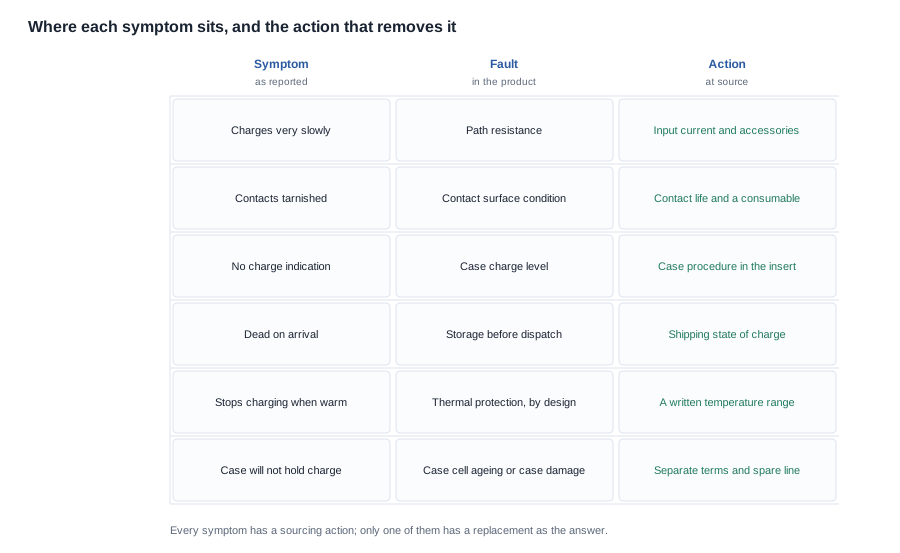
Six symptoms, their likely causes, and the action that removes each one at the source rather than in the returns queue.
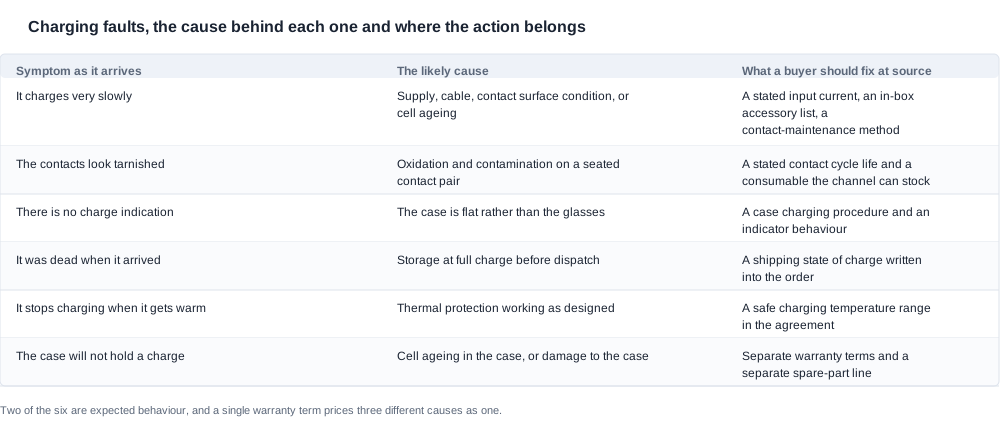
| Symptom as it arrives | The likely cause | What a buyer should fix at source |
|---|---|---|
| "It charges very slowly" | Supply, cable, contact surface condition, or cell ageing | A stated input current, an in-box accessory list, and a contact-maintenance method |
| "The contacts look tarnished" | Oxidation and contamination on a seated contact pair | A stated contact cycle life and a consumable the channel can stock |
| "There is no charge indication" | The case is flat rather than the glasses | A case-specific indicator behaviour and a case charging procedure |
| "It was dead when it arrived" | Storage at full charge before dispatch | A shipping state of charge written into the order |
| "It stops charging when it gets warm" | Thermal protection working as designed | A safe charging temperature range in the agreement |
| "The case will not hold a charge" | Cell ageing in the case, or mechanical damage to the case | Separate warranty terms and a separate spare-part line |
Smart glasses charging: six symptoms and the fault behind each one
"It charges very slowly" is the complaint that costs the most, because it is usually misread. The customer's account is that the battery has become worse, the natural conclusion is cell ageing, and the unit is replaced with a unit that has the same fault. The cause is nearly always electrical resistance somewhere in the path, and there are four places it can sit: the supply, the cable, the contacts and the cell. The first three are cheap to rule out; the fourth is the least likely within a product's service life and the most expensive to assume.
"The contacts look tarnished" is largely a product-life issue rather than a defect. Cleaning restores function in most cases. The specification question behind it is whether the contacts are plated and what the rated contact cycle life is, and our catalogue publishes neither for any model. The action at sourcing stage is to obtain the contact cycle life in writing, because it decides whether a three-year channel product still charges reliably in year three.
"There is no charge indication" is usually the case being flat rather than the glasses. The sequence looks like a dead product, because the glasses sit in a case that will not charge them and the case indicator shows nothing. The fix in the field is to charge the case first and then place the glasses. The fix at sourcing stage is a case charging procedure in the packaging insert, because the failure will otherwise recur on every unit sold.
"It was dead when it arrived" is nearly always storage rather than manufacture. Goods held at full charge for weeks or months in a warehouse or a container arrive degraded, and the symptom is a unit that appears completely flat. The remedy is a recommended shipping state of charge in the purchase order. It is a one-line term, it is very often missing, and it removes an entire category of arrival complaint.
"It stops charging when it gets warm" is expected behaviour. Thermal protection exists because charging a lithium cell above its safe temperature causes damage, and in practice it shows up as a case left in a hot vehicle or a unit left in direct sun. The action is to describe it in the listing and the support script rather than to treat it as a fault, and to obtain a safe charging temperature range in writing so that the support line can distinguish a protected unit from a defective one. We publish no such range for any model in the range.
"The case will not hold a charge" is either cell ageing in the case or mechanical damage to the case. Cases fail far more often than the glasses, because they are small, are carried loosely and contain a cell. The MT6's foldable case adds a hinge, which is a mechanical joint with its own failure mode and a different spare part from a rigid case.

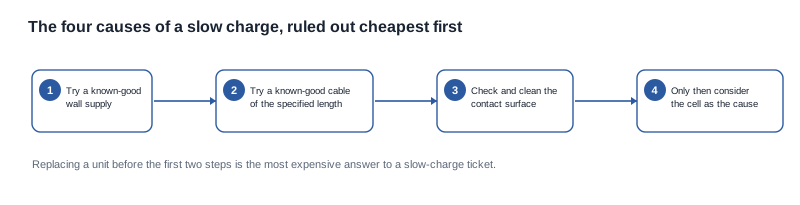
The four causes of a slow charge, in the order they should be ruled out
Ruling out the causes in the right order is what separates a cheap diagnosis from an expensive one, and the order is not arbitrary: each step costs less than the one after it.
-
The supply. A laptop port or a low-output adapter delivers a fraction of the current a wall supply does. This is not a fault and the product is not harmed, but it is the single most common explanation for a slow charge and it costs one known-good adapter to rule out.
-
The cable. A thin or long cable has higher resistance than the one the product was developed with. Our catalogue publishes no cable gauge for any model, which is why this cause is common and hard to diagnose: the product's own accessory is not a documented reference point.
-
The contacts. On a magnetic interface, lint and skin oil build up on the pads and the contact resistance rises over time. This presents as gradual slowing, and it is the cause that actually replaces units unnecessarily.
-
The cell. Ageing is real and it is the least likely cause within a normal service life. It is also the most expensive to assume, because assuming it means replacing a unit that would have worked.
The rule that follows is simple: never replace a unit on a slow-charge complaint until a known-good supply and a known-good cable have been tried. If the charge time normalises, the product was never the problem, and the channel has just saved a unit, a freight movement and the customer's goodwill.
The checklist a procurement team runs before you order
A procurement team running a charging programme has one advantage over a support team: it can remove the fault before it exists. The checklist is short, and it is worth running it against every model on the shortlist rather than against the ones that worry you.
-
Is the charging interface stated in writing for each model? Our catalogue publishes it for 24 of 28 rows, and the four it does not publish for are the ones that cannot be checked by the buyer alone.
-
What input current does the port accept, and does the accessory ship in the box? Both belong in the order, and both are absent from our published material.
-
What is the shipping state of charge, and who chooses it? A forwarder's default is not a deliberate choice.
-
What is the contact cycle life and what is the safe charging temperature range? We publish neither for any model.
-
Which parts are separate SKUs, and what are their spare-part price and lead time? The case is the obvious one, and it is also the one most often discovered late.
None of those is a technical question a buyer cannot ask, and each one is a question whose absence shows up later as a return.
The red flags in a charging specification
There are four warning signs in a charging specification that should stop a shortlist rather than start a discussion.
A charge time with no conditions is the first. A case capacity with no end criterion is the second. A contact cycle life presented as a typical figure rather than as a stated one is the third. And a model designation that appears on a family document rather than on the model's own file is the fourth.
None of them is a disqualifying defect in the product. Each of them is a sign that the supplier's documentation sits one level above where the question is being asked, and that pattern will recur on every other question you ask the same supplier.
The triage sheet to send with a return authorisation
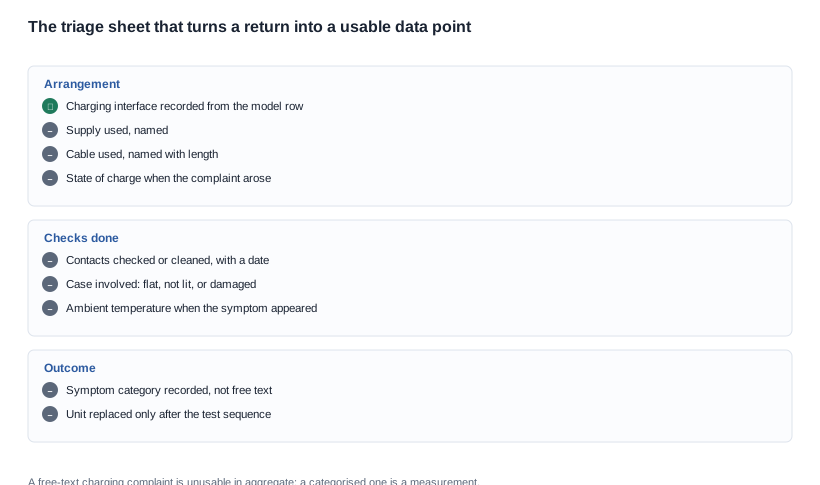
The sheet below is the version to hand to a support team with the return authorisation, because the value of a return is in the data that comes back with it. A free-text description of a charging fault is almost unusable in aggregate; a categorised one is a measurement.
-
Which charging interface does the unit use? Ask from the model row rather than from the customer, and note it on the sheet.
-
What supply was used, and what cable was used? A named adapter and a named cable length is worth more than a description of the room.
-
What was the state of the unit when the complaint arose? Full, part-charged or flat, and was it flat or partly charged.
-
Has the contact surface been checked or cleaned? A yes with a date is a diagnosis; a no means the unit has to come back before anything is replaced.
-
Is the case involved? Flat case, case indicator not lit, or case mechanically damaged are three different returns.
-
What temperature was the unit in when the symptom appeared? This one question separates a protected unit from a defective unit, and it is the question most often left blank.
The returns instruction that goes out with the sheet should be the same document the channel keeps. Otherwise the channel accumulates free text that tells nobody anything, and the failure keeps arriving in the same form for years.

The complaints that are expected behaviour rather than defects
Two of the six symptoms are not faults at all, and the commercial consequence of confusing them is disproportionate: units that work are replaced, customers are given a unit that behaves identically, and the returns rate does not fall while the replacement cost is paid every time.
Thermal cut-off during charge is a protection feature. A unit that refuses to charge above a certain temperature is behaving correctly, and treating it as a defect trains the support team to discount the customer's report on the next, genuine, fault. The distinction can only be made with a stated temperature range. Without one, the buyer has two bad options: replace good units, or discount genuine faults. Neither is defensible, and the fix is a written range rather than a policy.
A case that holds less charge than it did is also, in the early life of a product, a normal behaviour. A case cell ages like any other cell, and a case that is at the end of its life will not hold what it held. What the buyer should not do is apply the glasses' warranty to the case without separating the two, because the case's economics are different and the part that fails more often should not be the part priced at a lower replacement cost.
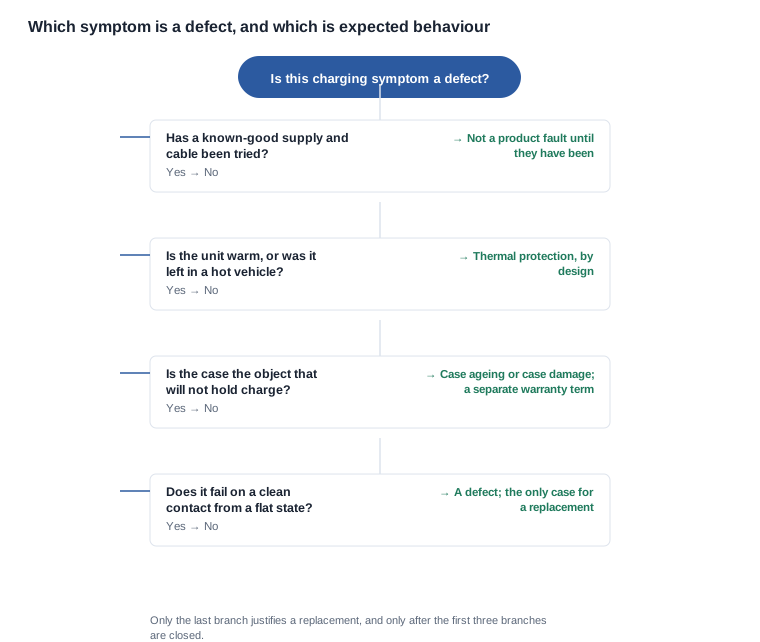
There is a third category that is neither a fault nor a design behaviour: the unit that never worked. A unit that will not charge at all, with a known-good supply and cable, on a clean contact pair, is a defect. That is the only category that justifies a replacement, and it is worth writing the test sequence into the support script so that the other five categories do not leak into it.

The case failures that a single warranty term misprices
A case is a second product. It contains a cell, it has a housing, it may have a hinge, it is dropped more often than the glasses because it is small and it is carried loosely, and it is not in the product's bill of materials in the way the glasses are. Four things follow, and each of them is a term a buyer can write.
Separate warranty terms. The glasses fail from use and from cell ageing. The case fails from cell ageing, from impact and, on the foldable design, from hinge fatigue. Three causes with different economics, priced as one, means either the glasses are overpriced or the case is underpriced, and in practice it is the case.
A separate spare-part line. The case is a different SKU with its own lead time. A channel that stocks spare glasses and no spare cases discovers the gap on the first case failure, and by then the customer has already had a gap in the product they bought.
A case in the returns taxonomy. The returns sheet has to separate "will not charge", "charges slowly", "charges intermittently", "loses charge faster than expected" and "case does not hold charge". The last of those points at the case and at nothing else, and a returns sheet that does not make the distinction sends case faults into the glasses' failure rate, which then distorts every reliability number the channel reports.
A case that is charged before it is trusted. Where a case is published with a capacity, the packaging insert should say that the case should be charged before the glasses are placed in it. A flat case that will not charge the glasses produces a complaint that describes the glasses as dead, and the diagnostics behind that complaint are considerably longer.
The trade-off a buyer is actually making is not between two suppliers' charge times. It is between the price of a documented arrangement and the price of an undocumented one, and an undocumented arrangement is cheaper at quotation and more expensive across the life of the channel, because the six symptoms in this article have to be paid for in replacements, in freight and in returns handling. How to compare two quotations that both publish a charge time is therefore straightforward: ask which of the six symptoms each quotation has pre-empted, and price the difference in the returns model.
What to negotiate on a charging arrangement sits mostly on the same list. The charge time is a fact and the interface is a physical fact, so neither is a negotiation. The accessory list, the spare-part allocation, the case configuration count, the returns taxonomy and the documentation package are all negotiable, and all of them are worth more than the unit price. The specific questions to ask at quotation are the spare-part price and lead time for every separate SKU, the model designations the documentation covers, and the configuration count with each configuration named. A channel that learns the case lead time after launch has already priced a gap into its service model, and a channel that cannot say which designations the documentation covers cannot make a claim at all.
Total cost is the right frame for the whole question. A charging arrangement that is cheap on the quotation and undocumented in practice is not cheaper; it is a returns model that has not been priced yet.
What we can and cannot diagnose from a charging ticket
We publish the interface, the stated charge time, the case capacity where we hold them and the cell capacity, and we do not publish input current, cable gauge, contact cycle life, safe charging temperature range, charge efficiency or cycle life, because none of those appears in our published material.
That boundary decides what a support ticket can be used for. Given a model designation and a symptom, we can say which published row applies, which of the six symptoms the pattern matches, and which rows of the diagnosis are ours and which are yours. We cannot tell you where the resistance sits inside a unit, we cannot tell you whether a cell is at the end of its life, and we cannot tell you whether a case has been dropped. Those require the unit in front of you.
The line we will not cross is a technical one and it is the same in every category we publish: we do not fill an unpublished row with a typical value. A typical contact cycle life is exactly the number that lets a three-year channel fail quietly in year three, and a typical safe charging temperature range is exactly the number that lets a support team argue with a customer about a unit that is behaving correctly.
The sourcing actions that remove each symptom at the source.
-
Slow charging — write the accepted input current into the agreement and put the in-box accessory list on the order, so that the first two causes are eliminated by the product rather than by the customer.
-
Tarnished contacts — obtain the contact cycle life and the plating in writing, and put the contact-maintenance method and its consumable into the packaging insert and the depot's stock list.
-
No charge indication — obtain the indicator behaviour for case-equipped models and write a case charging procedure into the insert.
-
Dead on arrival — write the shipping state of charge into the purchase order, and choose a partial charge deliberately rather than leaving it to the forwarder.
-
Stops charging when warm — obtain the safe charging temperature range and publish the protected behaviour in the listing, so that the support line stops treating a feature as a fault.
-
The case will not hold charge — separate the warranty terms, stock the case as its own spare part, and split the returns taxonomy so that the case's failure rate is visible.
The next step. Send us the models, the quantities and the support tickets, and we will tell you which of these six symptoms the pattern matches, which published rows apply to the arrangement, and which rows you will have to establish on your own units. The purchasing decisions that prevent most of these are set out in smart glasses charging buying mistakes to avoid, the specification gaps behind them in what the spec sheet does not tell you about charging, and the interface decision behind slow charging in why the interface matters for charging.


