

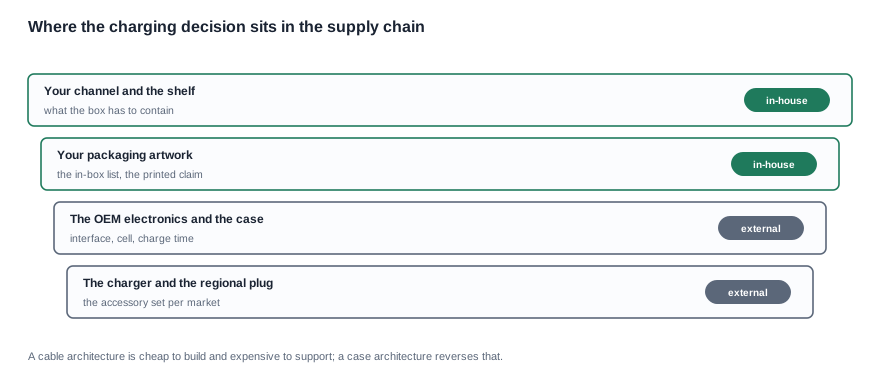
The charging architecture is a commercial decision before it is an engineering one, because it determines the box, the accessory range, the packaging artwork, the support script and the returns rate. The decision to fix early is between a cable, a dedicated cradle and a charging case, and the question that settles it is not which is more elegant but which one your channel can support without generating a contact on day one.
Two facts from our own catalogue set the frame. The published charge time is two hours or less on twenty-six of the twenty-eight models, and about one hour on the D17 and the ZH12. And a published charge time has no starting state, no charger and no termination criterion behind it, which means it cannot be used to plan a shift, to promise a turnaround to a customer, or to compare two suppliers' figures with each other. It is a laboratory statement with a number on it.
That leaves the interface itself as the thing to decide, because the interface is the part of the charging architecture that the customer interacts with. A magnetic interface means the customer needs the product to be placed on a cradle that ships in the box. A Type-C interface means the customer needs a cable, and will supply their own if the box does not contain one. A case interface means the customer has a second object to keep with the product, and the product has a second energy budget. These are three different support and logistics models, and they are settled in the quotation rather than in the engineering.
Smart glasses charging: decided by the packaging
A buyer who evaluates a charging option by asking whether it is fast enough is asking the wrong question first. The interface is a packaging decision with an engineering consequence, and the packaging decision propagates outwards into everything a channel team actually deals with: the box dimensions and its shipping weight, the number of items in the box and the assembly labour in the fulfilment centre, the accessory list that has to be printed on the packaging, the regional plug treatment for each destination market, and the stock-keeping unit count that the retailer's system has to hold.
A Type-C architecture is the cheapest to build and the most exposed. The cable is a low-cost item, but the customer is left to find a compatible one if the box does not contain it, and a customer who owns three USB-C cables and cannot tell which one works is a support contact. A magnetic interface removes the compatibility question, because there is only one thing the product will sit on, and it costs more in the bill of materials because the contact geometry, the cradle and the alignment all have to be designed. A case interface removes the compatibility question and adds a second object, which changes the box, the shipping weight and the battery transport documentation, and it also adds a second charging cycle that a customer has to understand.
The return-rate consequence is the part that usually gets missed in the comparison. A cable architecture converts a hardware question into a customer service question, and the cost of that conversion lands in the channel's support budget rather than in the factory's unit price. A buyer comparing two quotations on unit price alone is comparing the wrong line. The comparison that matters is the unit price plus the accessory cost plus the expected cost of the contacts the architecture generates, and only the first of those is usually quoted.
There is a third option that changes the arithmetic more than either of the others, and it is the option of a case that carries a meaningful charge. A case that merely stores the product is packaging. A case that holds a cell of its own is a second power source, and it changes the product's story from "charge it every night" to "charge it when the case is empty, and the case when it is empty". That is a genuine commercial difference for a channel selling to people who use the product for more than a few hours at a time, and it is a difference the customer can see, which means it has to be in the copy as well as in the box.
The last interface decision is the one that is easiest to defer and most expensive to defer: whether the charging accessory is the same in every market. A cradle or a cable with a fixed plug is fine for one territory and wrong for another, and the error surfaces at artwork release, when the packaging is already printed and the first shipment is two weeks away. Settling the regional accessory set per market before the artwork is released is the cheapest part of the whole charging decision.

What the catalogue publishes about charging, and what it leaves open
The published charging data in our catalogue is a set of configuration rows: a charging method, a charge time and a rated runtime, with a charging case named on some rows. The distribution across the range is more useful to a buyer than any single row, because it shows what the category actually does.
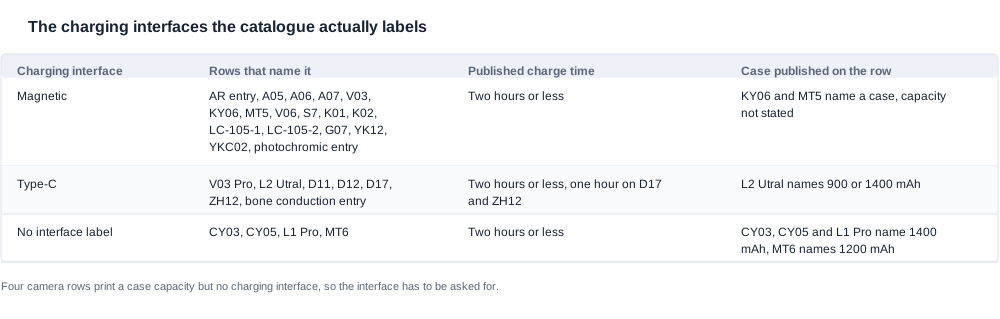
Three groupings matter. A large majority of the range charges magnetically: the AR entry, the A05 and A06 children's models, the V03 and the KY06, the A07 and the MT5, and the S7, and the V06, the K01 and K02, the LC-105 pair, the G07, the YK12, the YKC02 and the photochromic entry. A smaller group charges over Type-C: the V03 Pro, the L2 Utral, the D11, the D12, the D17, the ZH12 and the bone-conduction entry. And four camera models — the CY03 and the MT6, and the L1 Pro and the CY05 — publish a charging case capacity without printing a charging interface on the row at all.
That last group is worth pausing on, because it is a genuine open row rather than an inconsistency we have smoothed over in the copy. The four rows state a case capacity: 1400 mAh on the CY05, the CY03 and the L1 Pro, and 1200 mAh on the MT6, whose case is described as foldable. They do not state whether the glasses themselves charge magnetically, over Type-C, or through the case. A buyer who needs to know has to ask, and the answer belongs in the configuration string on the quotation. It also has a downstream consequence: an unstated interface means an unstated accessory, which means an in-box list that is not yet settled, which means packaging artwork that cannot be released.
The case configuration across the range is worth mapping out because it determines the box. The L1 Pro and the CY05, and the CY03 each name a 1400 mAh case. The L2 Utral names either a 900 mAh or a 1400 mAh case, which makes the case a genuine configuration choice rather than a fixed part, and therefore its own minimum and its own artwork. The MT6 names a 1200 mAh foldable case. The KY06 and the MT5 name a charging case without publishing its capacity, and the V03 Pro has no case on the row at all. A buyer who wants a consistent case across a range is asking for something our catalogue does not currently support, and the right way to find that out is at the configuration stage rather than at the first delivery.
On the numbers themselves, the catalogue is complete on charge time — every model in the range states one — and that completeness is worth pausing on, because it is unusual. Twenty-six models state two hours or less. The D17 and the ZH12 state about one hour. What no model states is the starting state, the charger, the ambient temperature, the termination behaviour, or how the charge time behaves when the cell is partly full. The charge time is a ceiling under stated conditions that are not stated, which is why two suppliers quoting "two hours" may be describing different experiments.
The same completeness applies to the runtime rows, and the same caveat applies to them. The camera models publish five to eight hours on the V03 and the V03 Pro, six to eight hours on the KY06 and the MT5, and about seven hours on the L1 Pro and the L2 Utral, and the CY03 and the CY05, and the MT6. The V06 and the S7 publish five to eight hours. The audio tier publishes about eight hours on the K01, the K02 and the LC-105 pair, about six hours on the G07 and the YK12, and about seven hours on the D11 and the D12. The sport models publish about eight hours on the YKC02 and the ZH12 and about seven hours on the D17. These are rated figures, and a rated figure is a ceiling under favourable conditions, not a working day.
Why a published charge time cannot plan a shift
The reason a charge time is worth so little on its own is that the number is a laboratory condition with the condition missing. A charge time stated without a starting state is not a runtime at all; a cell charged from ten per cent takes a different time from a cell charged from empty, and a customer who puts the product on the cradle at twenty per cent and leaves it for the stated time will not get the same result as the laboratory did.

The second missing condition is the charger. A wall adapter at a stated output, a power bank, a laptop port and a case all deliver different current, and the charge time moves with the difference. The third is the termination behaviour, and this is the one that generates the support contacts. A published charge time says nothing about whether the product can be left connected overnight, whether it stops drawing current when it is full, or what happens to a cell that is left on a cradle for a week. Those are questions a customer asks in the first month, and they are answered by a product behaviour rather than by a number, so they have to be specified.
The fourth missing condition is the environment. A cell charged in a cold warehouse behaves differently from one charged in a warm room, and a programme that ships into a market with a cold season needs to know whether the stated time holds at the low end of the range. This is a question about the cell and the charging electronics rather than about the interface, which is why it belongs on the same list.
The practical consequence for a buyer is that a charge time can be used to plan a programme but not to plan a customer's day. It tells you roughly how long the product is occupied during the manufacturing and fulfilment steps, and it sets a reasonable expectation for the listing. It does not tell a channel how many times a customer has to charge per day, and it cannot, because the answer depends on the load the customer puts on the product and the state the cell was in when they started. The only way to get a usable number is to specify the conditions and then measure them on a sample under a protocol you have written down.
That is also where the case earns its place in the calculation, and it earns it with numbers rather than with adjectives. A product with a 290 mAh cell and a 1400 mAh case has a second energy budget that is roughly five times the first, and that changes the shape of a customer's week rather than the shape of a night's routine. It also changes the box, the shipping weight, the battery transport documentation and the support script, because the customer now has two objects to charge and one of them has its own indicator to interpret. A buyer should not take the case on faith. Ask what the case capacity is, how the case reports its own state, how long the case takes to charge, and what happens to a product that is put in a flat case.

Turning a charging specification into testable acceptance criteria
The verification work here is short, concrete and entirely within reach of a buyer who has ordered a sample. Four checks, each with a stated completion condition, and each of them producing a written record rather than an impression.
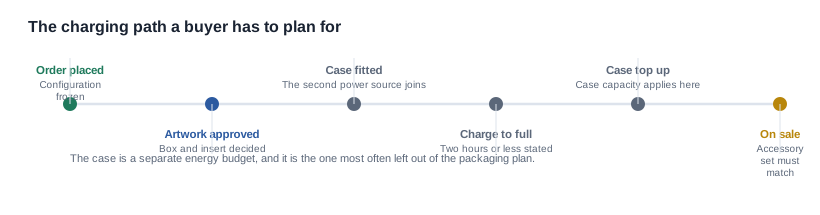
Check the charge time from a stated starting state, with a stated charger. Write down the starting state, the charger, the ambient conditions and the completion criterion before the first reading, and record the elapsed time to the point the product indicates full. If the supplier's own figure was produced under different conditions, you now know that the two numbers are not comparable, and that is a fact worth having before the purchase order rather than after.
Check the termination behaviour. Leave the product connected well beyond the stated charge time and observe what it does. The three answers that matter are whether it stops drawing current, whether it reports full, and whether it can be left indefinitely without a defined consequence. This is the check that prevents the overnight-charging support category, and it takes ten minutes.
Check the case separately from the product. If the case charges the product, then the product should charge from the case, and the case should charge from a known source. A case that stores the product is not a charger, and the two are routinely conflated in product photography and in listings. The acceptance criterion is behavioural: place the product in the case, close it, confirm the product's state changes.
Check the whole accessory chain rather than the product. Whatever the interface, the box has to contain the thing that makes the product work, and that has to match the regional accessory set for the destination market. This check costs nothing and it is the one that most often stops a shipment, because the packaging artwork is already printed by the time anyone walks the accessory list.
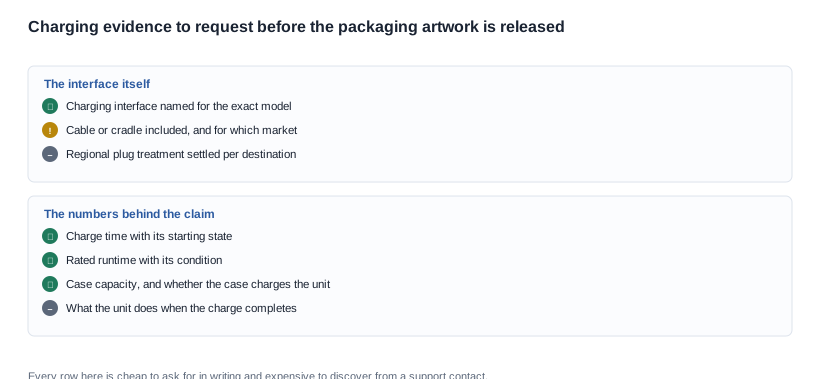
The red flags in a charging quotation are ordinary enough to be invisible. A charge time with no starting state. A case capacity quoted without a case function. A runtime quoted without a condition. An in-box accessory list that does not match the interface. Every one of them is ordinary, and each is cheap to repair at the quotation stage and expensive to repair once the packaging is printed.

The commercial split between the interface you choose and the interface you inherit
Not every part of a charging architecture is available for negotiation, and a buyer who argues about the wrong one loses the round and gains nothing. The interface itself is largely inherited. It comes with the platform, it comes with the cell, it comes with the tooling, and changing it is a development rather than a configuration, with a new bill of materials, a new approval route and a new schedule. The same is true of the charge time in practice, because it is a property of the cell and the charging electronics rather than a commercial term.
What genuinely moves is everything around the interface. The in-box accessory list is a commercial term. The case configuration, including whether a model comes with a 900 mAh or a 1400 mAh case, is a commercial term, and so is the per-case minimum and the artwork it generates. The packaging design, the regional accessory set per market, the sample quantity, the split-delivery rule, the payment node attached to the artwork approval, and the warranty treatment for a cell that fails inside the stated period are all commercial terms. The tooling and the certification route are not: certification cost and certification time are fixed per product family and a queue at the test laboratory, and pressing on either produces a longer schedule rather than a shorter one.
The clauses worth having in the agreement are the charging method and interface as a named configuration attribute, the charge time with its starting state and its charger, the termination behaviour, the in-box accessory list per destination market, the case capacity and the case charging function as two separate attributes, and a notice obligation for any change to the interface or the cell. That last one is the clause most often missing and the one that matters most, because a silent change to the interface invalidates the packaging, the artwork, the listing copy and the accessory conversation all at once.
There is a total-cost argument worth making to a finance colleague, because it is the argument that gets the interface question taken seriously. The total cost of a charging architecture is the unit price plus the accessory cost per unit plus the packaging cost plus the expected cost of the contacts the architecture generates. For a cable architecture the third term is small and the fourth is not. For a case architecture the third is large and the fourth is smaller. A buyer who presents the interface decision as a support-cost decision rather than as an engineering preference is presenting it in the terms a finance team already uses.
How much of a charging specification we will put our name to
The working rule we apply: we publish the rows our documentation holds and mark the rest as open, and we would rather show you an empty charging row than a plausible value in it.
What our published data does settle is the charging method where the catalogue labels one, the charge time for every model in the range, the rated runtime, the cell configuration, and the charging case configuration where a case is named. The ZH12 and the D11, the D17 and the V03 Pro, and the L2 Utral and the D12 and the bone-conduction entry name a Type-C interface. The L1 Pro and the CY03, and the CY05 and the MT6 name a case capacity without naming an interface, and we will say so rather than fill the gap from a general description of the platform. The KY06 and the MT5 name a case without a capacity, and that is the row we are least able to help with.
What we do not publish, and will not estimate, is the starting state behind any charge time, the charger, the ambient temperature range, the termination behaviour, the cycle life of a cell, the case charging time, the contact resistance, the connector rating, or the number of cycles the charging interface is rated for. Across the whole range one weight is published, the 158 g of the MT6 glasses unit, excluding its foldable charging case, and no other model publishes a frame or unit weight. We do not publish charge cycle data, because we do not hold a test report that would support a number a buyer could rely on, and a cell cycle figure that cannot be traced to a document is a warranty exposure for the buyer rather than a specification.
We also make no health, vision or hearing-efficacy claim for any product in this range in any market.
If you tell us the models, the quantities, the destination market and the accessory you intend to put in the box, we will tell you which charging configurations exist, which rows our documentation answers today, and which ones you will need to establish on your own units. The field-by-field charging specification is in what the spec sheet does not tell you to know about smart glasses charging, the recurring buyer errors are in smart glasses charging buying mistakes to avoid, and the field-level fault analysis is in smart glasses charging problems and fixes. The technical background sits under charging solutions page.
Related reading
- The specification fields that do not get filled in: what the spec sheet does not tell you to know about smart glasses charging.
- The buyer errors this causes: smart glasses charging buying mistakes to avoid.
- charging solutions page
- smart glasses charging problems and fixes
Send the configuration, the quantity and the market, and we will say which parts of the charging specification are settled and which are yours.


