
Compatibility is the word that carries the least information in this category, and it is used as though it carried the most. "Compatible with Type-C", "compatible with most power banks", "compatible with the charging case" — three sentences that describe three unrelated questions, and a buyer who treats them as one question will pick a charging arrangement that solves two of them and discovers the third on a customer review. The eight combinations below are the ones that actually occur, and for each of them the requirement is written as a test with an observable result rather than as an adjective.
The single most useful thing a procurement team can take from this is a rule: compatibility is never a property of the device, it is a property of a device and a source, tested together. A device is not compatible with power banks; it is compatible with that power bank, at that output, in that mode. The rule sounds pedantic until a buyer realises that the specification sheet for the device is a statement about the device, and every compatibility claim in the category is a statement about a combination that the supplier has or has not tested.
Smart glasses charging: compatible hides three questions
Before the eight combinations, the three questions that hide inside the word. Every compatibility claim in this category is answering one of them, and a claim that does not say which one is not usable.
The first is the physical interface. Does the connector, the contact pad or the dock geometry physically correspond? This is the easiest question and the one most specifications answer. It is also the one that settles the least, because a physical correspondence does not imply an electrical one. A Type-C connector on a device and a Type-C connector on an adapter are physically compatible whether or not the device will draw anything from it.
The second is the power profile. Can the source deliver what the device will accept, and will the device negotiate correctly with it? This is the question that decides whether a charging session happens at all. It involves the source's output current, the source's output profile, and the negotiation between the two. It is the question where the published information in this category is thinnest: our catalogue states a charge time for every model and a charging method for the twenty-four models that carry one, and it publishes no fast-charge protocol, no output current and no power profile for any model in the range. That means a claim like "charges from any power bank" is, in our own documentation, unfalsifiable — there is nothing published that it could be checked against.
The third is the functional relationship. Does the combination do what the customer expects it to do, beyond moving charge? Does the case charge the frames or does it store them? Does the port carry data as well as power, so that a firmware update is possible from a laptop? Does the device charge the case and the case charge the device, or does the pair only work in one direction? These are the questions a customer forms an opinion about, and they are the ones that generate the support contacts.
Most specification disputes in this category are the third question being answered as though it were the first. The supplier says the case is compatible, the buyer assumes it charges the frames, and the customer discovers a dock. The supplier is not being evasive and the buyer is not being careless — the word allowed both readings.

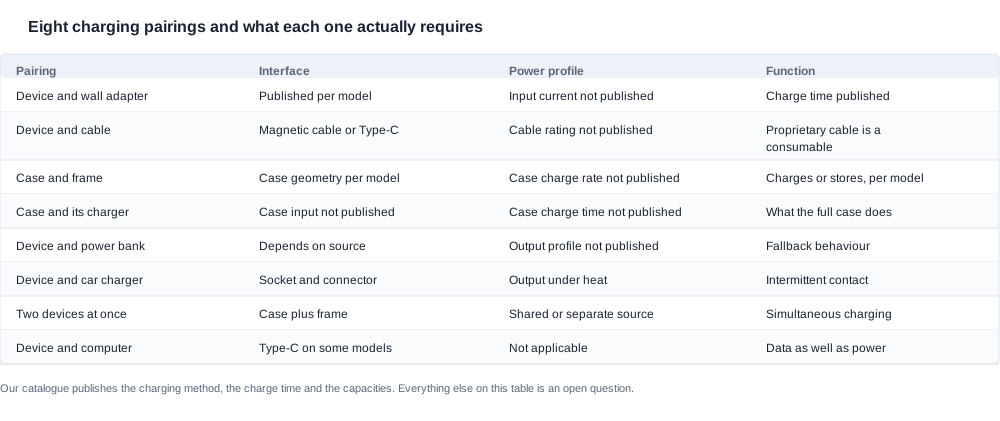
The eight combinations that decide whether a device charges at all
The device and a wall adapter
The most common combination and the one most often assumed rather than tested. What has to hold: the interface corresponds, and the adapter delivers a current the device accepts.
We publish the interface on twenty-four of the twenty-eight models — magnetic contacts across most of the range, Type-C on the V03 Pro, the L2 Utral, the D11, the D12, the D17, the ZH12 and the bone conduction entry — and the L1 Pro and the CY03, and the CY05 and the MT6 publish no charging interface at all. We publish the charge time, which is two hours or less across most of the range and about an hour on the D17 and the ZH12. We publish no fast-charge protocol for anything, which makes the input current a genuine open question rather than a formality: a one-hour charge time on the D17 tells you what the test produced, and not what the input was.
The failure mode is not that the device refuses to charge. It is that it charges slowly on a weak adapter and the customer concludes the battery is faulty. That is a returns problem, and it arrives within weeks.
The device and a cable
On the Type-C models the connector is standard and the cable becomes a question of rating rather than of shape. A thin cable carries less current, and a device that charges slowly on one cable and quickly on another presents as a product defect rather than as an accessory mismatch. We publish no cable requirements for any model, so the only defensible statement in customer-facing copy is the generic one about using the supplied cable.
For the magnetic models this combination is different in kind: the cable is a proprietary contact cable, it is not interchangeable with anything the customer owns, and it becomes a consumable that the channel has to stock. That changes its commercial character completely.
The case and the frame
Two separate requirements have to hold at once, and they are frequently confused. The first is functional: the case charges the frame. The second is physical: the frame sits correctly in the case. The second is not automatic — a case designed for one model may not seat a sibling — and the confusion between them is why "the case fits" is often the phrase used for what is really "the case charges".
Our catalogue publishes case capacities of 900 mAh on the L2 Utral as an option alongside 1400 mAh, 1200 mAh on the MT6 in a folding case, and 1400 mAh on the L1 Pro and the CY03, and the CY05. It publishes no statement, per model, of whether each case is a charger or a dock. That distinction has to be requested per model; it cannot be read off the capacity.
The case and its own charger
A separate question from the previous one, and one that is usually unanswered. How the case itself is charged, how long it takes, and what the case does when it is full are three different facts, and a buyer who knows the frame's charge time knows none of them. Where the case has a cell, the case is a second device with its own charge cycle, and a deployment plan that charges only the frames has planned for half the energy.
The device and a power bank
The combination that appears most in buyer enquiries after the interface, and the one with the least published information. It is also the one with the largest practical consequence, because a power bank is how most customers extend a device away from a socket, and a device that only charges from a wall adapter is a different product in the customer's hands.
Whether the device accepts a power bank's output is a question about the output profile rather than the connector. A device that charges from a wall socket may not charge from a power bank at all, because the negotiation behaves differently when the source cannot guarantee a fixed output.
The device and a car charger
Three variables: the socket, the output, and the heat. A device left charging in a parked car in summer is in a genuinely hot environment, and a charger that cannot deliver enough current in that heat will be slow. This combination is also where a flat cable or a poor contact is most likely, and where the symptom appears as intermittent charging rather than as no charging.
Two devices at once
Whether the frame and its case can be charged simultaneously, and from what. On a case-charged model this is the ordinary question rather than an edge case, because the case is the only charger the customer has. If the pair cannot be charged at the same time, then the total energy available per night is the case's cell plus one frame charge, and a deployment plan has to be built on that number rather than on the sum of the two published capacities.
The device and a computer
Whether the port carries data as well as power. We publish nothing on it, and a brand whose staff want to update firmware from a laptop needs to know before they write the procedure. This is the combination most often assumed to work, because Type-C data is common on personal computers, and it is the one where an assumption is cheap to make and expensive to discover in a production release.
What each combination needs before you can call it compatible
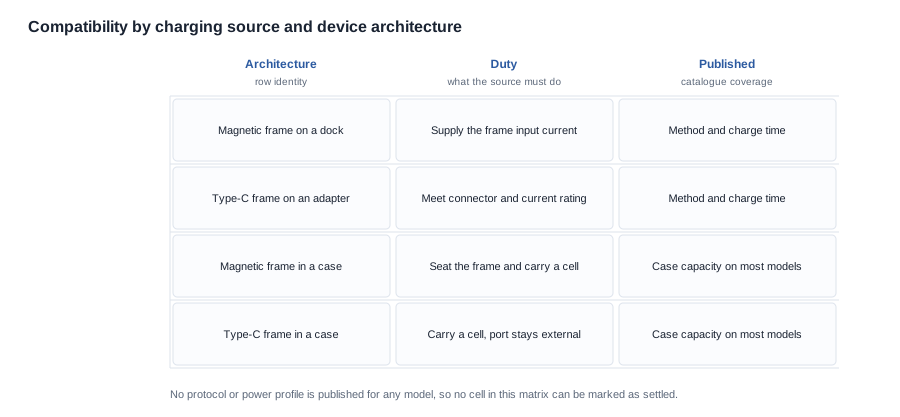
A combination becomes testable when it is written as three separate conditions — interface, profile, function — with an observable result for each. That is the format below, and it is the format to ask for when a supplier makes a compatibility claim.
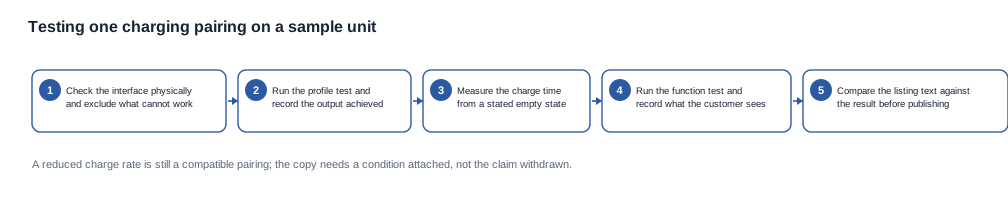
The order matters. Start with the physical check, because it is fast and it excludes the combinations that cannot work at all. Then run the profile test, which is the one that produces the meaningful number and which most suppliers have actually performed. Then run the function test, which is the one that settles the question the customer will ask.
The profile test is the one worth doing carefully, because it is the only one where a naive result is misleading. A device that charges from a power bank may charge at a reduced rate, or only when the bank is connected first, or only with one cable orientation, or not at all below a threshold output. The observable result that matters is not does it charge but does it reach the stated charge time from a stated empty state, with this source, at this output. If the answer is a charge time that differs from the catalogue figure, the pair is compatible and the copy needs a condition attached. If the answer is that it does not charge at all, the pair is not compatible and the listing must not say it is.
The function test is where a specification written by someone in a hurry fails. Ask, for each case-equipped model, whether the case charges the frames — and then ask the question a second way: what happens if the frames are placed in the case and the case is connected to power, and what the customer sees while it happens. A case that charges silently and a case that charges with an indicator are different products, and our catalogue publishes no indicator behaviour for any model, so the visible answer has to come from a sample.
There is one more test that costs nothing and catches a whole class of problem: read the instruction text on the supplied cable and case, and compare it with the product listing. If the instructions describe a step that the listing does not mention, the listing is incomplete. If the listing promises a behaviour the instructions describe differently, the listing is wrong, and it is wrong in the document the customer reads first.
The power bank combination, which decides more than it appears to
Because the power bank combination gets asked about so often, it is worth being precise about why, and about what a buyer can actually do about it.
The reason it gets asked about is that it is the combination a customer actually has. Most customers have a wall socket at a desk and a power bank for everything else. A device that works from a desk but not from a bank is not a device that works away from a desk, and the customer finds this out in a place where they cannot fix it.
The follow-up question that produces a real answer is: which output profiles has it been tested against, and what does it do when the source cannot supply enough. The second half is the one that separates a product that has been tested from a product that has been tried. "It charges from a power bank" is a statement that the combination was attempted. "It charges from a power bank that negotiates 2.4 A, and it falls back to a lower rate rather than stopping" is a statement that the combination was characterised.
For a brand, the commercial version of this is a decision about what to claim. There are three positions, and they are not equally defensible. The first is to claim universal power bank support, which is a claim about sources the supplier has never seen. The second is to claim nothing and say nothing, which leaves the listing without an answer and pushes the question into support. The third is to characterise the combination with the supplier — to state the profiles tested and the behaviour below the threshold — and to write that into the listing. The third is more work and it is the only one that survives a customer who has a bank the supplier never tested.
The same logic applies to the two-at-once combination and to the car charger combination, and it is worth noticing that the three of them together are the reason a power bank, a case and a car charger are a set of questions rather than three instances of one. A buyer who wants a single criterion for all three is looking for a specification that no supplier in this category publishes.

What belongs in the listing and the manual, and what does not
The output of all of this is customer-facing text, and the discipline there is simple: say only what has been established, and put the condition next to the number.
Three lines are worth having in the manual because they prevent most of the contacts. Charge with the supplied cable and adapter. Do not charge a device that is wet. A case that does not charge the frames is a dock, and the listing should say so.
The third line matters most, because a customer who bought a case on the assumption that it charges, and then discovered that it does not, has bought the wrong product. The fix is a line in the listing, not a paragraph in a support script, and it is cheaper than the return.
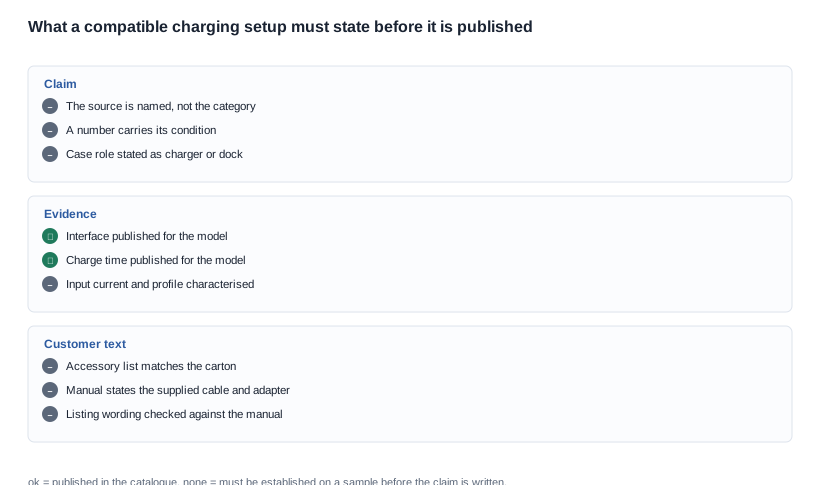
The listing side has two rules. First, the compatibility claim must name the source, not the category: "charges from a 5 V source that delivers at least the input current stated in the manual" is a claim; "universal fast charging" is not, and neither is "charges from any USB-C charger" when no output figure has been established. Second, the accessory list in the listing must match the carton, because the accessory is the most common thing a customer finds missing and the most common thing a customer blames on the product rather than on the packaging.
What does not belong is the inferred claim. "Compatible with all Type-C chargers" is an inference from the connector shape, and the whole of this article is the argument that the connector shape is not the question.
What we publish about compatibility, and what only a sample can settle
The short answer: we publish the charging method for the twenty-four models that carry one, the stated charge time, the case capacities where the catalogue states one and the cell capacities, and we publish no compatibility matrix, no fast-charge protocol and no power profile for any model, because our source document contains none of them. We will not infer a power profile from a charge time, and we will not describe a case that stores as though it were a case that charges.
That is worth restating plainly because it is the part of the range where buyers most often expect a table and will not find one. There is no compatibility matrix in our documentation. What exists is the method for building one, and it is the same for every model: list the eight combinations, mark each as published, not answerable from a document, or needing a sample, and then run the three-condition test on the ones that matter to the channel you are selling into.
What we can do is tell you, for a specific model, which of the eight combinations our documentation already answers, and which of them need a test on a sample unit. In practice the answers divide cleanly. The device-to-wall-adapter combination is answered by the published interface and charge time, with the input current as the outstanding sub-question. The device-to-cable combination is answered for the magnetic models by the proprietary cable's status as a consumable, and left open for the Type-C models on the cable rating. The case combinations are answered on capacity for most case-equipped models and left open on whether the case charges. The power bank, car charger, two-at-once and computer combinations are the four that are open on every model in the range, and they are the four that a sample settles.
That distribution is the practical answer to how to evaluate a supplier on compatibility. The question is not whether they publish a compatibility table; almost nobody does. The question is whether they can tell you, model by model, which combinations have been characterised and which have not — and whether they will characterise the remaining ones on a sample rather than describing them in a brochure.
The charging architectures are described under charging solutions, the vocabulary is in the charging glossary, and the claims to interrogate are in charging manufacturer claims. If you want the test protocol written out as a sampling procedure, the pre-order tests are set out in how to test before ordering.
Related reading
- The language used — charging glossary
- The claims to interrogate — charging manufacturer claims
- The pre-order tests — how to test charging before ordering
Send us the model and the list of chargers you expect the customer to own, and we will tell you which combinations our documentation answers.


