

Smart glasses charging: the architecture behind the box
The charging figures in this category are all rated values with no test condition attached, and that is the smaller problem. The larger problem is that the charging interface is not a detail of the product, it is a decision with a footprint across the whole programme: it determines what the customer has to own, what goes in the box, whether the shipment contains a second cell, and which eight of the tests you should be running. A buyer who asks "how long does it take to charge" before establishing how it charges will order a program that cannot be evaluated.
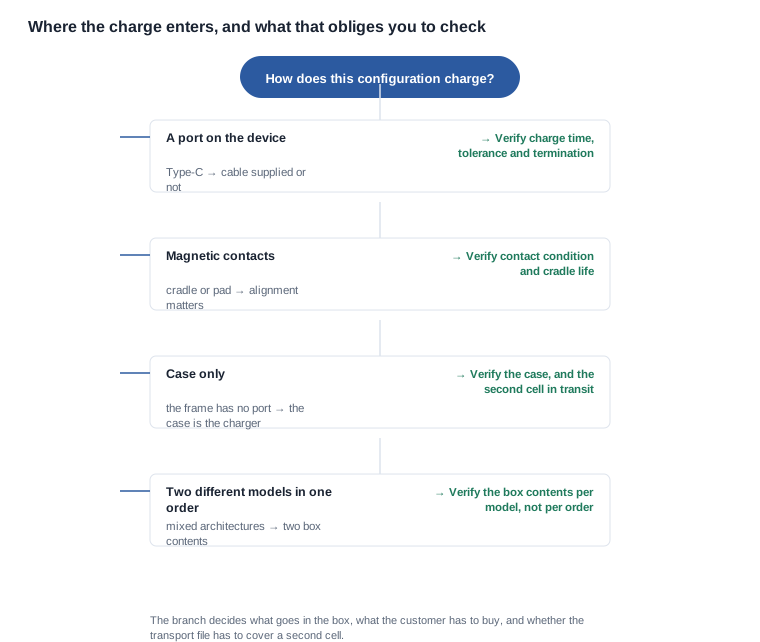
The decision, in three sentences. Establish the charge architecture before anything else — a port on the device, magnetic contacts on the device, or a device that only charges while seated in its case — because that single answer determines the box contents, the transport documentation and the test list. Then time a full charge with a meter on the cable rather than by the device's own indicator, because the indicator shows when the device thinks it is full. And treat the published figure as a screening number until a sample confirms it, because no supplier in this category publishes the starting state, the ambient or the charger, and those three variables are the difference between the figure and the reality.
Who is running this evaluation, and what it has to protect. The reader is a brand buyer or a channel buyer assembling a line that mixes charging architectures, and they are usually working with a quotation that lists a charge time but not a box contents, which is the omission that later becomes a packaging change and a second artwork round. The evaluation has to produce two things: a measured charge time with its conditions attached, and a box contents list that is specific per model rather than per order — because an order containing a Type-C model and a magnetic model cannot have one box contents line.
What our catalogue publishes on charging. A charge time of two hours or less on most models and about one hour on the D17 and the ZH12. A rated runtime from about six hours on the audio tier to about twenty on the children's models. Case capacities of 900, 1200 and 1400 mAh. The charging interface: Type-C on the D11, the D12, the D17, the ZH12, the bone conduction entry, the V03 Pro and the L2 Utral, and magnetic charging on the K02 and the V03, the LC-105-2 and the YK12, the V06 and the YKC02, the S7 and the LC-105-1, the G07 and the K01, and the KY06, and the MT5, the A05, the A06, the A07, the AR entry and the electrochromic entry, with four camera models — the CY03 and the MT6, and the L1 Pro and the CY05 — publishing no interface row at all. Cell configurations from 40 mAh on the A05 and the A06 up to 290 mAh on the CY03 and the CY05, and the L1 Pro and the L2 Utral.
It publishes no test condition for any of them. We also publish no fast-charge capability, no charge termination behaviour, no deep-sleep current and no thermal behaviour during charge for any model — and those four rows are exactly the ones a buyer needs when something does not work.
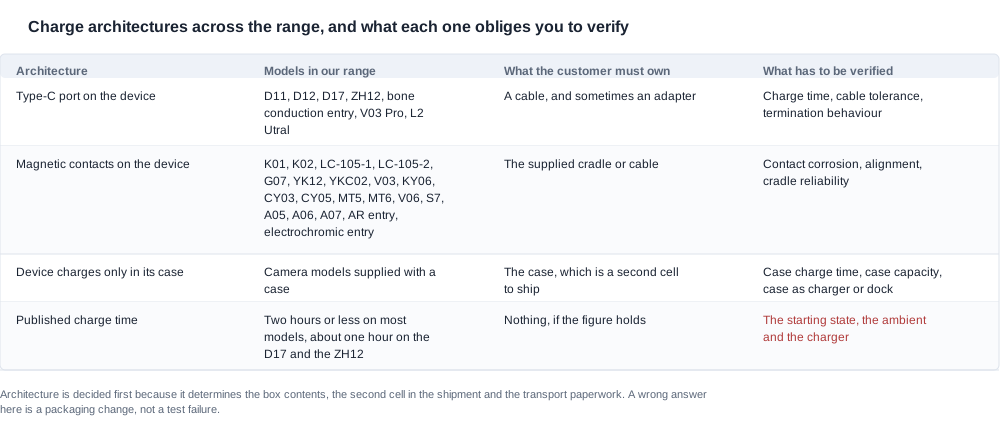
Where the cost of a charging decision sits. The interface itself is nearly free; the cost around it is not. A cable or a cradle in the box is a procurement line, a packaging line, an artwork line and a per-market compliance line. A case with its own cell is a second lithium cell in the shipment, which changes the transport documentation, the box volume, the shelf cost and the customer's expectation of what the case is for. And a model that only charges in its case couples the charging problem to the accessory problem in a way that a Type-C model never does, which is why the architecture question comes first.

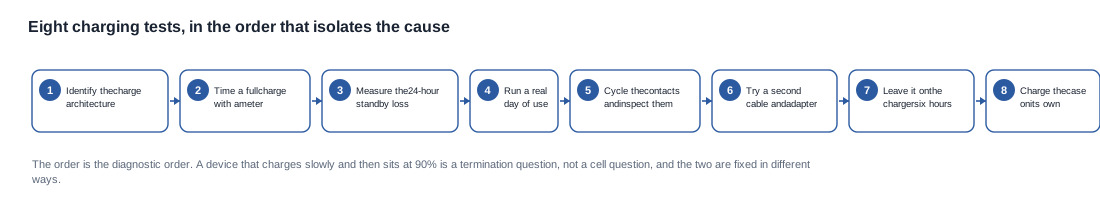
Eight charging tests, in the order that isolates the cause
Test one, identify the architecture. Is there a port on the device? Are there magnetic contacts? Is there neither, in which case the frame charges only while it is seated in a case? This single question determines which of the remaining tests apply, what goes in the box, whether the customer owns a cable, and whether the transport documentation has to cover a second cell.
Test two, time a full charge with a meter. From empty, and record the ambient temperature while it happens. Compare the measured figure against the published one, and diagnose the difference rather than noting it: the difference is usually the starting state, the temperature or the charger, and each of those is a variable the customer will also experience. Time it with a meter on the cable rather than by the device's own indicator, because an indicator shows when the device believes it is full rather than when it is.
Test three, measure the standby loss. Leave the device connected and untouched for twenty-four hours, then read the level. This is the number that decides whether a customer picks the product up in the morning, and it is the one figure nobody in this category publishes. Twenty-four hours is the right window because it is the interval that separates a device put down for the evening from one left in a bag for a weekend.
Test four, run a real day. Time your own workload with the device in the state you would actually ship it in — not a continuous playback test, but a day of intermittent use, which is the workload that produces the customer complaint. Compare the result against the rated figure; the ratio between them is more informative than either number.
Test five, exercise the contacts. Charge from the case repeatedly, and then look at the contacts under a light. What you are looking for is corrosion, and the reason this test is on the list is that a case that charges intermittently is very often a contact problem rather than a dead cell — and the two are diagnosed differently and cost differently to remedy. If the sample arrives with an already-used case, note it, because a used case is a better test than a new one.
Test six, use your own cable and adapter. Charge with a cable and an adapter you already own, and with a different one from a colleague. We publish the interface and the charge time, and we publish no fast-charge support for any model, which makes this a genuinely open question rather than a formality. What you are establishing is what the customer has to buy, and that answer belongs in the listing and in the box contents.
Test seven, leave it on the charger. Six hours connected, then read the level and feel the device. A product that keeps drawing from a charger will eventually be warm, and a product with no charge termination will keep doing it indefinitely. We publish no charge termination behaviour and no thermal behaviour during charge for any model, so this is a test rather than a specification check.
Test eight, charge the case on its own. Time the case's own charge separately and record what the case does when it reaches full. This answers the question a customer asks first: is the case a charger or a dock?
What to record with every result. The model designation and configuration, the architecture, the charger used with its output rating, the cable used, the starting state, the ambient temperature, the elapsed time to full, the level after the twenty-four-hour standby window, the level after six hours on the charger, and the date. A charge time without the charger output rating is not comparable with anything, because the same device on a different adapter is a different product in the customer's hands.
What these eight tests cannot establish. They do not establish the behaviour of the production lot, they do not establish the charging behaviour at a different ambient, they do not establish what happens after a hundred charge cycles, and they do not establish the transport position of the cell, which comes from documents rather than from a bench.
The case question: a second charger, a dock, or a second cell in the shipment
The case is the most misunderstood item in this category, and the misunderstanding is expensive. A customer picks up the glasses, finds no port, and concludes the product is broken or that they have to buy something. The listing has to say what the case is, and the box has to contain what the customer needs, and the two are commercial decisions before they are descriptive ones.
On our camera platforms the case is a second cell. The CY05 and the L1 Pro, and the CY03 carry a 1400 mAh case, the L2 Utral is available with a 900 or a 1400 mAh case, and the MT6 has a 1200 mAh folding case. The KY06 and the MT5 are supplied with a case as well. A case with a cell is not an accessory; it is a second lithium cell in the shipment, a second charge interface, and a second thing that can fail.
Is the case a charger or a dock? These behave differently and customers describe them differently. A charger takes the device and puts energy into it. A dock holds the device and draws energy out of it, or holds it while it charges. The test that distinguishes them is simple: put the case on charge with no device in it and watch what happens, then put the device in the case and take the case off the charger. A case that only charges when the device is in it is a charger; a case that holds a device and charges it independently is a dock, and it will also hold a device that is flat, which is the behaviour a customer actually wants.
The case's own charge time is a separate published number that is usually missing from the listing. A 1400 mAh case does not charge in the same time as the glasses inside it, and a customer who expects a two-hour figure for the case will be disappointed. Time it separately, publish it separately, and make the box contents line say which number applies to which object.
The second cell has consequences that run beyond the box. It changes the transport documentation, because the shipment now contains a second lithium cell. It changes the box volume and the shelf footprint, which matters in a retail channel. And it changes the customer's mental model of the product: a case that holds a 1400 mAh cell is a power bank as well as a case, and a listing that never says so produces a support load and a returns problem rather than an upsell.
What to request in writing about the case. The case capacity for the exact configuration. The case's own charge time and its starting point. The behaviour of the case when it reaches full, and whether the indicator reports the case or the device. Whether the case charges the device when the case itself is not plugged in. The case's own cell chemistry, or a written statement that it is not published. And whether the case is included or optional in the configuration, because that changes the box contents, the packaging and the shelf space.

What the customer has to buy, and what belongs in the box
A cable in the box is a decision, and the two architectures make it differently. On a Type-C model the cable is nearly free to include and it removes the most common first-week complaint in the category, which is a customer who opens the box and has nothing to charge with. On a magnetic model the customer needs the cradle or the pad, which is a bigger decision, and if the pad is not in the box then the product does not charge out of the box at all.
The box contents line is per model, and this is where orders go wrong. An order that contains a Type-C model and a magnetic model cannot carry one box contents line, and a factory that quotes one line for the order has quoted something that cannot be executed. Ask for the box contents per model designation, in the quotation, and treat a change to it as a change to the order.
The accessories are a commercial line worth more attention than the unit price. A spare cable, a spare cradle, a spare case and a spare tip are all items with their own minimum order quantities, and in a category where the accessory is what makes the product usable, the accessory minimum is often more awkward than the product minimum. Agreeing the accessory minimums alongside the product minimum is one of the easiest wins available at the quotation stage.
The corrosion check is a test that protects the accessory programme. A magnetic model whose contacts corrode produces a fault that a customer experiences as intermittent charging, and the customer will usually return the whole product rather than the case. Testing the contacts on the received unit and looking at them under a light takes five minutes and protects the accessory relationship for the life of the programme.
The thermal question is unanswered in this category and it is worth answering. Nobody publishes what the device or the case does thermally during a long charge, and a customer in a hot market or a vehicle left in the sun is a real case. Six hours on the charger, then a hand on the device, is a twenty-second test.
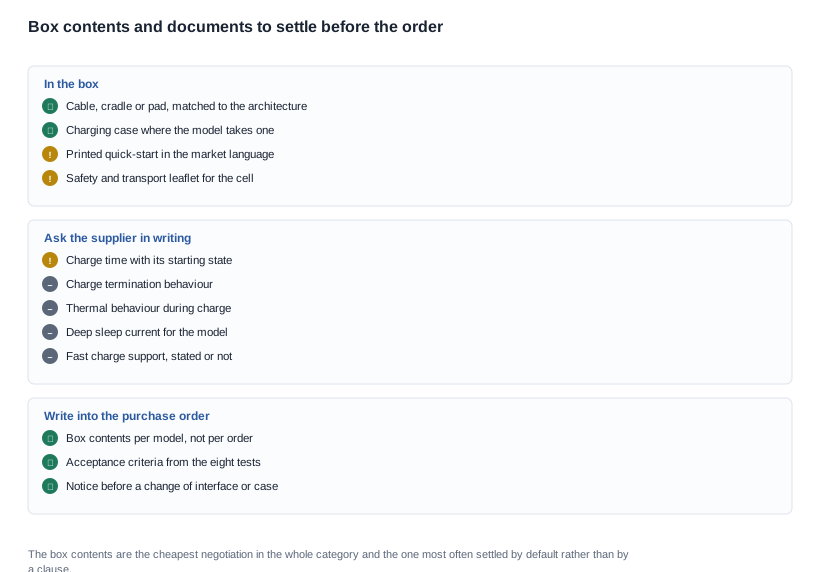
The checklist below is the set of documents and box items to settle before the deposit. The certificate numbers with the issuing body and the validity dates. The battery transport documentation for the fitted cell, and for the case cell where a case is included. The charge time with its starting point. The charge termination behaviour, or a written statement that it is not published. The deep-sleep current for the model, or a written statement that it is not published. The fast-charge position. The box contents per model. And the model designation written on the quotation.

Where a charging programme goes wrong, and the early warning for each
The measured charge time is longer than the published figure and nobody can say why. The symptom is a listing that overstates and a support queue that repeats the same question. The root cause is that the published figure was produced from a partial charge, at a different ambient, on a different charger. The prevention is to publish the figure with the starting state and the ambient, and to state the charger output in the listing when it matters.
The customer has nothing to charge the product with. The symptom is a cluster of tickets on day one, and a review score that reflects a packaging decision rather than a product decision. The root cause is that the box contents were settled by default rather than by a clause. The prevention is to write the box contents per model into the purchase order.
The case charges the glasses but not itself, or the reverse. The symptom is a customer who leaves the case in a drawer because it never seemed to do anything. The root cause is that nobody established what the case is for. The prevention is to run test eight and publish the answer in the listing.
A case starts shipping with corroded contacts and the failure is intermittent. The symptom is a small but steady return rate that nobody can attribute to a cause, because the unit itself charges fine on a bench. The root cause is that the accessory was not inspected, or was inspected at the factory and then stored. The prevention is to specify the inspection standard for the accessory and to check it at incoming inspection, not only at the factory.
The order arrives with the wrong box contents for one model. The symptom is a pallet that cannot be packed, or a customer whose product does not work out of the box. The root cause is that the box contents were quoted per order rather than per model. The prevention is to make the per-model line a term of the order, with a notice clause for any change to it.
The programme slips because a model designation was requested last. The symptom is a launch date that moves while the factory reports the units are ready. The root cause is that the artwork, the insert and the customs description all waited on an identifier that could have been in the first email. The prevention is to ask for the identifier in the first message and to treat the date as derived from it.
A worked charge evaluation for a two-model order
This is a worked case rather than a live order. The point is the order of steps.
Assume a brand whose first order mixes an eight-megapixel camera model with a folding 1200 mAh case and a Bluetooth audio model on magnetic charging, and whose packaging team has assumed one box contents line for the whole order. The supplier's quotation says "two hours or less" for both models and says nothing about the case.
The first decision establishes the architecture for each model and splits the order into two box contents lines. The camera model with the case is a case-charged configuration with a second cell in the shipment; the audio model is a magnetic configuration that needs a cradle in the box. The brand asks for the two lines before the artwork is designed, and the packaging team is told that the case configuration adds a second printed item to the insert, which changes the artwork plan rather than the tooling plan.
The second step is the charger question, asked early. The brand asks what the customer owns and what the supplier recommends, and finds that a Type-C cable is not included by default on any model in the range. That becomes a negotiation and a packaging line, and the brand decides to include a cable because the cost of a cable is smaller than the cost of the first-week tickets it prevents.
The third step is the sample run on the camera configuration, with the case. The brand charges from empty with a meter on the cable, records the ambient and the charger rating, then measures the twenty-four-hour standby loss, then leaves the case on charge for six hours and reads both the case and the device levels, and finally charges the case on its own to see what it does at full. The finding is that the case reports the device's charge state rather than its own, which is exactly the confusion the listing must not create.
The fourth step is the case's role, established by observation. The brand puts the case on charge with the glasses out and observes that it does nothing, then puts the glasses into a flat case and observes that the case delivers power to the glasses even though the case was not charging. That is a dock, and the listing can now say so, because the brand established it rather than assumed it.
The fifth step is the contact inspection on the second sample. The brand charges from the case repeatedly, inspects the contacts under a light, and finds clean metal on the new case and light dulling on the case that arrived used. The used case is kept as the incoming inspection reference, which is a cheap and unusually effective quality-control asset.
The sixth step is the order. The brand writes the box contents per model into the purchase order, attaches the eight test results as the acceptance criteria, adds a notice clause for any change of interface, cable, cradle or case, and holds a retention against the documentation package. It also negotiates the accessory minimums for the spare cradle and the spare case, which is where the money is on an order like this one.
The outcome is a programme that can actually be packed, a listing that tells the customer what the case is for, and an accessory relationship that was set up before the first pallet rather than after the first complaint.
Where our charging rows stop and the bench takes over
Stated plainly: we publish the charging figures our catalogue holds, in the units it uses, and we publish the empty rows next to them rather than filling them with values from a typical device. We will not infer a chemistry from a milliampere-hour figure, and we will not publish a fast-charge capability we have not confirmed. We publish the interface and the charge time; we do not publish the charge-time starting point, the deep-sleep current, the charge termination behaviour or the thermal behaviour during charge for any model, and we will not estimate them.
We will also say plainly that a charge time on a case-equipped model is two different numbers — one for the glasses and one for the case — and that a listing which quotes only the smaller of them is describing an object the customer does not own.
Three things to settle before the box contents are agreed
Ask for the charge architecture per model, and the box contents per model, in the quotation itself. A box contents line that is per order rather than per model is not executable, and the error is discovered at packing.
Send the eight results and we will tell you which are consistent with our published figures and which point at something a buyer should raise. The charging architectures are described under charging solutions, the cost side is in charging cost factors, and the claims to interrogate are in charging manufacturer claims.
Related reading
- The claims to interrogate — charging manufacturer claims
- The procurement version — charging checklist for procurement teams
- The terminology — charging glossary
Send us the eight results and we will tell you which of them are consistent with our published figures.


