

Every supplier in this category makes the same eight charging claims, and most of them are true. That is what makes them dangerous. A claim like "charges in under two hours" or "up to 8 hours of battery" is a statement our own catalogue does not word that way, and it is also a statement with no condition attached, and it will end up on a product page in a channel where it cannot be defended.
The eight claims below are the ones that appear on charging material, spec sheets and quotation notes. Each one is paired with the single question that deflates it — not to catch a supplier out, but to find out whether the claim is a measurement, a description or a slogan. The distinction is what decides whether the claim can be copied into your own documentation.
Our catalogue publishes a charge time for all 28 model rows, a cell capacity for all 28, a rated runtime for all 28, a charging interface for 24 of them, and a charging case on seven rows with a capacity published on five. Those are the rows that make a claim checkable. Everything in the list below that falls outside them is a claim that has to be established on your own units before it is repeated.
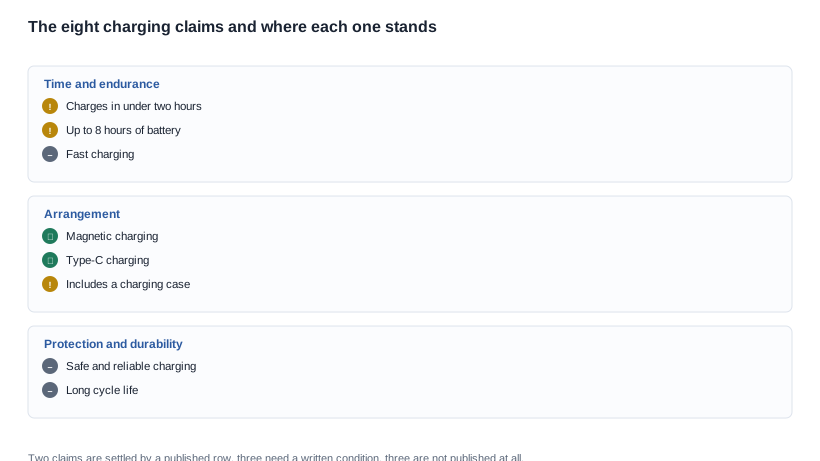

Smart glasses charging: eight claims and the question that deflates them
Claim 1: "charges in under two hours". A charge time is published on all 28 of our rows, but the claim as it is worded is only literally supported by two of them — the D17 and the ZH12, at about one hour — while the other 26 publish two hours or less, a ceiling that a buyer can read as a figure under two hours without the catalogue having written it that way. The question that deflates it: from what state of charge, to what end criterion, at what input current. A figure without those three is an upper bound, and a buyer who copies it into a product page as a customer-facing promise is publishing a condition they do not know.
Claim 2: "up to 8 hours of battery". The catalogue publishes rated runtimes from about six hours to about twenty hours, and the twenty-hour figures sit on the children's audio and protection models, which are low-load products. The question that deflates it: at what workload, with the radio in what state, and is the figure measured or calculated. "Up to" is doing a great deal of work, and the word to interrogate is "up".
Claim 3: "fast charging". Nothing in our published material defines it. The question that deflates it: fast compared with what, measured how, and against which baseline. Where a supplier has two charge times for the same model under different conditions, that comparison is a legitimate claim and it is also the most useful single piece of information in a charging conversation.
Claim 4: "magnetic charging for effortless docking". The interface is published on 17 rows, so this is a factual statement. The question that deflates it: what is the rated contact cycle life, and what is the recommended maintenance interval for the contacts. Both are unpublished, and they are the two numbers that determine whether a magnetic interface is cheap to service or expensive.
Claim 5: "includes a charging case". Seven of our rows carry a case. The question that deflates it: what capacity, in milliamp-hours, and what does that capacity convert into in terms of recharges — never in terms of hours. The L2 Utral's published 900/1400 mAh also means the claim can be true of one delivered product and false of another.
Claim 6: "Type-C charging". Published on seven rows: the V03 Pro, the L2 Utral, the D11, the D12, the D17, the ZH12 and the bone conduction model. The question that deflates it: what input current does it accept, and does a cable ship in the box. A Type-C port with no stated input current accepts whatever is offered, which is how a "two-hour charge" becomes a six-hour charge in a customer's hand.
Claim 7: "safe, reliable charging with built-in protection". Thermal protection during charging is standard and is a genuine feature, and we publish no safe charging temperature range for any model. The question that deflates it: what is the range, in writing, and what happens at each end of it. Without the range, a unit that stops charging on a hot day is indistinguishable from a defective unit.
Claim 8: "long cycle life". We publish no cycle life for any cell or any case. The question that deflates it: what cycle life, measured to what end-of-life criterion, under what charge protocol. A cycle count without a failure criterion is a quantity, and it is not a warranty term.
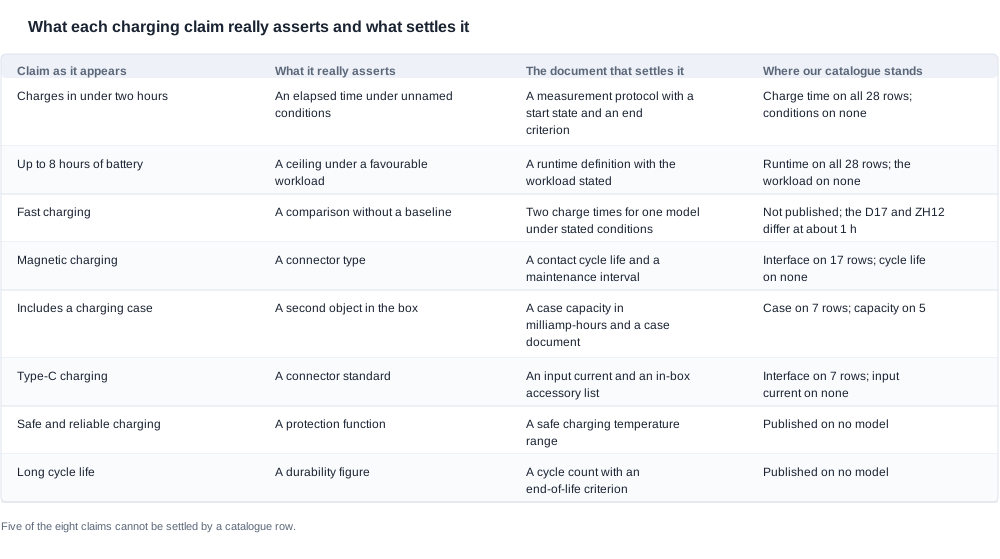
| Claim as it appears | What it really asserts | The document that settles it | Where our catalogue stands |
|---|---|---|---|
| Charges in under two hours | An elapsed time under unnamed conditions | A measurement protocol with a start state and an end criterion | Charge time published on all 28 rows; conditions on none |
| Up to 8 hours of battery | A ceiling under a favourable workload | A runtime definition with the workload stated | Runtime published on all 28 rows; the workload on none |
| Fast charging | A comparison without a baseline | Two charge times for one model under stated conditions | Not a published claim; the D17 and ZH12 differ at about 1 h |
| Magnetic charging | A connector type | A contact cycle life and a maintenance interval | Interface published on 17 rows; cycle life on none |
| Includes a charging case | A second object in the box | A case capacity in milliamp-hours and a case document | Case on 7 rows; capacity on 5 |
| Type-C charging | A connector standard | An input current and an in-box accessory list | Interface published on 7 rows; input current on none |
| Safe and reliable charging | A protection function | A safe charging temperature range | Published on no model |
| Long cycle life | A durability figure | A cycle count with an end-of-life criterion | Published on no model |
Cost is worth noting here, because it determines where a buyer's limited diligence effort goes. Four of the eight claims are settled by a catalogue row and cost a minute each. Three need a written condition from the supplier, which cost one email and usually one reply. The remaining one — the safe charging temperature range — needs a supplier who has measured it, and if they have not, it needs a measurement on your own unit under a controlled procedure. That last claim is the only one in the list that can cost real time, which is why it should be asked first rather than last: the answer decides whether the rest of the list is worth sending.
The three claims that are true and still dangerous
Three of the eight deserve particular attention because a reasonable buyer would sign off on them without asking, and each of them can still end up on a product page that cannot be defended.
"Charges in under two hours" is the most repeated claim in the category, and it spreads because 26 of our 28 rows publish two hours or less, a ceiling that reads as a figure under two hours, while only the D17 and the ZH12 publish a time that is unambiguously under it. It becomes indefensible at the moment a customer charges from a laptop port and measures a different number, which is the most common way the claim is broken in the field. The mitigation is cheap: attach the condition, or measure it yourself.
"Includes a charging case" is true on seven rows and becomes indefensible in a different way, because it invites the buyer to treat the case as a battery extension. A case carries spare energy; the hours it produces depend on conversion efficiency and on the end criterion, and neither is published. The mitigation is a wording change: describe the case as carried spare energy.
"Safe and reliable charging" is the hardest to remove because it is a qualitative phrase that reads as a reassurance rather than a specification, and it is therefore rarely interrogated. The question behind it — the safe charging temperature range — is the one a support team needs most and the one that is hardest to get. If the supplier will not state it, the product page should not imply protection the buyer cannot describe.
The remaining five claims are less dangerous because they are less likely to be copied. A supplier who writes "long cycle life" on a quotation note is making a statement to a buyer rather than to a customer, and a buyer with any diligence process at all will ask for the end-of-life criterion. The exception is a claim that migrates: "safe and reliable" and "fast charging" are the two phrases that travel from a spec sheet into a marketing brief and from a marketing brief into a listing, and they are the two that need a rule rather than a question. The rule is that neither phrase appears in your copy unless there is a figure behind it that you have checked.

How to run the claim list without turning it into a trust exercise
The failure mode of a claim list is that it becomes an audit of the supplier's honesty, which is the wrong target and which gets a bad response. The right target is narrower: which of these claims will you be copying into your own documentation, and on what basis.
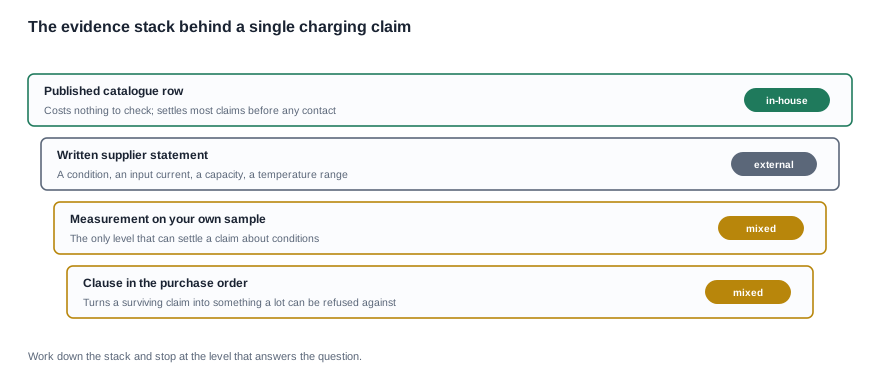
A claim can be supported at three levels, and the levels are worth keeping separate because a buyer who confuses them either over-invests in checking or under-investes. At the top is the published row, which exists in our catalogue for most of these claims and costs nothing to check. In the middle is a supplier document — a test report, a protocol, a written statement of conditions. At the bottom is the buyer's own measurement on a sample, and it is the only level that can settle a claim about conditions.
The practical rule that follows is to spend the effort in that order and no further. Most claims are settled by the published row, a good many more by a one-line written statement, and only two or three ever need a sample measurement. A buyer who sends a twelve-page questionnaire to settle a claim that is already published is buying a slow supplier and getting nothing.
A supplier who replies with a question — asking which of two charge times is meant, or asking what workload is intended — is giving a useful signal. It means the claim is not a fixed marketing sentence on their part, and it means there is something behind it that can be discussed. That is a better position to be in than a supplier who repeats the claim word for word.
The order to run the list in is short.
-
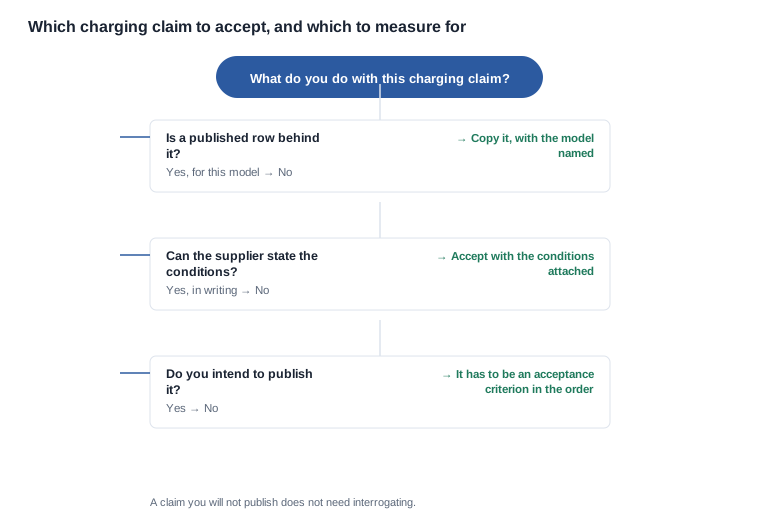
Mark every claim that appears on the material you have been sent. Include the claims in the quotation notes, not only the claims on the spec sheet; the quotation note is where the unqualified version usually sits.
-
Mark which claims you intend to repeat. A claim you will not publish does not need interrogating, and removing it from the list is the fastest way to shorten the list.
-
Send the remaining claims as a numbered list with the question attached to each. One email, one list, no narrative. A supplier who answers all of them has a documentation habit; one who answers two is telling you something useful before the deposit.
-
Classify each answer as a measurement, a description or a marketing statement. A measurement has conditions; a description names a fact; a marketing statement can be discarded without argument.
-
Write the surviving claims into the purchase order as acceptance criteria. A claim that is going on a product page has to be a claim you can refuse a lot against, and that only happens if it is in the order.
A worked scenario: a brand that rewrote eight claims into two
The worked example here is a constructed scenario rather than a client project; it sets out the sequence rather than describing an outcome.
Assume a brand launching a camera glasses line with a bundled case, working from a supplier's material that carried all eight of the claims above, and a retailer that reviews product copy before the listing goes live.
Step one: the triage. The brand marks every claim in the supplier's material and then marks which of them it intends to publish. Only three survive that filter: the charge time, the case inclusion and the Type-C charging interface. The other five were never going to be on the page, so they come off the list and the questionnaire drops from eight items to three.
Step two: the questions. The brand asks for the start state and the end criterion behind the charge time, for the case capacity in milliamp-hours, and for the input current the Type-C port accepts. All three are answerable in writing by a supplier who has measured them, and two of the three come back within a day. The answer on the input current is the most valuable of the three, because it tells the brand whether to ship a cable.
Step three: the class. The charge time comes back as a measurement with conditions, so the brand publishes it with the conditions attached. The case capacity comes back as a published figure, so the brand publishes the capacity and describes the case as carried spare energy. The input current comes back as a specification, so the brand writes the charger into the order.
Step four: the copy. The retailer reviewer asks for the charge-time claim to be qualified. The brand qualifies it rather than removing it, because the qualification is the sentence that makes the claim true: a charge time with a stated starting state, a stated supply and a stated end point is defensible, and the same claim without them is not.
Step five: the order. The three surviving claims go into the purchase order as acceptance criteria, along with the case capacity in milliamp-hours and the in-box accessory list. The five discarded claims go nowhere, which is exactly the right place for them.
The result is a product page with two claims instead of eight, a retailer that did not ask for a withdrawal, and an order that can refuse a lot.
The claims we will not repeat, and the clauses that make the rest enforceable
The boundary we hold: we publish the rows we hold and we will not restate a claim that our rows do not support. That means we publish the charge time exactly as the catalogue states it, the cell capacity, the rated runtime, the interface where the catalogue states it and the case capacity where it exists — and we publish no safe charging temperature range, no cycle life, no charge efficiency, no input current, no contact cycle life and no fast-charging definition, because none of those appears in our published material.
We also make no vision, health or eye-protection claim for any product in any market, and none of the eight charging claims above is a health claim, which is exactly why they need conditions rather than disclaimers.
There is a distinction worth keeping clear between the rows we publish and the claims on a supplier's material, and it carries a liability. Our published rows are ours: we publish them knowing they came from the catalogue, and we publish them with the gaps named. A supplier's charging claim is theirs, and the moment a buyer copies it onto a product page the buyer is making that claim. The practical consequence is that a copied claim has to be treated as the buyer's own statement regardless of where it came from, which means the conditions have to be attached before it goes anywhere near a listing. A page that says "charges in under 2 hours" with no condition is the buyer's statement from the moment it is published, whatever the supplier's document says.
A claim register is cheaper than a claim dispute
A buyer running more than one charging programme should keep a register rather than a correspondence file: one row per claim, with the claim text, its source, whether it will be published, the answer received, the answer's class, and where it ended up. The register costs an hour to set up, and it settles three recurring arguments — what was claimed at quotation, what was agreed in the order, and what is currently on the product page.
Most of the disputes in this category are not disagreements about facts. They are disagreements about which document was believed to be current. A register with a date on every row removes that argument, and it also makes a price comparison between two suppliers possible, because two suppliers' claims can finally be compared line by line rather than in prose.

The clauses that make a claim enforceable. Put the start state, the input source and the end criterion into the acceptance criteria wherever a charge time is claimed. Put the case capacity in milliamp-hours on the order line, so "includes a charging case" cannot be true of one delivered product and false of another. Put the in-box accessory list on the order, so a product page that says "cable included" is a commitment rather than an assumption. Put the safe charging temperature range into the agreement if the supplier will state it, and if they will not, remove the protection language from the copy rather than from the claim. And put the measurement protocol into the agreement so that first-article units are tested the same way every time, because a claim with a protocol behind it is one you can refuse a lot against and a claim without one is only a sentence.
The next step. Send us the models, the quantities, the target market and the supplier material you have been given, and we will tell you which of the eight claims our published rows already settle, which ones need a written condition from the supplier, and which ones you will have to measure on your own units. The testing route is set out in how to test before ordering, the programme checklist in the charging checklist for procurement teams, the warning signs in charging red flags, and the arrangements themselves under charging solutions.


