

Smart glasses charging smart glasses glossary exists because the charging language in this category is borrowed from phones and does not map cleanly onto glasses. A phone charges over a port it also uses for data. A pair of glasses may have no port at all and charge only in a case, and the difference changes the accessory list, the packaging, the retail experience and the freight weight. The eight terms below are the ones that come up in a real procurement conversation, each with what our catalogue publishes and what it does not. A second set follows them: the terms that a buyer will meet in a supplier's own documentation and that we do not publish at all.
The useful thing about a glossary in this category is that it is not neutral. Each of these terms carries a commercial consequence, and the consequence is where the money sits — in the carton, in the freight, in the accessory line or in the returns queue. Knowing which term decides which cost is most of what a buyer needs in the first meeting.
There is one further reason the vocabulary matters, and it is the reason a buyer is usually given this list: a term is only dangerous when it is understood in the abstract and applied to the wrong object. "Cell capacity" understood properly tells a buyer that the D11's single 100 mAh cell and the LC-105-1's paired 55 mAh cells are not interchangeable statements about the same product, and "charge time" understood properly tells a buyer that the D17's published hour is a figure about a particular model under a particular condition rather than a property of Type-C. Most of the vocabulary in this category is dangerous in exactly one direction — it reads correctly and means something else in the buyer's own product.
The reason the borrowed vocabulary misleads is worth spelling out, because the same three words mean three different things in a phone quotation and a glasses quotation. "Charges in two hours" in a phone context means two hours from empty with the supplied charger, because that is the only condition anybody quotes. In a glasses context the starting state, the input current and the charger are all unpublished, so the same sentence has a range of possible values. "Battery life" in a phone context means a day of ordinary use; in a glasses context it is a rated figure with no workload behind it, and the range on the camera models is wide enough that the top and the bottom of the published range describe different products. And "case" in a phone context means a silicone cover; in a glasses context it may mean a second battery, and the two are separated by nothing more than a word.
None of this is a criticism of the suppliers who use the phone vocabulary. It is a description of a category where the product is new and the language is old, and where the most expensive mistakes are made by a buyer who correctly understands a word and wrongly applies what it means elsewhere.
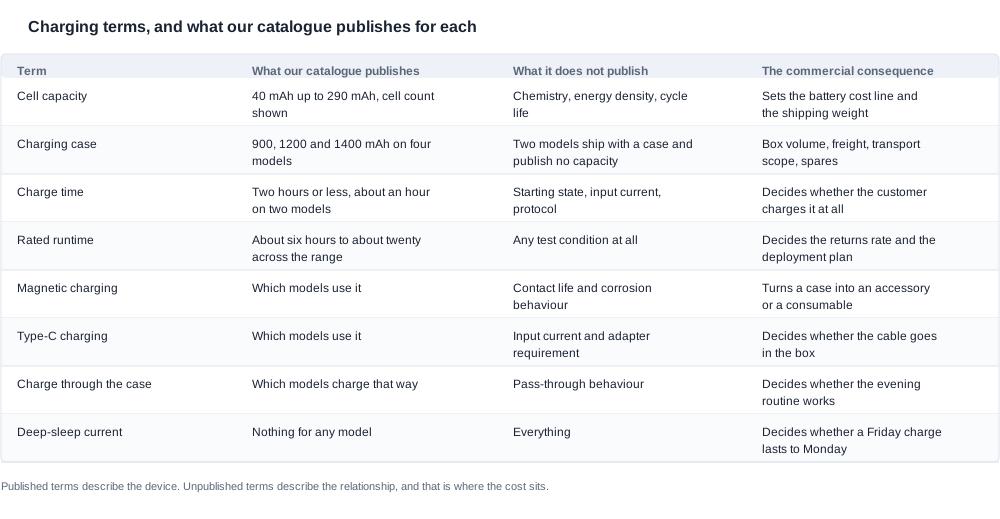
Smart glasses charging: eight terms in a negotiation
Cell capacity
The size of the battery inside the frame, in milliampere-hours. Our range runs from 40 mAh on the A05 and the A06 through 220 mAh on the V03 and the MT5, and the V03 Pro, to 290 mAh on the L1 Pro and the CY03, and the L2 Utral and the CY05. The audio models appear as paired cells, and the catalogue prints them that way: 90 mAh × 2 on the K01 and the K02, and 55 mAh × 2 on the G07 and the LC-105-2, and the YK12 and the LC-105-1. The D11 and the D12 each publish a single 100 mAh cell. Among the sport models the YKC02 appears as 70 mAh × 2, the D17 as a single 115 mAh cell and the ZH12 as a single 100 mAh cell.
We publish the capacity and not the chemistry, the energy density or the cycle life. Capacity alone does not predict runtime, because runtime is capacity divided by average power draw, and the main controller, the camera module and the radio all sit in that denominator. The question to ask is what the average power draw was in the test, because that is the number the runtime depends on.
Charging case
A powered holder that charges the frame and stores it. We publish three case capacities: 900 mAh on the L2 Utral as an option alongside 1400 mAh, 1200 mAh on the MT6 in a folding case, and 1400 mAh on the L1 Pro and the CY05, and the CY03. The KY06 and the MT5 ship with a case and publish no capacity for it. The case is one of the highest-value parts of the package in this category, and it is also a second failure point and a second thing in the box.
The question to ask is whether the case charges the frames or only stores them, and the answer is not implied by the capacity. A case capacity and a case role are two separate rows, and a quotation that carries only one of them is half an answer.
Charge time
How long a full charge takes from empty. Our catalogue states a charge time of two hours or less across most of the range, and about one hour on the D17 and the ZH12, which are Type-C models. We do not publish whether any model accepts a fast-charge protocol, and that is worth asking about, because it is the difference between a customer charging overnight and a customer charging at a desk.
The question to ask is the starting state and the input current. A charge time without a starting state is two possible numbers, and the one that ends up in your retail listing is whichever one the reader assumed.
Rated runtime
The published hours of use. Across the range this runs from about six hours on some audio models to about twenty on the A05, the A06 and the A07, with five to eight hours on the camera models that publish a range, about six to eight on the KY06 and the MT5, and roughly seven on the models that publish a single figure.
Every one of these figures comes without a stated test condition, and that is the single most important thing on this list. The question to ask is what workload the number describes — continuous capture, continuous playback, or mixed use — because a camera that is recording and a pair of glasses that are idle are different products as far as the battery is concerned.
Magnetic charging
Contacts that align by magnet rather than a plug. It removes the port, and with it removes one of the classic ingress failure points, which is why it appears on the models aimed at sport and outdoor use. We publish which models use it, and not the contact life or corrosion behaviour over a charge cycle.
The question to ask is how many mating cycles the contact is rated for, because that number decides whether the case is an accessory or a consumable.
Type-C charging
A wired USB-C interface on the device itself. It is the most convenient arrangement for a buyer because the customer already owns the cable, and it is also the arrangement that exposes a port to contamination. We publish which models use it — the D17 and the D12, the D11, the ZH12 and the V03 Pro and the bone conduction entry — and not whether it charges from a standard wall adapter or needs a specific one.
The question to ask is what input current the device accepts, because that decides whether the customer's existing cable and adapter are adequate or whether they need to be in the box.
Charge through the case
The distinction that catches new buyers: on some models the frame has no charging interface of its own and can only be charged while seated in its case. That is a genuine change to the customer experience — the glasses are not chargeable on a desk, the case is not optional, and the case becomes part of the product rather than part of the packaging. Ask which architecture each model uses before you write the listing.
Deep-sleep current
The standby drain between uses, and the one figure in this list that is publicly benchmarkable across the industry, which makes its absence conspicuous. We publish no deep-sleep current for any model, so a buyer who wants it has to ask, and a supplier who cannot answer it has not measured it.
The question to ask is the current in the state the product actually rests in, because that is the number that decides whether a unit charged on Friday is usable on Monday.

The terms we do not publish, and why the absence matters
A second group of terms appears in supplier documentation and in buyer conversations, and none of them is in our catalogue. Listing them matters as much as listing the eight above, because a buyer who knows a term exists knows to ask for it.
Cell chemistry. We publish milliampere-hours and not the chemistry. The consequence is that two cells with the same capacity can behave very differently in cold conditions and in storage, and a buyer who has planned a seasonal product cannot answer the question from the row we publish.
Cycle life. A count of charge cycles at a stated depth of discharge, at a stated temperature. We publish none, and this is the number that decides when the second wave of returns arrives in a channel that charges the same units every night for years.
Fast-charge protocol. The negotiation, the power profile and the power level. We publish the charge time and none of these, which is why the word "fast charging" should not appear in a listing on our evidence.
Charging input. The current and voltage the device accepts. It is the term that settles every "does it charge from my power bank" question, and it is the one we cannot answer from a catalogue.
Charge indicator. What the customer sees while charging, and whether anything is shown at all. This is the mitigation for a magnetic frame that looks seated and is not charging, and it is not published for any model in the range.
Case recharge count. How many times a case can recharge a frame, and how long the case itself takes. It depends on the case efficiency and its state of charge, neither of which is published, so it is also the number most often derived rather than measured.
Pass-through behaviour. Whether the case can charge the frames while it is itself plugged in. This decides whether an evening routine works at all, and it is absent for every model.
Contact life. The number of mating cycles a magnetic contact is rated for. It converts the case from an accessory into a consumable, and it is the difference between a spares budget and a warranty provision.

How to use the vocabulary when you read a quotation
The point of a glossary is not to be able to define the words. It is to know which word is load-bearing in a given sentence, so that a quotation can be interrogated in the right order.
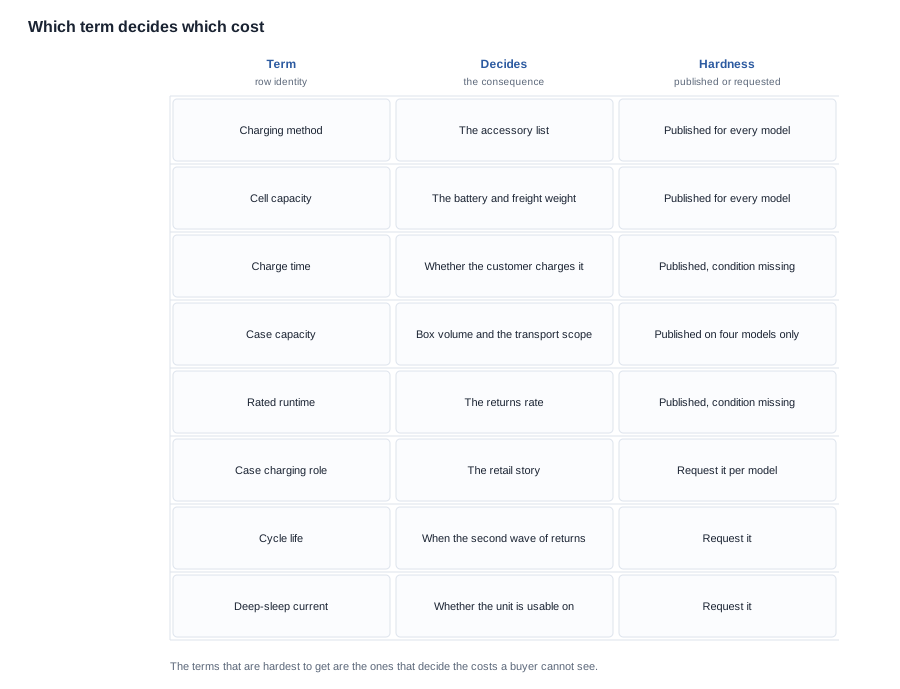
A quotation that contains charging method, charge time and cell capacity has answered the easy part. Those three terms describe the device: cell capacity and charge time are published for every model in the range, and the charging method is published for twenty-four of the twenty-eight, magnetic or Type-C. The quotation becomes difficult to evaluate when it reaches charging case and rated runtime, because those two are the terms a buyer is most likely to accept without a condition and most likely to be wrong about. And the hardest terms to get answered at all are the eight in the unpublished group above, because they have to be requested by name.
The practical reading method is to take every number in the quotation and ask which of these terms it is an instance of, and then ask what condition that term requires. A charge time without a starting state, a runtime without a workload, a case capacity without a charging role, a cell value without a cell count — those four sentences cover most of what goes wrong in this category, and all four are visible without reading any document beyond the quotation itself.
Two habits make this faster. The first is to ask the supplier to restate the quotation's charging lines as a table with one row per model and one column per term, because a table exposes an empty cell and a paragraph hides it. The second is to write the terms into the purchase order rather than describing them, so that the specification and the contract use the same vocabulary and there is no room for two documents to describe the same arrangement differently.
A worked example makes the method concrete. Take a line that reads L2 Utral, 290 mAh, Type-C, charging case, ≤2h, ~7h. Naming the terms gives: cell capacity, charging method, charging case, charge time, rated runtime. That is five terms, and each one can now be interrogated. The cell capacity is a frame cell and the case is a separate row, so the two are not added together. The charging method is Type-C, which means the case charges the frames through the port rather than through contacts. The case is published at 900 mAh or 1400 mAh, so the line is ambiguous and needs the capacity. The charge time carries no starting state, so the figure needs a condition. The runtime carries no workload, so it needs a condition too. One line of quotation produced five specific questions and one concrete ambiguity — and every one of them would have been invisible while the line was read as a sentence rather than as a row of terms.
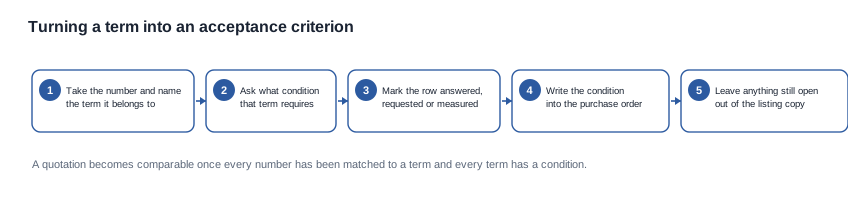

Where each term's cost actually hides
Each of these terms has a commercial consequence, and the consequence is where the cost hides. The charging architecture decides the accessory list. The case capacity decides the box volume, and the box volume is freight, and freight on a lithium battery product is governed by rules that most buyers only meet for the first time. The runtime figure decides the returns, because a customer who expected a full working day from a five-hour figure will return the product. The charge time decides whether a customer charges it at all, and an uncharged device is a device that will not be bought twice.
The term that causes the most arguments in writing is the runtime. Our catalogue publishes a rated figure for every model and a test condition for none of them, and the same number has been quoted by a buyer and a supplier meaning different things in the same email. Fixing the condition in the purchase order is cheaper than fixing it in a dispute, and the four words to add are shorter than the argument they prevent.
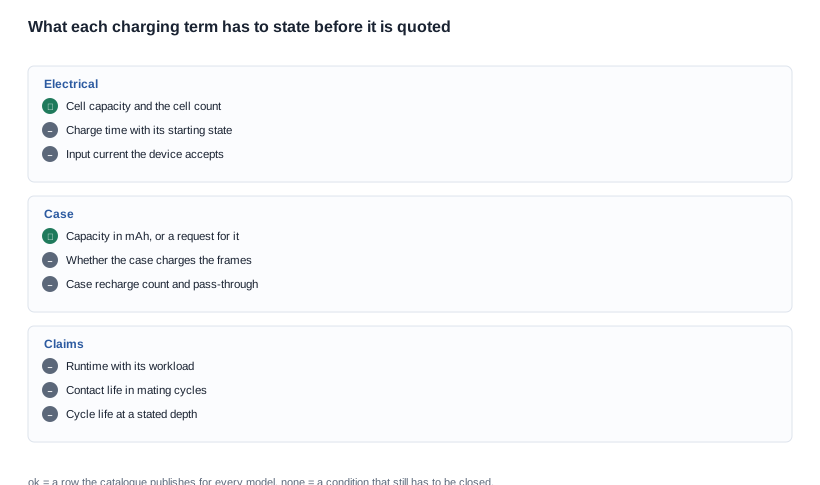
There is a second-order effect worth noticing, because it is where the category's costs concentrate. The terms that decide the costs are all terms with a condition attached to them, and the conditions are exactly what suppliers rarely publish. That is not an accusation; it is a property of a specification written to describe a range rather than an order. The consequence for a buyer is that the difference between a cheap supplier and an expensive one is often not the unit price at all — it is the number of rows that arrive with a condition attached, and how much of the programme you can therefore plan without guessing.
The same logic explains why the glossary is worth reading before the quotation rather than after it. A term you do not know is a term you cannot price, and a term you cannot price is a term somebody else prices for you. A buyer who knows that the case capacity decides the carton volume will ask for the capacity before the freight is quoted; a buyer who does not know it will accept the carton that arrives and discover the cost in the freight invoice. The vocabulary is not a reading exercise. It is the set of levers that move the costs.
The units we quote are the catalogue's own
The boundary we hold: we publish the charging figures our catalogue holds, in the units the catalogue uses, and we publish the empty rows next to them rather than filling them with values from a typical device. We will not infer a chemistry from a milliampere-hour figure, we will not publish a fast-charge capability we have not confirmed, and we will not present a runtime figure as though it were valid under a condition nobody stated.
There is one convention worth stating explicitly, because it is the one most often misread: where the catalogue prints two cells, it prints the value of one cell and a count of two. The YK12 and the G07, and the LC-105-1 and the LC-105-2 are printed as 55 mAh × 2; the K01 and the K02 as 90 mAh × 2; the YKC02 as 70 mAh × 2. A total is a derived figure and we do not print totals as though they were published, because a total in a specification table is read by the next person as an official number. Where a comparison in a document needs the total, it is labelled as a derived total at the point of use.
What we can do is confirm, for a specific model, which of these terms our documentation answers, and identify the ones that need a test on a sample. The charging solutions themselves are described under charging solutions, the platform range is on the oem ready products page, and the runtime side of the same question is in battery life cost factors.
One closing note on how to use the glossary in a negotiation, because the failure mode is not ignorance but politeness. A buyer who has quietly filled in a blank with a typical value has made a commercial decision without a document behind it, and the usual reason is that asking felt like doubting the supplier. It is not; it is the ordinary way this category's specifications get completed. The terms above are the ones where a blank gets filled, so they are the ones worth naming in the request, and the request itself is three lines long: which of these terms can you state for this model, which are you still confirming, and which will you confirm on a sample and by when.
Related reading
- Choosing between the charging architectures — how to choose a charging approach
- The runtime side of the same glossary — battery life glossary
- What to ask a supplier about charging — charging supplier verification
Tell us the model and we will tell you which of these eight terms our documentation answers and which need a sample.


