

Charging is the one part of a smart glasses product where cost and customer experience point in different directions, and where the cheapest option is often the most expensive over a year. The three architectures are a magnetic dock, a Type-C cable, and a dock with a charging case — and the difference between them is not the electronics, it is what they do to your parcel, your paperwork and your returns.
We do not publish prices, minimum order quantities or lead times, and our internal documentation currently holds three conflicting minimum order quantity figures that have not been arbitrated, so this article works in the only unit that is available: what each architecture adds, what it removes, and what the buyer gets for it. The unit that turns out to matter is not the charge time and not the cell capacity. It is the number of interruptions a customer has per day, the failure rate of the charging relationship, and whether the product's story can be written in a retail listing at all.
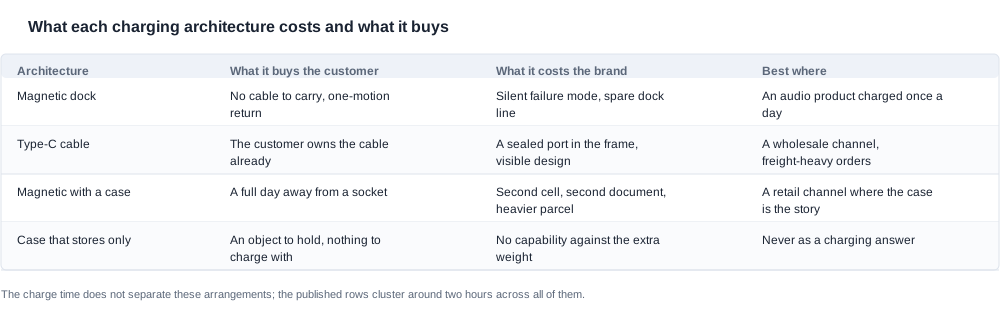
Smart glasses charging: cost is not capability
A buyer comparing two charging arrangements is usually holding two numbers and treating them as the same kind of thing. One is a unit cost. The other is a charge time. Neither is what the decision is actually about.
The reason is that charge time and cell capacity are properties of the product, while the cost of the charging arrangement is a property of a system — the device, the object it comes with, the paper that travels with it, the channel that stocks it and the support queue that answers for it. Two arrangements can have identical electrical behaviour and completely different economics, because one of them involves a second object and the other does not.
So the useful question is not "which is cheaper" and not "which charges faster". It is: for the extra money, what capability does the customer actually receive, and where does that capability show up? A capability that shows up in the parcel is a freight line. One that shows up in the channel is an accessory line. One that shows up in the returns queue is a warranty provision. One that shows up in the listing is a copy decision. Only the last of these is something a brand owner can sell, and it is the one that is usually missing from the comparison.
That reframing has a practical consequence. It means the buyer who wants to know how to evaluate two arrangements should not start with the quote and should not start with the specification. The buyer should start with the channel, because the channel determines which capabilities are worth buying and which are dead weight. A product sold wholesale into a channel that already stocks cables does not benefit from a case. A product sold direct to a customer who will use it for a full working day benefits from a case enormously. Same factory, same charge time, completely different decision.
There is a second consequence, and it is the one that catches experienced buyers out. The capability is bought by the customer but paid for by the brand, and the two are not always the same person. A direct-to-customer brand pays for the capability and collects the return on it. A distributor buys the product, sets the retail price and decides whether to bundle an adapter or a case, so the capability may be paid for by the brand and consumed by somebody else's customer, at a price the brand does not control. Where that is the arrangement, the case decision belongs to the channel rather than to the factory, and a brand that fixes the accessory bundle in the quotation has taken a decision that belongs further down the chain — and usually taken it with less information than the distributor has.

What each of the three architectures buys, and what it costs
The magnetic dock: the cheapest to build and the most expensive to support
A magnet, two contacts and a cradle, with the frame dropping into it.
What it buys the customer: no cable to carry, no connector to align, and the frame going back on a dock in one motion. The routine becomes automatic, and automatic is what produces the published twenty-hour figures on the A05, the A06 and the A07 rather than a dead frame in a bag.
What it costs the brand: a silent failure mode. A frame that looks seated and is not charging is indistinguishable from a broken product, and the customer's conclusion is that the product is faulty. The mitigation is a visible charge indicator, which is not published for any model in this range, and a line of instruction about charging on a non-metallic surface.
The dock is also a spare-parts line that has to exist from day one, and a retailer treats it as a design item rather than an accessory.
The Type-C cable: the cheapest in the parcel and the most visible on the frame
A standard port, a standard cable, and the customer owns the cable already.
What it buys the brand: the lightest parcel, one battery in the consignment rather than two, a smaller carton, and a visible failure rather than a silent one. A cable either works or visibly does not, which removes the most common support ticket in this category. It also removes the cradle from the accessory line entirely.
What it costs: a port cut into the temple, which has to be sealed and which degrades with use, and a visible design element in a design-led channel. In a lens-driven product, a visible port works against the story; in an electronics channel it works for it.
And the charge time does not improve. In this range the frames that charge over Type-C publish up to two hours and one model publishes roughly one hour, while the magnetic models publish up to two hours as well. A wired connection is not automatically a faster charge, and a listing that implies it is would be making a claim the published rows do not support.
The dock with a charging case: the most expensive to ship and the most valuable at retail
The frame goes into a case, and the case holds a second cell.
What it buys the customer: the thing that actually changes a product's proposition. The CY03 and the CY05, and the L1 Pro pair a 290 mAh frame cell with a 1400 mAh case, and the frame's published runtime is about seven hours — so the case converts a device that needs a socket every few hours into one that can be used through a working day. It also removes the anxiety of running out of power in the middle of a shoot, a shift or a ride. It is the highest-value accessory in the category, and it is what a retail story about picking something up and putting it down is built on.
What it costs the brand, and the costs are real:
- A second lithium cell in the consignment, so the battery transport documentation has to cover it, and a case capacity has to be published for the scope to be written.
- A heavier carton and a different volumetric calculation, which changes the freight cost per unit on every order. The MT6 makes the point sharply: it is the only model in the range whose weight is published, at 158 g for the glasses body including the battery and the camera and excluding the folding charging case; the case holds 1200 mAh and the case's own weight is not published, so the parcel cannot be calculated from the catalogue alone.
- A more complex insert, because the case and the frame have to be packed in the right order and the case has to be protected.
- And a published capacity you need to have. In this range, the CY03 and the CY05, and the L1 Pro publish a 1400 mAh case, the L2 Utral publishes 900 mAh or 1400 mAh, and the MT6 publishes a 1200 mAh folding case — while the KY06 and the MT5 are published as shipping with a case and state no capacity at all, and the V03 Pro has no charging case because it charges over Type-C. A brand that has not resolved the capacity of the case it is shipping cannot write the transport scope.
And the case is where the brand's identity lands, because a customer opens it before they put the glasses on — which is why the case artwork is the most valuable customisation surface in the camera range.
The capability that is actually being bought
The useful way to frame this is what the customer gets per unit of added cost, and the answer is not the charge time. It is three things, and all three are countable.
One: the number of interruptions in a day. A case-equipped product can be used for a full working day without a wall socket. A bare frame has to go back to a dock, and if the dock is at home the customer does not use the device in the evening. This is the capability a customer feels, and it is the one a retail listing can promise — provided the promise is written as an availability rather than as a runtime extension, because a case does not extend the published runtime and we publish no efficiency figure for any case cell.
Two: the failure rate of the charging relationship. A magnetic dock that fails silently generates a support call; a cable that fails visibly generates no call at all. This is a cost that appears in the support line and not in the bill of materials, and it is the one that a first order is most likely to under-budget.
Three: what the customer can believe. A product with a published case capacity and a published charge time is a product whose retail story can be written. A product with a case of unknown capacity is a product whose story has to be written around the absence — and a story written around an absence is worth less than a story written around a number, because the customer can check the number.
And the thing that is not being bought: a faster charge. The published charge times cluster around two hours, and the one-hour figure belongs to two specific models over Type-C. A faster charge is a product decision, not an architecture consequence, and a buyer should choose the architecture for the failure mode and the retail story rather than for a number that barely moves.
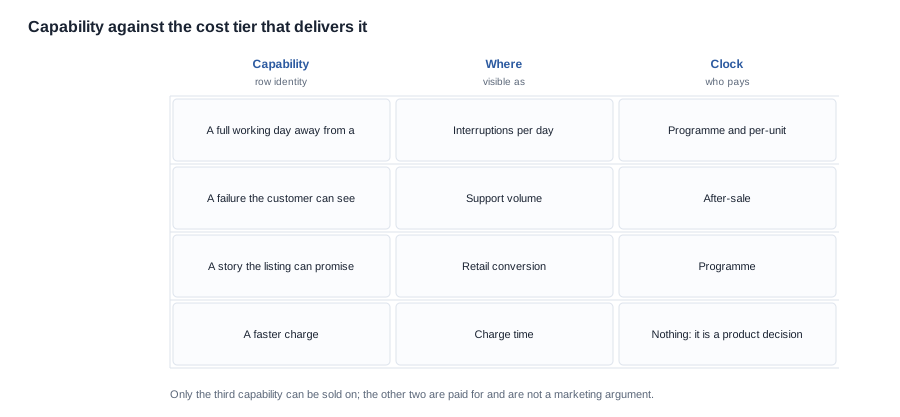

Reading a charging cost across three horizons
The reason the architecture decision is usually made badly is that the cost arrives on three different clocks and the capability arrives on a fourth. A buyer who looks at one clock sees a fraction of the decision.
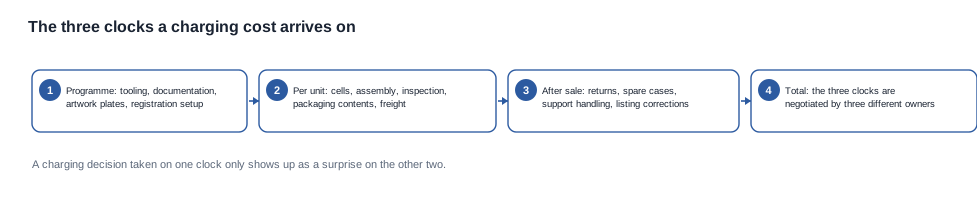
The programme horizon. Tooling, documentation, artwork plates, registration setup, the engineering time to characterise the charging behaviour on a sample. These are paid once, they are paid before any revenue, and they are the horizon on which a case-equipped architecture looks most expensive. The trade-offs here are real but narrow: a separate case tool is one-off cost that only amortises across volume, and a transport summary that has to cover a second battery configuration is a schedule item that can move the launch date.
The per-unit horizon. Cells, assembly, inspection, packaging contents, freight. This is where the published capacity numbers belong, because the cell value and the case value are the two lines that actually scale with the order. A buyer who has a quotation for the frame and a quotation for the case has most of the per-unit picture, and the missing part is usually the inspection step and the packing.
The after-sale horizon. Returns, spare cases, support handling, listing corrections, the diagnostic path. This is the horizon that is hardest to estimate before launch and the one that decides whether the cheap architecture was cheap. A magnetic dock with a published charge indicator would be a support story you can manage; without one it is a story you pay for.
The three horizons have one thing in common that is worth stating: each of them can be negotiated independently, and each of them will be negotiated by a different person. The programme horizon belongs to engineering, the per-unit horizon to sourcing, the after-sale horizon to support. A charging decision made without all three in the room is a decision made on one clock, and the other two arrive later as surprises. That is the trade-off a buyer should watch for: the arrangement that is cheapest on the horizon being discussed is rarely the cheapest on the total.
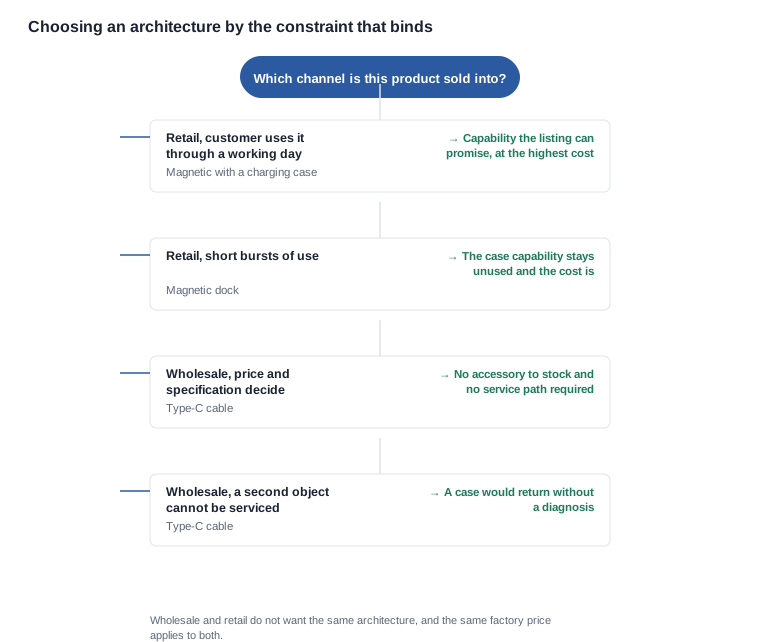
Where the exchange rate stops working
Two situations produce a poor return on the extra money, and both are common.
The first is a case sold into a channel that will not service it. A wholesale channel takes the product and sells it on; it will not hold spare cases and it will not run a diagnostic step. A case in a wholesale programme is a second object with no service path behind it, and the returns it generates come back to the brand without a diagnosis. The capability the case was bought for — a full working day away from a socket — is rarely what the wholesale customer was purchasing in the first place, because the wholesale customer is buying price, specification and supply.
The second is a product whose use is short. If the device is used in bursts rather than in sessions, the case's extra capability is unused and the extra cost is permanent. The published runtimes in this range run from about five hours on the camera models to about eight on the audio models to about twenty on the A05, the A06 and the A07, with no test condition stated on any of them — so the question of whether a case is worth buying is a question about how the device is actually used, and that has to be established from the channel rather than from the catalogue.
There is a third, quieter failure: buying the more expensive architecture and then not telling the customer what it is for. A case that arrives in the box with no explanation of what it does is an object the customer cannot use and a support contact they will make. The listing copy and the manual are part of the capability, and a programme that budgets for the case and not for the copy has under-budgeted.
The way to protect against all three is to state the capability in the quotation rather than in the campaign. A purchase order that says supplied with a 1400 mAh charging case that recharges the 290 mAh frame cell, with the case role stated as charging rather than storage in the listing and the manual makes the capability a contractual item, which means it cannot quietly disappear between the factory and the shelf. It also gives the brand a defensible answer when the channel asks why the two configurations cost different amounts, because the difference has a name that is already in the document.
What the architecture should follow, and what we publish about it
Stated plainly: the architecture should follow the retail story and the support cost, and the charge time should follow the architecture rather than lead it. A case-equipped camera product for a retail channel, a magnetic dock for an audio product whose customer charges once a day, and a cable for a product whose parcel weight is the deciding constraint.
We will not publish prices, minimum order quantities or lead times, and we will not estimate a charging input, a case recharge time or a charge indicator behaviour. We will also not fill a missing case capacity from a neighbouring model, because that is the specific mistake the KY06 and the MT5 invite. The distinction between a case that charges and a case that stores is not one we will infer from a capacity figure either.
What we will do is tell you which models publish a case, which publish a capacity and which publish nothing at all, so the architecture decision is made against facts rather than against a photograph. On the camera family the picture is: the L1 Pro and the CY03, and the CY05 publish a 1400 mAh case, the L2 Utral publishes 900 mAh or 1400 mAh, the MT6 publishes a 1200 mAh folding case, the KY06 and the MT5 ship with a case and publish no capacity, and the V03 Pro has no case at all. The logistics guidance covers how the parcel is usually structured, and the charging system on a single model is set out in detail for the L1 Pro in L1 Pro charging options and for an audio model in A07 charging options.
Before you order, the two questions worth asking are the ones this article has been circling. Ask which capability the extra money is meant to buy, and get it written as a number of interruptions rather than as a charge time. Then ask where that capability will show up — in the parcel, in the channel, in the returns queue or in the listing — because the answer decides which of the three horizons the decision belongs to, and therefore who has to agree to it. A third question is worth asking at the same time and is usually skipped: what will the arrangement look like to the customer on the day it arrives, and how much of that explanation has to be written before the first unit ships. The copy is part of the capability, and it is the part that costs the least to get right in advance.
The camera family is on our AI camera glasses page.
Related reading
- The charging system on one model, in detail — L1 Pro charging options
- The charging routine in a family — A07 charging options
- How the parcel is usually structured — logistics
- The cost structure behind each arrangement — charging cost factors
Tell us the channel, the volume and whether the case is part of your retail story, and we will come back with what is available.


