

Smart glasses charging smart glasses cost factors is a question about architecture rather than about a charger, because the charging arrangement determines what else has to be built, certified, packed, shipped and supported. Four arrangements cover everything in our range, and the difference between them is not the price of a cable. It is whether the product is one device with one battery, or two devices with two batteries and two sets of paperwork. The cost model that follows works in four buckets — one-off, per-unit, per-shipment and per-market — because those are the four buckets a quotation can actually be sorted into, and a buyer who cannot sort a quote into buckets cannot compare two of them.
Our published figures for the arrangements are a charge time of two hours or less on most models and about an hour on the D17 and the ZH12, a case capacity of 900, 1200 or 1400 mAh depending on the model, and a charging method on the twenty-four entries that carry one. We publish no cell chemistry, no cycle life and no fast-charge support for any model.
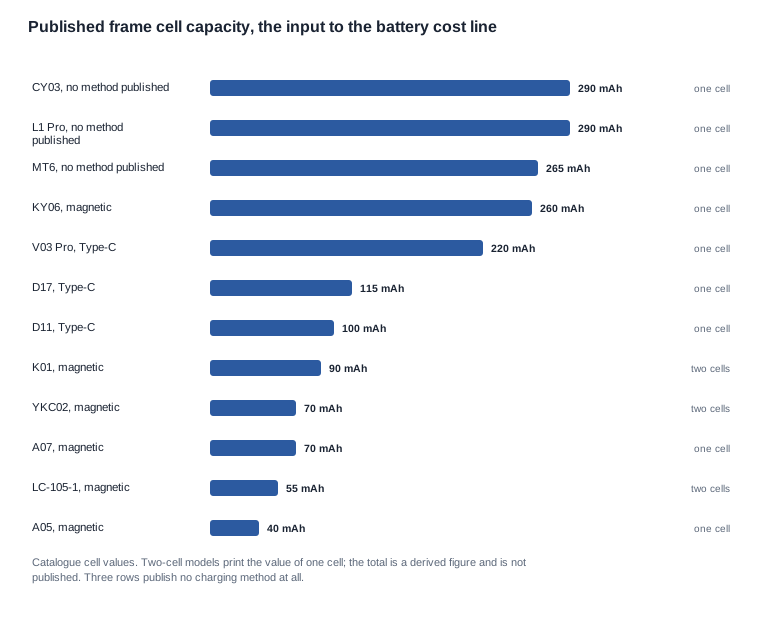
Smart glasses charging: the arrangement, not the charger
The habit that costs money in this category is to price the charger. A magnetic cable and a Type-C cable have a unit price, and comparing those two prices feels like comparing two arrangements. It is not. The cable is the cheapest line in the comparison. Everything that makes one arrangement more expensive than the other sits outside the bill of materials: the mould tooling for a second object, the second battery in the consignment, the second transport document, the heavier carton, the accessory line the channel has to stock, and the failure mode that appears in a support queue rather than on an invoice.
That is why two quotations for the same product can differ by a meaningful margin while the line items look almost identical. The difference is not in the lines that are quoted; it is in the ones that have not been costed by either party. A buyer comparing quotes on the quoted lines alone is comparing the part of the cost that is easy to compare.
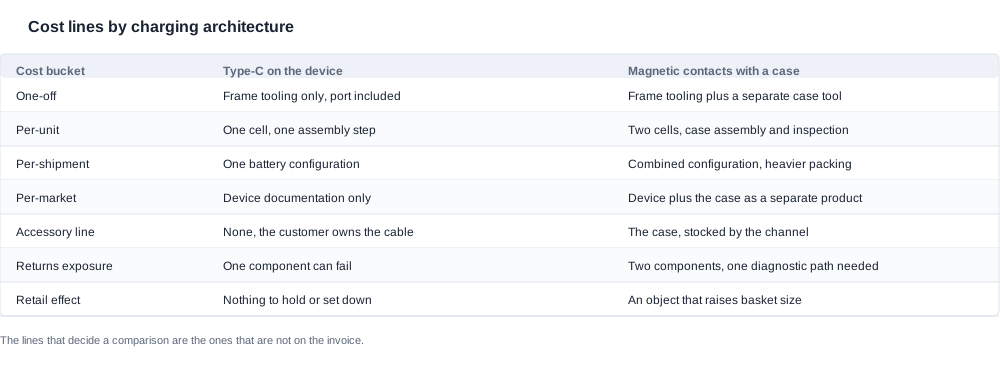
So the method below sorts every cost line into one of four buckets, and the buckets behave differently:
- One-off. Tooling, engineering setup, documentation work, artwork plates, registration setup. These are paid once per programme or per variant, and they are the bucket where volume changes the picture most.
- Per-unit. The bill of materials, assembly, inspection, packaging contents. These scale linearly with the order and they are the only bucket where a price tier is meaningful.
- Per-shipment. Freight, packing instruction, transport documentation, the labour to reconcile them. These scale with the number of consignments, not with the number of units, which makes them punishing on small orders and negligible on large ones.
- Per-market. Registration, document translation, separate conformity work for a destination. These scale with the number of markets and the number of model strings.
A total-cost comparison that mixes the four buckets is meaningless, because a buyer optimising per-unit cost will happily add a per-market cost and a per-shipment cost without noticing. So the rule for comparing two charging arrangements is that every line has to carry its bucket before the two are added together.

Type-C on the device: the simplest cost structure and the one that hides a port
Type-C on the device has the smallest cost structure in the category, and it is worth understanding precisely which lines disappear, because most of them disappear only because the arrangement moves them somewhere less visible.
What disappears. The frame carries one cell, so the consignment contains one battery configuration and one transport document covers it. There is no case, so there is no case tooling, no case circuit board, no case contacts and no second battery to declare, pack and mark. There is no accessory in the box that the channel has to stock, and no accessory that can fail separately from the device.
What the customer covers. The cable and the adapter. This removes an accessory cost and it removes a class of support question, but it transfers the sourcing decision to the customer, and the customer will make it with whatever they already own. A device that charges slowly from a weak adapter generates a support contact that has nothing to do with the device and everything to do with the price point of the arrangement.
What the port costs. A Type-C port is an opening in the temple, and it has to be sealed, aligned and tested. That sealing is part of the frame tooling rather than a separate item, which is exactly why the port is easy to overlook: it is buried in the frame tool, not in a line item. On models with an ingress rating the port interacts with that rating, and on this range the IP54 marking appears on only two models — the V06 and the S7 — so for most of the range the port is simply a mechanical feature with a service life.
What it does to the parcel. One battery, no case, the lightest carton in the category. This is where Type-C shows up most plainly in a landed-cost model, and it is the reason the arrangement wins on freight-heavy programmes.
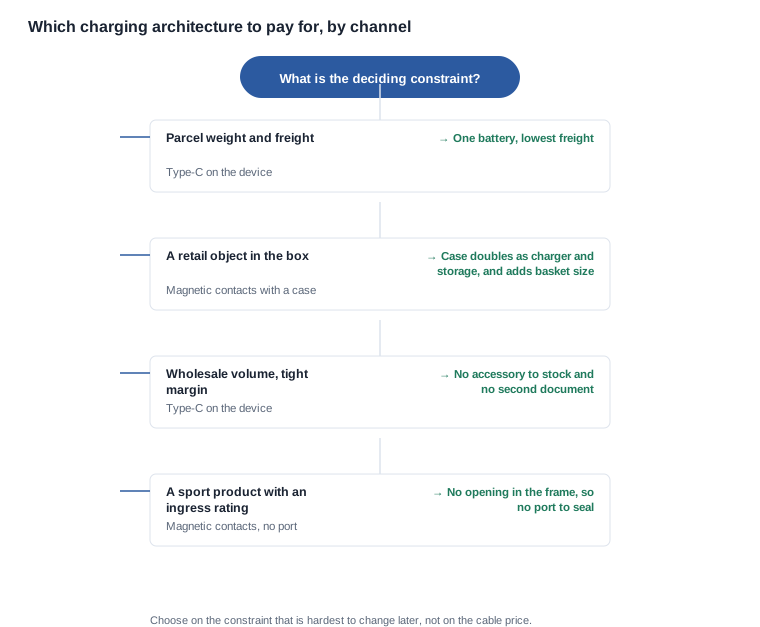
The commercial conclusion for this arrangement is that it is the right one when the parcel is the deciding constraint, when the channel is wholesale rather than retail, and when the customer already owns a suitable cable and adapter. It is the wrong one when the retail story depends on an object the customer holds, and when the product's proposition is the thing you put down and pick up.
Magnetic contacts with a case: the arrangement that creates a second product
Magnetic contacts on the device, with a case, has a completely different cost structure, and the difference is not incremental. The case is a second product, and it is treated as one by everyone who touches the programme after it is specified.
The second battery is a second document. Where the case contains a cell, the transport test summary has to cover the cells in the shipment, which is a different configuration from the frame's own cell. The transport rules apply to the shipment as a whole, and a heavier configuration changes what can move by air and at what cost. Our catalogue publishes the case capacities that exist — 1400 mAh on the L1 Pro and the CY03, and the CY05, 900 mAh or 1400 mAh on the L2 Utral, and a 1200 mAh folding case on the MT6 — and it publishes no cell references or test summaries for any of them, so the transport scope for a case-equipped model has to be requested before it can be written.
The mould tooling for the case is tooling. A case that seats a specific frame needs its own tool, and it is tooling in the same irreversible sense as the frame itself. It is also tooling that has to be redone if the frame changes, which couples two decisions that are usually taken at different times by different people. The commercial rule that follows is simple and worth defending in a negotiation: a case tool and a frame tool are separate one-off lines, and a frame change during the case's life does not come free.
The yield of the contact interface. A magnetic contact pair is a mechanical interface that has to align, mate and conduct, thousands of times. Every additional mating surface is a potential fault that presents to the customer as a device that will not charge, and it is a warranty event rather than a customer-caused defect. The cost of this does not appear in a quotation at all; it appears in the returns provision.
The second thing that can fail. A device with a case has one more component with one more failure mode, and the most common one is a case that will not charge. It is also the failure that is easiest to prevent: the case in the box needs the same attention in the inspection instruction as the device does, which is a per-unit quality control cost, and a supplier who has not written the case into the inspection instruction has not costed it.
The weight and the volume. A case changes the shipping weight and the box volume, and both are on every unit rather than being a one-off. On a lithium battery product that also interacts with the packing instruction, which is a per-shipment cost that gets worse as the case gets larger.
What the arrangement buys. In exchange for all of that, the customer gets the case as both charger and storage, and the product gets a meaningful accessory that raises the perceived value and the basket size in a retail channel. That last point is a commercial gain rather than a cost, and it belongs in the same model as the freight, because it is the reason the arrangement can be worth more than its cost.
The gain is not automatic, and it depends on one detail that is easy to lose in a cost discussion: the case has to be the thing the customer actually picks up. A case that stores but does not charge gives the customer an object to hold and nothing to charge with, and the retail story it supports is the storage story rather than the power story. Where the arrangement is chosen for its retail value, the charging role of the case has to be settled in the same meeting, because the two are the same decision seen from two sides.

The cost lines that appear on no invoice
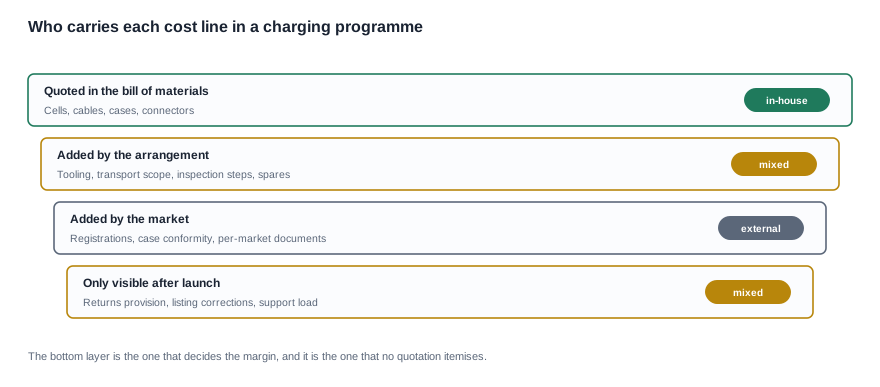
These are the lines that a buyer who compares quotations line by line will never see, because no supplier quotes them separately. They are the reason the same product costs what it costs, and they are the lines to interrogate before accepting a price.
The documentation work. The transport summary for a case configuration, the separate conformity work for the case as a product, the market-specific documentation for each destination. This is a per-market and per-shipment cost that arrives as a lead-time item rather than as an invoice.
The packaging and producer-responsibility registration. In several markets the packaging attracts an obligation regardless of the electronics obligations that apply to the product. That registration is a per-market cost with a lead time, and it belongs in the landed-cost model from the first quotation rather than being discovered when someone asks for a registration number.
The artwork revision. A carton printed with a wall charger in the picture, when the charger is not in the box, is a plate change or a write-off. Small in isolation, and a one-off that scales with the number of variants in the programme.
The spare-parts provision. Magnetic contacts degrade with mating cycles, so a case eventually stops charging the frame it is supposed to charge. A channel that cannot replace a case cannot service the product, and a brand that has not priced spare cases will be asked to supply them at a cost it has not budgeted, against a returns rate it has not modelled.
The listing and the manual. A case whose charging role is ambiguous produces copy that has to be corrected after publication, which is not a printing cost but is a support cost in the first weeks of a programme.
The returns provision. A case-equipped product has two components that can fail and one diagnostic path. Without a diagnostic step that separates them, case failures are returned against the device warranty, and the warranty provision is charged for a fault it was not priced for.

How to compare two quotes that are not comparable
A buyer who wants to know how to evaluate two quotations for different charging arrangements is usually doing it badly, because the two quotes are answering different questions. The method below makes them answer the same one.
Step one: make the configuration identical. If one quote has a 1400 mAh case and the other has a 900 mAh case, the comparison is meaningless until both are at the same case capacity. The L2 Utral publishes both, so it is the model where this mistake is most easily made. The same applies to the accessory bundle: a quote with a Type-C cable in the box and a quote without one are not comparable at all, and the cable is the cheapest line in the box, which is why it gets used as the difference.
Step two: sort every line into the four buckets. One-off, per-unit, per-shipment, per-market. A quote that does not separate them is not comparable, because the buyer cannot see whether the difference between two quotations is a one-off that amortises or a per-unit that repeats forever.
Step three: convert to landed cost at your own volume. Ex-works unit price is the number suppliers publish and the number buyers should not compare. Add the freight, the packing and the transport documentation handling; add the registration and per-market work amortised over the units you will actually ship; add the inspection and packaging steps the arrangement creates. Then divide by the units in the order.
Step four: add the returns provision, even roughly. The two arrangements have different failure economics, and the difference shows up in the support line rather than in the invoice. An arrangement with more components has more ways to fail and a higher provision, and the fact that it also carries a higher retail value is not a substitute for pricing the failure.
Step five: state the assumption you made. Every number in a comparison that came from the buyer rather than the supplier should be marked. If the transport summary is assumed to cover the case configuration, say so. If the returns rate is a planning assumption, say so. A total cost model with unmarked assumptions is a negotiation position, not an analysis, and the difference matters when the other side starts asking.
There is a sixth step that most buyers skip, and it is the one that decides whether the comparison survives contact with a purchase order: check that the two arrangements are being compared at the same point in the programme. A Type-C frame tool and a magnetic case tool are quoted on different assumptions about how long the frame design will stay fixed, and a comparison that treats them as the same kind of one-off is comparing a number that repeats with every order against one that repeats once.
The output of that process is a comparison that a supplier can quote against, which is the point. A buyer who arrives with a bucketed model and a marked assumption list gets a quotation that is specific; a buyer who arrives with "what is your best price on the L2 Utral" gets a price and a second round of work.
What the negotiation can move, and where the cost actually sits
The commercial conversation in a charging programme is about allocation and timing rather than about headline price. What the negotiation can genuinely move: the case configuration, and therefore the freight and the battery cost; the accessory bundle; the delivery split by model, so that a slow-moving variant does not hold a fast-moving one; the payment milestones against the sample and against production; the volume tiers and where they reset; and the tooling schedule, including which tool is charged when.
What it cannot move: the cost and cycle of a test regime once it is triggered, and the character of mould tooling as a non-recurring cost that only amortises across volume. A good quotation separates these two groups, because a buyer who is told that the tooling fee is negotiable will later be told that the compliance fee is not, and the credibility of the first answer collapses.
Two clauses are worth more than most of the rest. The first treats a change to the box contents as a priced variation, because a case removed from the bundle is not an accessory substitution — it changes the transport configuration, the packaging, the artwork, the documentation set and the per-unit freight, and a change absorbed silently lands on the compliance team without a schedule. The second fixes the documentation set that travels with the goods, and states which transport summary covers which battery configuration, so that a refused booking is a supplier obligation rather than a buyer surprise.
Where our own limits sit is worth stating plainly. We publish the charging figures our catalogue holds, in the units it uses, and we publish the empty rows next to them rather than filling them with typical values. We do not publish unit prices, minimum order quantities or lead times, and we will not infer a chemistry from a milliampere-hour figure, will not publish a fast-charge capability we have not confirmed, and will not price a case against a device without separating the two, because the two arrive as one box.
What we can do is tell you, for a given model, which arrangement it uses, what it adds to the box, which cost buckets it adds lines to, and which of its lines are one-off and which repeat. The charging methods are described under charging solutions, the vocabulary is in the charging glossary, the packaging consequence is in standard oem packaging options, and the claims worth interrogating are in charging red flags.
One closing note on a number buyers often ask for and cannot get from us. The per-unit cost of a charging arrangement is not a figure we publish, because it is a figure that changes with the order quantity, the case configuration, the accessory bundle and the destination market, and because it is a commercial figure rather than a technical one. What we can give you instead is the structure that number has to be built from — which cells are in the build, how many of them, whether a second object with its own tooling exists, and which of the four cost buckets each line belongs to. That is enough to build your own model against, and it is the model a supplier can actually quote against. If you send us the model, the configuration and the destination, we will tell you which lines the arrangement adds to your cost model and which of them we can confirm from the catalogue.
Related reading
- The vocabulary behind the options — charging glossary
- The claims to interrogate — charging red flags
- The packaging consequence — standard oem packaging options
- The exchange rate between money and capability — charging cost vs performance
Tell us what the product has to do and what the channel expects, and we will tell you which arrangement fits and what it adds to the box.


