
Charging is described in this category as an interface — magnetic or Type-C — and that is the least useful level of description for a buyer. A buyer is not choosing a socket. They are choosing how the product behaves at month eight, which spare part the after-sales operation has to hold, and whether the charge time printed on the product page survives contact with a customer who charges from a laptop port.
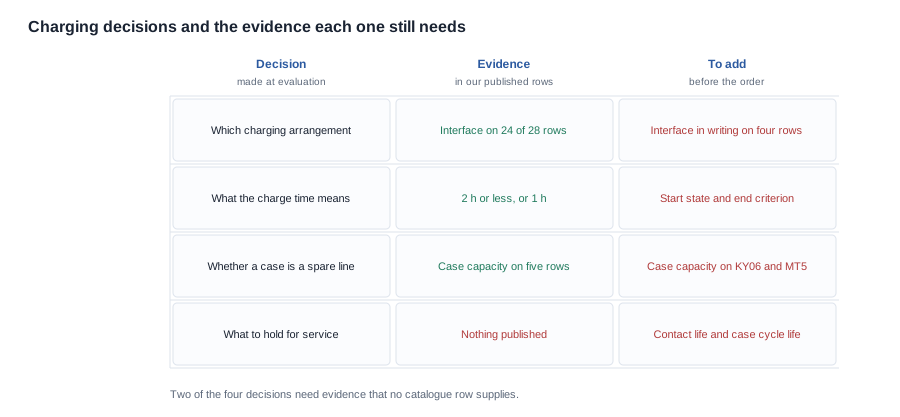
Three questions settle most of that. First, whether the charging interface is magnetic or Type-C, because the choice fixes the degradation mechanism, the consumable list and the service procedure. Second, whether the product carries a charging case, because a case is a second lithium cell with its own transport document, its own warranty exposure and its own stock line. Third, and this is the question to ask before you order, whether you accept a published charge time that carries no start state and no end criterion, or set that condition yourself before the sample order.
Every one of the 28 model rows in our catalogue publishes a charge time — 26 rows at ≤2 h, the D17 and the ZH12 at ~1 h — and not one of them publishes the state the cell started in or the point at which charging is judged complete. That is not a gap a supplier phone call closes. It is a measurement condition you have to define. The mechanism, the published rows and the measurement are set out below.
Smart glasses charging: what the charger actually does
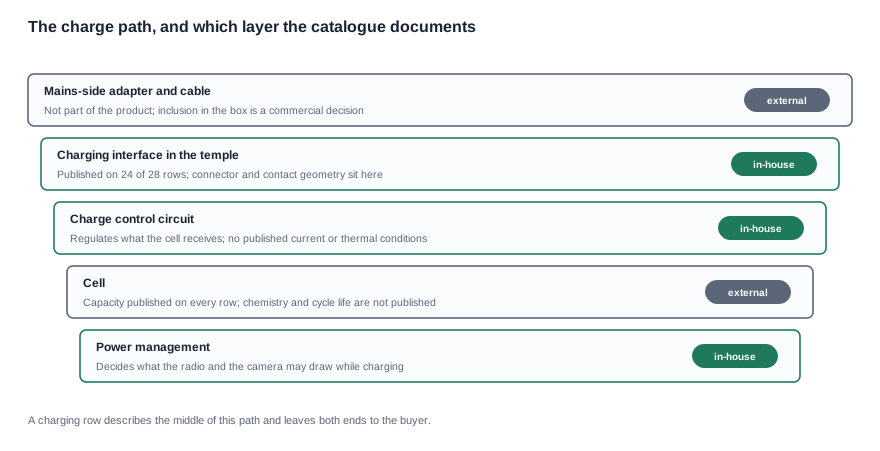
A charge moves through six layers, and a catalogue row for "charging" describes only the middle two. There is a mains-side adapter that converts wall power to a low-voltage supply. There is a cable or a cradle that carries it. There is a connector or a pair of contacts that meets the product. There is a charge-control circuit inside the temple that regulates what the cell receives and what happens when the cell is warm. There is the cell itself. Above all of that sits the power-management layer, which decides what the radio, the audio stage and the camera are permitted to draw while charging.
Each layer introduces a condition that no product page captures. The adapter introduces an input-current question. The cable introduces a gauge and a length question. The connector introduces an alignment and a surface-condition question. The control circuit introduces a thermal question. The cell introduces a chemistry and a cycle-life question. The power-management layer introduces the flat-battery behaviour, which is a product behaviour and therefore a support-script line.
This is why "magnetic or Type-C" is a weak description even though it is the true one. A better description asks what the interface does to the product over its service life, because that is what the buyer is actually paying for.
The mechanical difference a buyer ends up paying for
A magnetic interface seats itself. Two contacts are brought together, magnets pull them into alignment, and the connection is made. The user does not have to think about it, which is the commercial argument for it. The mechanical consequence is that the contact faces are exposed surfaces inside a temple opening, exposed to grit, to pocket lint and to skin oil, and the connection degrades gradually rather than failing at once. Charge current falls, the charge time lengthens, and the symptom the customer describes is that the battery has become worse.
A Type-C receptacle is a recessed connector with a defined insertion geometry. Nothing has to be aligned by the user, nothing is exposed to the same degree of particulate, and the failure mode when it does occur is usually a cable or a port rather than a pair of pads. The cost moves instead of disappearing: the cable becomes a consumable, so the decision about whether a cable ships in the box becomes a commercial one that belongs on the purchase order rather than in a packing list. A product shipped without a cable generates a support load that has nothing to do with the product.
Neither arrangement is the better engineering answer in the abstract. The question for a buyer is which failure they would rather own, and that question is settled by the channel's service model rather than by the interface name. A channel with a regional repair depot and a parts budget can carry a contact-replacement programme. A drop-ship channel cannot, and should look harder at the Type-C side of the range.
What our own catalogue states, and what it leaves to you
Our catalogue publishes the charging interface for 24 of the 28 rows, the charge time for all 28, the cell capacity for all 28 and the rated runtime for all 28. It publishes no input current, no cable specification, no contact cycle life, no cell chemistry and no safe charging temperature range for any model in the range. Those are not modest gaps; they are the rows on which a charging specification is actually built.

The catalogue's charging rows and the four that publish no interface
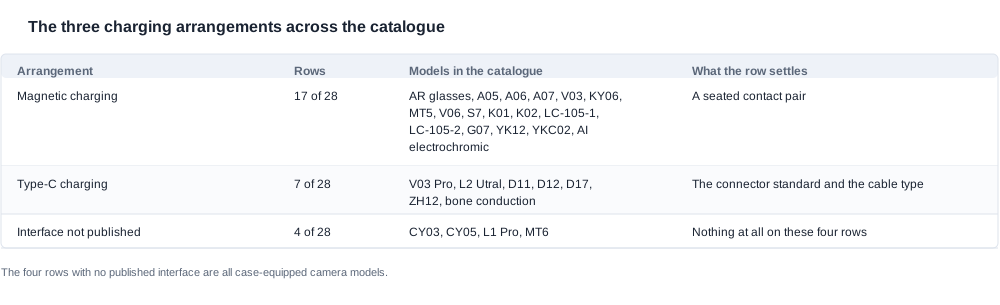
Our charging arrangements split three ways, and the third way is the one worth arguing about with a supplier. Seventeen rows publish magnetic charging. Seven rows publish Type-C charging. Four rows publish no charging interface at all.
| Arrangement | Rows | Models | What the row settles | What it leaves open |
|---|---|---|---|---|
| Magnetic charging | 17 of 28 | AR glasses, A05, A06, A07, V06 and KY06, MT5 and S7, and LC-105-1 and YKC02, G07 and K02, LC-105-2 and K01, and YK12 and V03, AI electrochromic | That the product uses a seated contact pair | Contact plating, contact cycle life, alignment tolerance, surface contamination rate |
| Type-C charging | 7 of 28 | V03 Pro, L2 Utral, D11, D12, D17, ZH12, bone conduction | The connector standard and the cable type | Input current, port cycle life, whether a cable ships, in-box charger |
| Interface not published | 4 of 28 | CY05 and CY03, and MT6 and L1 Pro | Nothing | The entire mechanical charging arrangement on four case-equipped camera rows |
The four rows that publish no interface are all case-equipped camera models, and three of them — the CY03 and the L1 Pro, and the CY05 — share an otherwise identical electrical profile of a 290 mAh cell, a charge time of ≤2 h and a rated runtime of ~7 h. A buyer comparing them has no published basis for assuming they use the same interface. That assumption would be reasonable on engineering grounds and it is still an assumption, and it is the kind of assumption that is discovered at the receiving dock rather than at the order.
The practical consequence is a question to put in the first email rather than a line to correct later: state the charging interface for the MT6 and the CY05, and the L1 Pro and the CY03 in writing, and if the answer is magnetic, ask what the contact arrangement and the alignment tolerance are. If the answer is Type-C, ask whether a cable is in the box. Either answer changes what your customer support script says, and it is the kind of gap that is cheap to close at quotation and expensive to close at first article.

Why a published charge time cannot be compared across two SKUs
A charge time is a function of three conditions. The catalogue publishes none of them. The first is the state of charge the cell started in — a cell at 5% and a cell at 40% are different experiments. The second is the current the charger delivered, and a wall adapter and a laptop port are not the same source. The third is the point at which charging is judged complete, which is either an absolute state of charge or the current drawn falling below a threshold, and the two produce different elapsed times from the same hardware.
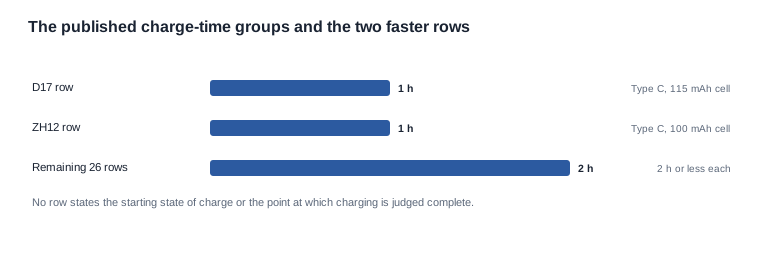
The catalogue therefore divides into two published groups. Twenty-six rows state ≤2 h. Two rows — the D17 at 115 mAh and the ZH12 at 100 mAh — state ~1 h. Both of those faster rows are Type-C sport models, so the fastest published charging figure in the range sits on the connector side of the catalogue, but neither of them states the start state, which means you cannot tell whether ~1 h means from empty or from a fifth of capacity.
There are two ways a buyer gets this wrong, and both of them are expensive. The first is treating a catalogue charge time as a shift-change interruption allowance, so that a service team promises a two-hour turnaround for a swap that in practice takes four hours on a warm unit with a partially charged cell. The second is treating a case charge time as a case turnaround time, which is not what the figure is: it is a cell-level figure, it does not describe how long the case itself takes to refill, and it says nothing about how many case cycles a customer gets.
The fix is short and it costs nothing. Ask for the start state and the end criterion in writing, and if the supplier cannot state them, write your own protocol and measure on a sample. A charge time measured under your protocol is a figure you own, and it can be published with the condition attached.

Turning a charging arrangement into a serviceable programme
Verification in this category is mostly measurement plus paperwork, and it is fast once the protocol is fixed before the sample ships. The sequence below is deliberate: each step assumes the previous one passed, and a failure at any step tells you what the next step would have told you.

-
Ask for the input specification, not the in-box accessories. What does the product accept, at what current, from what source. Whether a cable or an adapter is included is a commercial question and belongs on the purchase order, because a product shipped without a cable creates a support cost that has no relationship to the product's quality.
-
Ask for the shipping state of charge. Goods held at full charge for weeks in a container arrive degraded, and the symptom is a unit that appears dead on arrival and is returned as a manufacturing fault. This is a one-line term, it is very often missing, and it removes an entire category of arrival complaint.
-
Fix the protocol before you take the first reading. Charge from a stated state, with a stated supply, to a stated end point, and record the elapsed time. Repeat it from a different state to establish that your end criterion is actually being detected by the product rather than by your stopwatch. A protocol designed after the first reading is a description of what happened, not a test.
-
Run the contact-resistance check on the sample. On magnetic models, measure the charge current with the contacts clean and then with the contacts deliberately soiled, and record both figures. The gap between them tells you how much of your field failure rate is surface condition, which is a servicing problem you can solve with a cleaning instruction, rather than a cell problem you cannot.
-
Put the criteria into the purchase order. In a category where no supplier publishes the conditions, the contract is the standard. If the acceptance criteria live in an email, they are not binding; if they live in the order, a lot that fails them is a lot you can refuse.
The charging case as a second supply chain
Where a case is included it is not an accessory. It is a second battery with its own failure modes, its own transport documentation and its own stock line, and it is usually the part that fails first because cases are small, are carried loosely and contain a cell.
Our catalogue publishes case arrangements on seven rows. The CY05 and the L1 Pro, and the CY03 carry a 1400 mAh case. The L2 Utral is published as 900/1400 mAh, which is a single model designation describing two different products. The MT6 carries a 1200 mAh foldable case. The KY06 and the MT5 are published as magnetic charging with a charging case, but the case capacity is not published for either of them.
Two consequences follow and both of them are commercial. The first is the L2 Utral ambiguity: the model number on the purchase order does not determine which case arrives, and that ambiguity propagates into freight, packaging, the customer expectation and the warranty claim when the wrong case is fitted. Name the capacity in milliamp-hours on the order line, and treat the two as separate configurations with separate minimums if your volume supports it.
The second is the foldable case on the MT6, which introduces a hinge — a mechanical joint with its own cycle life and its own failure mode, and a different spare part from the rigid case. It should have its own spare-part line, and its own warranty treatment, because it fails for a different reason than the cell inside it does.
A case also carries its own compliance obligation. It is a separate lithium cell that travels separately from the glasses, and a transport summary that covers the product cell does not automatically cover the case cell. Ask for the transport document that names the case, not the one that names the product.
What a buyer can and cannot negotiate around a charging arrangement
Some of the cost in this arrangement is negotiable and some of it is a physical fact, and spending negotiating capital in the wrong place wastes it.
The room to move sits in the configuration count, the per-configuration minimum, the artwork round count, the packaging format and the accessory list. A case-equipped programme is a configuration programme, and the negotiation that matters is over how many combinations you commit to rather than over the per-unit price of any one of them. The number of case capacities written into the product description is also a commercial variable: a model published as 900/1400 mAh is a model you can buy at two price points, which is an asset if your channel wants a good/better structure and a liability if your artwork cannot carry both.
What is not a commercial variable at all is the degradation behaviour of the interface, the absence of a published input current, and the absence of any cycle-life figure for any cell or case in the range. Pressing on those produces a longer schedule rather than a shorter one, and a figure of typical contact life would let a three-year channel fail quietly in year three. The charge time is published for every model in the catalogue and we publish it as stated, with the missing conditions named rather than filled in with typical values.
A worked scenario: a European distributor adding a case-equipped camera line
This is a worked case rather than a customer case. The order of choices is set out.
Assume a European distributor that already sells a camera glasses line and now wants to add a case-equipped variant, with a channel that includes both a regional depot and a drop-ship segment. The constraint that matters is not the unit price; it is that their previous line produced a cluster of "it stopped charging properly" returns which they believe were cell faults.
Step one: the interface. The distributor asks for the charging interface in writing for each candidate. The four case-equipped camera rows publish no interface, so that becomes a condition of the quotation rather than an assumption. Two of the candidates turn out to be Type-C and two magnetic, which changes the segment they are positioned in.
Step two: the protocol. Before the sample order they write a charge-time protocol: a stated start state, a stated wall supply, an end criterion expressed as a current threshold, and three units per candidate. The result is that the ≤2 h catalogue figure and their own measurement differ on the magnetic models by a margin large enough to matter, because their protocol starts from a partially charged state and the catalogue figure starts from somewhere else. They publish their own number with the condition attached.
Step three: the case. They put the case capacity in milliamp-hours on the order line, which turns the L2 Utral into two configurations with two minimums and two artwork versions, and they ask for a transport document that names the case cell separately from the product cell.
Step four: the service model. Because the depot can clean and reseat contacts, they accept a magnetic interface for the depot channel and specify a Type-C model for the drop-ship segment, on the reasoning that the failure they cannot service is the one they cannot reach.
Step five: the returns instruction. They issue a triage sheet with the return authorisation that separates slow charging, no charge indication, intermittent charging, and case does not hold charge. Within a quarter, the split between expected behaviour and defect becomes visible, and the "cell fault" cluster turns out to be split between two servicing causes and one genuine defect class.
The result is not a cheaper programme; it is a programme whose returns are attributable. The decisive decisions were made before the sample order, and none of them was the unit price.
The boundary of what we publish about charging
The boundary we hold: we publish the rows we hold — the interface where the catalogue states it, the charge time exactly as stated, the cell capacity, the runtime and the case capacity where those exist — and we mark the rest as open rather than filling them with plausible values.
For the four rows that publish no charging interface, the CY03 and the L1 Pro, and the CY05 and the MT6, we publish no interface either. We publish 158 g for the MT6 glasses unit, which includes the battery and the camera and excludes the foldable charging case, and the case capacity is published separately as 1200 mAh; no other model in the range publishes a weight at all. We publish no charge efficiency, no input current, no contact cycle life, no cell chemistry, no safe charging temperature range and no storage state-of-charge, because none of those appears in our published material.
We also make no vision, health or eye-protection claim for any product in any market. A device that charges a cell does not make a medical intervention, and a listing that implies otherwise is a regulatory exposure rather than a marketing decision.
Three things to do before the next supplier call. Ask for the charging interface in writing for every model on the list, including the four rows that publish none. Ask for the start state and the end criterion behind every charge time, and treat a figure without them as absent rather than as a good number. Then send us the models, the quantities and the target market, and we will tell you which charging arrangements exist in our range, which rows our documentation answers today, and which ones you will have to measure on your own units.
The checklist for a charging arrangement is short: the interface in writing, the start state, the end criterion, the input specification, the shipping state of charge, the case capacity if there is a case, and the spare-part line for that case. A shortlist built on those seven answers is defensible; a shortlist built on a catalogue charge time alone is not.
The charging arrangements in this catalogue are described under charging solutions, the measurement procedure is set out in how to measure smart glasses charging, and the published limits are examined in charging limitations and drawbacks.


