

Charging specifications appear comparable until you try to compare them, and then three of the numbers turn out to be measuring different things. Capacity is not energy in use. Charge time is not an interruption allowance. Runtime is not endurance. A comparison table built by sorting those columns produces a confident answer to a question nobody asked.
The specification set that actually decides a charging purchase is short: the charging interface, the charge time, the cell capacity as the catalogue publishes it, the rated runtime, and the charging case where one exists. Every one of those five is published across our range. What none of them publishes is the condition that turns a charge time into a measurable figure — the starting state of charge and the point at which charging is judged complete.
So the buying problem is not finding the numbers. It is deciding which of them are comparable, labelling the ones that are derived, and adding the four or five rows the catalogue does not have.
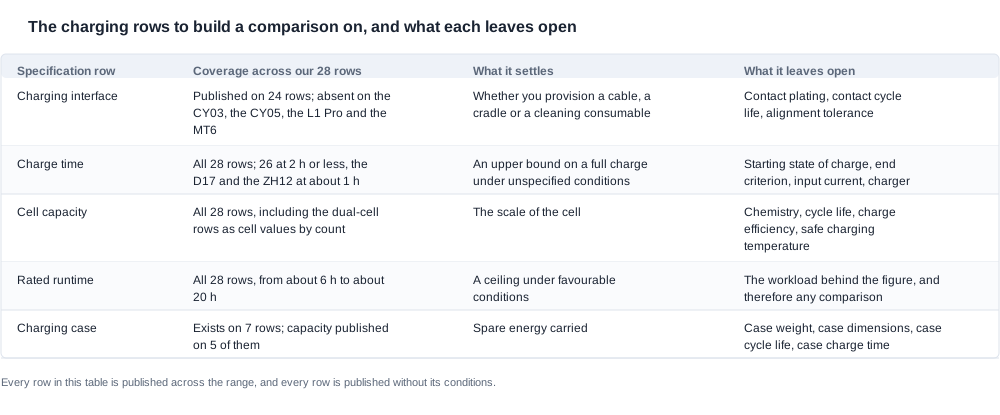
| Specification row | Coverage across our 28 rows | What it settles | What it leaves open |
|---|---|---|---|
| Charging interface | Published on 24 rows; absent on the L1 Pro and the CY05, and the CY03 and the MT6 | Whether you provision a cable, a cradle or a contact-maintenance consumable | Contact plating, contact cycle life, alignment tolerance, whether a cable ships in the box |
| Charge time | Published on all 28 rows, 26 of them at ≤2 h and the D17 and the ZH12 at ~1 h | The upper bound on a full charge under unspecified conditions | Starting state of charge, end criterion, input current, charger, ambient temperature |
| Cell capacity | Published on all 28 rows, including the dual-cell rows as cell values by count | The scale of the cell | Chemistry, cycle life, charge efficiency, safe charging temperature |
| Rated runtime | Published on all 28 rows, ranging from about 6 h to about 20 h | A ceiling under favourable conditions | The workload behind the figure, and therefore any comparison |
| Charging case | Exists on 7 rows; capacity published on 5 of them | How much spare energy travels with the product | Case weight, case dimensions, case cycle life, case charge time |
Smart glasses charging: the published rows and what each one omits
The single most common mistake in this category is treating the catalogue as a blank row rather than as a set of rows published under conditions. Our catalogue publishes a charge time for every one of the 28 models, and it publishes no starting state and no end criterion anywhere in the range. That is not a data gap in one model; it is a condition gap in all of them, and it is the reason a catalogue charge time cannot be handed to a logistics team as a turnaround allowance.
Why capacity is not the quantity a buyer is shopping for
The instinct is to sort by milliamp-hours. The instinct is wrong, and the range itself demonstrates why. The A05 and the A06 publish 40 mAh with a rated runtime of about 20 hours. The L2 Utral, the CY05 and the L1 Pro, and the CY03 publish 290 mAh with a rated runtime of about 7 hours. A buyer sorting by capacity would place the camera models at the top of a table and the children's models at the bottom, and would be comparing a radio plus a camera plus a processor against a much simpler product with a much smaller load.
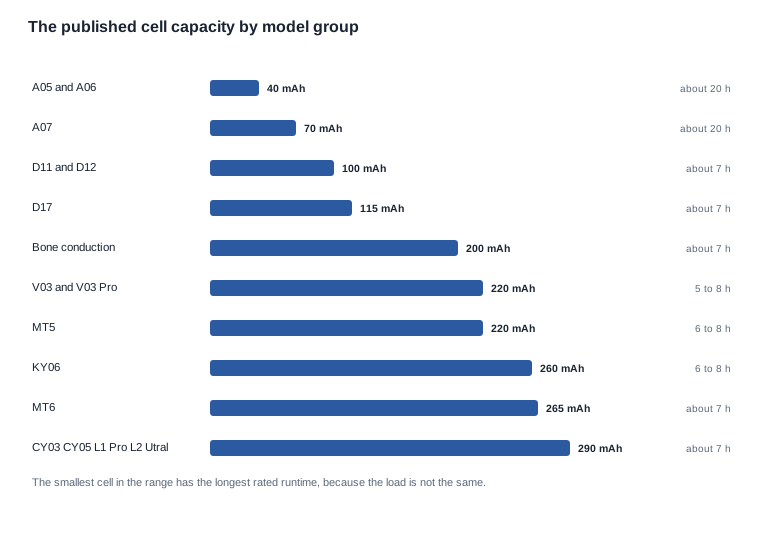
The capacity figures themselves are correct and worth recording. They are also answers to a different question than the one a buyer asks. Capacity tells you how much charge the product carries. It does not tell you how long the product runs, because runtime is a function of what the product draws, and a camera product draws a different load from an audio product in a way that has nothing to do with the cell. The A05's 40 mAh cell is small and its runtime is the longest in the range; the camera rows carry seven times the charge and run for a third of the time.
The honest use of capacity in a comparison is therefore internal, within a product type, where the load is comparable. Across types it is a packaging and logistics figure — it affects freight, it affects the size of the cell the supplier has to source, and it does not predict the customer's experience.
Why the charge time column cannot be compared across two models
The two published groups are ≤2 h on twenty-six rows and ~1 h on two. The two faster rows are the D17 and the ZH12, both Type-C sport models, and both fast for a reason a buyer should check before relying on it: neither states the starting state. A figure of ~1 h could describe a charge from empty or a charge from a fifth of capacity, and the difference between those two readings is large enough to change whether a unit is ready for a shift.
The comparison rule that follows is simple and it is the one to write into a supplier questionnaire: a charge time without a starting state and an end criterion is not comparable with any other charge time, including one from the same catalogue. If the supplier states the conditions, the figures become comparable. If they do not, the column is a set of independent numbers that should be treated as an upper bound and nothing more.

Comparing a magnetic model against a Type-C model without inventing precision
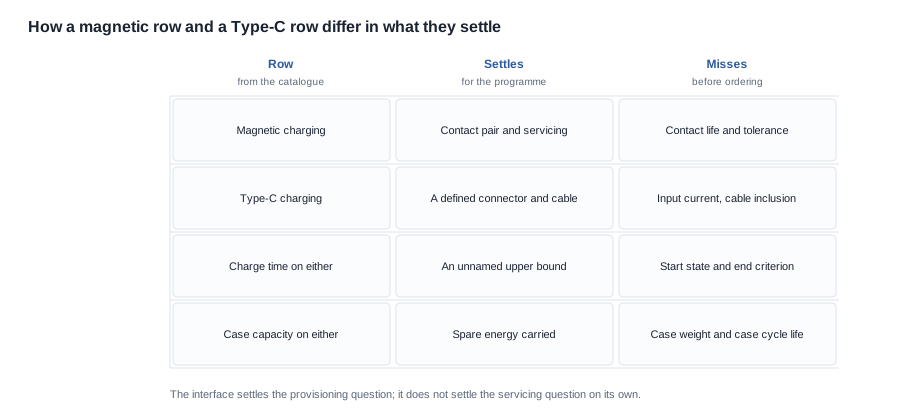
Putting a magnetic model and a Type-C model side by side is the comparison most buyers want to make and the one most likely to produce a false result, because the two columns describe different things. The magnetic column describes a seated contact pair, which is a self-aligning interface with consumable servicing implications. The Type-C column describes a connector standard, which is a defined geometry with a defined cable.
A table that puts them in the same column invites a comparison that cannot be made. What can be compared is the consequence for the programme, and that comparison is entirely legitimate: what has to be provisioned for the channel, what the failure mode will be, and what the aftersales operation will be handling.
Three differences are worth putting in the comparison, and they are all commercial. The first is the consumable. A Type-C model needs a cable, which is either in the box, in which case it is a cost and an accessory line, or not in the box, in which case it generates a support load that has no relationship to the product's quality. A magnetic model needs a cradle or a contact-maintenance consumable, which is a smaller and more predictable cost. The second is the service. A magnetic interface degrades through surface condition and alignment, which a depot can address with a contact-maintenance instruction and a pad; a Type-C interface fails through the cable or the port, which is a swap. The third is the in-box document position, which is set out in the section on what has to be added.

The derived comparisons you may make, and the label each one needs
Some comparisons are worth making and are not published. The rule is that a derived number has to be labelled as derived, in the column heading or in a footnote, so that nobody downstream reads it as a catalogue value.
Totals for the dual-cell rows. Three groups publish their cells as a value and a count: 55 mAh × 2 on the G07, the LC-105-2 and the LC-105-1, and the YK12; 70 mAh × 2 on the YKC02; and 90 mAh × 2 on the K01 and the K02. The A07 publishes 70 mAh as a single cell and is a different number from the YKC02's 70 mAh × 2, and those three figures are easy to conflate. Totals of 110 mAh, 140 mAh and 180 mAh are our arithmetic, not the catalogue's, and a table that prints them bare will be read as though they were published. Write them as "110 mAh in total (derived from 55 mAh × 2)" or keep the catalogue form in the table and do the addition in prose.
Runtime per unit of capacity. This is the ratio that exposes the load difference described above, and it is useful for sorting within a product type. The A05 at 40 mAh and about 20 hours and the CY03 at 290 mAh and about 7 hours produce ratios that differ by a wide factor, and that factor is not a charging property. It is a statement about how much the two products draw. Publish the ratio only with the load caveat attached, or it will be used to argue that the children's models are technically superior, which is not what the number means.
Case energy against product energy. The 1400 mAh case on the CY03 and the CY05, and the L1 Pro against a 290 mAh product cell, and the 1200 mAh foldable case on the MT6 against its 265 mAh cell, are comparisons a buyer will want. What they measure is how many times the product could be recharged from the case rather than how long anything runs, and the answer depends on the case's own efficiency and on the end criterion, neither of which is published. Use it as an order-of-magnitude statement about spare energy carried, and do not convert it into hours of runtime.
A worked example: building a comparison table for a camera glasses shortlist
This is a hypothetical case rather than a client project, and it is written to show how the rows are applied rather than to report a result.
Assume a brand selecting a camera glasses line for a European retail channel, with a charging case required in the bundle and a two-year channel life. The buyer starts with the rows the catalogue publishes: the interface, the charge time, the cell capacity, the runtime and the case capacity, and the first cut produces five candidates — the CY05 and the MT6, the L1 Pro and the L2 Utral, and the CY03.
The interface row removes two of them. The MT6 and the CY05, and the CY03 and the L1 Pro publish no interface, so the buyer writes to the supplier for those four in writing, and the answer arrives before the sample order. Two are magnetic and two are Type-C, which means the comparison now has a real dimension rather than a blank, and the buyer can start thinking about which channel segment each one fits.
The case row separates them further. The CY05, the CY03 and the L1 Pro publish a 1400 mAh case, the MT6 a 1200 mAh foldable case, and the L2 Utral a case published as 900/1400 mAh. The L2 Utral is now two configurations under one model designation, and the buyer converts it into two order lines with two minimums and two artwork versions, or drops one. They drop the 900 mAh variant for the first run and keep it as a price-point option for a second run.
The charge time row contributes nothing, and that is a finding. All five candidates state ≤2 h with no conditions, so the column carries no discriminating power. Rather than leave it out, the buyer keeps it and writes "conditions not stated" against it, because a shortlist table with an empty column invites someone to fill it in later from a brochure.
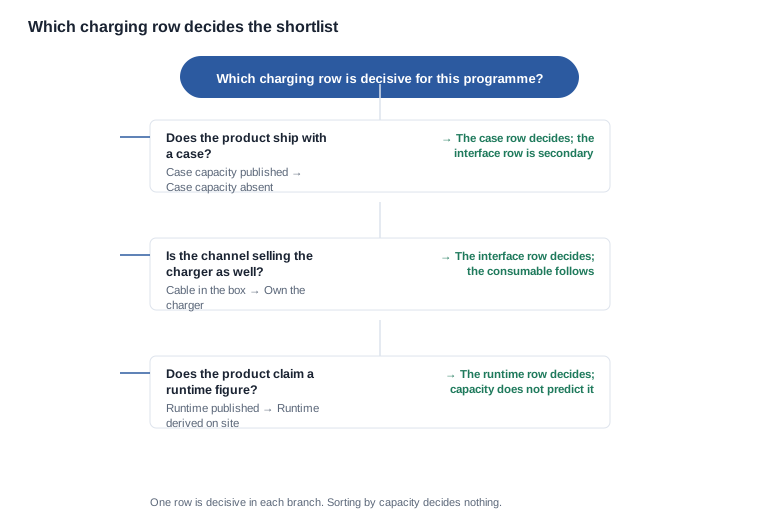
The runtime row does the real work. The five candidates all publish about 7 hours, which tells the buyer that the charging decision is not a runtime decision at this point in the selection, and that the case and the interface are the rows that will actually determine whether the product suits a retail bundle.
The rows the buyer has to add. The buyer adds four: the input specification, the shipping state of charge, the case weight and the contact and case cycle life. Three of the four are blank in the catalogue, and one — the case weight — is blank for every model in the range, including the MT6, whose published 158 g covers the glasses unit only and excludes the foldable case.
The result is a five-row table with three rows that discriminate, one row that carries no information and is marked as such, and four rows that have to come from the supplier. That is a defensible shortlist. A table sorted by capacity would not have been.
The comparison checklist to run before the order
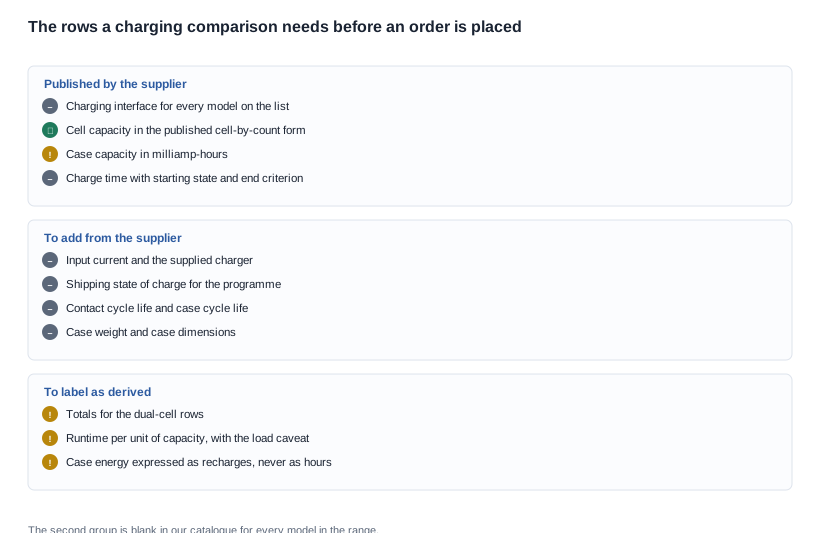
The order to ask the questions in follows the dependency rather than the size of the number.
-
The interface decides what you provision. A Type-C model needs a cable decision; a magnetic model needs a cradle or a contact-maintenance consumable. Ask it first, because every line below it is scoped by the answer.
-
The interface and the case together decide the spare-part lines. A magnetic interface creates a consumable and a servicing step; a case creates a replacement part that is a different SKU from the glasses and needs its own stock line and its own warranty treatment.
-
The charge time and the case together decide the interruption you promise a channel. This is the pair that ends up in a service-level conversation, and it is the pair with no published conditions behind it.
-
The cell and the runtime together decide the claim you are allowed to publish. Capacity alone decides nothing about the customer experience; the pair is what supports a runtime statement on a product page.
-
The last group has to come from the supplier, because no catalogue row answers it. The input specification, the shipping state of charge, the cycle lives and the case weight are all blank in our published material, and the comparison table is not finished until each one has an owner.
A comparison table should also mark an absent row explicitly rather than leaving it blank, because a blank cell in a shortlist gets filled in later from a brochure by somebody with no way of knowing it was absent. Four rows in our catalogue publish no charging interface, two rows publish a charging case with no capacity, and no model in the range publishes a case weight. Write those as "not published", with a note of where the answer has to come from, and the table becomes a list of open questions rather than a list of gaps.
There is one further comparison that is not a specification at all and yet decides more programmes than any of the rows above. Two models with identical published charging rows can carry very different commercial structures, because one has a case published as a single capacity and the other publishes 900/1400 mAh. The first is one configuration. The second is two, with two minimums, two artwork versions and two packaging variants. When you compare the rows, compare the configuration count the rows imply, not only the rows themselves.
Two further questions belong in the same questionnaire because they sit outside the specification set. The first is what the product does while it is on charge: whether the radio stays connected, whether the camera can still be used, whether the audio output continues. A charging arrangement that interrupts the product's function is a different commercial proposition from one that does not, and nothing in a capacity or a charge-time row tells you which one you have. The second is whether the interface and the case are frozen for the life of the programme. A repeat order that arrives with a different interface is a new configuration rather than a repeat order, and it lands as a surprise at the receiving dock with a warranty claim attached.

What we publish about charging specifications, and what stays unpublished
The short answer: we publish the specification rows we hold, in the form the catalogue holds them, and we mark the rest as open. For the charging function that means the interface where the catalogue states it, the charge time for every row, the cell capacity for every row in the published cell-by-count form, the rated runtime for every row, and the case capacity on the five rows where it exists.
We publish no charge efficiency, no input current, no cable gauge, no contact cycle life, no cell chemistry, no cycle life for any cell or any case, no safe charging temperature range and no shipping state of charge, because none of those appears in our published material. We publish no derived totals in the catalogue form, so the dual-cell rows stay as 55 mAh × 2, 70 mAh × 2 and 90 mAh × 2 rather than as 110, 140 and 180 mAh; the addition is a legitimate analytical step, and it belongs in a buyer's own working rather than in a row that other people will quote.
One weight is published in the whole range: the MT6 glasses unit at 158 g, which includes the battery and the camera and excludes the 1200 mAh foldable charging case. We publish no weight for the case itself and none for any other model, and we would rather name that gap than fill it with a typical figure, because a typical frame weight is exactly the number that lets a channel quote an all-day claim it cannot defend.
We also make no vision, health or eye-protection claim for any product in any market, and the charging arrangement does not change that.
The terms to write. Put the interface and the case capacity in milliamp-hours on the order line, put the conditions behind any charge time you publish into the purchase order, put the shipping state of charge in the order, and put a change-notification obligation on the cell, the case, the connector and the firmware. What can be negotiated is the configuration count, the per-configuration minimum, the artwork round count and the accessory list; what cannot be negotiated is the certification cost and lead time, or the physical behaviour of the charging interface.
The next step. Send us the models, the quantities, the target market and whether a case is in the box, and we will tell you which charging arrangements exist for that requirement and which rows you will have to obtain from the supplier yourself. The case options are covered under AI camera glasses charging case options, the audio models under Bluetooth audio glasses charging options, the battery change question under can I swap the battery, and the transport document under battery transport compliance buyer checklist.


