

Every smart glasses charging smart glasses buying mistakes to avoid list stops at the cable, which is the cheapest mistake on this page. The expensive ones are in the box contents, the specification columns nobody fills, and the second battery most buyers forget they are shipping. None of these are technical failures. They are commercial decisions made without information, which is why they survive all the way to the returns figure.
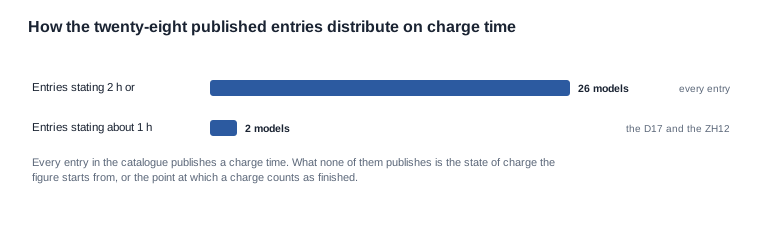
One point of fact belongs at the top, because it changes how the first mistake should be read. All twenty-eight entries in our catalogue publish a charge time. Twenty-six state two hours or less, and the D17 and the ZH12 state about one hour. So the mistake is not quoting a number that does not exist. The mistake is treating a number with no starting state and no completion criterion as if it were a specification.
Smart glasses charging: six mistakes, and what each one costs
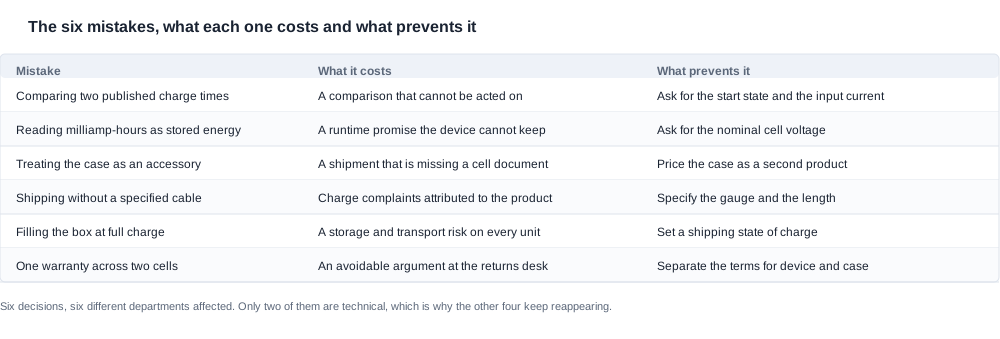
The pattern across all six is the same, and it is the reason they survive. Each one is a decision that looks like a detail, each one is made once, and each one is made long before anyone can see its cost. By the time the cost appears it is in a returns report, and a returns report does not say which decision caused it.

The mistakes that live in the specification
Mistake one: comparing two published charge times
Two hours here and two hours there is not a comparison, because the input current behind each figure is different and is published in neither case. The same device charges quickly from one supply and slowly from another, and a buyer comparing two catalogue numbers is comparing two unknown conditions.
The published figures also carry no starting state of charge and no completion criterion, so even two figures measured from the same point would not settle the question of which device is out of service for longer during a shift. Two hours or less from a nearly flat battery and two hours or less from a nearly full one are not the same two hours.
There is a version of this mistake that is more expensive than the others, and it happens in the specification rather than in the comparison. It is the decision to write "fast charge" or "charges in under two hours" onto a product page. Those phrases are claims about a measurement, and the measurement behind them is not published in a condition a customer can reproduce. A customer who charges the device overnight and finds that it took longer than the page implied has a complaint, and the complaint will not be answered by the catalogue.
The corrective action is one sentence in the request: ask what state of charge the published figure assumes, what source was used, and at what point the charge is judged complete. A supplier who answers all three has a charging specification. A supplier who answers with "it depends on the charger" is telling you the figure is a best case.
Mistake two: reading milliamp-hours as energy
Capacity in milliamp-hours describes charge, not stored energy. Energy also depends on the cell's nominal voltage, and voltage is not published for any model in our range. Two products rated at the same 100 mAh can hold materially different energy, and the difference shows up as a runtime discrepancy that gets attributed to the software.
Our own catalogue shows how easily this error is made, because five entries carry a 100 mAh cell and they do not all publish the same runtime. The AR glasses publish about eight hours on 100 mAh with a magnetic interface, the photochromic model publishes about seven hours on 100 mAh with a magnetic interface, the D11 and the D12 publish about seven hours on 100 mAh with a Type-C interface, and the ZH12 publishes about eight hours on 100 mAh with a Type-C interface.
The second example is the sharper one, because the cell configuration is identical rather than merely similar. Four audio platforms in the catalogue publish 55 mAh in a two-cell configuration: the LC-105-1 and the LC-105-2 publish about eight hours, while the G07 and the YK12 publish about six hours. The capacity rows are the same and the runtimes are not. Some of that difference is explained by the published features — the G07 and the YK12 are the two models with the slim or detachable temple line — and the rest is not explained anywhere in the material we hold.
That is the practical lesson. Two identical capacity rows are not the same battery. A buyer who plans a shift rotation on capacity alone will plan it wrong, and the error will not appear until a device is flat in the middle of a task.
The same discipline applies to the published runtime rows when they are quoted on a product page. A runtime quoted without its condition is a range compressed into a number, and the number is the one a customer will hold the product to. The six to eight hours published for the KY06 and the MT5, the five to eight hours published for the V06, the S7 and the V03 Pro, and the V03, and the about seven hours published for the CY05, the L1 Pro and the MT6, and the CY03, and the L2 Utral are all usable figures. None of them is usable without the condition, and the condition is the part that is not published.
Two identical capacity rows are not the same battery. A buyer who plans a shift rotation on capacity alone will plan it wrong, and the error will not appear until a device is flat in the middle of a task.
The three questions to ask before you order
What to ask a supplier about charging, before the order rather than after it, comes down to three questions in most cases, and all three are answerable in writing by a supplier with a charging programme.
- What state of charge does the published charge time assume, and what point counts as complete? This one question closes the first mistake and half of the others, because it turns a catalogue number into a measurement with a condition.
- What is the case's own recharge time, measured the same way, and what is the case capacity? For a platform that ships a case, this is the number that governs the rotation, and it is the one we cannot publish for any model in the range.
- What cable ships in the box, and what input current does the device accept? The two halves of the comparison that the catalogue cannot make on its own.
Ask them in one message, with a date, and identify the model on each line. The questions to ask are short enough that there is no excuse for sending them one at a time, and the answers are worth more than the catalogue row because each one arrives with the condition attached.
The mistakes that live in the box and the supply chain
Mistake three: treating the charging case as an accessory
Where a case is supplied, it contains its own cell. That makes it a battery assembly in its own right, with its own transport documentation, its own warranty exposure and its own recharge time. Our catalogue publishes case capacity for five camera models — 1400 mAh on the CY05 and the CY03, and the L1 Pro, 900 or 1400 mAh on the L2 Utral, and a foldable 1200 mAh on the MT6 — and it publishes a case with no capacity for two more, the KY06 and the MT5.
Treating the case as an accessory produces four separate failures. The consignment ships without a cell declaration for the second cell, and the freight forwarder stops it. The warranty is written against the device, so a case that fails is either free or unsupported depending on which clause the customer finds. The returns route expects one item and receives two, or receives one of the two. And the recharge time of the case — the number that actually governs a rotation between two devices and one case — is not published for any model in the range.
The correction is to treat the case as a second product with its own line in the bill of materials, its own documentation, its own warranty term and its own position in the returns route. The supporting detail is in does the charging case need its own report.
Mistake four: shipping without a specified cable
A long, thin cable has more resistance than a short, thick one, so the same device charges at different rates depending on which cable it is given. Nothing on the datasheet tells the buyer which cable shipped, so the complaint arrives attributed to the product, gets handled as a product fault, and costs a support contact, a replacement unit and a review that says the battery does not last.
The mistake is not shipping a cable. The mistake is shipping a cable without specifying it. The packing list should state the gauge, the length and the connector, so that a slow charge can be diagnosed from the box rather than argued about from the listing.
The related omission is the supply. Whether a supply is included, and at what rating, is a decision about the market rather than about the device, and it is the input current half of the first mistake. A device shipped without a supply will be charged from whatever the customer owns, and the published charge time says nothing about that.
The packaging decision belongs with the cable decision rather than with the product decision, because it is the carton that determines what a customer has to hand when the battery is flat. A carton that holds the device, a specified cable and a printed instruction card gives the customer everything the charging arrangement requires. A carton that holds the device alone gives the customer a device that cannot be charged, which is the worst possible outcome because it converts a specification decision into a customer service contact on day one.
Whether a supply is included, and at what rating, is a decision about the market rather than about the device, and it is the input current half of the first mistake. A device shipped without a supply will be charged from whatever the customer owns, and the published charge time says nothing about that.
Mistake five: filling the box at full charge
Goods do not go from the production line to the customer. They sit in a container, they sit in a warehouse, they sit in a returns centre, and every one of those holds cells at a temperature and for a time nobody planned. A device despatched at full charge is a device that has been sitting at full charge for however long the freight took, and the cells least able to absorb that are the smallest ones — the 40 mAh cells on the A05 and the A06, and the 55 mAh pair on the LC-105-1 and the LC-105-2.
The decision here is one line in a despatch instruction: what state of charge do the goods ship at? It costs nothing to decide and a great deal to leave to a default, because the default is always full, and full is the worst case for storage.
The related decision is how long the goods may be held, and who carries the risk during the hold. The second one is settled by the incoterms rather than by the packing department, and it is worth checking that the term matches the storage decisions actually being made.

The mistake that lives after the sale
Mistake six: one warranty covering both parts
A device and its case are two assemblies with two failure modes, two service lives and two sets of evidence, and a single warranty term across both of them creates an argument at the returns desk instead of a decision.
The argument is always the same shape. The customer returns the device with the case because the device is not charging, and the case is the only way it charges. The supplier asks for the case to test the charging path, and the customer asks why the accessory is being treated as optional. Neither side is unreasonable and neither side can settle it, because there is no document that says which part is covered and for how long.
The fix is a line in the warranty schedule naming the device term and the case term separately, and a returns instruction that says what to do with a returned device and a returned case, including how long each may wait and whether each is charged on arrival. A returned device that is never charged will discharge, and a device that has discharged deeply cannot be diagnosed, which turns a straightforward claim into an unresolvable one.
The commercial point is that a warranty term is a cost that has to be priced before it is written, and a single term across two assemblies is a number that was never calculated.
This one is also negotiable in a way that buyers do not always realise. A separate case term is a request, and a supplier with a case that performs can usually meet it. The trade-off to weigh is the cost of a longer device term against the cost of a case replacement that the buyer never budgeted for, and the second is usually larger because it arrives in volume while the first is negotiated once.
The other side of the negotiation is the evidence. A supplier that logs failures can support a shorter case term honestly, because the data supports it. A supplier that does not log failures will offer a longer term for the wrong reason, and the buyer will be paying for a period in which nobody is measuring what is happening.

Where a charging mistake enters the programme

The flow is the reason these mistakes survive. Each one is made in the first two steps of the chain — when the specification is copied from the catalogue and when the comparison is made on published figures — and each one is only visible in the last step, when a customer charges what arrived in the box and complains.
That is why a returns report is a late document. By the time it exists, the decision that caused it has been made, priced, ordered, manufactured and shipped, and the only thing left to change is the credit. A credit settles the invoice and leaves the process exactly as it was, so the next shipment fails in the same way.
The total cost of each mistake lands in a different place, and a buyer who knows where can size the problem before it happens. The first mistake lands in the listing and in the support traffic. The second lands in the returns, as devices that ran out earlier than the specification implied. The third lands in freight, as a consignment that does not clear, and in the returns route as items that cannot be diagnosed. The fourth lands in the same place as the first. The fifth lands in the freight and in the storage, and it is the only one of the six that can be noticed before a customer does. The sixth lands in the after-sales budget.
Put the six decisions on a checklist that is completed before the order, and require each of them to be answered by a number or a named instruction rather than by a default. That is the whole difference between a charging programme that improves and one that repeats.
The question that covers most of the six
If you only ask one question, ask: what is the measured charge time from a stated low state, at a stated input current, using the cable that ships in the box, to a stated completion point? Everything above either falls out of that one answer or goes unrecorded, and the answer is only obtainable from a sample rather than from a datasheet.
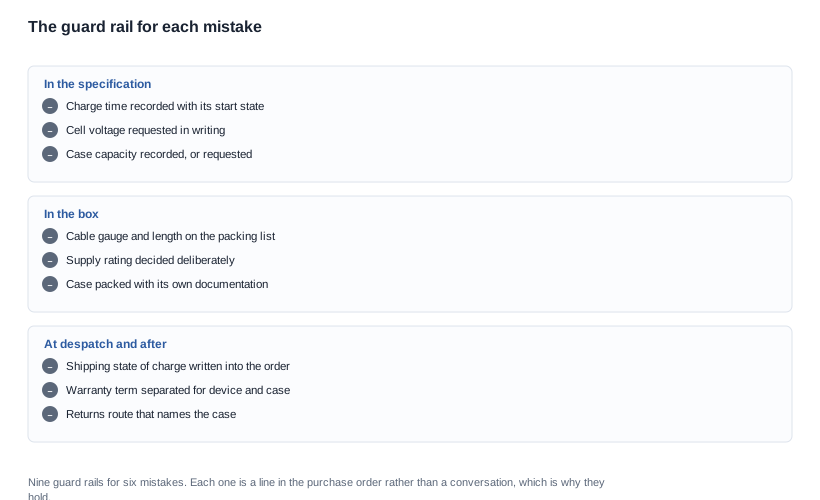
The nine guard rails above are the six mistakes written as the control that prevents each one. They are also the criteria against which a supplier's answers can be judged: a supplier who has the guard rails in place will answer without being asked, and a supplier who does not will answer each one in the way that lets them be argued with later. Each one is a line in the purchase order rather than a conversation, which is why they hold: a conversation is re-argued at the next order, and a clause in the order is applied to every shipment.
Better a Flagged Gap Than a Returns Report
We publish the interface, the stated charge time, cell capacity and case capacity for our models. We do not publish input current, cable gauge, shipping state of charge or the case's own recharge time, because those are not in our published material. We would rather flag them than let a buyer discover them from a returns report.
That is the whole argument of this article in one sentence. A charging figure with no starting state and no completion criterion is a perfectly good catalogue row, and it is a poor specification. The gap between those two things is where all six of the mistakes live, and closing it costs a paragraph in the request and an evening with a sample.
The remaining specification gaps are in what the spec sheet never tells you, the interface decision itself is in smart glasses charging smart glasses why it matters, and the post-freeze decisions are in smart glasses charging advanced considerations.
Related reading
- Field fault patterns: smart glasses charging problems and fixes.
- The freight-document question that catches people out: does the charging case need its own report.
Send us the box contents you plan and the destination markets and we will tell you which of these six apply to your product.


