

The charging architecture is a commercial decision before it is an engineering one, because it determines the packaging, the accessory range, the listing copy and the returns. The choice to fix early is between a cable, a dedicated cradle and a charging case, and the question that decides it is not which one looks better but which one your channel can support without generating a support contact on day one. The second thing the spec sheet never tells you is that the same milliamp-hour figure appears on products that are not remotely comparable, because the interface, the charge time and the runtime behind that figure are all different. And the third is that a published charge time, which every entry in our catalogue does carry, still cannot plan a shift handover.
Smart glasses charging: a returns decision first
What the buyer is actually deciding
The reader is a brand-side product manager or a channel buyer who is choosing how the product gets its power in the customer's hands, and the decision reaches further than the charging port. It reaches the box, the accessory range, the regional plug treatment, the product photography, the quick start guide, the support script and the returns reserve in the margin.
Three architectures cover almost the whole market. A Type-C product is charged with a cable, which is the cheapest to build and the one that pushes the accessory problem onto the customer. A magnetic product is charged on a cradle, which is more expensive and moves the accessory into the box where it belongs. A product with a charging case is charged by the thing the customer already owns and carries, which is the most expensive per unit and the one with the lowest accessory-related returns.
The cost of the three is easy to model in the wrong way. A cable architecture looks cheapest and is the most exposed, because a customer who expects a cable and does not get one raises a support contact, and a customer who gets a cable that is not in the box raises a return. A cradle or a case architecture costs more per unit and removes most of that exposure. The honest way to make the decision is to compare the accessory cost against the expected cost of the returns it prevents, and to put the accessory set in the quotation as a line rather than as a rounding.
The three architectures and what each one obliges you to
The cable architecture obliges the brand to a cable in the box, to a regional plug treatment per market, and to a listing that says what is included. It is also the architecture that makes the customer responsible for finding a compatible alternative when the supplied cable is lost, and a lost cable is a reason to buy a second product rather than a reason to return one.
The cradle architecture obliges the brand to a cradle in the box, which is a moulded item with its own tooling, its own colour and its own artwork, and it makes the product photograph differently because the cradle is visible.
The case architecture obliges the brand to a case that is a device in its own right. It has cells, so it has a transport obligation; it has a charger inside it, so it has a conformity question of its own; and it becomes the thing the customer sees when the product is not in use, which means its industrial design is part of the product's identity rather than an accessory.
The mistakes buyers make here are consistent. Choosing on unit price alone, choosing before the in-box list has been written, and treating the case as a storage box when it is in fact the charger — which is the error that produces the customer who opens the box, cannot find a cable, and does not know that the case is the answer.

Four products with the same 100 mAh cell and four different charging answers
Why the milliamp-hour figure is not comparable across architectures
The clearest illustration in our catalogue is a group of four entries that all publish a 100 mAh cell and all behave differently.
The display entry publishes 100 mAh, magnetic charging, a charge time of two hours or less and a runtime of about eight hours. The electrochromic entry publishes 100 mAh, magnetic charging, a charge time of two hours or less and a runtime of about seven hours. The D11 and the D12 publish 100 mAh, Type-C charging, a charge time of two hours or less and a runtime of about seven hours. The ZH12 publishes 100 mAh, Type-C charging, a charge time of about one hour and a runtime of about eight hours.
Four products, one cell figure, three interfaces or configurations, two charge times and three runtimes. A comparison table that sorts on milliamp-hours tells a buyer nothing at all about these four, and the two that differ on the same interface differ on the charge time as well, which is the row that decides whether the product suits a channel that charges between uses.
The rule that follows is simple and worth stating in a procurement file: never compare two products on a cell figure without also comparing the interface, the charge time and the runtime, in that order. A cell figure is a component specification and the other three rows are the system behaviour.
The cases, and what a case capacity does and does not say
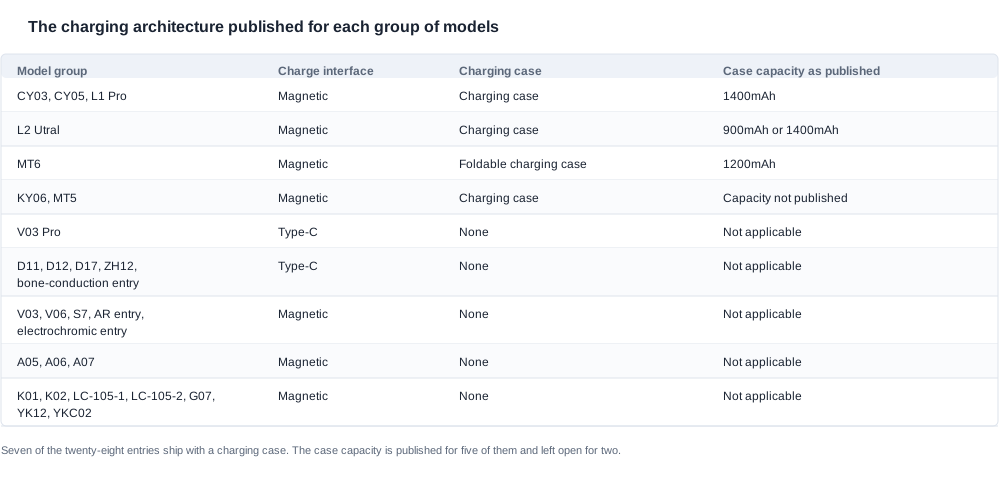
Seven entries in our catalogue ship with a charging case, and the capacity is published for five of them: 1400 mAh on the CY05 and the CY03, and the L1 Pro, 900 mAh or 1400 mAh on the L2 Utral, and 1200 mAh on the MT6's foldable case. The KY06 and the MT5 have a case whose capacity is not published, and the V03 Pro has no case at all.
Three things follow from that, and each of them is a place where a buyer can be caught out.
First, a case capacity is not additive to the device cell in any sense the customer experiences. The case holds its own cells, and the number of complete charges it can deliver is a function of conversion losses, not of arithmetic. A product page that adds 290 mAh to 1400 mAh is making a claim about a device that does not exist.
Second, a case is a second device for every compliance purpose. It has cells, so the transport documentation for the shipment covers it, and the question of whether the case needs its own conformity treatment is a real question rather than a theoretical one.
Third, the capacity published for a case does not describe the charging time of the case, and the two are routinely confused. A buyer who assumes that a 1400 mAh case recharges the device twice is making a statement about an efficiency figure that has not been published.
The chain of accessories, and who owns each link
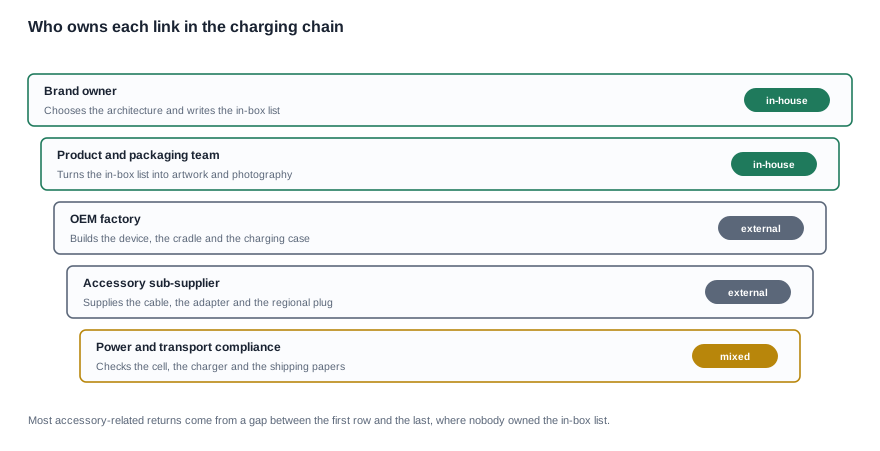
Most accessory-related returns come from a gap between the first link and the last, where nobody owned the in-box list. The chain has five links and they do not all sit with the same party, which is why the list has to be a document rather than a habit.
The brand owner chooses the architecture and writes the in-box list. The product and packaging team turns that list into artwork and photography, and it is usually the first place the gap shows up, because the photography is shot with a cable that the list does not include. The factory builds the device, the cradle and the case. The accessory sub-supplier supplies the cable, the adapter and the regional plug, and the regional treatment is where the per-market variation lives. And the compliance owner checks the cell, the charger and the shipping papers, which is a different review from the one the marketing team does on the claim.
The practical fix is unglamorous: one list, one owner, one version, circulated before the artwork is released, with the per-market variations listed rather than assumed. A buyer who asks for the in-box list per destination market in the first round of a quotation gets an answer in an email; a buyer who asks after the packaging is printed gets a reprint.

Checking the charging chain on a sample
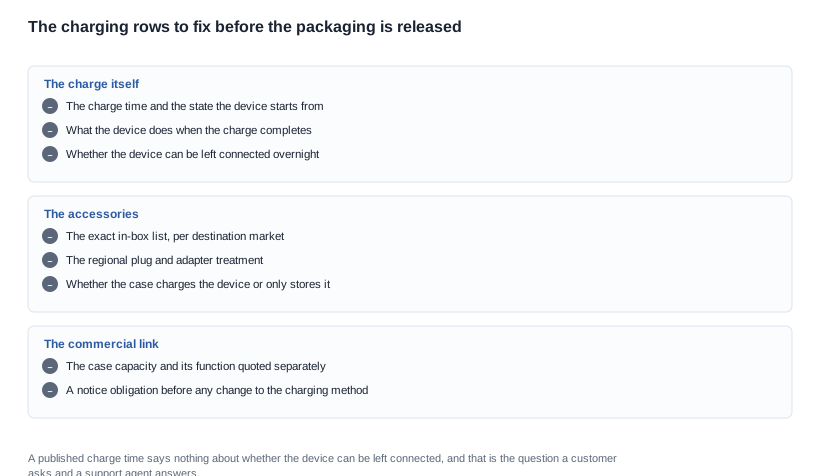
The checks are quick, and the first two are the ones that resolve the questions customers actually ask.
- Ask for the charge time with its starting state. A charge time quoted for an empty device on a wall charger is not comparable with one quoted for a partial fill from a power bank, and the two appear in quotations from different suppliers constantly.
- Ask what the device does when the charge completes. A published charge time says nothing about whether the device can be left connected, and that is the question a customer asks and a support agent has to answer. It is also a question with a safety dimension, which is why the answer belongs in writing rather than in a script somebody improvises.
- Test the case separately from the device. If the case charges the frames, the in-box documentation and the product photography have to say so, because the expectation follows the photograph and a customer who does not know the case is the charger will look for a cable that is not in the box.
- Check the whole accessory chain rather than the device alone. A cable-based architecture needs a cable in the box, a case-based architecture needs a case, and both need the regional plug treatment for the destination market settled before the packaging is designed.
- Confirm the in-box list per market, in writing, and check the shipped box against it. The first unit of the production run is the cheapest place to catch a missing accessory, and it is the last chance before a container of wrong boxes is on its way.
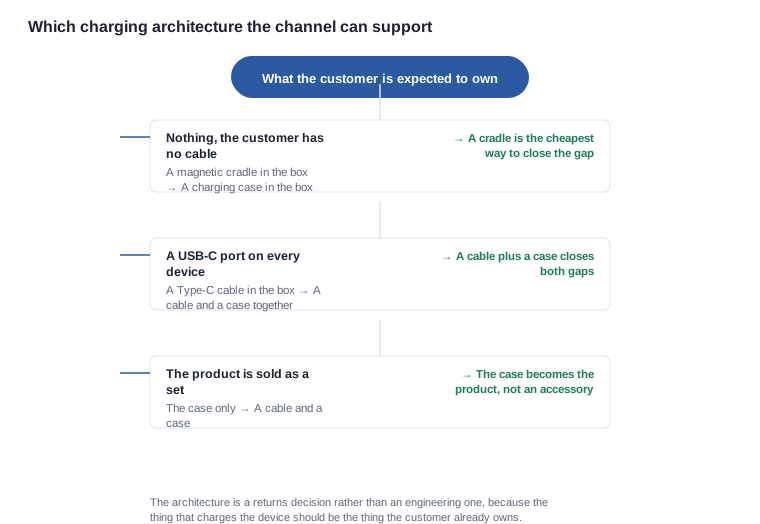
The decision chart above is the same decision stated as a question about the customer rather than about the product, and it is the version that survives contact with a channel. The root question is what the customer is expected to own, because the accessory gap is measured in what the customer does not have.
A worked example: a brand opening an accessory-based audio line
Consider a constructed case rather than a client project, and read the steps below as the decision sequence rather than as an outcome.
Assume a brand with a strong presence in three European markets, opening an open-ear audio line, with a retail buyer that requires a regional accessory set and will not list a product with a bare cable. The binding constraint is the accessory set and the return rate that follows it.
The architecture is chosen against the customer, not the invoice. The retailer's requirement removes the cable architecture from consideration, and the choice is between a cradle in the box and a case in the box. The brand chooses the cradle, because the line is audio rather than camera, and a case would add a second cell to the transport file for a product whose runtime is already published at about eight hours.
The in-box list is written first and per market. Cable, cradle and regional plug for each of the three markets, in one document, with one owner. The artwork brief carries the list, and the product photography is shot with the cradle visible.
The charge rows are requested in the first round. The charge time with its starting state, the termination behaviour, and whether the device can be left connected. The third one is answered in writing because the brand's support team needs an answer it can give.
The case question is closed by removing it. Because the line has no case, the question of whether the case is a charger does not arise, and the documentation burden of a second device disappears with it. The brand records that as a deliberate decision rather than as an omission, because a distributor will ask.
The first production units are checked against the list. Three units, checked against the per-market list, before the run is released. The gap that is found is a plug treatment in one market, which is a five-minute fix at that point and a container of wrong boxes at any later one.
The result is a line that lists in three markets without an accessory-driven returns trend. The decisive decision was the architecture, and it was taken against the customer's possessions rather than against the supplier's invoice.

What the charging architecture costs, and what you can move
The charging architecture carries a cost that is rarely visible in the unit price: the packaging, the accessory set, the conformity treatment of the charger, and the transport obligation where a cell is involved. The total cost of a charging decision is the unit price plus the accessory cost plus the returns reserve plus the freight documentation effort, and the trade-offs between those are settled in the quotation rather than after it.
The part that genuinely moves in a negotiation is the factory's own scope: the minimum order quantity against a committed combination count rather than a per-market count, the artwork round count, the number of regional variants committed at the outset, and the retention held against the documentation package. Committing to a combination count is the lever most buyers never pull, and it is the one that turns an accessory minimum into a volume tier.
The part that does not move is the cost and the duration of the third-party work: the laboratory fee and the queue that belong to the laboratory rather than to the order size, the tooling for a custom cradle or a custom case, and the transport testing for a cell. A supplier who offers to absorb a conformity cost for free is either carrying it in the unit price or has not yet asked what it costs.
The clauses worth having in the agreement are the charge method and the interface as a configuration item, the charge time with its starting state, the termination behaviour, the in-box accessory list per destination market, and the case capacity and charging function quoted as two separate attributes where a case is part of the configuration. A change to either one of those last two is a change to the bill of materials and to the packaging, and both need a re-approval rather than a purchase order.
What the published charge times settle, and what they leave open
Every entry in our catalogue publishes a charge time, and it is worth saying plainly that this is a complete row rather than a missing one, because a buyer working in this category often finds it absent elsewhere and concludes the supplier is careless. Twenty-six entries are published at two hours or less. Two — the D17 and the ZH12 — are published at about one hour.
Those two are the interesting ones commercially, because a one-hour charge time is a scheduling fact rather than a specification fact. It suits a product that is charged between uses, it suits a channel that trades on being able to top up during a shift, and it changes the accessory architecture, because a customer who can wait an hour does not need a second device. A buyer evaluating those two models should read the charge time as part of the use case rather than as part of the electrical data.
What the row leaves open is the starting state, the point at which the charge is treated as finished, and the cell voltage. The first two are what stop the figure from planning a shift handover, because the interesting question is the time to a usable state from the state a device is actually in. The third is what stops two products with the same milliamp-hour figure from being compared at all.
Our published position on charging, and what to send us
It is worth being precise: we publish the electrical rows and the case rows as the catalogue states them, and we will not fill the open rows with a plausible figure or convert a case capacity into a number of charges.
The rows our published data does settle are these. The charge interface for twenty-four of the twenty-eight entries, the charge time for every entry, and the charging method on the same twenty-four. The case configuration for the seven entries that have one, with the capacity published for the L2 Utral, the L1 Pro and the CY05, and the CY03, and the MT6, and the capacity not published for the KY06 and the MT5.
The rows we do not publish are these. Cell voltage is not published for our range, so two products with the same milliamp-hour rating are not comparable on paper. We publish no charge termination behaviour, no starting state for the charge time, no conversion efficiency for the cases, and no in-box accessory list for any model.
We will also be precise about one thing that is easy to get wrong in both directions. The catalogue's charge time is a published figure for every entry, and it is not the same thing as a shift handover plan, because the starting state and the termination criterion are both absent from it. We will not present a published charge time as a claim about how long a device is unavailable during a working day.
If you are evaluating this category, send us the models, the destination markets, the quantity and the channel, and we will tell you which configurations exist, which rows of the charging data are settled, and what the accessory set has to be for each market. The background is under charging solutions, the freight question is covered in does the charging case need its own report, and the architectural choices are set out in smart glasses charging advanced considerations.
Related reading
-
The freight documentation question: does the charging case need its own report.
-
Choosing an interface deliberately: smart glasses charging advanced considerations.
Send the configuration, the quantity and the market, and we will say which parts of the charging data are settled and which are yours.


