

Verifying a charging supplier is different from verifying most other suppliers in this category, because the charge is the one function where a customer forms an opinion in the first ten minutes and where the failure modes are quiet enough to go unnoticed for months.
Our published position across the range is the material the verification works from: two hours or less to charge for most models and about one hour for the two fastest sport models; magnetic charging across the audio, camera and sport tiers and a Type-C port on the V03 Pro, the L2 Utral, the D11, the D12, the D17, the ZH12 and the bone conduction model; case capacities of 900, 1200 and 1400 mAh on the five models that publish one; and cell configurations from 40 mAh up to 290 mAh. Every one of those charge times is stated without a condition, and no charge current, no cell temperature and no case charge time is published for any model.
So smart glasses charging smart glasses supplier verification is a question about what to demand and what to test.
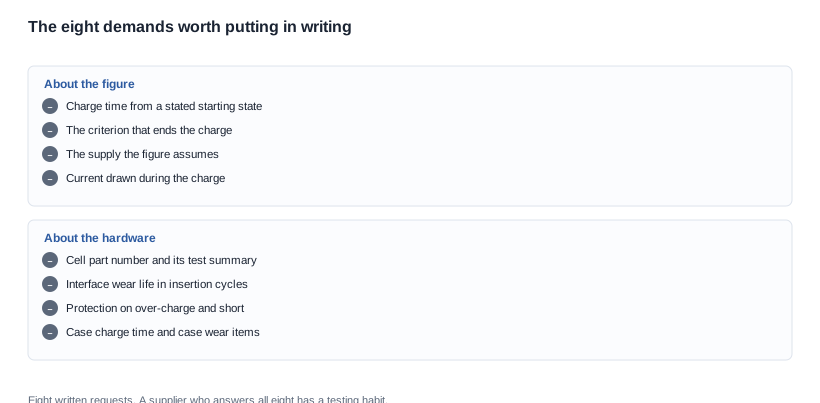
Smart glasses charging: the eight demands worth putting in writing
Why charging is verified differently from the rest of the product
Most of a smart glasses product can be assessed from a datasheet and a sample in an afternoon. The charging function cannot, for a specific reason: the published figure is a ceiling without a condition, so there is nothing to check the sample against until somebody produces the condition.
That means the order of operations inverts. You do not order a sample and then decide what to measure. You write the measurement down first, with the condition attached, and the sample becomes the execution of a protocol rather than an exploration.
It also means the written demands matter more here than for other functions, because they are the only place where a condition can be obtained at all. A supplier who will not state a starting state has not measured the figure in the way that matters, and that fact is itself the finding.
Demands about the figure
1. The charge time from a defined starting state, at a defined temperature, with a defined charger. The published figure without a condition is not a specification, and a supplier who will not state the condition has not measured it in the way that matters.
2. The charge current profile. The shape of the current over time, not just the total. The shape tells you where the time goes — a long low-current tail is the taper stage, and a plateau is the charger holding rather than charging.
3. The cell temperature during the charge, measured at the cell rather than at the case. An abnormal temperature rise is the earliest visible sign of a problem, and it is invisible from the outside.
Demands about the hardware
4. The wear life of the charging interface, in insertion cycles. A magnetic contact in a temple has a finite life and it is the number that predicts the returns.
5. The protection behaviour on over-charge, on over-discharge, on short circuit and on an interrupted charge. This is a design characteristic and a supplier can describe it precisely.
6. The cell part number and its documentation. The transport test summary covers a specific cell, and a substitution invalidates it regardless of whether the finished product has changed in any way a customer would notice.
7. The end-of-charge criterion, and what the indicator means. A unit that reports full at a voltage threshold and a unit that reports full on a timer will produce different elapsed times from the same starting state, and the customer sees only the indicator.
8. The input current the unit accepts. Without it, a customer charging from a laptop is a support ticket, and the supplier's own charge-time figure becomes unreachable in a large share of real use.

Five tests a sample settles in one afternoon
The five tests below are ordered so that each one isolates a different variable, and the order matters more than it looks: run out of order, a team usually changes the supply when the product was the variable, which produces a wrong answer rather than no answer.
1. The charge time from flat, in your own environment. A ten-minute test per unit, and it catches a substantial proportion of problems. The conditions to record are the starting state, the ambient temperature and the supply used, because without them the result cannot be repeated by anyone else.
2. Ten insertions of the interface, checking that the charge begins immediately and consistently each time. Intermittent charging is the most common charging fault and it presents as a product fault. Log the contact condition at the start and at the end, because a contact that has visibly darkened across ten insertions is telling you about the next ten thousand.
3. The charge with a partly charged unit, because a customer tops up for ten minutes and expects a usable device. This is the figure that a published two-hour ceiling does not describe, and it is usually the one a shift-based channel actually experiences.
4. The case's own charge time and its own cell. The published case capacities are 900, 1200 and 1400 mAh on the models that publish one, and the case's own charging behaviour is not published for any of them.
5. The behaviour at the end of the cycle. Does the unit report full? Does it stop drawing current? A device that keeps drawing current after the charge is a standby drain problem, and a device that lives on a bedside table is exactly where that shows.
What a vague answer means
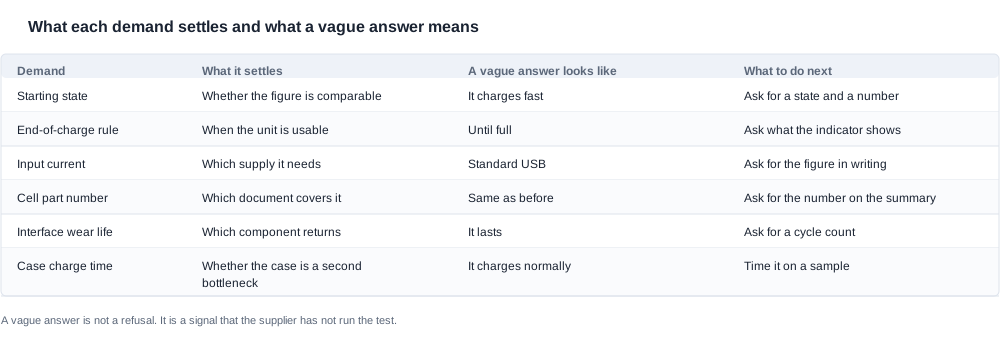
The most useful thing about a written demand is that it makes a vague answer legible. Four patterns come up repeatedly, and each one means something different.
| The answer | What it usually means | What to do next |
|---|---|---|
| "It charges fast" | No figure and no condition were kept | Ask for a state, a supply and a number |
| "Until full" | The end-of-charge rule is undefined | Ask what the indicator shows |
| "Standard USB" | The input current was never measured | Ask for the figure in writing |
| "It lasts" | The interface has not been cycle tested | Ask for a cycle count |
None of these is a refusal. A supplier who answers "it charges fast" has told you something true and something useless, and the useless part is the part you need. The right response to each is the same: ask for the number and the condition, in writing, and see whether it can be produced.
What a failed test means
A failed test is a finding about a specific variable, and the useful response is to identify the variable before drawing a conclusion about the supplier. If the flat charge is slow but the top-up is fast, the product is sound and the condition was wrong. If the case delivers fewer charges than its capacity suggests, the case is the bottleneck and the glasses are not the problem. If the interface does not charge on the third insertion, that is a wear or alignment defect and the conversation is about quality control rather than about specifications.
Writing the variable down before the conclusion is what turns a test result into a supplier action, and it is the reason the protocol above asks for the conditions to be recorded before the result.
The case as a separate verification problem
In practice the case is a separate supplier problem, and it is verified separately. Four questions cover most of it.
1. Is the case's own charge time published? If not, ask for it with the condition, and treat the case as a potential bottleneck in the chain rather than as a passive container.
2. What is the case's own ingress position? A case is a separate enclosure. No case in our range carries a published ingress marking, and the glasses' marking does not extend to it. The ingress position of the case is a question for the supplier, and the answer belongs in your file rather than in an assumption.
3. What is the interface alignment tolerance? A case that accepts the glasses only one way up produces returns, and the tolerance question is how many ways up it accepts.
4. What is the case's cycle life? The lid, the hinge and the contact are the wear items, and a case that dies at the hinge rather than at the contact has a completely different service cost from one that dies the other way round.
Two models in the range are published as shipping with a case and no published capacity at all: the KY06 and the MT5. For those two, the capacity request is not a refinement, it is the first question.
There is a fifth case question worth asking about one model in particular. The L2 Utral's catalogue page carries a Type-C charging interface line alongside the Utral Pro Max designation, and a case offered at 900 or 1400 mAh depending on configuration. The published material does not bind that case option to a configuration, so a buyer asking which case ships with which port is asking a question the catalogue genuinely leaves open. The answer belongs in the verification file rather than in an inference made from a page layout.

The documentary checks that belong in the same file
A charging verification file that contains only measurements is half a file, because the measurements answer whether the product works and the documents answer whether you can ship it. Four document checks belong in the same folder, and each one is cheap to do and expensive to skip.
The transport test summary for the cell. It names a cell, with a cell part number, a model designation, a test laboratory and a date. The check is that the cell part number matches the cell the supplier quoted and that the model designation matches the model on the order. A summary for a superseded cell is not a wrong document; it is a document for a product that is no longer the one you are buying, and the correction is a request rather than an argument. This summary has been mandatory since 2020, which means its absence is a current, live problem rather than a legacy one.
The safety data sheet. A different document from the transport summary, covering a different question, and frequently the one that arrives instead of the summary when somebody has confused the two.
The substance declarations for the product. The RoHS declaration covers the product. A material certificate covers a material. They are not interchangeable, and a material certificate presented as product evidence is a gap that only shows up in a file review.
The conformity documentation for the radio. The product's own radio is covered by the Radio Equipment Directive (EU) 2014/53/EU, and the declaration of conformity that supports it is the document to request. If the quotation includes a mains adapter, the adapter is a separate regulated item with its own declaration and its own marking, and it is not covered by the glasses' document. Conflating the two is a shortcut that produces a documentation package with a hole in it.
The general rule for all four is the same, and it is the rule that makes a verification file worth keeping: every document has to name the exact model and the exact cell. A document that names a family is a question, and a document that names the model is an answer.

The record sheet that makes a result comparable
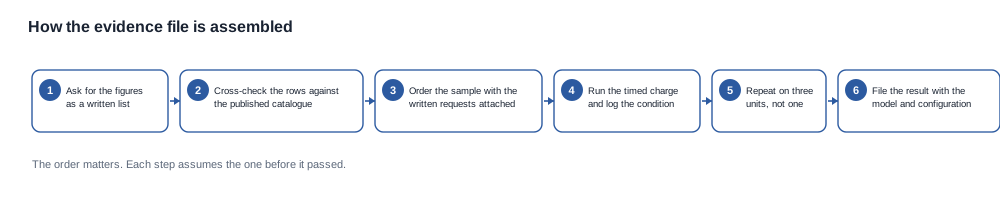
A verification result that cannot be reproduced is a number rather than evidence, and the difference costs nothing to maintain. Nine fields, and every one of them is something the person running the test already has.
- The model and the exact configuration.
- The cell part number.
- The starting state.
- The end-of-charge criterion.
- The ambient temperature.
- The charger and the cable used.
- The measured elapsed time.
- The cell temperature during the charge.
- The interface condition after ten insertions.
A verification sequence with no slippage
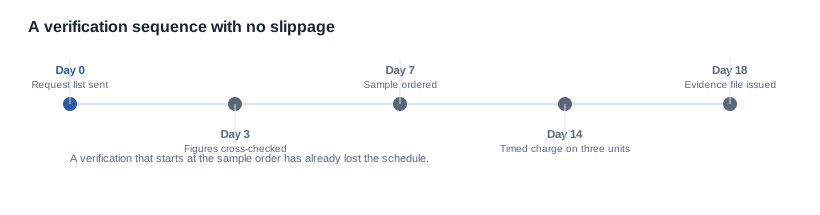
The sequence above assumes one rule, which is that the written demands go out before the sample is ordered. A verification that starts at the sample order has already lost the schedule, because the conditions are then negotiated while the goods are in transit.
Four answers that tell you what a supplier has actually done
Not every answer to a written demand carries the same information, and there are four that tell you something about the supplier rather than about the product.
A charge time with a condition attached. Someone ran the test, kept the conditions and wrote them down. This is the single most informative answer in the list, and it is uncommon.
A charge time with a condition requested and promised. Someone understands that the condition matters and has not yet run the test. This is a good sign with a date attached to it.
A fast-charge claim with no protocol, power or thermal description. The claim has been copied from somewhere, or it describes the absence of a slow baseline rather than the presence of a fast one.
A charger that is not in the box, presented without the customer consequence. Whether a cable is included is a commercial decision with a regulatory dimension in some markets, and the published charge time may assume a supply the customer does not have.
A hypothetical verification file, assembled
Treat this as an illustrative case rather than a client project; the purpose is to show the decision order rather than to report what happened.
Assume a brand-side product manager qualifying a camera model for a European launch. She has a supplier's catalogue PDF, a quotation, and a sample order to place this week. The file she intends to build is one folder with six sections.
Section one: the published rows. The interface, the charge time, the cell configuration, the runtime and the case row for that exact model, quoted as published, with the absences marked as absences. This section exists so that everything after it can be compared against something.
Section two: the written demands and the answers. The eight demands go out as a list. Two of them come back with conditions attached — a starting state and an end-of-charge criterion — which is the most informative answer in the whole exercise and tells her that the supplier has run this test before. One comes back with a hedge and no figure, which becomes a request attached to the sample order.
Section three: the documentary checks. The transport summary arrives naming a cell part number that does not match the cell in the quotation. The supplier explains it as a second source and sends the summary for the cell that will actually ship. The conformity documentation names the model and is filed. No adapter is in the box, which the manager has already decided is acceptable for this market.
Section four: the sample measurement. Three units, the nine fields, the same supply throughout. The measured charge time comes in under the published ceiling, which is the expected result and is still worth recording, because it is the first figure in the file with a condition attached. The top-up measurement is materially shorter than the full charge, and that is the figure that will go into the operating guidance.
Section five: the case. The model has a case. The case charge time is measured, the number of delivered charges is counted, and the question of whether the case charges the glasses is answered in writing. The case's own ingress position is not published and is requested; the supplier's answer is that it is not rated, which is a usable answer and is recorded as a limitation rather than as a rating.
Section six: the conclusions. Three columns: what is now evidenced, what is published but uncharacterised, and what is still not published. Only the first column may be used as a claim. The second may be used as a ceiling. The third may be used as a question.
The whole file took two weeks and two sample units, and it is the document that survives a distributor's compliance review in a way that a catalogue extract never does.
Which demands we can answer today, and which we cannot
The working rule we apply: we publish the interface, the charge time, the cell configuration and the case capacity accurately for each model, and we will not present a charge time as a specification without the condition, because the condition is what determines whether the figure is usable in a particular market.
We will also be direct about the limits of what our published data can settle. The charge current, the cell temperature during a charge, the interface wear life, the case charge time, the case's own ingress position and the end-of-charge criterion are all not published for every model in the range. Each of them has to come from the engineering team or be measured on a sample, and a buyer who asks us for them will be told which of the two routes applies.
We will not supply a typical value for any of them, and we will not present a published ceiling as though it were a characterised figure. We would rather a buyer measure those on a sample than trust a number that cannot be defended.
If you tell us the model, the destination markets and the customer use case, we will tell you which of these eight demands matter for that programme, and which ones are the ones where the answer is already in the published rows. The measurement protocol is in how to measure smart glasses charging, the case as a separate object is in charging case review checklist, the regulatory reach into the charging function is in how regulations affect this, and the architecture behind all of it is under charging solutions.
Related reading
- Charging solutions and interfaces
- How to measure charging
- Charging case review checklist
- How regulations reach the charger
Tell us the model, the markets and the use case, and we will say which demands matter.


