

Smart glasses charging: questions that decide an order
Charging is the most under-questioned part of a smart-glasses order, and the reason is that the catalogue publishes a charge time for every model it lists, which makes the category appear settled. It is not settled. What the catalogue publishes is a bound, and a bound with no starting state and no criterion for completion cannot be turned into an operating plan, a staffing plan or a warranty. Underneath that published number there is a second decision that is much more consequential and much less discussed: the charging interface itself, whether the product is a magnetic-contact product or a Type-C product, because that single choice determines the cable, the dock, the accessory line, the depot logistics, the end-of-life story and the certification scope.
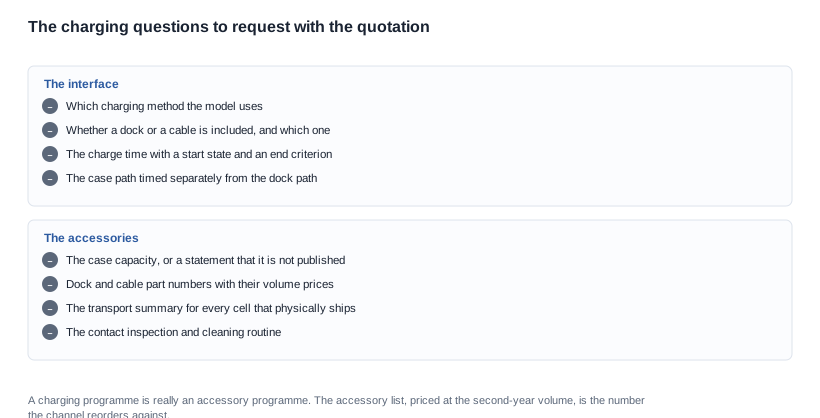
- What is in the box? A cable, a dock, or neither, and whether the dock is a stocked consumable or a free item.
- What does the accessory line cost at volume? Docks, cables, cases and spares, priced at the second-year quantity the channel will reorder.
- Does the case charge faster or slower than the dock? The catalogue publishes one figure, and the path used at volume is often the slower one.
- What happens to the contacts over a year of shared operation? A consumable with a service life, or a cable with no contact at all.
- Who charges the units, and in what environment? A depot controls the routine; a customer at home creates a support question instead.
The questions buyers ask are usually about speed — how long does it take, can I charge it in an hour, is it fast enough — and they are usually answered with the published figure. The questions that decide the order are different. What is included in the box: a cable, a dock, or neither? What is the accessory line at volume, and what does the second year of that line cost? Does the case charge faster or slower than the dock, and does the published figure describe the dock, the case, or both? What happens to the contacts over a year of continuous operation in a shared environment? And what does the certification file say about the charging system, because a magnetic dock is a piece of the product and it is assessed with the product rather than as an accessory.
There is a fourth question that is almost never asked and that determines whether a product can be sold into a particular channel at all: who charges the units, and in what physical environment. A product charged on a shared dock at a retail counter experiences a different duty cycle from one charged in a case in a warehouse, and a product that is charged by a customer at home is a support question rather than an operations question. The charging interface interacts with that answer, because a magnetic contact is a consumable and a USB-C port is not, and a shared environment multiplies the contact degradation.
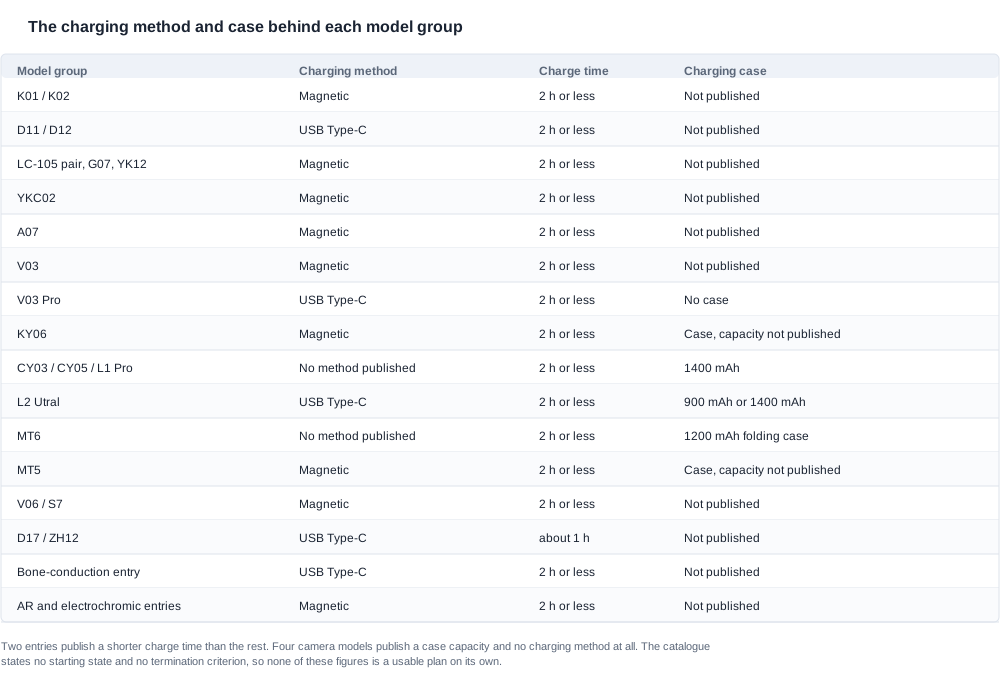
The catalogue publishes the charging method on the twenty-four rows that carry one, the charge time for every model, and, where the catalogue states one, the case capacity. It does not publish the starting state of charge, the termination criterion, the charge time through the case as distinct from the dock, the contact material or the service life, the cable or dock part numbers, or the number of cycles the cell is rated for. The consequences of each of those gaps are set out below, and the mechanism is on the charging solutions technology page. The terminology behind the interface options is set out in the charging glossary and the selection logic in the choosing a charging interface article.
The charge time is missing two conditions
Every model in our catalogue publishes a charge time, and that is more than most suppliers offer. Twenty-six of the twenty-eight entries publish two hours or less, and two publish about one hour. The figures are useful as a ceiling and they are not usable as a plan, and the reason is the two conditions they do not carry.
The first condition is the starting state. A charge time measured from an empty cell and one measured from a part-charged cell are different measurements, and the difference is large enough to matter in the two situations a buyer actually cares about: the overnight batch where units come back at a low state, and the midday swap where a unit has been used for a few hours. A buyer who plans a shift rotation from a published bound has to assume the worst case, which is the empty-cell figure, and if the published figure was measured from a half-charged cell the plan is wrong in the direction that matters.
The second condition is the termination criterion, which is to say the statement of what state counts as finished. A charge that stops at 80 per cent and a charge that stops at 100 per cent can have the same elapsed time, and the difference decides whether the unit is ready for a shift. A supplier that states the termination behaviour, and the current the system draws at that point, has given the buyer something usable. A supplier that does not has given a bound.
There is a third gap that sits behind the two conditions and that applies to any product with a case. The published charge time describes a charge path, and a product with a case has more than one. The dock path and the case path are not the same, because the case adds a cell, a contact and a conversion stage between the product and the supply. A buyer needs the figure for the path that will actually be used at volume, and that is usually the case path.

Magnetic and Type-C, and what each one commits you to
The interface is not a convenience detail. It is a commitment that propagates into the accessory line, the operating environment, the certification file and the end-of-life story, and it is worth choosing on those grounds rather than on the feel of the product.
A Type-C product is committed to a standard port. The practical consequences are that the cable is a commodity item that can be bought anywhere, that the buyer's existing stock of spares works, that the packaging does not need to carry a bespoke component, and that there is no contact degradation to manage because there is no contact. The cost of that convenience is that the charging experience is entirely on the customer, that the cable is loose at the other end, and that a device in a pocket is charged by remembering to plug it in.
A magnetic product is committed to a proprietary dock. The practical consequences are that the charging experience is a single action the customer will actually perform, that the product can be charged by a depot in batches, that the dock becomes a consumable in a way a cable is not, and that the contact surfaces are consumables with a service life. The benefit is a lower friction rate; the cost is a proprietary accessory line and a physical maintenance routine attached to it.
Neither is right in the abstract. A product sold to industrial customers who charge in a shared depot is usually better served by the dock, because the depot controls the process and can schedule the wipe-down. A product sold to a consumer channel is usually better served by Type-C, because the customer will not replace a lost dock and the cable is a purchase they can make anywhere. A product sold to a channel that recharges from a case in a field bag is a third case again.
The commitment also reaches the documentation. A magnetic dock is a component of the product in the assessment of the charging system, and the charging system sits inside the radio equipment conformity assessment under the Radio Equipment Directive (EU) 2014/53/EU when the product carries a radio. A Type-C product has a smaller system to assess. Either way, the charging documentation is per-configuration, and a buyer who adds a dock to a product that shipped without one has added a component to the file.

Running a charging check on a sample unit
The charging check is quick, it is entirely within the buyer's control, and it produces the numbers that a shift plan needs. What makes it fail is running it on a unit that has been charged all day in a showroom, and recording only the elapsed time.
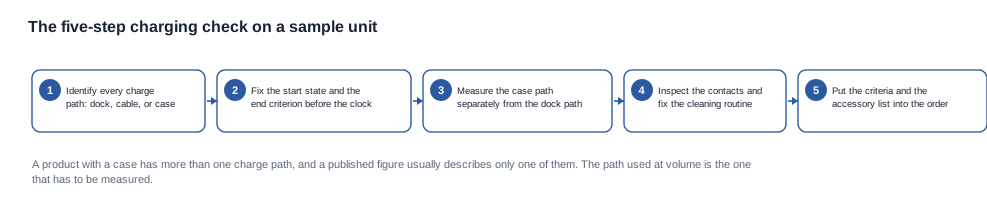
Step one: identify the charge paths separately. List every way the unit can be charged: the dock, the cable, the case, and any combination. Each path is a separate measurement, and a published figure that describes only one of them is not a description of the product. Record the path against every number the supplier gives you.
Step two: fix the start state and the end criterion before starting the clock. Use a unit that has been discharged to a defined state, and decide what "finished" means before the test — a vendor-specified current threshold, a fixed elapsed time, or a level the unit itself reports. Write it down, because a charge time without a stated end point is a story.
Step three: measure the case path separately from the dock path, on the same unit, from the same start state. The difference between the two is usually substantial, and it is the difference between a product that recharges overnight in a batch and one that does not. If the supplier quotes a single figure for both, that is the question to press.
Step four: inspect the contacts and the routine. Count the charge cycles the sample has already taken, inspect the contact surfaces, and ask what the wipe-down routine is and how often the site is expected to do it. On a magnetic product this is a maintenance task that has to be owned by somebody; on a Type-C product it is a cable replacement that has to be stocked.
Step five: put the criteria and the accessory list into the order. The charge time with its start state and end criterion, the accessory part numbers and their prices at volume, the case configuration with its capacity or an explicit statement that it is not published, and the warranty treatment for the charging system. A lot that fails these is a lot the buyer can refuse.

The charging failures that surface in the channel
Four charging-related failures appear after launch, and each of them is an information failure rather than a hardware fault.
The units do not come back charged. The symptom is a channel reporting that a proportion of the fleet is unavailable at the start of each day. The root cause is that the charge plan was built on a published bound rather than on a measured path, usually the case path, and the depot was never sized against the real number. The prevention is to measure the path that will be used at volume, at a stated start state, and to size the batch against the measured figure rather than the catalogue figure.
The docks degrade and nobody owns the replacement. The symptom is a gradual increase in the number of units that will not charge, spread across sites, with no single event to point at. The root cause is that the contact surfaces are a consumable with a service life that was never stated and never budgeted. The prevention is to ask for the service life, to stock the docks as spares, and to put a wipe-down and inspection routine into the site operating procedure.
The unit charges and stops before it is full. The symptom is units that appear charged on the depot indicator and are flat at the point of use. The root cause is that the termination criterion was never stated, so two parties had two different definitions of charged. The prevention is to write the criterion into the order and to have the depot and the supplier use the same one.
The battery transport file does not cover what shipped. The symptom is a freight query or a rejected consignment, usually when a new cell or a new configuration is introduced. The root cause is that the transport documentation was treated as a per-model item when it is per-cell and per-configuration, and a new case or a new cell was added without reissuing it. The prevention is to request the transport summary for every cell that physically ships, including the cell inside the case, and to put a re-issue obligation into the contract for any cell change. The relevant compliance route is covered on the battery transport page.
A charging evaluation for a multi-site retail chain
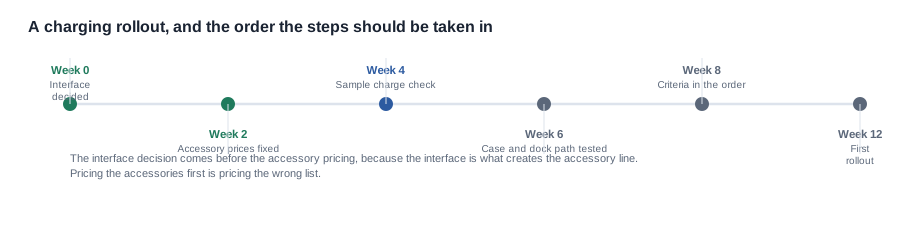
The sequence below is a constructed case, included to show how the decisions would be taken rather than to report a client result. Assume a channel buyer supplying a uniform product to a retail chain with many small sites, where each site holds a small number of units, staff turnover is high, and the charging is done at the counter during a shift. The constraint that matters is not the charge time; it is that the chain cannot train staff on a proprietary routine at four hundred sites, and it cannot afford a dock that has to be wiped down by a person who changes every week.
Step one: the environment is written down before the interface is chosen. The buyer describes the charging reality at a site: one counter, a shared power point, a shift of eight hours, staff who are not trained on the product, and a site that closes at night with everything in a drawer. That description eliminates one of the two interface options immediately, and it does so on operational grounds rather than on a preference.
Step two: the shortlist is cut on the published rows. The buyer eliminates on the charging method that the operating reality can support, on the case configuration, because a case has to be stored and charged somewhere, and on the cell configuration against the shift. What is left is a small set, and the charge time appears in the list only as a sanity check that it is not absurd for a shift.
Step three: the sample is measured on the path that the site will actually use. If the site charges from a dock, the dock path is measured. If the units live in cases overnight, the case path is measured, and it is measured from the start state the site will produce, which is not empty. The buyer records the two numbers separately and sizes the site's batch on the slower one.
Step four: the accessory line is costed before the order. Dock part numbers, cable part numbers, spare quantities, the price at the second-year volume, and the wipe-down consumables if any. The buyer asks what happens to a dock that fails, and the answer becomes a stocking decision with a number attached rather than a surprise.
Step five: the claim is written to match the product. The listing says what is included in the box and what has to be bought separately, because the most common support contact in a magnetic-dock product is a customer asking where the dock is. The order carries the charge criterion with its start state and end criterion, the accessory list with prices, and the battery transport summary for every cell that ships.
The walk-through did not settle the charge time. It settled the interface, the accessory line and the site operating routine, and it left the charge time as a figure that the buyer's own plan is built on.
The charging terms worth negotiating, and the ones that are fixed
The commercial structure of a charging decision has three layers, and a buyer who negotiates them as one category spends effort badly. The variable layer is the unit price, where the charging method barely moves the number. The setup layer is where the charging decision actually costs money: the tooling for a dock, the accessory tooling for a case, the packaging that has to carry the cable or the dock, the certification work that the charging system triggers, and the artwork that has to show the charging instruction on the box. The third layer is the recurring layer, which in a charging-led programme is the accessory line: docks, cables, cases, spares and the consumables the wipe-down routine needs, priced at first-order volume and again at second-year volume.
A buyer comparing two charging quotations should work through a short checklist before comparing any prices: which interface the operating reality supports, which accessory items are on the quotation and at what volume price, which charge criterion is stated with a start state and an end point, and which cell documentation covers every cell that physically ships. That is the checklist that makes two quotes comparable. A shortlist built on the published charge time alone is not comparable between suppliers, because the figure omits the two conditions that decide it. The trade-offs the buyer is actually making are explicit at that point — the cost of a proprietary dock against the cost of a commodity cable, the cost of a case in the box against the cost of a second battery in the field, the cost of a documented criterion against the cost of a fast launch. And the red flags are short: a charge time quoted with no start state, a case capacity quoted as a total the catalogue does not state, and an accessory line that turns up in the sample but not in the quotation.
Four terms are worth asking for explicitly. The first is a volume price for the accessory line with a stated lead time, because the accessory is what the channel will actually reorder and a channel reorder at retail price destroys the margin the buyer built. The second is a written statement of the charge criterion with its start state and end criterion, so that a lot which fails it is a lot that can be refused. The third is a part number and a service life for the charging accessory, so that the contact degradation has an owner and a cost. The fourth is a re-issue obligation covering the cell and the case configuration, since a cell change is the event that invalidates the transport documentation.
One cost is not negotiable in any useful sense. The battery transport work under UN 38.3 is a per-cell and per-product task with a laboratory queue attached, and its cost and duration are a property of the test house rather than of the order size. The same is true of the radio conformity work under the Radio Equipment Directive (EU) 2014/53/EU, and for a magnetic-dock product the charging system sits inside that assessment. The useful question is not whether a supplier can shorten either; it is whether the documents cover the exact cell, the exact configuration, the exact charging accessory and the exact markets the buyer is shipping into.
What we publish about charging, and what we do not
We publish the charge time for every model, the charging method for the twenty-four models that carry one, and the case capacity for the five camera configurations where the catalogue states one: L1 Pro and CY05, and CY03 — each at 1400 mAh, L2 Utral offered at 900 mAh or 1400 mAh, and MT6 at 1200 mAh in a folding case. We also record the two configurations that have a case with no published capacity, KY06 and MT5, and the one camera configuration with no case at all, V03 Pro. We do not publish a starting state of charge, a termination criterion, a charge time for the case path stated separately from the dock path, a contact material or service life, a cable or dock part number, or a cell cycle rating, because we do not hold verified figures for them.
We do not publish frame weights for any of these models, and the single weight our catalogue states belongs to a different product in a different family. A buyer who needs a weight for the model in front of them should ask for that model directly rather than borrow a figure from elsewhere in the range.
What we will do is walk you through the published charging rows, confirm which configurations exist and which do not, and say plainly where a charging requirement in your brief is one we cannot answer from the catalogue. If the requirement is specific, the productive next step is to write it as a path, a start state, an end criterion and a pass rule, and to put it to a supplier who is willing to be measured against it. The charging solutions page is where the published position is set out, and the OEM-ready range is where the configurations that ship with a defined accessory set are listed.


