

Smart glasses charging: what the interface decides before price comparison
Why the interface is the first decision, not the last
The charging architecture of a smart-glasses programme is settled at the configuration level, and it is the least expensive decision in the product to get wrong. A magnetic dock and a Type-C port are not two accessories for the same device; they are two products with different tooling on the temple, different in-box lists, different accessory economics and a different documentation scope. Before you compare two quotations, establish which interface each supplier is actually quoting and whether a charging case sits inside the configuration or merely beside it in the box. A published charge time without a starting state is not a specification, and our catalogue publishes a charge time for every one of the twenty-eight models without yet telling you what state the cell was in when the clock started or what the device does when the charge finishes. If your channel cannot answer the question "what does the customer have in their hand at the shift change", the charging question is not the one you should be negotiating hardest.
The quotation comparison that has stalled
The reader here is a brand-side product owner or a channel buyer who already has quotations in front of them, or who is opening a new programme and has to write the specification that the factory will quote against. The situation is one of three. Two suppliers have quoted the same headline specification and the unit prices are close, so the comparison has stalled. A new product line is being opened and the charging architecture has not been written into the configuration at all, which means every supplier is quoting a different thing. Or a market is being entered and the in-box accessory set has not been settled per destination, which is the point at which a good quotation becomes a customs problem.
The fear underneath the enquiry is rarely the unit price. It is a first shipment that arrives with a different interface from the one the artwork was approved against, or a case that was presented as a charger and turns out to be a storage shell, or a paperwork route that holds the consignment at a border because the charger that shipped in the box was never declared. The buyer who has been burned once by this stops trusting the sample and starts checking the configuration string on every unit that lands.
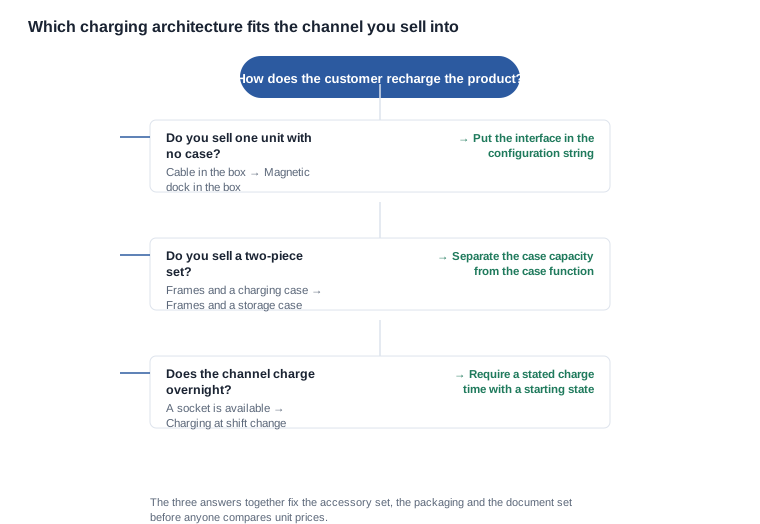
The position of the reader in the supply chain matters here, because it decides which of the questions below are theirs to answer. A brand owner controls the configuration string and the artwork, so the interface is theirs to fix. A channel buyer who resells a finished SKU does not control it at all, and has to ask a supplier for the configuration string in writing before an order is placed. A distributor who holds several brands at once has to manage the accessory set across all of them, because the packaging is the only place where the interface becomes visible to the end customer.

The charging rows in our catalogue, and the three they do not settle
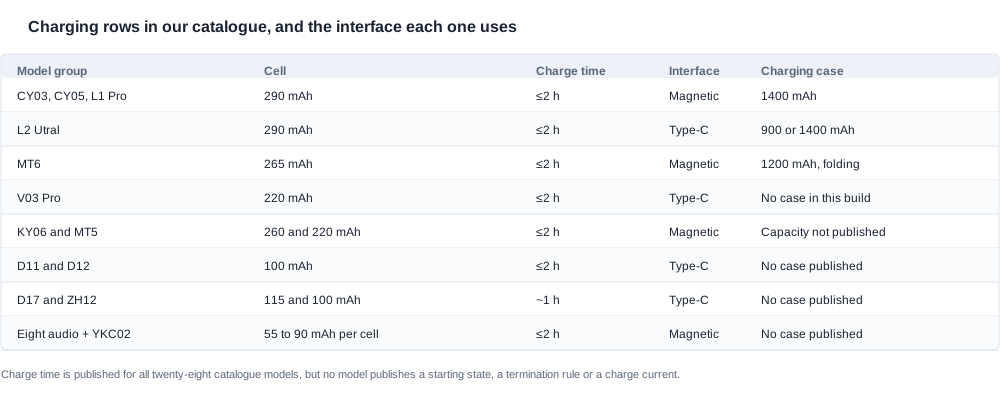
Our catalogue publishes a charging row for every model. That is unusual enough to be worth stating plainly, and it is also the reason a buyer can compare two configurations from this range without a supplier supplying a number. The table below groups the twenty-eight models by the interface they publish and by the case, where a case exists, that sits beside them.
What the catalogue publishes is the interface, the charge time, the cell capacity, and the case capacity where a case is part of the configuration. Seven of the twenty-eight entries charge over Type-C: the V03 Pro, the L2 Utral, the D11, the D12, the D17, the ZH12, and the bone conduction entry. The rest use a magnetic interface. Three camera models carry a 1400 mAh case, the L2 Utral carries a 900 or 1400 mAh case, the MT6 carries a 1200 mAh folding case, and the KY06 and MT5 have a case whose capacity is not published. Charge time is published across the range: twenty-six models are quoted at two hours or less, and the D17 and the ZH12 are quoted at around one hour.
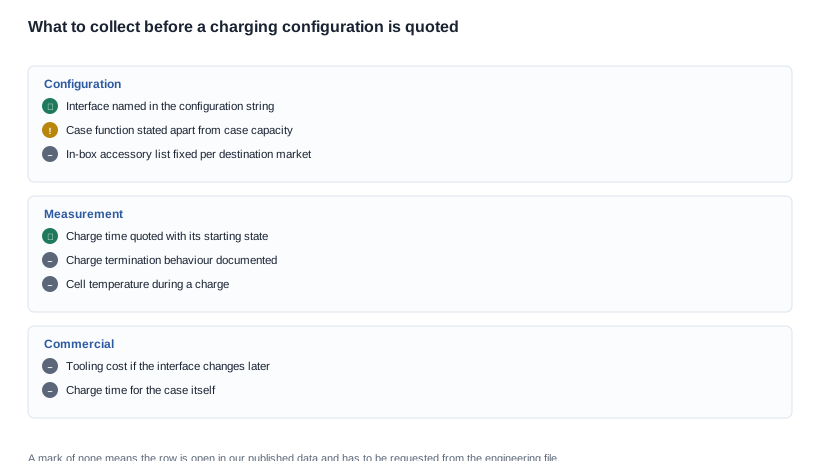
The rows that a buyer actually needs in order to make a decision are three, and all three are absent.
The starting state. Every charge time in the catalogue is a duration without a condition. A cell taken from flat to the point where the charge logic stops is one measurement; a cell put on the dock at forty per cent is a different and much shorter one. A supplier who quotes "two hours" for a model has told you the worst case, which is the useful direction, but a buyer who wants to promise a customer a number needs to know which one they are getting. The threshold to hold is a duration with the state attached, and the state should be one you can reproduce on a sample.
The termination rule. Nothing in the published data says what the device does when the charge completes, whether it can be left connected overnight without a support question, or whether the case and the device behave differently when both are on the same charger. This is the row that generates a first-week ticket, because the customer is the one who discovers it.
The case's own charging behaviour. Where a case is part of the configuration, the catalogue publishes the case's cell capacity, and it does not publish how long the case itself takes to recharge, how many full device charges it can deliver in practice, or whether it can hold a charge while the device is inside it. A case capacity and a case charging function are two different attributes, and a quotation that gives you only the first one has not given you the second.
There is a fourth row worth naming, and it is the one that causes the most argument later: the in-box accessory set. Our catalogue does not publish a regional accessory list, because the accessory set is a channel decision rather than a product fact, and the same model sold into two markets does not necessarily ship with the same cable, the same plug treatment or the same case. The buyer's practical protection is to write the accessory list into the purchase order as a configuration item rather than accepting a generic "accessories as per packing list" clause, because a packing list is a document the factory writes.
One warning applies to every row in the table above: these figures are not directly comparable between suppliers, and the reason is almost always the measurement rather than the product. A charge time measured with a wall charger is not comparable with one measured with a power bank, and a magnetic interface measured on the factory's own dock is not comparable with one measured on a third-party magnetic pad, because the contact geometry is part of the measurement. Until the conditions are stated, two numbers in the same row are two different measurements.
Twelve questions that separate a charging specification from a charging claim
These are the questions that produce the most useful answers, and the order is deliberate: the early questions fix things that are expensive to change later, and the later ones only become answerable once the earlier ones are settled.
- Which charging interface does this quotation use, and is that interface written into the configuration string rather than described in the brochure?
- Is the charge time quoted from an empty cell, and is the charger in the test the charger that ships in the box?
- What does the device do when the charge completes, and can it stay connected without a support consequence?
- If a case is part of the configuration, what is the case cell capacity, and what is the case charging function, stated as two separate answers?
- How many full device charges does the case deliver in practice, and under what temperature?
- If there is no case, what is the in-box accessory list, and how does it differ by destination market?
- What is the charge current, and is there a published charge termination curve rather than a single duration?
- What happens to the cell and the device if the device is left on the dock for twenty-four hours, and is that covered by the warranty?
- If the interface changes later, what is the tooling cost, what is the lead time, and what happens to the existing approval?
- What is the change-control route for the interface, the case and the accessory list, and who must approve each?
- Which certification scope covers the charger as a supplied accessory, and is the charger's own declaration separate from the device declaration?
- What is the cell's transport classification for the shipment, and is the UN38.3 summary available for the fitted cell?
The last three are the ones most buyers leave until the first shipment, and they are the ones that convert a routine order into a held consignment. Question eleven in particular is worth resolving early, because the Radio Equipment Directive (EU) 2014/53/EU covers the radio and the EMC requirements of the device, while the mains charger supplied in the box sits under a different conformity route. A device that is properly documented can still be held if the accessory in the box is not.
The method behind the list is simple and it is the same method used for charging supplier verification: insist on the condition before the number. A supplier who answers question two with a duration and no state has not refused the question, they have answered a different one.

Turning a charging answer into evidence you can put in the file
Verification in this category is mostly documentary, and it moves quickly once you know which four items to ask for. The sequence below assumes that each step passed, and a failure at any step tells you what the next step would have told you anyway.

Step one: ask for the configuration string in writing, before the quotation is compared. The configuration string is the only artefact that names the interface, the case and the variant together. A brochure page describes a range. A quotation describes a price. The configuration string is what a factory builds against, and it is the thing a quality control inspector will read on the line. If a supplier cannot produce one for the configuration you are evaluating, that is a due diligence finding in itself, because it means the product is not fully defined anywhere in the factory's own system.
Step two: ask for the charge time with its state, and treat a duration without a state as an absent row. Do this in the email rather than on a call, so the answer is on the record. The value of this step is that it converts a marketing figure into a testable instruction, and it takes one sentence from the supplier to do.
Step three: look the conformity position up rather than accepting a summary. Where a certificate number is offered, check it in the issuing body's register and confirm that the model designation on the document matches the designation in the configuration string, character by character. This is the check that catches a substitution in a family where several models share their electrical rows. For the radio side, the relevant instrument is the Radio Equipment Directive (EU) 2014/53/EU; for the material side, RoHS applies; for the transport side, the UN38.3 test summary for the fitted cell is the document a forwarder will ask for.
Step four: test the case separately from the device. If the case charges the frames, the in-box documentation, the product photography and the listing all have to say so, because the expectation follows the photograph. If the case is only a storage shell, the same three artefacts have to say that instead. A case that is presented as a charger because it has a charging contact in it is the single most common source of accessory-related returns in this category, and it is entirely a documentation problem.
Step five: measure the sample yourself, on a written protocol, and record the result as your measurement. The protocol that closes the rows is short: time a charge from a stated state with the supplied charger; time a charge from a stated partial state; leave the device connected past completion and record what happens; run a full case cycle and count the device charges it actually delivers. Write the protocol down before the first reading, because a protocol designed afterwards is a description of what happened.
Step six: put the interface, the charge time with its state, the termination behaviour, the case capacity and the in-box accessory list into the purchase order. In a category where the published data stops short of the acceptance criterion, the contract is the standard. If those five items live only in an email, they are not binding, and a lot that fails them is a lot you cannot refuse. This is the difference between a specification and a description, and it is also what how to measure charging sets out in more detail.

The charging failures that arrive after the first shipment
The failures below are the ones that reach a buyer as a surprise rather than as a rejection at the factory gate. Each is written as a symptom, a root cause and a control that stops it.
The device arrives with a different interface from the approved sample. The symptom is a shipment that passes the visual inspection and fails at first power-on, because the dock in the box is not the dock the artwork shows. The root cause is that the interface was agreed verbally and never written into the configuration string, so the factory built the variant that matched the tooling it already had. The control is to make the interface a named field in the purchase order and to check the string on the units on receipt rather than on the carton.
The case that was not a charger. The symptom is a cluster of support contacts in the first two weeks from one channel, all of them describing a case that would not charge anything. The root cause is that a case with a charging contact and a case without one look similar in product photography, and the listing was written from the photograph. The control is to separate the two functions in the specification, in the listing, in the packaging and in the support script, consistently, and to say which one the customer is holding.
The accessory set that did not match the market. The symptom is a shipment to one destination that arrives with the wrong plug treatment and cannot be sold, while the units for the next destination are correct. The root cause is that the packaging was designed once for the shelf and the accessory set was settled per shipment afterwards. The control is to fix the accessory list per destination market before the artwork is released, and to treat a market change as a packaging change.
The charge time that turned out to be a different measurement. The symptom is a customer who charged the device for the promised duration and it was still not ready, with a support log that shows a full charge taking materially longer than the published figure. The root cause is that the published figure was measured from a different state, or with a different charger, or at a different temperature. The control is to record the state on the published row for your own programme, and to publish the state on your listing rather than the duration alone.
The charger in the box that was never documented. The symptom is a consignment held at the border with a question about the mains accessory. The root cause is that the device's conformity scope was closed and the supplied charger was treated as a packaging item rather than as a product in the box. The control is to ask for the charger's own conformity position separately from the device's, and to include it in the technical file for the programme.
The overnight charge that became a returns driver. The symptom is a small number of units returned with a "stopped working" description after a customer left them charging for a week. The root cause is that no termination behaviour was ever defined or published, so nobody knew what the device was supposed to do. The control is to publish the behaviour and to give the support team a written answer, and to check the warranty language against it.
Charging gets discussed on every first order, and none of what follows is a reason to change supplier. They are reasons to write into the order, and each one is cheaper to prevent at the quotation stage than to correct in the field.
What is fixed in a charging programme, and what is still open
The total cost of a charging decision is the unit price plus the accessory set plus the packaging plus the documentation route plus the accessory-related returns, and only the first of those appears in the quotation. The buyer's negotiating capital is therefore much larger than it looks, and it sits in the setup lines rather than in the per-unit number.
The parts of this decision that genuinely move are worth naming precisely. The accessory set is negotiable per market and is worth a real conversation, because a market list that includes a market where approvals already exist is a better programme than a market list that requires new testing. The number of configurations is negotiable, and per-configuration minimums move when you commit to a combination count rather than a unit count. The artwork round count is negotiable and each round costs a week. The tooling cost of an interface change is negotiable in the sense that it can be priced in advance and amortised over a stated volume, which is a better conversation than discovering it later. The case capacity is a product decision with a cost attached, and it moves with volume in a way the unit price does not.
The parts that do not move are worth naming with equal precision, because arguing against them costs time. Certification cost and certification time are fixed per product family and sit in a queue at the test laboratory; pressing on either produces a longer schedule rather than a shorter one. The interface itself is not a commercial variable: a magnetic dock and a Type-C port are different toolings, and no unit price turns one into the other. The cell's transport classification is a fact about the fitted cell, not a negotiation. And the charge time, once measured under a stated condition, is a measurement rather than a price.
The documents worth collecting before the deposit are: the configuration string for the exact variant, the charge time with its state, the termination behaviour, the case capacity and case function as two items, the in-box accessory list per destination market, the conformity position for the device, the conformity position for any supplied mains accessory, the RoHS statement, the UN38.3 test summary for the fitted cell, and the cell specification for anything that ships with a case.
The clauses worth writing into the purchase order are: the interface and the case as named configuration fields, the charge time with its stated condition, the termination behaviour, the in-box accessory list per market, a clause requiring notice before any change of interface, case or accessory list because each of those invalidates the configuration and the packaging artwork, a clause requiring the documentation pack to be reissued for such a change, and a warranty set against the stated behaviour rather than against an assumed one.
On our own side, the boundary is this. We publish the interface, the charge time, the cell capacity and the case capacity for every model in the range, and we mark the rows that are open. We do not publish frame weight for most models, and we would rather say that than quote a typical figure nobody can verify. We do not publish charge current, cell temperature during a charge, interface wear life, the charge time of a case itself, the number of full device charges a case delivers, or a regional accessory list. Each of those is a question for the engineering file, and the honest commercial position is that a buyer who asks for them gets them, while a buyer who accepts a typical figure finds the error in the field where the correction costs more than the question did. The charging solutions and interfaces page is where the published interface rows sit, and choosing the right charging approach covers the channel logic behind the architecture in more detail.
Send the models, the quantities, the destination markets and the accessory strategy you intend to run, and we will tell you which charging configurations exist, which of them are open on the published data, and what the charge time actually means for each one. If the answer to the shift-change question is not in our published rows, we will say so and tell you what to put in the order to get it.
Related reading


