

A first order in this category has costs that live inside the contract rather than inside the quotation, and they are the ones that decide whether the second order is a reorder or a rescue. The unit price is the smallest of the six lines below and the least interesting of them, which is exactly why it absorbs the attention that should have gone to the other five.
The breakdown below is organised by where the money actually goes rather than by where it is invoiced. Two of the six lines are ordinary payments. Three are conditions attached to those payments — the points at which money moves against an event rather than against a date. The sixth is not a cost at all, and it is the most expensive of the six because it arrives as a delay.
The conclusion for a buyer opening a new programme: take the breakdown into the quotation stage, not the signing stage, and treat the six questions in the fifth section as part of the comparison rather than as paperwork to be done afterwards. Two suppliers quoting the same unit price with different answers to those six questions are not competing with each other, and the difference between them will not surface on the invoice. It surfaces in month four, when the artwork was approved late or the model designation changed after the carton was printed.
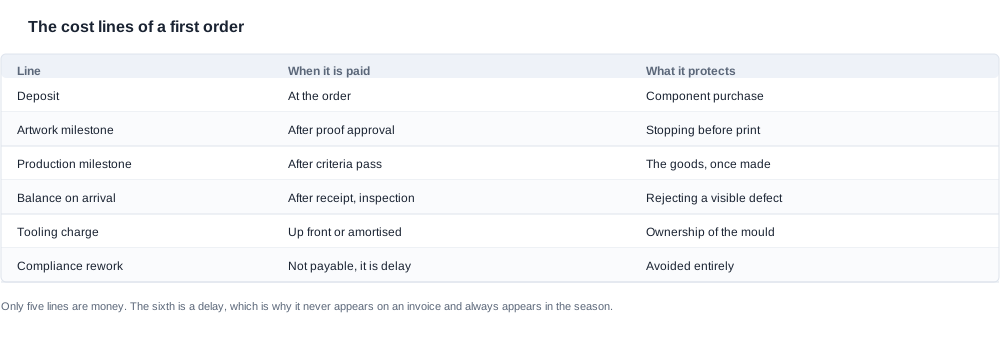
Smart glasses contract: where a first order's money actually sits
The cost of a first order in this category is not a price. It is a sequence of transfers, and each transfer is a point at which the buyer either gets something checkable or gets a promise. The distinction matters because a promise can be priced and a checkable transfer cannot.
The first transfer is the deposit, and it buys the supplier's commitment to purchase components. That is what it is for, and it is the reason a deposit is not recoverable in most cases once the component order has been placed. The second transfer is against an artwork proof, and it buys the right to stop before print — which is the last moment at which a packaging change is cheap. The third transfer is against the production milestone, and it buys the goods, at the point where the acceptance criteria have passed. The fourth is the balance, and it is triggered by the shipping document set rather than by the passage of time, which is the clause that protects the buyer from paying for goods it has not judged.
Between those four transfers sit three conditions, and they are where the cost actually hides. Each milestone has a trigger, and each trigger has to be observable by the party paying. "Before shipment" is not a trigger, because it is not an event with a witness; "on presentation of the original bill of lading" is, because a document either exists or it does not. The gap between the two phrases is the gap between a payment schedule and a vague arrangement.
There is a fifth line that only appears on some orders and is usually the largest single number in the agreement: the tooling charge for a custom mould or temple shape. And there is a sixth line that never appears at all, which is the cost of compliance rework, and which we address separately because it is the only one of the six that cannot be paid for.
One more dimension of the breakdown deserves naming before the individual lines, because it is the dimension most often left out entirely: the inventory cycle. The payment structure does not only decide when money leaves; it decides how many cycles of unsold stock the buyer carries between the deposit and the sale of the first unit from that batch. A deposit of thirty per cent with a balance on arrival means the buyer has funded the full cost of the goods before a single unit has sold. A balance against a delivery document that arrives after the stock is already in the channel is a different funding pattern, and the difference between the two is the working capital requirement of the whole programme rather than of the order.
This is why the milestone structure is a cost line and not an administrative detail. Two suppliers can quote the same unit price, for the same configuration, with the same delivery date, and leave the buyer with materially different working capital — and the difference will not appear anywhere except in the buyer's own cash model. Production lead times are not published in our material and are therefore a term rather than a figure, which means the length of the buyer's cash cycle cannot be looked up; it has to be written into the agreement.


The lines that appear on the quotation
The quotation normally carries two of the six lines and hints at a third. The unit price is the one everybody reads. The tooling charge appears where there is one, usually as a separate figure with a note about amortisation. The deposit percentage appears in the payment terms, often informally, before anybody has written an agreement.
The interesting omission is the carton. The cost of a unit in this category is inseparable from what it arrives in, and the carton is determined by the configuration rather than by the product. Our own catalogue makes the point: the CY05 and the CY03, and the L1 Pro carry a 1400 mAh charging case, the L2 Utral can ship with a 900 mAh case or a 1400 mAh one, the MT6 carries a 1200 mAh folding case, the KY06 and the MT5 have a case whose capacity is not published, and the V03 Pro has no case at all. Each of those is a different object in a different carton, and a carton is not a neutral container: it sets the carton dimensions, the units per carton, the freight rate, the pallet count and the damage rate in transit.
The practical consequence for a cost comparison is that two quotations are only comparable when the case configuration is the same on both sides. A quotation that includes a 1400 mAh case and a quotation that includes a 900 mAh case are not two prices for one product, and the unit price gap between them may simply be the case. This is the same point that the configuration string makes in a specification schedule, arriving in a different place: cost comparison fails at the configuration, not at the terms.
The second thing a quotation rarely carries is the freight and delivery terms in a form that can be costed. "FOB" on its own leaves the point of transfer ambiguous, and an ambiguous Incoterm cannot be turned into a landed cost because it does not say where the risk sits or which party arranges the carriage. A costed comparison needs the named place, and the named place is a port, an airport or a warehouse address.
The third thing is the returns reserve, and no quotation carries it because it cannot be derived from a quotation. It can only be derived from the description that will be published alongside the product and from the buyer's own observed rate once there is one. Which is why a listing that states "about seven hours, measured on a sample" has a different return profile from a listing that says "all day" — and why the two statements are not a marketing choice but a cost line.
The endurance figures in our catalogue show exactly where this bites. The camera models run at 5~8 hours for the S7 and the V06, and the V03 Pro and the V03, at 6~8 hours for the KY06 and the MT5, and about 7 hours for the L2 Utral and the CY05, and the MT6 and the CY03, and the L1 Pro. Every one of those figures is published without a test condition, and the charging time is published for every catalogue entry — two hours or less for twenty-six of them and about an hour for the D17 and the ZH12 — but without a starting state or an end criterion. So the catalogue gives the buyer a band and no basis for interpreting it, and the gap between the band and the promise is exactly the returns reserve. A buyer who publishes the band as the band has a reserve; a buyer who publishes a rounded promise has a larger one, and it is invisible until the returns arrive.
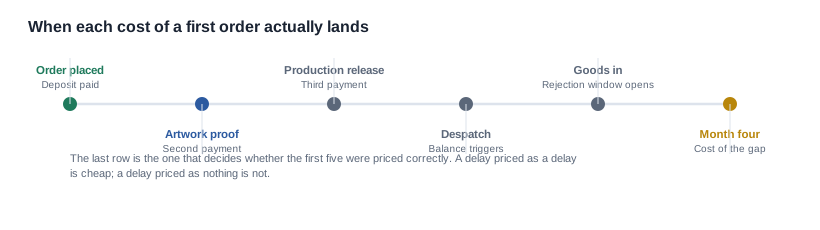
The delay lines that never reach an invoice
Compliance rework is the cost buyers do not price, and it does not appear as a cost because it is a delay. A model designation changed after artwork approval. A market added after the technical file closed. A responsible economic operator unnamed until the carton is printed. Each of these produces the same result: the programme stops for a period, and nothing on the invoice reflects it.
The delay is not recoverable by paying more, which is what makes it different from the other five lines. There is no premium that buys back a lost season. On a seasonal programme the arithmetic is brutal and entirely understandable: three weeks of delay on a launch window is a third of the selling window gone, and it is gone whether or not the goods eventually arrive. The cost lands on the buyer because the buyer set the launch date, and no clause in the agreement moves it.
In the European Union the paperwork that sits behind this line is the technical file under the Radio Equipment Directive (EU) 2014/53/EU and the traceability obligations under the General Product Safety Regulation (Regulation (EU) 2023/988, applicable since 13 December 2024). Both are documents, both belong to a schedule, and both can be closed before the carton is printed. The avoidance is entirely upstream: freeze the configuration, publish the approvals, name the operator before print. That is three decisions, all of which are free on the day they are made and expensive a month later.
There is a second delay line that is even more widely ignored, because it is a delay in the buyer's own operation rather than in the supplier's. The acceptance window, if it is measured from the production date rather than from arrival, expires before the goods exist — and the buyer then discovers defects at the point where it no longer has the contractual right to reject them. The cost of that is not a delay. It is a returns cycle, a customer service cost and a channel conversation, and it lands in the same quarter as the launch that the delay has already damaged.
The third delay line is the one that catches first-time importers. A consignment held at a border is a delay of days per unit of stock that has already been paid for, plus a demurrage line that nobody budgeted. It happens when the document route is opened late, and the prevention is the same as the prevention of compliance rework: a document delivery schedule with dates and named holders, agreed before production.

The tooling line, and why the number is the wrong part of it
A custom mould or temple shape is quoted as a one-off, and it is tempting to compare two suppliers on the number directly. The comparison is misleading in two ways, and both of them are structural rather than accidental.
The first is amortisation. One quote may spread the tooling charge across the first order while the other quotes it up front, which makes the two numbers incomparable without knowing the volume the amortisation assumes. The fix is not to argue about the number but to ask what the number assumes.
The second is ownership, and this is the part that actually decides the cost. A tooling charge is not a price for a mould; it is a deposit against an asset that stays useful only as long as the factory that owns it is willing to keep producing. The clause that matters names the asset, states who paid for it, and states that ownership passes once it is paid for in full. Without it, a buyer who has spent a year building a brand on a distinctive mould is negotiating from a weak position the first time the relationship sours, and a buyer who has negotiated the charge down by half has lost the asset as well as the money.
The third question is the one most often skipped, and it is the most expensive: what happens to the tooling if the programme ends? The clause should say how long the supplier holds it after the last order, what notice applies before it is scrapped or moved to another customer, and whether the buyer can take possession. This is a commercial term rather than a technical one, and it is the one most often settled by whoever writes the stronger letter last, which is not a method.
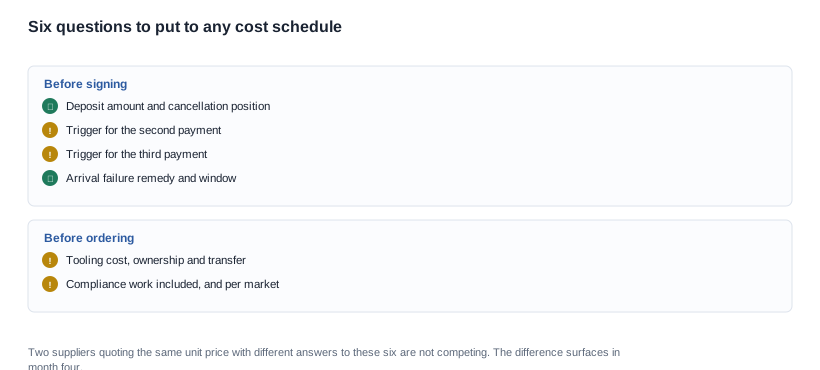

Six questions to put to any cost schedule
The six questions below are the ones that turn a quotation into a cost model. They are asked at quotation stage, in writing, and they are asked of every supplier in the same wording so that the answers are comparable.
-
What is the deposit, and what happens to it if the order is cancelled after components have been ordered? A deposit that is partially recoverable after component purchase is a materially different commercial position from one that is not, and the difference only appears in the cancellation scenario.
-
What triggers the second payment, and can I observe the trigger? The trigger has to be an event with a document attached. If the answer is a date rather than an event, the buyer is paying for a state of mind.
-
What triggers the third payment? Same test. The production milestone is usually tied to the acceptance criteria passing, which is why the criteria have to exist as a document with a method before the third payment is reachable.
-
What happens if the goods fail at arrival, and within what window? The window must start at arrival at a named place. The remedy must be stated — replacement, credit, rework or an allowance — because a window with no remedy ends in an argument.
-
What does the tooling cost, who owns it, and what happens to it if the relationship ends? Ask all three parts or accept that the first part is the only one being answered.
-
Which compliance work is included, and for which markets? The answer should name the documents, the markets and the holder. A supplier who answers "all the certificates" has answered a question about nothing.
The six questions are the cheapest part of a first order and the ones most often skipped, because they produce no document and no signature. They produce a comparison that can be defended later, and a defence that arrives in month four is worth more than a unit price negotiated in month one.
There is a seventh question that the list above implies but does not spell out, and it decides whether the answers to the other six are worth having: what happens to this cost structure when the configuration changes. A programme whose structure survives a re-quote is a programme a season can be planned around; a programme whose structure is rebuilt every time the case option or the colourway changes is a series of small negotiations, each carrying its own setup cost, and the setup cost is invisible because it lands on the buyer's own staff rather than on an invoice. The question to ask is whether the cost structure is tied to a stated quantity and configuration, and what happens to it when either of those moves.
The cost structure we will write, and the figures we do not publish
We will put a configuration schedule, acceptance criteria with methods, milestones with observable triggers and remedies, compliance ownership, change control and the ownership clauses into the agreement. We will not sign an order that leaves compliance ownership unallocated, and we will not change a structure mid-programme without a reason in writing.
Cost terms and performance terms are written separately in most agreements in this category, and only one of them is usually negotiated. Our production lead times, unit prices and minimum order quantities are not published, so any cost clause we offer is expressed as a structure tied to a stated quantity and configuration rather than as a fixed schedule. What that means in practice is that a contract clause has to survive a re-quote, and we will write it so it does.
This is worth being explicit about, because it is the reason the cost breakdown above is written the way it is. A buyer who wants a fixed cost schedule is asking for something that does not exist in this category until the configuration and the volume are both fixed. The published material does allow the configuration space to be mapped: the camera models, the resolution tiers, the case options, the charging interfaces, the endurance bands and the colour availability are all published. What is not published is what any of them costs, what the minimum order is, or how long the line takes. Those three have to be written into the agreement in order to exist.
So the cost breakdown is not something a supplier can hand over ready-made, and a buyer who asks for one is asking for a number that will not survive the first re-quote. What a supplier can hand over is the structure — which milestone triggers which payment, which document closes which gate, which change moves which cost — and that structure is what the buyer should be comparing. The total cost of a programme is the unit price plus the returns reserve plus the cost of the documentation route, and the trade-offs between those three are settled in the quotation rather than after it.
The contract terms section covers the clauses behind each line, the payment terms page sets out the milestone structure in detail, the eight omissions that cost buyers money covers the clauses that protect these lines, and the sign-off SOP template is the version to use when the order has to move through five gates before production.
Related reading
- Eight mistakes that cost money — the omissions
- SOP template for signing off — the five gates
- Payment terms — the milestones in detail
- Contract terms and agreements — the clause detail


