

Smart glasses contract smart glasses what to ask before ordering is a list of fourteen clauses, and the one that governs all the others is the first. A contract without an annexed, signed specification is a set of promises about a product nobody has described, and every dispute under it will be a dispute about what was agreed. Everything else on this list exists to make the specification enforceable.
We publish no contract terms, because a contract is not a fact and because the terms depend on the configuration, the volume and the relationship. What follows is the clause list and the question each clause has to answer.
The clause list below is deliberately not a template. A template is what most buyers end up with, and a template applied to a category with near-neighbour model designations, multiple charging-case options and a catalogue that publishes some figures without their measurement conditions will produce a contract that is unenforceable in exactly the places it matters.
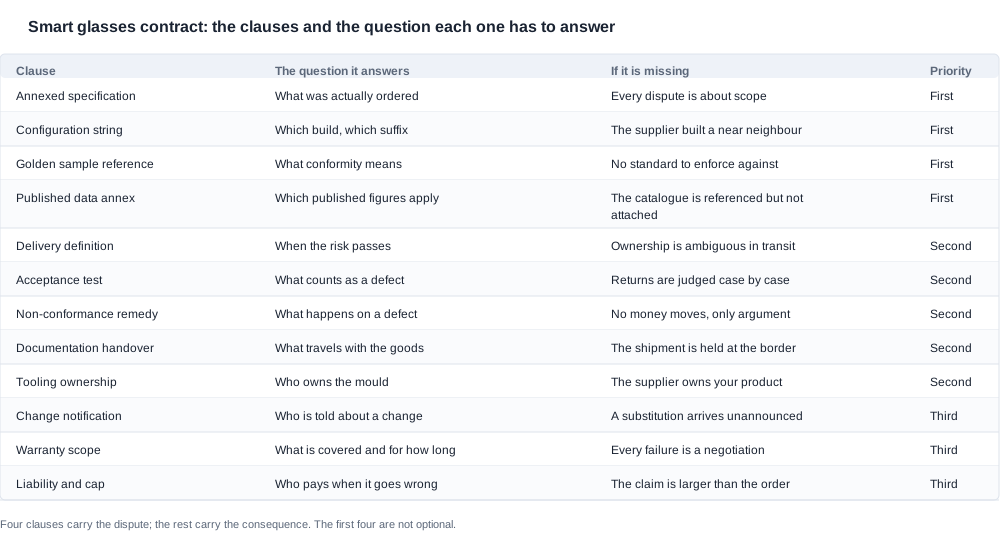

Smart glasses contract: the fourteen clauses, and the question behind each
1. The annexed, signed specification. Model string with every suffix, configuration, colourway, charging-case option, packaging version, the published rows that apply to the build, and the accessories. The question it answers is: what exactly was ordered. The signature matters as much as the content, because an unsigned annex is a proposal.
2. The configuration string as a single line. The same information in one unbroken string that appears on the order, the packing list, the test report and the label. The question it answers is: which build, which suffix. Every other document is checked against this string, so if the string is not written down it cannot be checked.
3. The golden sample reference. Which unit is the reference, where it is held, who may inspect it, and how a deviation from it is determined. The question it answers is: what does conformity mean here.
4. The published data annex. The catalogue rows that apply to this configuration, attached rather than referenced. The question it answers is: which published figures are contractual and which are descriptive.
5. The measurement condition annex. For each published figure relied upon, the condition under which it was determined, where that condition is known. The question it answers is: how is the figure to be tested when it is disputed.
6. The delivery term and the point at which risk passes. The question it answers is: when does the goods become the buyer's property, and where are they during the gap.
7. The documentation handover. A list of the documents that travel with the goods, with the holder of each. The question it answers is: what has to be in the box, in the file and in the hands of the forwarder.
8. The acceptance test. The method, the criterion and the number of units inspected. The question it answers is: what counts as a defect.
9. The non-conformance remedy. What happens when a unit fails the acceptance test: replacement, credit, rework, or rejection at a stated threshold. The question it answers is: what actually happens when something arrives that you did not order.
10. Batch record access. Where the production records are kept, for how long, and how a buyer obtains them. The question it answers is: can a claim three years later be investigated.
11. Tooling ownership. Who owns the mould or the fixture, what happens to it at the end of the relationship, and what the supplier may and may not do with it in the meantime. The question it answers is: who owns the product.
12. Change notification. Which changes to the product or the production route require notice, how far in advance, and what the buyer may do about them. The question it answers is: who is told, and when.
13. The warranty scope and period. What is covered, for how long, from what date, and the process for a claim. The question it answers is: what happens in month fourteen.
14. Liability, cap and governing law. The question it answers is: who pays when it goes wrong, and up to how much.
Why the first clause does the work the other thirteen depend on
A clause list read as a menu gives the impression that fourteen provisions are thirteen separate protections. They are not. They are thirteen protections attached to one spine, and if the spine is missing, the attachments are decoration.
The spine is the specification annex, and the reason it is decisive is that every other clause refers back to it. The acceptance test refers to the golden sample, which is described in the annex. The documentation handover refers to the model strings in the annex. The published data annex is a subset of the annex. The liability clause refers to a non-conformance against the specification.
So a contract with a strong acceptance clause and a weak specification annex settles disputes by reference to an ambiguous document. And an ambiguous document is interpreted against the party that drafted it, which in a supplier's standard terms is the supplier.
This is also why the order of negotiation matters more than the order of the list. Agreeing the price first and the specification last is the standard way to end up with a cheap contract, because the specification is the clause that determines whether the price was ever for the thing you received.


What the specification annex has to contain for the clauses to work
The annex is a document in its own right, and it is worth treating it as the deliverable of the negotiation rather than as an appendix.
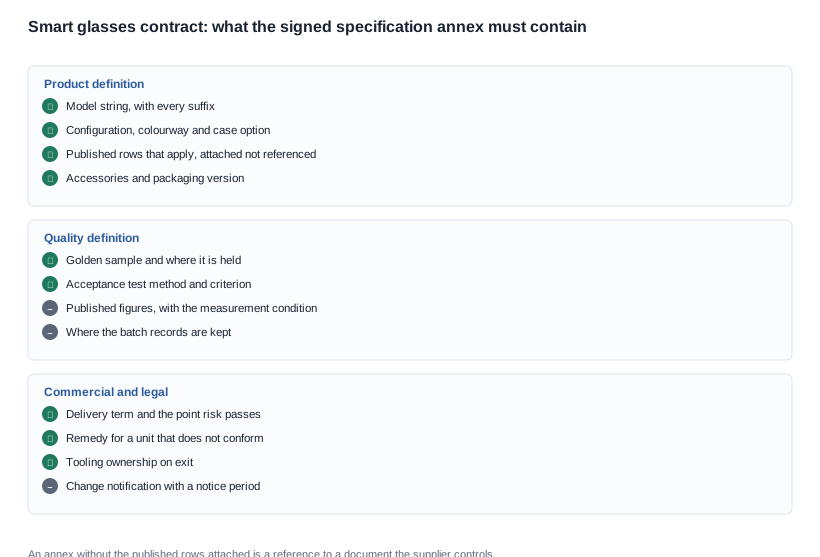
Three of the rows in that checklist deserve explanation, because they are the ones this category makes necessary rather than merely prudent.
The published rows attached, not referenced. A clause that says "conform to the published specification" is a reference to a document the supplier controls and can change. A clause that attaches the specific rows is a definition the buyer holds. The distinction is the difference between a standard and a number.
The measurement condition, where it is known. This is the sharpest point in the whole category, because the published figures here are published without their measurement conditions in most cases. The published charge time is two hours or less across the range, without a starting state of charge or an end criterion. The published run times are given as bands — five to eight hours, six to eight hours, about seven hours — without the usage profile that produced them. The published weights, where they exist, exist for one model in the range, and they are the weight of the glasses body rather than the weight of the shipped unit.
A contract that says "runtime shall be as published" therefore specifies a figure whose test condition is unknown to both parties. That is not automatically fatal, but it means the acceptance test has to supply the condition itself, and the buyer should write that condition rather than assume it.
Where the batch records are kept. This is the clause that determines whether a complaint in month thirty is a claim or a conversation. It costs the supplier nothing to agree at the start, because records are kept anyway; it is worth a great deal at the end, because a supplier who has never kept a batch record will not be able to produce one retrospectively.
Which clause settles which dispute
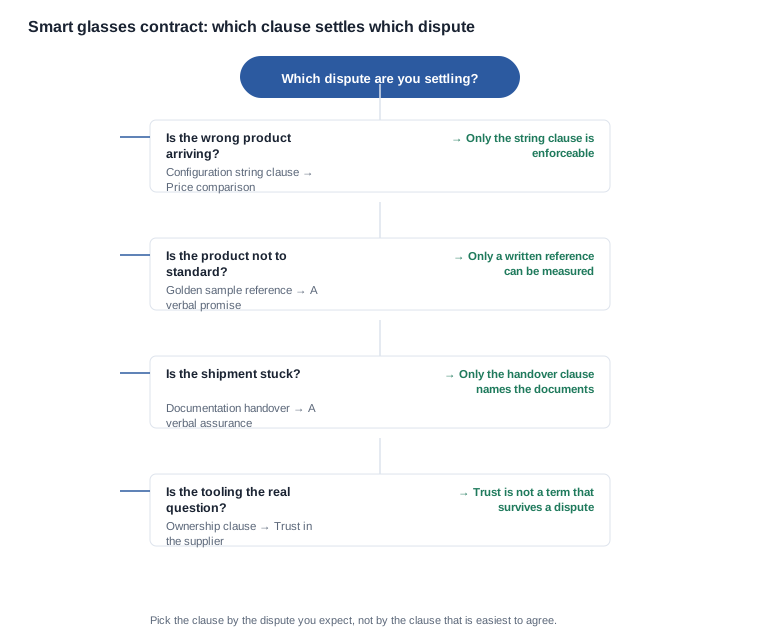
The diagram is a practical way to prioritise the fourteen, because a buyer cannot argue all of them in a first negotiation and should not try. The right way to choose is to work backwards from the dispute you actually expect.
A buyer who expects the wrong product to arrive needs the configuration string, and needs it to appear on every document. A buyer who expects quality drift needs the golden sample reference and an acceptance test with a written criterion. A buyer who expects a shipment to be held needs the documentation handover, with the documents named rather than described. A buyer who expects to change suppliers in two years needs the tooling ownership clause, and needs it agreed while the supplier still wants the order.
The trade-off worth naming is between clause count and clause enforceability. A fourteen-clause contract where four are precise and ten are general is harder to enforce than a six-clause contract where all six are precise, because the imprecise clauses invite an argument about which clause governs, and an argument about governing clauses is an argument about the specification annex all over again.

The questions worth asking before signing
The clauses above are what the agreement should contain. These are the questions to ask the supplier while the terms are still negotiable, and each of them produces a clause rather than an assurance.
-
Which model string, with which suffix and which configuration, does this agreement cover?
-
Which published rows apply to this build, and will they be attached to the agreement?
-
Under what condition was each published figure determined, and will the condition be stated?
-
Which unit is the golden sample, where is it held, and who may inspect it?
-
What is the acceptance test, what is the criterion, and how many units are inspected?
-
Which documents travel with the goods, and who holds each one?
-
Where are the batch records kept, and for how long after delivery?
-
Who owns the tooling, and what happens to it at the end?
-
Which changes require notice, how far in advance, and what may we do about them?
-
What is the remedy when a unit does not conform, and what is the cap on liability?
A buyer who asks all ten in the first round is not asking for unusual terms. They are asking for a specification, and in this category that is the ordinary requirement.
What a clause has to achieve in this category specifically
Four of the fourteen clauses exist because of features of this product range rather than because of how contracts work in general. It is worth setting out what each one has to achieve, because a buyer who has negotiated contracts in another category will otherwise write clauses aimed at the wrong problems.
The configuration string clause has to disambiguate near neighbours. This range contains several model pairs that differ only by a suffix and are different products. The V03 and the V03 Pro differ in the lens configuration and in whether a charging case is involved. The CY03, the CY05 and the L1 Pro differ in camera module and in published case option. The K01 and the K02 differ in feature line. A contract that says "the CY03" without a configuration string is capable of meaning more than one product, and the ambiguity is resolved by whoever the drafter was.
The acceptance clause has to work without a published measurement condition. This is the clause that catches most buyers in this category. The published figures for this range are, with very few exceptions, published as figures without the condition that produced them: a charge time of two hours or less without a starting state of charge or an end criterion, run times as bands without the usage profile, a Bluetooth version per model on some rows and no row at all for the camera series, and a charging method published on seventeen rows and Type-C on seven while four camera models have no published charging method row. The buyer therefore has to write the condition into the acceptance test rather than refer to a published number and hope the two parties agree what it means.
The documentation handover clause has to cover more than one cell. A configuration that ships with a charging case carries two cell types in the consignment — the device cell and the case cell — and the catalogue publishes several different case capacities across the camera models: 1400 mAh, 900 mAh, and 1200 mAh in a foldable case. A general undertaking to provide documentation does not obviously cover the second cell, and the point at which that becomes apparent is the booking.
The tooling clause has to cover the case option as well as the frame. A private-label programme in this category commonly has a bespoke carton and sometimes a bespoke case, and the mould for the case is as much the buyer's property as the mould for the frame. The clause that names only one of them leaves the other in the supplier's hands.
None of these four is exotic, and each of them takes one sentence in the annex. What makes them worth writing down is that each corresponds to a published feature of the range, and each is therefore predictable in advance rather than discovered in a dispute.
How to read a supplier's standard terms against this list
Supplier standard terms in this category are usually long, usually drafted for a different market, and usually consistent in one respect: the specification is referenced rather than attached. That single feature accounts for most of the gap between the standard terms and the fourteen clauses.
The practical method is to read the supplier's terms once against three questions rather than against all fourteen clauses. Does the specification define the goods, or does it point at a document the supplier can change? Does the acceptance test name a criterion, or does it leave conformity to be assessed against the goods generally? And does the liability clause cap the exposure at something related to the order value?
Where the answer to all three is acceptable, the remaining clauses are refinements and can be deferred. Where the answer to the first is no, nothing else in the agreement is worth very much, because every remedy will be measured against an ambiguous description of the product. That is the point of putting the specification annex first in the negotiation order, and it is also the reason a buyer should treat a supplier who will not attach the specification as a supplier who will not be held to anything later.
The evaluation question is therefore not "which supplier's terms are most favourable", which is unanswerable in the abstract. It is "which supplier will agree a specification annex that identifies the product", which is answerable, is worth a great deal, and can be established before a purchase order is drafted.
The commercial terms that are worth arguing about and the ones that are not
Three clauses in this category carry real money and are worth negotiating hardest.
The acceptance threshold. Whether a defect rate is judged per unit, per batch or per sample inspection decides what the returns reserve has to be. A clause that judges conformity on a sample of the delivered batch rather than on the batch itself is cheaper for the supplier and costlier for the buyer, because it moves the uncertainty onto the buyer's warehouse.
The documentation handover. Where a document that should have travelled with the goods is missing, the cost is storage and delay and it lands on whoever cannot produce it. Naming the documents and the holder in the contract is worth doing precisely because the alternative is a dispute about who was supposed to have had them ready.
The tooling ownership clause. This is the one that costs the supplier nothing at the start and everything at the end, and it is the one most often deferred. Agreeing it in the first contract is easy; renegotiating it after two years of production is not, because by then the supplier knows that the buyer cannot walk away without losing the mould.
Three clauses are not worth arguing about, and spending negotiating capital on them is a mistake.
The payment schedule, where the standard structure is already reasonable and the real leverage is in the acceptance clause rather than in the deposit percentage. The governing law and jurisdiction, where the practical difference is small compared with the difference between an enforceable specification and an unenforceable one. And the confidentiality language, which matters in both directions and is rarely the clause that decides the outcome.
Our position, and what we will and will not put in writing
We publish no contract terms, and we will not publish a template that pretends to fit every configuration in this range. A contract is not a fact about our catalogue; it is an agreement between two parties about a specific build, a specific quantity and a specific market, and its content follows from those three things.
What we will do is tell you what the specification annex needs to contain for the clauses to be enforceable, and we will supply the published rows that apply to your configuration so that the annex can be built from them rather than from a description. We will also tell you where our own published material leaves a row open, because those are the rows that have to be answered with a document from the supplier's own file rather than from the catalogue.
That last point has a specific consequence for how the annex is written. Where the catalogue publishes a figure, the annex can reference it and attach it. Where it does not — the per-model conformity documents, the packed carton dimensions and gross weights, the charging method on the four camera models where that row is not published, the Bluetooth version for the camera series — the annex has to say what the figure is and where it comes from, or it has to leave the row out and accept that the acceptance test cannot rest on it.
The contract terms section sets out the framework, the contract practical advice covers the negotiation sequence, and the contract supplier verification article is about testing whether a counterparty's terms are the ones they actually work to. The export documentation article covers the documents that travel with the goods.
A first contract, and the annex to negotiate
The case below is invented for the sake of the reasoning, not a client project. A brand-side procurement manager is signing the first contract for a camera model with a charging case, for a European retail programme, and the supplier has sent their standard purchase terms.
The first negotiation is the annex, and it is where the disagreement turns out to be. The supplier's terms say "conform to the manufacturer's published specification", which is a reference to a document they control. The buyer replaces it with an attached list of the specific published rows for this configuration, together with the condition behind each figure the acceptance test will rely on. The run time is the figure that matters most, and the buyer writes the usage profile into the annex because the published band does not state one.
The second negotiation is the acceptance clause. The supplier's draft judges conformity on a sample inspection, and the buyer moves it to batch-level inspection with a stated criterion, accepting a higher inspection cost in exchange for a returns reserve the buyer can actually model.
The third negotiation is the documentation handover, and it is where the charging case pays for itself as a topic. The supplier offers a general undertaking to provide documentation on request. The buyer asks instead for the list, and in the process discovers that the case cell is a second cell type in the consignment, which is not mentioned in the general undertaking at all. The clause is rewritten to name the documents, including the transport documentation for both the device cell and the case cell.
The fourth negotiation is the tooling ownership clause, which the supplier's terms omit entirely. It is agreed in one paragraph on the basis that the tooling is paid for by the buyer over the first orders, and the alternative — a mould the supplier owns and the buyer has no right to use elsewhere — is not something to discover in year three.
The outcome is a contract that is longer and no cheaper than the supplier's template, and a buyer who can state exactly what was ordered, what it will be measured against, and what happens when it fails. The contract terms section sets out the wider framework, and the practical advice article covers the sequencing.
Send the configuration, the quantity, the destination market and the delivery term, and we will tell you which published rows apply, what the specification annex has to contain, and which clauses we would expect to matter for that particular programme.


