

When to you can skip it smart glasses contract smart glasses has a counterintuitive answer. On a first order of a few hundred units, the clauses worth arguing over hardest are the ones nobody drafts, and the clauses a corporate lawyer will ask for are the ones a small order can defer. The written specification, the inspection reference, the acceptance clock and the data-clear step are four short clauses that nobody argues about, and they are the four that decide what happens when a unit is wrong. Liability caps, intellectual property assignment and termination and exit terms are what a legal reviewer will want, and on a small order the negotiation can cost more than the exposure it is there to cap.
We publish no contract terms, because a contract is a bilateral document rather than a fact about a product. What follows is a mapping of which clause does what, and a test for deciding which clauses your next order can defer without leaving yourself exposed.
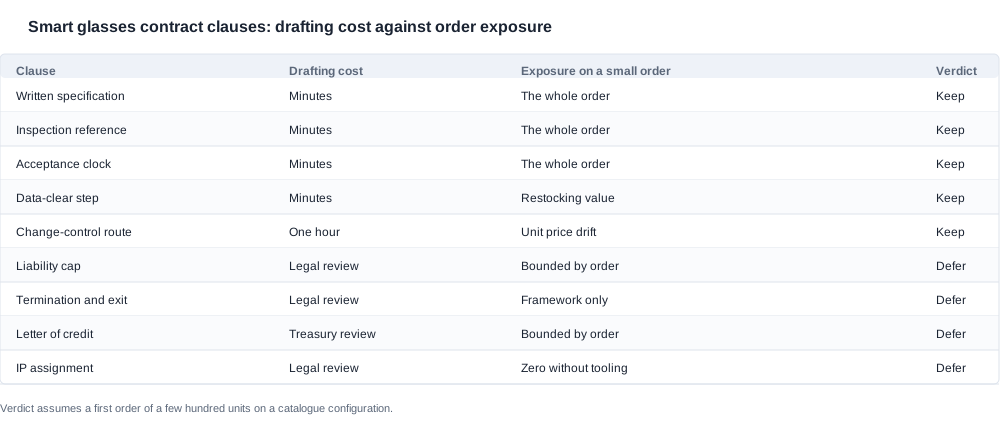
When to you can skip it smart glasses contract: clause triage by drafting cost, not by importance
Most buyers triage a supplier's standard contract by importance, which is the wrong axis. Importance is a property of the clause in general. What you need is the interaction between two numbers for this specific order: how long the clause takes to draft and agree, and how much of the order value sits behind it. A clause that takes two minutes to write and protects the whole order value is worth more than a clause that takes two weeks of legal review and protects a fraction of it.
That gives you three practical buckets rather than a list of important clauses.
The short clauses that carry the whole order
These are the specification annex, the inspection reference, the acceptance clock and the data-clear step. Each one is a paragraph, each one is uncontroversial, and each one is the reference point every other clause depends on. If the contract has nothing else, it needs these. The specification tells you what the supplier agreed to build, including what it explicitly does not do. The inspection reference names the approved sample and the count, so that an inspection can actually fail something. The acceptance clock sets the number of days you have to accept or reject and defines what rejection means. The data-clear step tells you who wipes the previous owner's recordings out of a returned camera unit before it goes back into stock.
The long clauses a first order can defer
Liability caps, termination and exit, the letter of credit, the intellectual property assignment on non-tooling work, and a full change-control regime. Each of these can be perfectly reasonable in a framework agreement, and each of them can consume the better part of a month of back-and-forth on an order where the exposure they cover is bounded by the order itself.
The clauses whose answer does not depend on order size
Two sit in this bucket and they are easy to misfile. The tooling clause flips the moment money has gone into a mould: if the brand has paid for tooling, the tooling clause is not skippable at any order size, because the tooling outlives the order by years and the exit clause has to say who owns it. And the confidentiality clause matters in proportion to what is being discussed, not to how many units are involved — a camera product with a private firmware branch is a different conversation from a catalogue audio model with a sticker.

When to you can skip it smart glasses contract: the arithmetic behind each deferral
The arithmetic is unglamorous and it is the whole answer. For each candidate clause, write two figures: the drafting cost in hours including legal review and the translation of your commercial intent into words someone will enforce, and the maximum plausible exposure that the clause actually reduces on this order. A clause is worth its drafting cost when the exposure it removes is larger than the cost of removing it, and the two numbers are not comparable until you put them on the same scale.
Three figures go into that comparison, and only three:
- The drafting cost in hours. The time to agree the wording, counting the legal review and the work of translating your commercial intent into language that somebody can enforce against a supplier who has already shipped the goods.
- The maximum exposure on this order. The largest loss you could realistically suffer if this clause did not exist and the thing it covers went wrong. On a first order this is bounded by what you paid, which is what makes the comparison possible at all.
- The value it carries beyond this order. Whether the clause still does useful work in the reorder, which is what decides whether deferring it costs anything later.
When the first figure is smaller than the second, the clause is worth writing. When the third figure is large and the first is not, deferring it is close to free.
Order size sets the exposure ceiling because a supplier's recoverable loss on a first order of a few hundred units is bounded by what you paid. That is what makes a first order a sensible learning order: you have decided in advance to accept a bounded loss in exchange for information about the product and the supplier. The deferral is only sound if the clauses that would have converted that bounded loss into a smaller one are actually in place, and in a small order those clauses are the four short ones rather than the long ones.
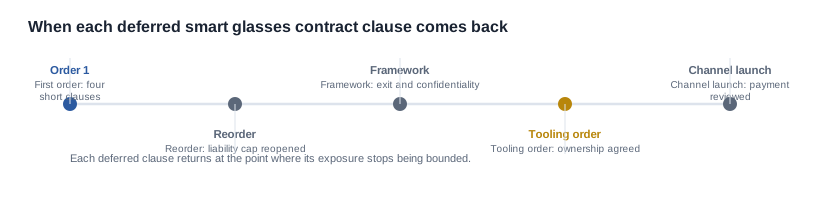
There is a second half to the arithmetic that buyers routinely miss, which is that a deferred clause is not free later. A liability cap negotiated in year one can be reopened at the point where the order value makes it matter, but it will be reopened from a weaker position if the relationship has already started. The practical rule is to defer clauses whose value arrives with scale, and to keep the clauses whose value arrives the moment something goes wrong.
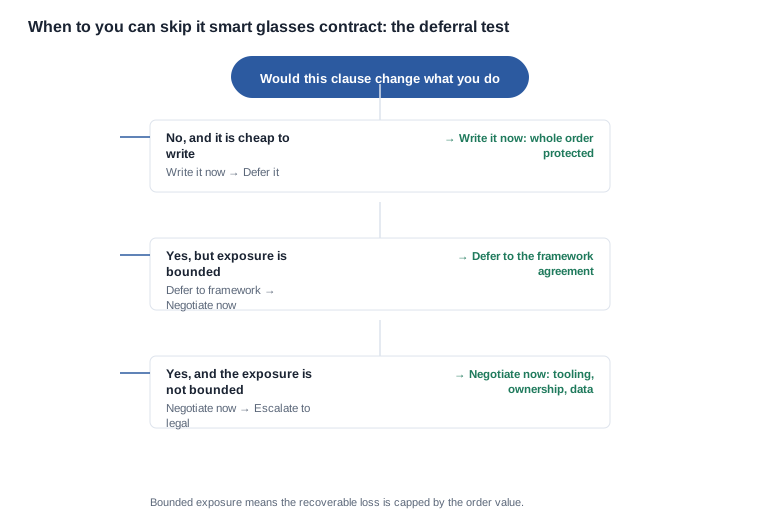
A third factor belongs in the same column: does the clause have a value outside this order? A termination and exit clause has value for a framework relationship because it decides who keeps the documentation and the tooling when a supplier is replaced. A letter of credit protects the payment, which is real but is usually covered by the buyer's own treasury decision. A confidentiality clause has value whenever the parties will exchange product plans, which is most of the time.
When to you can skip it smart glasses contract: the references a later reader can actually use
A contract is read after something has gone wrong, by people who were not in the negotiation, against events nobody predicted. That fact drives most of what makes a clause work. The clauses that fail are rarely the ones that say too little; they are the ones that point at something that is not in the contract at all.
The specification annex
One page, signed, describing what the product does and, at least as importantly, what it explicitly does not do. In this category the "does not" half carries unusual weight, because so much of the published range is not published in detail: no sensor model, no field of view, no video format, no frame rate, no low-light behaviour for the camera models, and no per-model certification line anywhere in the catalogue. A specification annex that says what the unit does and what has not been established is therefore more useful than one that restates a brochure, because it converts the gaps into agreed facts rather than into later misunderstandings.
The inspection reference
Name the approved sample, the number of units to be inspected, and the timing relative to shipment. An inspection without a reference cannot fail anything, because there is nothing for the unit to fail against. This is the highest return per line in the whole document: it converts a delivery dispute into a comparison, and it is the clause that links the contract to the sample you already paid for. If you want to know how to run that evaluation well, the sample evaluation pillar covers the method, and the sample policy checklist is the field list.
The acceptance clock and the payment trigger
These should be the same clock. The number of days the buyer has to accept or reject, what rejection means procedurally, and the moment the balance becomes payable. When they are the same clock, the money moves when the goods are accepted; when they are not, the money has moved before anyone has looked at the goods, and the buyer's only remedy is a claim rather than a refusal. This is the clause that makes the rest of the commercial negotiation coherent, and it is a short one.
The data-clear step
A returned camera glasses unit still holds the previous owner's recordings unless somebody erases them. The step belongs in the returns process rather than in the contract, strictly speaking, but it has to be agreed at the same time and written down, because it is the difference between a unit that can go back into stock and a unit that has to be destroyed. The quality consistency pillar covers the inspection side of the same question.

Read in that order, the four clauses have a dependency: the specification defines the standard, the inspection reference establishes the evidence, the acceptance clock defines the deadline, and the payment trigger converts acceptance into money. A contract that contains all four can be read by an outsider at three in the morning without a phone call. A contract missing the specification cannot be read at all, because there is no standard to read it against.

When to you can skip it smart glasses contract: where a small order goes wrong anyway
Deferring clauses is defensible. Deferring the four short ones is not, and the failure modes below are what a small order hits when the triage was done in the wrong order.
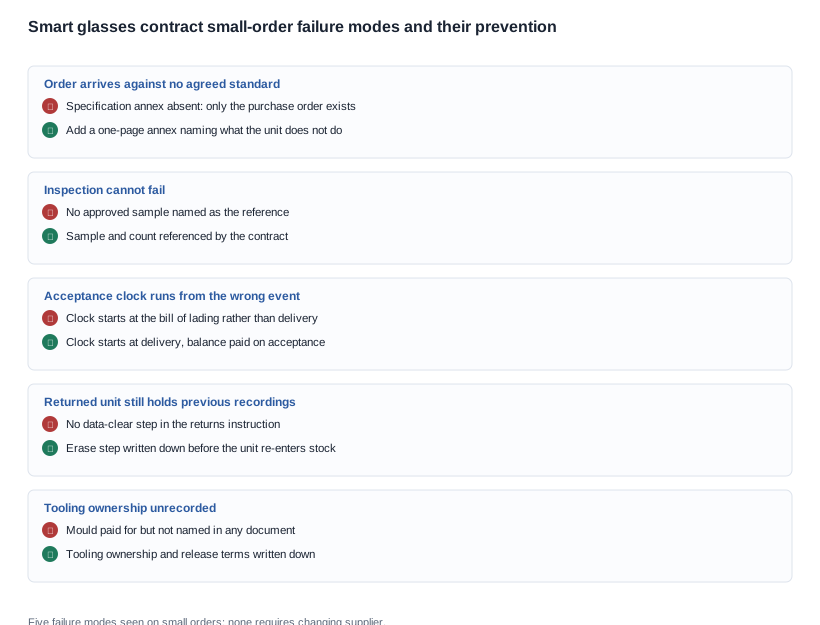
The order that arrives against a standard nobody agreed
The purchase order names a model and a quantity. The specification annex that would have pinned down the configuration was deferred as a formality. The supplier ships a configuration that satisfies the purchase order and not the product the buyer had in mind, and there is no document that says which of the two was intended. This is the single most common small-order failure in this category, and it is entirely a specification failure.
The inspection that cannot fail
Goods arrive, the buyer inspects them against nothing in particular, finds a unit that is not quite right, and cannot point to a line that says it should be. The rejection right existed on paper but had no reference, so the outcome becomes a discount negotiation rather than a rejection. This is why the inspection reference has to name the sample and not the specification. The two are different documents and only one of them tells you whether a unit conforms.
The acceptance clock that runs from the wrong event
The clock starts on the bill of lading date rather than on delivery, which quietly consumes the days the buyer needed to open cartons and run a functional check. Or the clock exists but the rejection consequence was never written, so a late rejection is treated as a late payment. Either way the buyer's remedy has been defined by default rather than by the contract.
The returned unit that comes back with somebody's holiday video still on it. The data-clear step was skipped as an operational detail rather than a contractual one. The unit cannot legally be restocked, and for a camera product that is a write-off of the unit plus the return freight. It is one line of process and it is the most expensive line to omit.
The tooling nobody mentions
A custom colour was ordered, a mould was paid for, and the contract has no tooling clause because tooling was "handled separately". When the relationship changes or the order is repeated, the ownership of that mould is a question rather than a fact, and the answer determines whether the second order is a purchase or a hostage negotiation. The OEM requirements checklist is the field-level list for a branded programme.
None of these five is exotic, and none of them is a reason to change supplier. They are reasons to write four short paragraphs and, on the strength of a small order, defer everything else.

When to you can skip it smart glasses contract: the negotiation worth having on a first order
There is a negotiation that pays on a first order, and it is not the one about price. It is the one about change control, because change control is what stops the small order from quietly becoming a custom order with the economics of a catalogue order.
A change-control clause does not need to be elaborate. It needs a route, a notice period, a price consequence and a named approver on each side. The reason it matters even at small scale is that the failure mode is not the large change, it is the small one. A firmware branch, a packaging print change and a colour adjustment are each cheap in isolation and each is treated as a request rather than as a change, and the sum of them is an order that no longer matches the price the buyer agreed to. A simple written route, applied to both the cheap and the expensive changes, is enough.
The letter of credit is usually not worth it at this scale, and it is worth being precise about why. It protects the payment against the supplier's non-performance, it costs fees on both sides, and it extends the payment cycle by weeks. On a first order where the exposure is already bounded by the order value, the protection is against a loss you have already decided to cap, while the cost lands on the cash cycle in the first quarter when cash is tightest. Where a buyer does want payment security at this scale, the cheaper version is a payment structure tied to the acceptance clock, because it protects the same money without the cycle.
Termination and exit is worth writing early precisely because it is cheap now and expensive later. What it has to decide is what happens to the tooling, the documentation file set, the approved sample and the records of the production run if the relationship ends. The contract supplier verification article covers the counterparty questions that a buyer should settle before agreeing the exit terms at all, because an exit clause that assumes a solvent, cooperative counterparty is not worth much.
The remaining commercial advice for a first order is short. Keep the change route, keep the acceptance clock tied to the payment trigger, keep the inspection reference, and let the legal reviewer see the draft in the same week as the quotation rather than the same week as the shipment. The contract practical advice article is the shorter version of that sequencing argument, and the contract terms pillar sets out the commercial context the clauses sit inside.
When to you can skip it smart glasses contract: a three-hundred-unit scenario
The scenario below is a reasoning exercise rather than a customer story. No client is described and no figures are claimed; the model, the quantity and the market are assumed so that the steps can be followed, and every product fact referenced is taken from the published catalogue.
The situation: a three-hundred-unit first order
A brand-side procurement manager is opening a camera-glasses programme for sale through a retail channel. The first order is three hundred units of one catalogue model in one colour, shipped to a single destination. The business case is a listing test: if the product works in the channel, a larger reorder follows in the same configuration. Nothing is being tooled, nothing is being customised beyond a printed box, and the total order value is small enough that the procurement manager knows the maximum possible loss without running a spreadsheet.
Step one: establish the exposure ceiling. Because the order value bounds everything, the liability cap can be deferred to the framework agreement, and the letter of credit can be dropped in favour of a deposit with the balance tied to acceptance. Both deferrals are recorded in the order file with the reason, which is what makes them defensible later.
Step two: build the four short clauses. The specification annex states the model, the colour, the packing configuration and, explicitly, the items the published range does not establish — the camera sensor detail, the field of view, the video format and the per-model certification line. The inspection reference names the sample the buyer has already tested and sets a count of units to inspect on arrival. The acceptance clock is set at a number of days from delivery, and the payment trigger is the same event. The data-clear step is written into the returns instruction and referenced by the contract.
Step three: apply the product's behaviour to the draft. Because the product is a camera model, the data-clear step is escalated from optional to mandatory, and because the order carries printed packaging artwork, the change route is given a named approver. The sample policy answer explains why a camera product in particular cannot be signed off on documents alone, and the MOQ case example shows the same three-hundred-unit shape treated from the volume side.
Step four: decide what is deliberately deferred. Liability caps, termination and exit, the letter of credit and the confidentiality clause are deferred to the framework agreement, with a note that the reorder will reopen them. The tooling clause is not deferred, because no tooling is being paid for on this order — which is exactly why the next order, if it introduces a custom colour, needs a fresh look rather than an assumed continuation.
Step five: record the decision. A short file holds the draft, the four clauses, the deferral list with reasons, and the date each deferred item will be revisited. The next order starts from that file rather than from a blank template, which is where the value of the exercise actually lands.
Concretely, narrow and we will state it plainly. We publish the product configuration and the capability gaps, and we will not present contract terms we have not agreed as a published policy, because a contract is a bilateral document rather than a property of a factory. What we can do is review a draft against the mapping above and tell you which clauses this product's actual behaviour makes urgent and which ones a first order can reasonably defer. We do not publish unit prices, minimum order quantities, capacity figures or lead times, and any draft that assumes otherwise will not survive its first factual question.
If you want to work through a specific order, send the model, the configuration, the quantity and the destination market, and we will tell you which clauses the product's behaviour makes non-negotiable on that order and which ones it does not. The contract supplier verification checks are the companion piece, and the full clause list sits in what to ask before ordering.


