

Smart glasses contract: what a red flag actually is
Reading a red flag
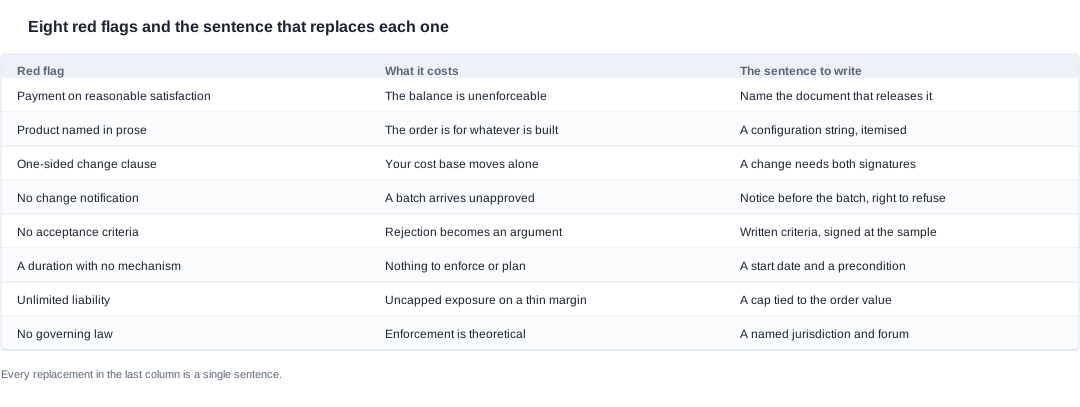
A red flag is not a reason to walk away from a supplier. It is a clause that will cause a specific, predictable problem later, and in this category it is usually fixable with one sentence before signature. The eight below are the ones that recur, written with what each one costs and what to write instead. The framing that makes them useful is that a red flag is a signal about how the supplier thinks, and the real question is not whether the clause can be repaired but whether you are willing to do business with that way of thinking. One clause that protects you can be a drafting oversight. A consistent pattern of them is a relationship that will keep producing the same problem in a different clause.
Who is reading this, and what they are trying to decide
The reader is a procurement manager on the brand side, a channel buyer or an importer, usually holding a draft agreement that somebody else negotiated and asking for a second opinion. The decision in front of them is usually a narrower one than they think: this clause gets fixed before signature, or this clause gets fixed before signature with a different supplier. That framing matters, because a red-flag list written as a screening tool produces paralysis — a hundred clauses, all of which could be argued about, none of which matter — while a red-flag list written as a repair list produces a document.
The second thing worth saying is that most red flags in this category are not hostile. They are the drafting defaults of a template that was written for a different kind of product, or the residue of a first negotiation where the point was never tested. "Delivery within thirty days" is not a trap; it is a sentence somebody wrote because it read as complete. It becomes a trap only because it lacks the mechanism that makes it enforceable, and by the time a buyer notices, the first shipment is in the water.
So the practical method is to separate the three kinds of finding. A clause that is present and wrong needs rewriting. A clause that is absent needs writing. And a clause that is present and correct but that the supplier resisted needs a different kind of attention, because it is the only one of the three that tells you something about the relationship.

The eight red flags, what each one costs and the sentence that replaces it
| Red flag | How it appears in the wording | What it costs you | What to write instead |
|---|---|---|---|
| A soft payment trigger | Payment on your reasonable satisfaction | The balance is unenforceable in a dispute | A named document that releases the balance |
| A blank configuration | Described as a model name in prose | The order is for whatever the factory builds | A configuration string, itemised |
| A one-sided change clause | The supplier may amend terms on notice | Your cost base changes without your agreement | Mutual change control with a price effect |
| No change notification | Silent about component substitution | A batch arrives that is not the approved one | Notice before the batch, with a right to refuse |
| No acceptance criteria | Subject to inspection with no criteria | Rejection becomes an argument | Written criteria, signed before the sample |
| A duration with no mechanism | Delivery within thirty days | Nothing to enforce and nothing to plan | A start date, a stage plan and a precondition |
| Unlimited liability | Liability for all loss arising | An uncapped exposure on a low-margin order | A cap, and an indemnity that is mutual |
| No governing law | Silent on jurisdiction and forum | Enforcement is theoretical | A named jurisdiction and forum |
The three that cost the most
A soft payment trigger. "Balance on your reasonable satisfaction" appears in a great many agreements and it is close to worthless. Satisfaction is a state of mind, it is not measurable, and it is decided by whoever is arguing. A buyer holding this clause has no balance protection at all, which means every other term in the agreement is a promise rather than an obligation, because there is no financial consequence attached to breaking one.
The rewrite is short: name the document that releases the balance. A third-party inspection report, a signed acceptance note against written criteria, or a bill of lading. One of those three, and the clause becomes enforceable, and the rest of the agreement becomes worth reading.
A blank configuration. A contract that describes the product as a model name in prose has left the most important thing unspecified. The catalogue is a good illustration of why. A 13 MP platform on a 290 mAh cell with a 1400 mAh charging case and an 8 MP platform on a 220 mAh cell with magnetic charging are both "a smart glasses model", and they are different products with different costs, different runtimes, different packaging and different prices. One of them also publishes no charging interface at all, so "the camera model with the case" is not a configuration for either of them.
The rewrite is a configuration string: resolution, cell capacity, charging interface, case configuration, colour, logo treatment, packaging and firmware build, itemised, with the unit price against it. The camera and audio range is the reference for which values exist and which are still open.
No change notification. The omission is easy to miss because nothing is being refused. It is simply not there, and in a category where cells, sensors and chips are all bought through distributors, substitution is a normal operational event rather than an exception. The published specification rows do not move when a same-capacity cell changes, so nothing in the documentation will catch it either.
Without the clause, a component can change and a batch can arrive that is not the batch the golden sample was built from, and the buyer discovers it at the goods-in gate. With it, the supplier gives notice before the batch and the buyer has a right to refuse it, which is a much cheaper place to discover the problem.
The two that arrive dressed as reasonable
A one-sided change clause. "The supplier may amend these terms on thirty days' notice" is often explained as a way of keeping the agreement current, and it is occasionally a good-faith request. The problem is the asymmetry: a change to price or delivery terms is a change to your cost base, and accepting it unilaterally is a structural loss of control rather than a detail. The buyer who agrees to it has not given up a negotiating point; they have agreed to be told.
The rewrite keeps the intention and removes the asymmetry: a change to price, delivery or configuration requires agreement, and a change requested by the supplier that you do not accept lets you cancel the affected balance without penalty. Notice with a right to cancel is a fair clause, and it is much closer to what a careful supplier expects than a rejection would be.
Unlimited liability. This one usually appears as standard supplier boilerplate and is usually intended to protect the buyer, so refusing it outright can read as unreasonable and can cost you goodwill for no commercial gain. The workable position is to ask for a cap tied to the order value, with the obvious carve-outs, and to check that the indemnity runs in both directions. A supplier that will not cap its liability is telling you something specific about how it sees risk, and it is worth weighing that separately from the clause itself.
The red flags that are missing rather than badly worded
Missing clauses are harder to see than bad ones, and they are the ones that matter most. A badly written clause at least announces itself, and a buyer who has read the document knows to question it. An absent clause leaves no trace, and the buyer's attention goes to what is present.
Three absences account for most of the trouble in this category.
No acceptance criteria. A draft that says the goods are "subject to inspection" without saying against what has left the buyer's only leverage in the hands of whoever holds the file. The rewrite is written criteria, signed before the sample rather than after it, and it does not need to be long: the criteria that matter most in this category are the ones that catch a fault that presents slowly, such as a unit that does not charge correctly from its case and therefore appears in the field as a unit that runs out by the afternoon.
No definition of the delivery date. "Delivery within thirty days" has no start event, so it is a duration without a trigger. The rewrite names the date — ready, shipped or arrived — and names the event that starts the clock, and says what happens if that event is late. The advanced guide covers the clauses that only matter once money is in the system, and the delivery date is the first of them.
No tooling and artwork exit. What happens to the tooling, the design files and the production records if the programme ends early or changes direction. This is the absence that is most often discovered at the worst possible moment, because by then the value is at stake and the argument is about the value rather than about the wording. It is also the cheapest clause in the agreement to write, at the point where nobody is invested in arguing about it.
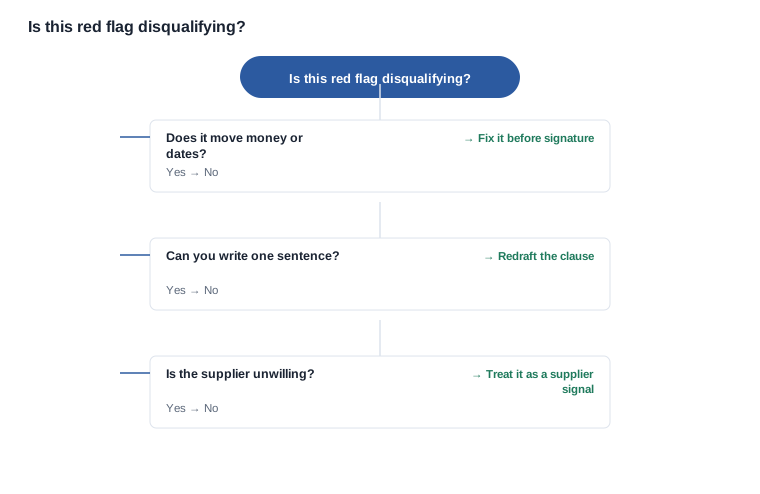
The three questions in that tree are worth running in order, because they escalate. A flag that moves money or dates needs fixing before signature. A flag that can be fixed with one sentence needs writing, and the supplier's response to that is informative. A flag that the supplier is unwilling to fix is not a drafting problem at all — it is a signal about the relationship, and it is the only one of the three that should change who you work with.

How to read a draft for red flags in one pass
Read the contract once for the eight red flags in the table, and then read it once more for the three things that are missing rather than the things that are present. Missing clauses are harder to see than bad ones, and the three that matter most are the change-notification clause, the acceptance criteria and the definition of the delivery date.
Then check the number that everything else depends on. The minimum order quantity, the price tiers, the capacity slot and the lead time in our own documentation are not published as standing figures, and the reasons are specific: our source material records three conflicting internal positions on the minimum order quantity, and capacity and lead time move with the order and the week. A contract that leaves those numbers blank is a contract that will be renegotiated at the worst possible moment, so they have to be written into the order itself.
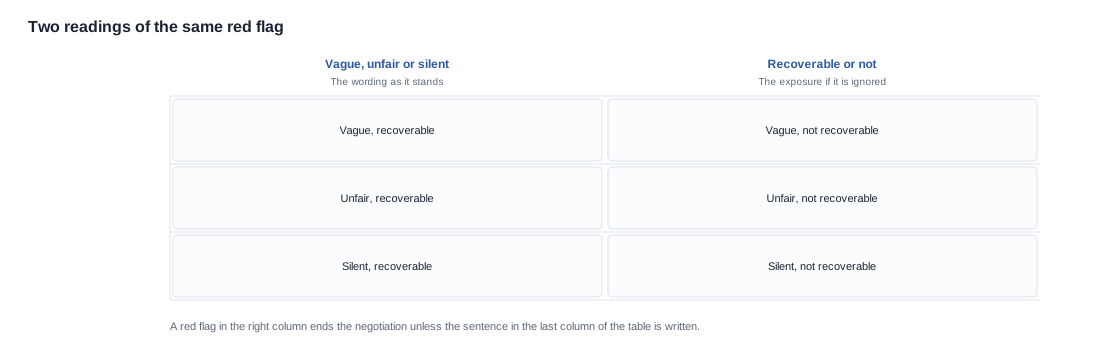
The matrix below is the summary version. A red flag that is both serious and not recoverable is a reason to pause before signature rather than a reason to walk away. A red flag that is serious and recoverable is an afternoon's work. The two on the left-hand column are the ones that get missed, because a clause that is merely unfair reads like a negotiation position, and a buyer who assumes the other side has a reason for it will not push.

The red flags that only bite at the reorder
Four of the eight red flags in the table above are visible on a first order, because a first order is small, close and supervised. The other four are invisible on a first order and expensive on the second, and they are the ones worth arguing about while the relationship is still new and the volume is still small enough to be worth something.
The configuration that was frozen once and never reopened. A configuration freeze with no rule for reopening it becomes, over time, a specification that describes the first order rather than the current one. The second order arrives with a battery that has quietly changed, a firmware build that has moved on, or an artwork file that was updated in the middle of the year, and the buyer discovers that the approval that was granted was granted for something else. The clause that prevents it is the one that says what a change is, who proposes it, what it costs, and what it does to the schedule — and the discipline that says a change is a change even when the published specification row does not move.
The acceptance window that nobody reopened. A first order is accepted in a week. A second order arrives in a month, or after a holiday, or when the person who wrote the inspection instruction is on another programme. The window in the agreement stays at the same number of days, and the inspection that it was written to prompt is the first thing that gets skipped. A clause that says the window runs from a defined event, rather than from delivery, and that the inspection instruction travels with the shipment, is what keeps it alive in the second order.
The tooling clause written for an ending that did not happen. Most first programmes end by being extended, not by ending, so the tooling clause is written and then never used. It sits in the file, unexamined, until the second or third year, when a supplier change or a volume collapse makes it live, and by then it is being read for the first time by two parties who have no shared history. Writing it correctly at the start costs an hour. Interpreting it in year three costs months.
The file that only the supplier holds. The compliance and technical file was assembled for the first order and the assumption was that it would simply continue to exist. In practice, files move with people. When the person who held it leaves, the file becomes a laptop and a memory, and the buyer who assumed a five-year retention period discovers that the evidence supporting a product already in the channel cannot be produced. The clause is a named holder, a stated location, and a retention period, and it is worth checking that the supplier's answer to "where is it" is a place rather than a person.
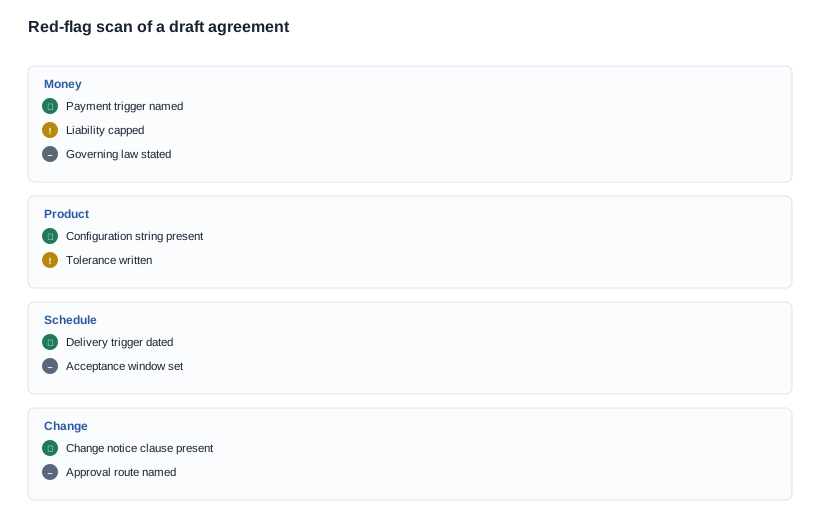
There is one more reading worth doing, and it takes longer. Read the draft for what it says about the two situations where the relationship will be tested: a unit that does not match, and a date that slips. Almost every agreement handles those two situations adequately, and almost every agreement handles them by describing a process without giving it an owner, a deadline or a consequence. Those are the two situations where the red flags above actually bite, so they are the two worth reading twice.
One red flag will sometimes be unfixable, and the decision about what to do with it is a procurement decision rather than a drafting one. A supplier that will not accept a cap on liability, or that insists on retaining the right to amend price on notice, is telling you how it will behave when the programme is under pressure. The useful response is not to refuse the order over it. It is to price the behaviour into the commercial structure instead: a higher deposit, a shorter payment window, a smaller first commitment, or a volume commitment that the supplier can lose. A clause you could not get is a risk you have to hold somewhere, and holding it in the payment schedule is usually cheaper than holding it in the quality of a relationship you are counting on.
What we publish, and what we will write into a contract for you
We publish the per-model configuration facts that belong in a contract: resolution, cell capacity, charging time, the rated runtime with its caveat, the charging interface, the case configuration, the Bluetooth version, the colour options and the customisation scope. These are the rows a configuration string is built from, and they are the reason a contract in this category can be specific.
We mark as Not published the frame weight of every model except the one body weight the catalogue states — 158 g for the MT6 glasses body, including its cell and camera, and excluding its foldable charging case, whose 1200 mAh capacity is published but whose own weight is not. The sensor part numbers, the field of view, the ingress test report numbers, the certification numbers and the AI implementation details are not published either. The catalogue's export certification line is a company-level capability rather than a per-model certification row, and no per-model approval can be inferred from it.
We will write the configuration, the minimum quantity, the price tiers, the delivery basis, the acceptance criteria and the change-notification commitment into the contract, and we will set the capacity slot, the lead time and the payment terms for the specific order rather than publishing a table that would be wrong for most orders. Where a term cannot be met, we will say so at quotation rather than at the shipping date, and we will mark any term we cannot meet as one we cannot meet.
The contract terms section sets out the clauses in drafting order. If you want to see what a repaired version of a red-flagged draft read end to end, the worked contract example is the longer read, and the first-order checklist is the short one.
Send us the draft and the model code, and we will mark up the red flags we can see, tell you which of them are repairable in a sentence and which of them are structural, and say which of the eight we would expect to find in a first agreement with any supplier in this category.
Related reading
Send the draft and the model code, and we will mark up the red flags, separate the repairable from the structural, and say which ones any supplier in this category would have.


