
A smart glasses contract is usually negotiated in the wrong order. Both sides open with the clause that is easiest to talk about — the unit price — and save the clauses that decide the outcome until the end, when there is no time left and no leverage left either. The order that works is the reverse: specification first, then the evidence, then the money, then the remedy. Here is the clause list in that order, what each one is actually worth, and which of them are structural and which are simply traded.
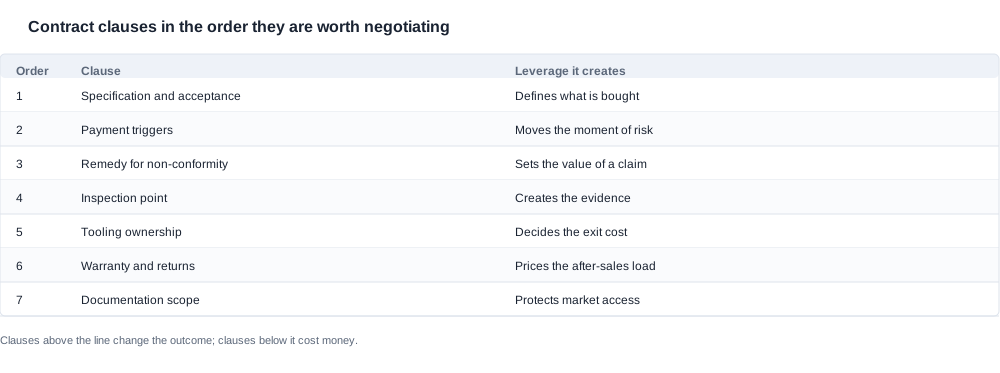
Smart glasses contract: the order the clause file is written in
The buyer reading this, and what the contract is for
The reader is a brand-side purchasing manager, a channel buyer or an importer who has agreed a commercial deal and now has to turn it into an agreement that survives contact with a production run. They have usually already had the price conversation. What they have not usually done is work out which clauses carry the outcome.
A contract in this category does four jobs, and they are not equal in weight.
It defines what is being bought. This is the largest and most neglected job, because a model name in a contract describes a family of possible products rather than one product. In our catalogue the camera models alone split into two published sensor tiers, eight megapixels across eight models and thirteen megapixels across three, and the charging-case position splits into five camera models with a published capacity, two with a case whose capacity is not published, and four with no charging-case row at all — the V03 and the S7, and the V06 and the V03 Pro.
It creates the evidence. A clause that says the goods shall conform to the specification is only as good as the specification. A clause that says the buyer may inspect before the balance is paid only works if there is a window in which the inspection can happen.
It moves the money. Payment terms decide when the buyer is committed and when the risk is the buyer's, and in this category those are separate decisions that are frequently made together by accident.
It prices the failure. The remedy clause is the only place where a defect, a delay or a documentation gap acquires a value. A contract without one does not prevent the problem; it removes the buyer's ability to respond to it.
The negotiation order follows from that list. The first three clauses exist to make the fourth one worth something.
Why the price is the wrong place to start
The price is the most discussed and the least consequential clause, because in this category the unit price is largely a function of a configuration that is already determined. What changes the buyer's outcome is not the number on the invoice but whether the number is the right number for the thing that arrives.
Negotiating the price first also spends the buyer's leverage. Price is the clause the supplier has the most reason to defend and the buyer the least ability to win without volume. Specification, evidence and remedy are clauses where the buyer has genuine leverage, because they are about the supplier's own process and the supplier would rather agree than re-explain.
The point at which leverage actually sits
There is a moment in a negotiation where the supplier's cost of continuing to disagree is higher than the cost of agreeing. For most clauses in this category, that moment is early — before the drawing is approved, before the sample is produced, before the tooling is cut. After that point, the supplier's exposure has grown and the buyer's alternatives have not.
This is the practical reason the order matters. Clauses settled late are settled from a weaker position, and the buyer usually does not notice the difference because the clause was signed either way. The order is therefore not a stylistic preference; it is the difference between negotiating and accepting.

The clauses that decide the outcome, ranked by leverage
First: the specification, written out rather than referenced
The single most valuable clause in this category is a definition of the product that is specific enough to be tested. A model designation alone is not a specification, because it leaves open every variable the catalogue leaves open.
The version worth negotiating names the model, the accessory position, the charge method where it is published, the camera resolution tier, the firmware build, the artwork and packaging position, and the destination market whose documentation is in scope. It attaches the acceptance criteria as a schedule rather than referring to a document the supplier controls.
That last point is the negotiation, and it is usually the hardest. An attachment that the supplier has not reviewed and accepted is not a specification; it is a document the buyer wrote. The clause worth getting is one where the attachment is referenced as an agreed schedule with a revision number.
Second: the acceptance criteria and the inspection point
These two clauses are one negotiation, because the criteria are useless without somewhere to apply them. The question to settle is where conformity is checked — before packing, at origin, or after arrival — and the clause should say which, what is checked, and what the result is called.
The commercial consequence of getting this wrong is larger than it first appears. If conformity is checked at destination, the buyer has released the balance, the goods are in the warehouse, and the remedy discussion starts from a position where the money is gone. If it is checked at origin, the buyer has a claim with evidence attached while the goods are still the supplier's problem to fix.
Third: the payment triggers, tied to documents
The payment clause should name documents rather than describe events. A balance released against the bill of lading copy is verifiable; a balance released "after shipment" is not, because shipment means at least three different points in a factory workflow.
The negotiation is about where the trigger sits relative to the inspection. Releasing the balance after the inspection report is issued is a stronger position for the buyer than releasing it against the shipping documents, and it is the clause where the two negotiations — evidence and money — either reinforce each other or cancel out.
Fourth: the remedy, and what happens to a rejected batch
A remedy clause names the outcome, not just the intention. Credit, replacement, rework or refund — which one, decided by whom, within what deadline, and what happens if the remedy itself does not solve it.
Without this clause, a rejected batch is settled on the same schedule as an accepted one, which means the buyer has paid in full for goods that are not what was ordered. The contract comparison table is the reference for how this clause is usually drafted, and the pricing hidden costs article covers the costs that appear when it is missing.
Fifth: tooling ownership, which decides the cost of leaving
Who owns the tooling is a clause that gets treated as a formality and that turns out to decide the price of ending the relationship. A buyer who owns the tool can move the programme, sub-contract it, or sell it. A buyer who does not own it has to negotiate a second time, from a position where the supplier knows the programme has nowhere else to go.
The related question is what happens to the tool if the supplier ends production, and whether the buyer can move it to another supplier. This is the tooling ownership question, and it is worth settling before the first order rather than at the end of the last one.
Sixth: warranty and returns, which price the after-sales load
The warranty clause is where a supplier's view of its own product becomes visible, and it is often absent. Ask for the period, the party who services it, and the event the period runs from. That last item is worth more than the first two, because the difference between a warranty that starts at the shipment date and one that starts when the goods enter the channel is a month of warehousing on every unit in the order.
Seventh: documentation scope, and the market it protects
The final clause is the documentation scope: which model designations are covered, by which file, for which destination markets, and what happens if the model designation changes.
It belongs in the contract rather than in an email because the catalogue publishes no per-model certification row for any of its twenty-eight models, and its text contains no CE, FCC or RoHS marking. A buyer therefore cannot verify from the catalogue that a file exists for a given designation; the only reliable basis is an agreement that names the designations and requires that they be kept in step with the order.
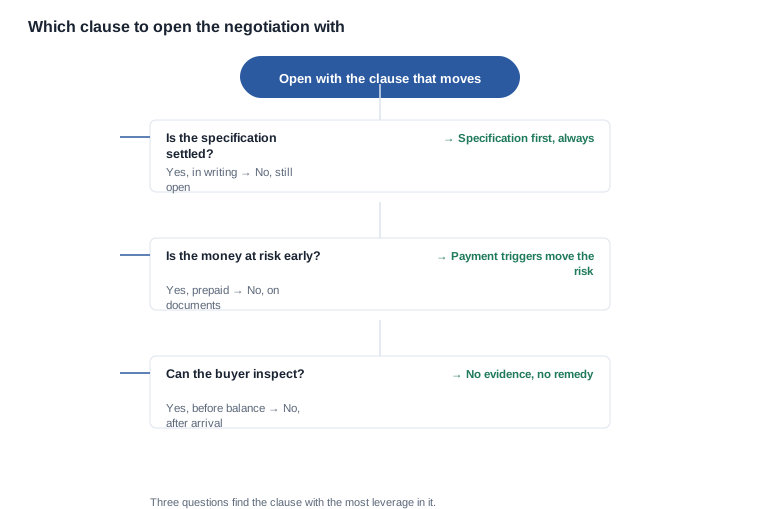
The clause list to put on the table, and the order to put it in
Round one: scope
The first round settles what is being bought. It is short, and it should be written rather than discussed.
- The model and configuration, named per line of the order.
- The accessory position, per model, since the catalogue leaves it open for several camera models.
- The charge method where it is published, and an explicit request for it where it is not.
- The firmware build identifier.
- The artwork and packaging position, and who owns the packaging tooling.
- The destination markets whose documentation is in scope.
Round two: evidence
The second round settles where conformity is checked and what the result is called. The items are the acceptance criteria, the inspection point, the sampling rate and acceptance number, the defect classes covered, the first-article check, the changeover re-check, the reject disposition procedure, and the deadline for the report to reach the buyer.
The lead time schedule template is usable here, because the inspection point has a date attached to it and a date is what makes it real.
Round three: money and remedy
The third round settles the payment triggers, the deposit percentage and its trigger, the currency, the bank charges, the remedy, and the linkage between the two. The linkage is the clause worth fighting for: the balance is released after the inspection report is issued, and a rejection stops the release.
The payment terms negotiation guide covers that clause set in more detail, and the pricing buyer checklist is the right preparation for the commercial round.
Round four: the rest
The fourth round settles tooling ownership, warranty and returns, confidentiality, the term of the agreement, and what happens on termination. None of these is as valuable as the first three, and none of them is worth losing the first three over.
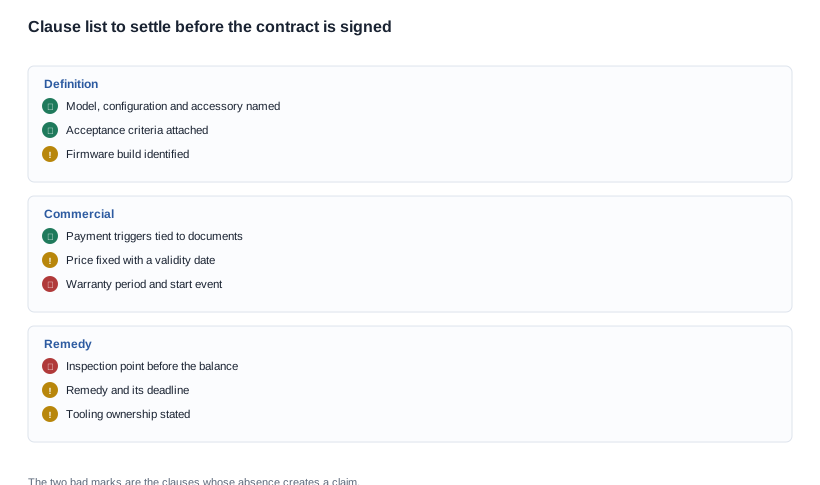
The negotiation order as a timeline
The chart below shows the four rounds. It is worth noticing where the timing sits relative to the production sequence: the rounds that carry the most leverage are the ones that happen before the tooling is cut, and by the time the goods are on the water there is no negotiation left to do — only a remedy to invoke.
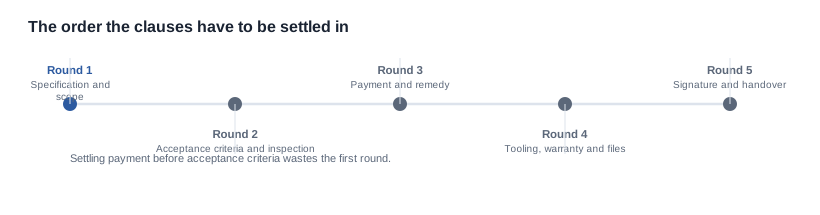

What can be traded and what is structural
The clauses in this category are not all the same kind of object, and treating them the same is what makes a negotiation feel like a series of disappointments.
Structural clauses are set by the physics and the paperwork of the transaction. The charge method on a model where the catalogue publishes one is structural; so is the number of cells in a carton. A buyer who tries to negotiate these is negotiating against a fact, and the attempt costs credibility that would be better spent on the clauses that can move.
Scope clauses are set by the market and the programme. The documentation scope, the number of destination markets, the number of models in the order. These are choices rather than facts, and they can be changed — usually at a price, and usually by removing something rather than by adding it.
Commercial clauses are genuinely traded. The deposit percentage, the trigger document, the inspection point, the sampling rate, the remedy, the warranty period. These move with the relationship, the volume and the order book, and they are where a buyer's preparation pays.
The practical discipline is to sort the clause list before the negotiation starts, because a buyer who spends their preparation arguing about a structural clause arrives at the commercial ones unprepared. It is also the fastest way to make a negotiation shorter, since a buyer who does not argue about the obvious is taken more seriously on the rest.
The two questions that settle most negotiations in this category
What does the buyer need the contract to do that it does not do now? This reframes a list of wants into a single objective, and it makes the trade-offs legible. A buyer who needs the contract to protect against a documentation gap can accept a narrower warranty; a buyer who needs it to protect against a scheduling failure cannot.
What is the buyer's alternative? Not rhetorically, but concretely: which other supplier, with what configuration, at what price and in what timeline. A buyer with a credible alternative negotiates differently from a buyer who has none, and the supplier knows the difference immediately. This is also why the lead time supplier verification article and the sample programme work matter commercially and not only operationally.

Where a well-negotiated contract still fails in operation
The attachment that was never agreed
What happens. The contract refers to an acceptance criteria document, the document exists, and the supplier never signed it. A rejection is met with the observation that the criteria were never part of the agreement.
Why it happens. The attachment was drafted by the buyer and attached as a courtesy. Nothing in the negotiation made it a schedule.
How it is avoided. Make the attachment a numbered schedule, referenced by revision, with a clause that changes to the specification require a written re-issue and a re-approval of the sample.
The designation that drifted between the quote and the order
What happens. The contract names a model designation, the purchase order names the same model with a different accessory, and the documentation for the first one is what travels with the goods.
Why it happens. The accessory position is genuinely open in the catalogue for several camera models, so a change of case is not obviously a change of model, and nobody treats it as a specification change.
How it is avoided. Define the configuration by its contents and its published rows, not by its name, and require that a change to any of them re-opens the documentation scope.
The inspection window that closed before the buyer used it
What happens. The contract provides for an inspection at origin, the buyer did not appoint anybody, and the goods shipped. The right existed and was not exercised.
Why it happens. The clause was written without a date, without a notice period and without a consequence for the window closing. An inspection right that nobody has to arrange is not an inspection right.
How it is avoided. Attach a notice period, a named contact and a deadline for the result, and write what happens if the buyer does not exercise the right — because in a live programme, that will happen at least once.
The remedy that was exercised and was not funded
What happens. The buyer rejects a batch and invokes the remedy, and the supplier agrees to a credit note and then does not issue it. The dispute is now about collection rather than about the goods.
Why it happens. The remedy was written as a replacement, which the supplier can perform with goods it has not yet paid for, rather than as a credit or a refund, which the buyer's cash flow can absorb.
How it is avoided. Agree the form of the remedy at the outset, and put the credit against the next order's invoice rather than as a separate payment. A remedy that is applied automatically is a remedy that works.
What we will negotiate, and what we will not pretend to negotiate
Our own standard payment terms, the deposit percentage, the warranty period and the clause set we propose are Not published, because in this category they are agreed per order against a specific configuration, a quantity, a destination and a market scope. We will put all of them on the table in the first round rather than in the last, which is our position on the negotiation order as much as on the individual clauses.
What we will do, against a named order, is write a specification with the configuration and the accessory position filled in rather than left open, attach the acceptance criteria as a schedule, name the charge method for the models where the catalogue publishes it, state clearly which attributes are not published for a given model, and mark the documentation scope for the destination markets in question.
What we will not do is claim a certification we cannot evidence. The catalogue publishes no per-model certification row for any of its twenty-eight models and its text contains no CE, FCC or RoHS marking, so when a buyer asks us what documentation exists for a model, we answer with the files we hold and with the designations they cover — not with a general assurance. Where a designation has no file, we will say so, because a contract that promises a file nobody has is a contract that fails on a schedule the buyer cannot see coming.
Send us the models, the quantity, the destination market and the clauses you want on the table, and we will answer against the specific order rather than against a policy page.
Related reading
- Procurement contract pillar
- Contract comparison table
- Payment terms negotiation guide
- Pricing buyer checklist
- Pricing hidden costs
- Lead time schedule template
- Lead time supplier verification
Tell us the models, the quantity and the destination market and we will put our clause positions on the table in the first round.