

A smart glasses factory audit glossary is only worth reading if every term in it changes a number, a date or a document. A list of definitions is decoration. A list of definitions paired with the precise question each term should provoke is a procurement instrument, and it is the difference between a supplier's word and a clause you can enforce.
The terms that cause the most trouble in this category are not exotic. They are minimum order quantity, lead time, capacity, certification, customisation and tooling, and they cause trouble for the same reason: they are used in a quotation with the same words a buyer uses in a contract, but they carry a different obligation. "Lead time" in a quotation is an estimate. "Lead time" in a purchase order is a commitment with a remedy attached. Nothing in the sentence distinguishes them.
Smart glasses factory audit: a decision tool, not a vocabulary list
The buyer, the moment, and the three words that cause trouble
The people who need this vocabulary are usually in one of three positions. A sourcing manager comparing two quotations whose numbers do not reconcile. A channel buyer reading a contract for the first time after a first consignment has already gone wrong. Or a brand owner whose legal team has returned a contract marked up in four places, each mark-up pointing at a term that was never defined.
What all three share is a vocabulary problem rather than a knowledge problem. Nobody in these situations lacks information; what they lack is a shared understanding of what a term commits the other side to. The practical consequence is that the conversation moves from numbers to adjectives, and adjectives do not go into a purchase order.
Three phrases do most of the damage. "Certified" tells you nothing unless it names the instrument, the issuing body, the model and the date. "Industrial grade" tells you nothing unless it names the standard it is measured against. "As per sample" tells you nothing unless the sample is retained, identified and bound to the order. Each of those phrases appears in quotations in this category every week, and each of them converts a specific obligation into an impression.

The eight terms that change a number, a date or a document
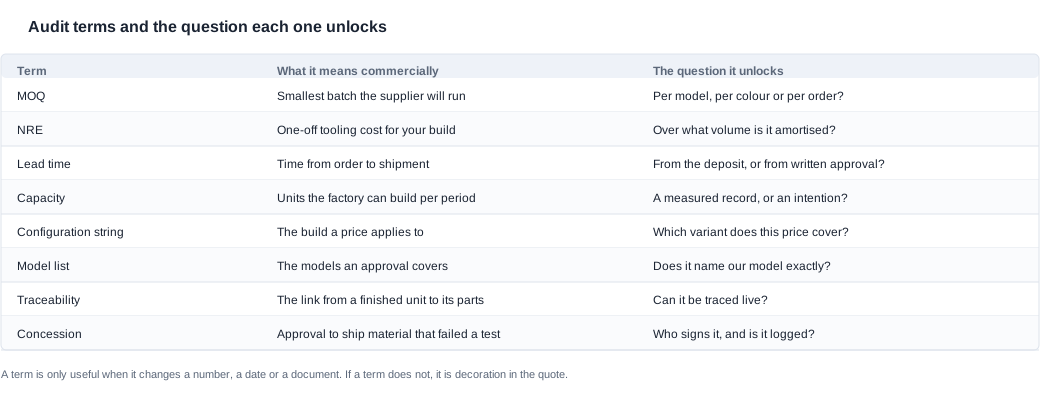
The table below is the working subset. Eight terms, each with what it means commercially and the question it should provoke when it appears in a quotation or a contract.
| Term | What it means commercially | The question it unlocks |
|---|---|---|
| MOQ | Smallest batch the supplier will run | Per model, per colour or per order? |
| NRE | One-off tooling cost for your build | Over what volume is it amortised? |
| Lead time | Time from order to shipment | From the deposit, or from written approval? |
| Capacity | Units the factory can build per period | A measured record, or an intention? |
| Configuration string | The build a price applies to | Which variant does this price cover? |
| Model list | The models an approval covers | Does it name our model exactly? |
| Traceability | The link from a finished unit to its parts | Can it be traced live? |
| Concession | Approval to ship material that failed a test | Who signs it, and is it logged? |
Two of these rows carry most of the commercial weight, and both are about the same thing: the difference between a number that describes a facility and a number that describes your model. Capacity is the classic example. A factory that states one capacity figure for the whole range is describing its floor, not your line, and a buyer who treats it as a per-model figure will discover the difference when a second programme is added and the first one slows down. The MOQ row has the same structure, and the question "per model, per colour or per order" is the one that changes the cash cycle.
How to read a term that arrives without a definition
When a term is used without a definition, there are three possible reasons and each one calls for a different response.
The term has an internal meaning the buyer does not know. This is the most common case with minimum order quantity and with lead time, and the response is to ask for the definition rather than to assume one. The cost of asking is one email; the cost of assuming is a missed commitment.
The term means several things and the parties have not chosen. "Customisation" in this category can mean a colour, a logo, a firmware image, a packaging change or a changed configuration. Those five have wildly different costs, and in two of them the change invalidates a published marking or an approval. The response is to enumerate the possibilities in the contract rather than to pick one.
The term is doing decorative work. "Industrial grade", "professional grade", "military specification", "enterprise quality". These phrases carry no measurable content, and the giveaway is that no document behind them can be produced. The response is not to argue about the phrase; it is to ask what measurable property it asserts, and to accept silence as the answer.
The third case is the one that quietly sets the tone of the whole negotiation, because a supplier who uses decorative language in the quotation will use it in the contract.
The same word, two contracts, two different obligations
Vocabulary problems become expensive when a term crosses from a document that informs into a document that binds. A buyer who treats a catalogue specification as a commitment has no remedy; a buyer who writes the same content into the purchase order has one.
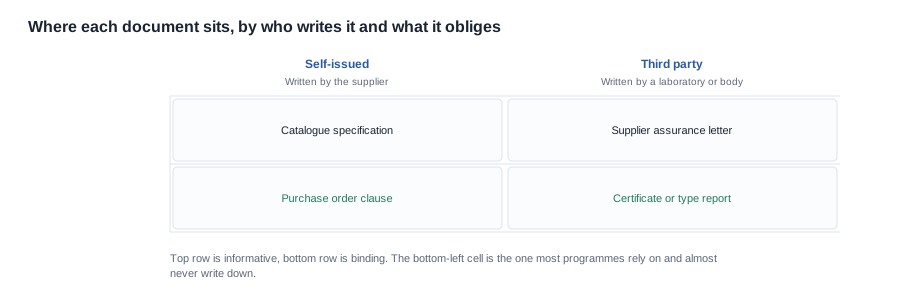
Read the diagram as a two-by-two. The top row is informative: a catalogue specification and a supplier's assurance letter tell you what somebody believes, and you can use them to plan but you cannot refuse a shipment on them. The bottom row is binding: a purchase order clause and a certificate or type report are both enforceable, and they are enforceable in different ways. A clause is enforceable against the supplier. A certificate is enforceable by whoever the certificate names, which in the European market means the holder of the approval, and that is usually you rather than your supplier.
That distinction has a practical consequence for how you write. If a term that matters commercially only exists in the catalogue, you have not agreed anything; you have observed something. Moving it into the bottom-left cell of that diagram is the entire point of a procurement exercise, and it costs nothing except the discipline to write the sentence.
Why the same word appears in a catalogue and in a clause
A supplier is not being evasive when the same term means different things in two places. The catalogue is written to be attractive and the clause is written to be enforceable, and those are different jobs.
The pattern is consistent enough to be useful. Terms in a catalogue describe a product family, a typical build or a best case. The same term in a contract fixes a specific build, a specific quantity and a specific date. "Water resistant" in a catalogue page and "protected against splashing water from any direction" in a clause are not a contradiction; they are two levels of precision, and the clause is the one that survives a dispute.
The buyer's job is to notice when a clause has inherited catalogue vagueness. The tells are recognisable: a term with no measurement method, a quantity with no unit, a date with no starting event, and a compliance claim with no instrument behind it. Each of those four can be written into the contract in a single sentence, and each of them is worth more than the entire negotiation over unit price.

Turning a term into a clause
The seven steps below are how a word on a quotation becomes an obligation that survives contact with a shipment.

Step one: name the term and ask what it obliges the supplier to do. Not what it means in general, but what it commits them to. "MOQ 500" means nothing until you know whether five hundred is per model, per colour, or per shipment, and whether it applies to the first order or to every order.
Step two: ask which document carries it and who can verify that document. This separates the two rows of the matrix above. If the only carrier is the catalogue, the term is informative and you have to move it.
Step three: convert the obligation into a measurable condition before you order. "Lead time 35 days" becomes "35 days from written approval of the sample, to the date of loading". A measurable condition has a start event, an end event and an object, and every term in a contract should have all three.
Step four: write it into the purchase order as an acceptance criterion. This is the step that converts a term from a description into something you can refuse a lot for, and it is the step most often skipped because it feels pedantic at the point where everyone is being agreeable.
Step five: name the evidence you will accept as proof, and where you will check it. "Certified for the European market" is not evidence. A report number, an issuing body, a standard and a model designation are evidence, and they can be checked against the unit in your hand.
Step six: set the date the evidence goes stale and what has to be re-issued. Every approval, licence, calibration record and technical file has a version or a date, and the contract should say what happens when it changes.
Step seven: agree who pays when the evidence arrives late, or does not arrive. This is the clause that decides whether the vocabulary work was worth doing. A late document costs a buyer far more than the cost of the document, and if the contract does not say so, the buyer pays.
The questions a shared vocabulary should let you ask
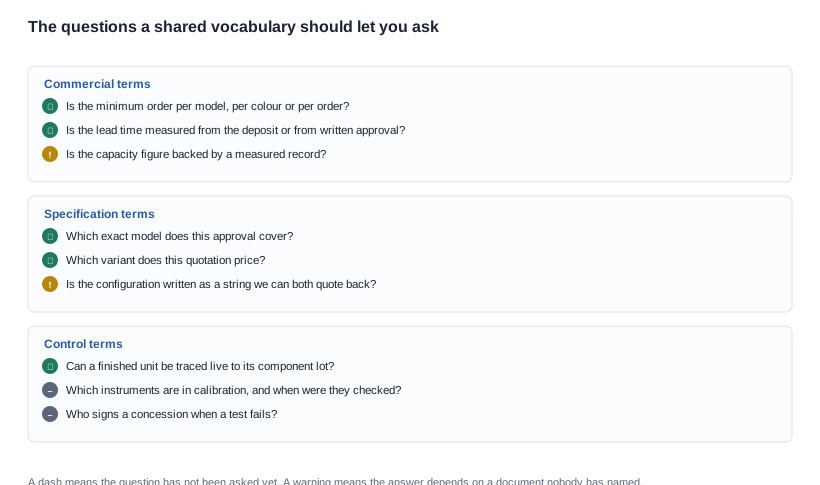
None of those twelve questions requires any technical knowledge. Each of them is a vocabulary question, and each of them is answerable by a supplier who has done the work. The value of a shared vocabulary is not that it makes you sound informed; it is that it makes the answer to a vague question into a specific one, and a specific answer is the only kind that can go into a contract.

Terms that hide a number rather than name one
Some of the most expensive words in this category are not commercial terms at all. They are quality claims that look like specifications, and they are used because they sound like evidence.
Industrial grade. What property does it assert? Without a standard, a test method and a threshold, it asserts nothing that can be checked, and it cannot appear on a product page without becoming an unsubstantiated claim.
Professional grade. In this category, this phrase is most often applied to camera products, and it is the phrase most likely to become a consumer complaint, because a buyer who has written it on a product page has promised an outcome that no published row supports. The published camera facts are a resolution tier — eight models at eight megapixels, three at thirteen — plus an ingress marking on two models. Field of view, frame rate, video format and storage path are not published for any model, so "professional grade" cannot be traced to anything.
Enterprise ready. Usually a claim about software support, update policy or device management, and in this category it hides a whole sub-specification that a buyer has to write explicitly if it matters.
As per sample. Not decorative, but under-specified. It becomes enforceable when the sample is retained, uniquely identified, dated and attached to the order as an exhibit. Without those four things, it is a reference to a document that may no longer exist.
Fully customisable. The phrase that hides the most cost, because customisation in this category ranges from a colour change through a logo to a changed configuration — and a changed configuration is a changed product, which means a new approval, a new model list entry and a new document set.
The phrase that most often costs a buyer money
If one phrase had to be named, it would be "MOQ 500" with nothing behind it. It sounds precise, it appears in almost every quotation, and it can mean five hundred units of one model in one colour, or five hundred units spread across a range, or five hundred units as a floor below which the supplier will not schedule the line at all. The three readings differ by a factor of twenty in working capital, and the only way to tell them apart is to ask.
The reason the phrase survives is that asking is awkward. It is the one question in a first meeting that sounds as though it does not understand the business. It is worth asking anyway, because the supplier's answer tells you something larger: a supplier who answers it precisely has a commercial department that defines its terms, and a supplier who answers it vaguely has a catalogue and a formula. The production capacity comparison is the longer version of that argument.
A worked glossary negotiation, and the position we take
This is a hypothetical scenario rather than a client project, and it is here to show the sequence, not to report an outcome.
Assume a brand owner signing a first supply agreement with a camera-model supplier, into a European market. The agreement is drafted by the supplier and is full of the decorative vocabulary this category produces. Four terms need to be defined before signature: the minimum order, the lead time, the capacity figure and the compliance language.
Minimum order. The supplier's clause says "minimum order quantity 500". The buyer asks which of the three readings applies. The supplier answers per model and per colour, and it also confirms that the first order may be lower as a sample production run, which was never stated. That single exchange moves the buyer's first commitment from a blended-range number to a per-colour number, and it introduces a sample option that changes the cash profile of the launch.
Lead time. The supplier's clause says "35 days from order". The buyer asks for the starting event, and the answer is that production begins on receipt of the deposit and the artwork. That is a real answer and it changes the clause: 35 days from deposit and written artwork approval, with the artwork approval date named in the order, because artwork is under the buyer's control and an open artwork date makes the lead time unfalsifiable.
Capacity. The supplier states 40,000 units per month. The buyer asks whether that figure is per model or per facility. The answer is per facility, across the range. The buyer then asks what the demonstrated figure is for the camera line specifically, and the answer is a measured record of a smaller number. The clause is rewritten to the demonstrated figure, with the difference between the two treated as the thing to re-check at the first re-order.
Compliance language. The supplier's clause says the product is "certified". The buyer asks for the instrument, the issuing body, the model and the date, and the answer is a report number that names a variant rather than the ordered build. The clause changes from a general compliance statement to a clause naming the report number and the exact model designation, with a notice obligation before any variant change. The radio instrument in the European market is (EU) 2014/53/EU, and the electromagnetic compatibility instrument is 2014/32/EU; writing them correctly takes one minute and prevents a claim that cannot be defended.
What the buyer got out of it. Four definitions and four clauses, none of which moved the unit price. What moved was the buyer's exposure: the minimum order is now per colour, the lead time has a falsifiable start event, the capacity figure is a measured one, and the compliance claim names a document that exists. Total cost of the programme is the unit price plus the returns reserve plus the cost of the documentation route, and the last of those three is exactly what this negotiation changed.
The factory audit question set is the practical version of the same exercise, and the quality consistency article covers the control terms in detail.
Where we stand, and what we will not define for you
The published rows in our catalogue are the specification we can stand behind, and anything else is a question for the supplier's own file. We publish what our documentation states, we mark the rows that are open, and we will not fill an open row with a typical figure from a general data sheet or from another supplier's catalogue.
There is a specific reason this matters for a vocabulary article. A term is a promise, and a promise we cannot evidence is worse than an admission that the row is open. Defect rate, production yield and re-work policy are not published in our documentation, and we will not claim a soak or burn-in duration without a stated duration, a sample size and a stated measurement. We will not estimate a minimum order quantity or a production capacity figure for a buyer, because in both cases a wrong number moves a cash cycle rather than a specification.
What we will do is take a configuration, a quantity and a market, and tell you which terms are settled, which are open, and which have to come from the supplier's own file — and then answer the four questions about our own operation directly and in writing, so a buyer who does not need a visit does not pay for one.
The three requests to make this week
Write the definition next to every term you intend to rely on. One line per term: the unit, the starting event, the ending event and the document that proves it. If a term resists that line, it is not ready for the contract.
Ask the three minimum-order questions in the first meeting. Per model, per colour or per order; from the deposit or from approval; and what happens on the first order. It is the highest-yield question in this category.
Send us the configuration, the quantity and the market, and we will say which terms are settled and which are open. The factory audit section holds the wider framework, and the procurement pillar is where the wider process sits.
Related reading
- Five audit questions — what to ask on the day
- Production capacity — the claims behind the terms
- Quality consistency — what the records protect
- factory audit section
Send the configuration, the quantity and the market, and we will say which parts of the vocabulary are settled and which are yours.


