
A smart glasses factory audit has one job: to establish whether the supplier's process can hold a written specification when nobody from the buying side is present. It is not a tour and it is not a conversation about capability. Five questions do most of that work, and this article works through each of them in the form a buyer can actually use: what the question reveals, how to ask it so the answer cannot be rehearsed, what a good answer sounds like, and what to put in the order when the answer is weak. Two of the five can be settled from documents, three of them cannot, and knowing which is which is what decides whether a visit is worth the travel and the time.
Smart glasses factory audit: the five questions, and who owns the answer
The five audit questions
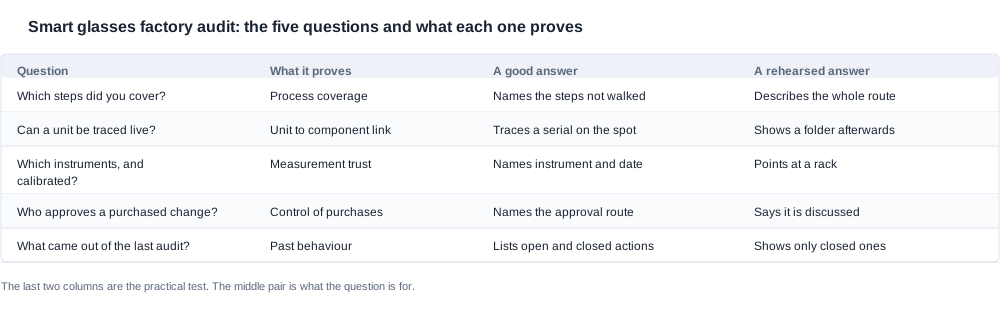
The five questions are the scope of the walk, live traceability, measurement equipment, control of purchased components, and the improvement record. The first asks which production steps were actually covered and which were not; a supplier that names its own gaps has answered the question honestly, and a supplier that describes the whole route has not. The second asks whether a finished unit can be traced back to its component lot, live, on the day. The third asks which instruments take the critical measurements and whether they are in calibration. The fourth asks who approves a change to a purchased component, which is where most of the substitution risk in this category actually sits. The fifth asks what came out of the last audit and which actions are still open, because a supplier that shows only closed actions has told you where the interesting part is.
The reason these five work in this category is that the published position is unusually good on product and unusually silent on process. The catalogue publishes 28 models with their cell capacities, charge times, run times, charging interfaces, camera classes, charging case capacities and colour availability, so the specification half of a buyer's file does not need an audit to complete it. What it does not publish is line count, capacity, yield, defect rate, calibration status, traceability capability, or the approval route for a purchased part. That is precisely the half the audit has to cover, and it is why a smart glasses factory audit in this category is a process exercise rather than a product exercise.
Who is asking, and what the visit has to produce
The reader is a brand-side buyer, a channel buyer or an importer. The usual situation is that two or three quotations are on the desk, the model is roughly decided, and the buyer has to choose between a supplier that describes a good process and a supplier that runs one. The fear underneath that choice is rarely a bad price. It is a shipment that arrives different from the approved sample, a documentation route that stops the goods at a border, or a first order that turns into a returns problem nobody priced.
So the output of a smart glasses factory audit is not a score. It is a list of the things that would have to go wrong for the buyer to receive a bad order, each traceable to a process step that can be checked later from the buyer's own side. That is a very different thing from an impression of a factory, and it is the difference between a buyer who can write a corrective action into the order and a buyer who can only write a complaint.
What the buyer brings to the visit
The visitor arrives with a configuration, not with a category. In this range the configurations are specific enough to be written down: whether a charging case ships in the box and at what capacity, whether the case row exists at all for that model, which charging interface applies, which camera class, and which market the units are for. The catalogue publishes a charging interface for 24 of the 28 models, split between magnetic charging on 17 and Type C on 7, and publishes no interface row at all for the MT6 and the L1 Pro, and the CY03 and the CY05 even though all four publish a charging case capacity. That gap is a legitimate item to resolve during an audit, and it is the kind of item that a general capability tour never reaches.
A second item to bring is the published weight position. Exactly one model in the range publishes a weight, and it is the MT6 at 158 g for the glasses body including the 265 mAh cell and the camera, with the folding charging case excluded and the weight of that case not published. Every other model has no published weight, and neither the camera sensor, the field of view, the frame rate nor the defect rate is published for any model. A buyer who arrives with a specification sheet built only from published rows arrives with a document that is true, and an audit is where the remaining rows get closed.

What each of the five questions actually proves
Question one: which production steps did the walk cover, and which were not walked
This is the question that decides whether the rest of the visit is worth anything, and it is the one most often skipped because it sounds administrative. The supplier's written scope is compared against the actual production route for the model being built, and the gap between the two is the most useful output of the whole conversation.
A good answer names the steps that were not covered. That sounds like a weakness and it is the opposite: a supplier that can state which steps it excluded from the walk, and why, has a route it understands well enough to have boundaries. A rehearsed answer describes the entire route in the abstract, with no exclusions, which usually means the scope was written before the route was understood.
Question two: can a finished unit be traced back to its component lot, live
Traceability is the control behind every other claim a factory makes. If a unit cannot be traced to its components, then a defect analysis, a recall decision, a certification question and a customer complaint are all unanswerable, and the buyer ends up owning the problem without owning the records.
The test is performed on the day and not described in advance. A good answer traces a serial number on the spot, through the route, to the lot numbers of the purchased components in that unit, and back to the incoming inspection record. A rehearsed answer produces a folder. Both can be genuine, but only one of them proves the process is in place rather than the paperwork.
Question three: which instruments take the critical measurements, and are they in calibration
This question looks narrow and it is the one that decides whether the supplier's own figures mean anything. The measurements that matter in this category are the cell capacity and the charge behaviour, the run time, the camera output, and the charging interface and case function. If the instruments behind those figures are not in calibration, the figures are still numbers, but they are not measurements.
A good answer names the instrument, the calibration date and the interval, for each critical measurement. A rehearsed answer points at a rack of instruments and says everything is maintained. The practical control when the answer is weak is to require calibration certificates for the critical instruments to be filed with the order, which is a cheap document to obtain and an expensive gap to discover later.
Question four: who approves a change to a purchased component
This is where the substitution risk in this category actually sits. A camera model with a charging case and the same camera model without a case row are different commercial products; a model whose charging interface row is absent is a model where the interface has to be confirmed rather than assumed. If a purchased component can change without a recorded approval, then every document that referenced the original component is describing a product that no longer exists.
A good answer names the approval route, the role that signs it, and what happens to the affected documentation when a change is approved. A rehearsed answer says the change is discussed, or that the supplier is careful, or that it rarely happens. The control is a change clause in the order, and it is the clause that most protects the evidence file.
Question five: what came out of the last audit, and which actions are still open
The improvement record is the cheapest available evidence of how a supplier behaves when something is wrong, and it is the question that most reliably separates a process from a description of one. A good answer lists both the closed actions and the open ones, with owners and dates, and explains what the open ones are about. A rehearsed answer shows only the closed actions, because the closed ones are the ones that look good.
Which questions need a visit, and which a document
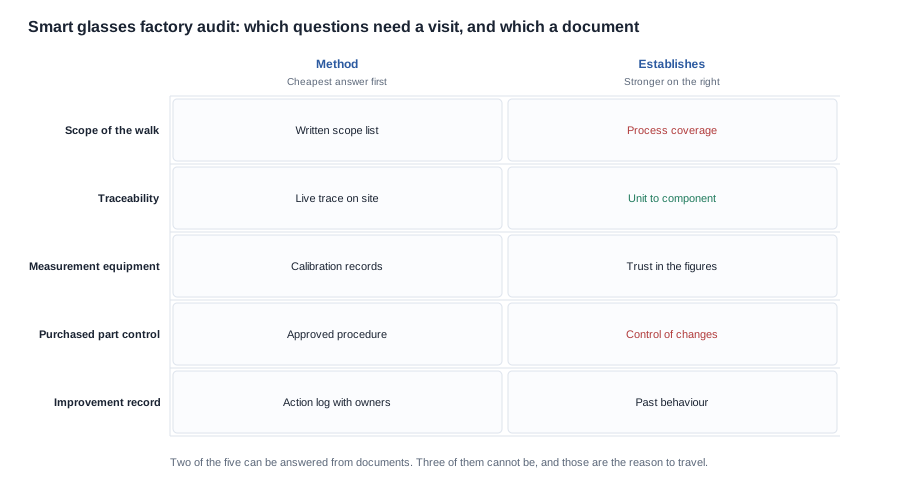
Two of the five are document questions, and three are not
The practical test for whether to travel is simple: two of the five questions can be answered in writing before anyone books a flight, and three cannot. Asking which is which is the difference between a visit that produces findings and a visit that produces a tour.
The scope question is a document question. The written scope exists before the visit and can be compared against the route in the buyer's own office, and the gap between them is what the visit then has to test. The improvement record is also a document question, because an action log with owners and dates can be requested and read. Both of these can be asked in the first round of an enquiry, and a supplier that answers them well has already told you more than most suppliers tell you during a visit.
The other three cannot be answered from a document, because each of them is a claim about a live process. Traceability has to be traced. Calibration has to be evidenced with dates for named instruments. Control of purchased components has to be demonstrated on a part that arrived in the store. None of these is a test of goodwill; they are tests of procedure, and procedure is what a document describes rather than what it proves.
What a first round of written questions should contain
A buyer who asks the right questions in the first round is establishing which quotation is complete, and the list is short. The first question asks for the written scope of the most recent walk and which production steps it covered. The second asks whether a finished unit can be traced to its component lot live. The third asks which instruments are used for the critical measurements and whether they are in calibration. The fourth asks how a purchased component change is approved and who signs it. The fifth asks what corrective actions came out of the last audit and which are still open. The sixth asks, for the model in question, which parts of the specification are open on the supplier's side and which are documented.
The sixth question is the one that connects the audit to the programme, and in this category it has a specific answer for every model. The catalogue publishes the electrical rows for all 28 models, and the charge time for every one of them, with 26 written as a ceiling of two hours or less and the D17 and the ZH12 written as about one hour. It publishes a charging interface for 24 models and no interface row for four. It publishes an ingress marking on two models, the V06 and the S7, and on no other. So the open items are known in advance, and the audit is the place to close them rather than the place to discover them.
The audit day, and what to record
Running the day in a fixed order
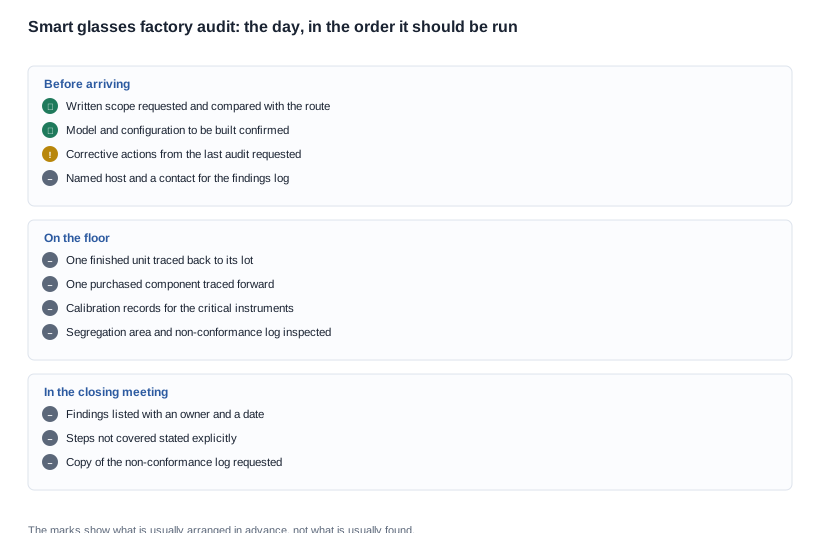
The order below is the one that works, and it is deliberately front-loaded onto evidence rather than onto introductions. The first group is what has to be arranged before anyone arrives, because an audit that has not been scoped in advance is an audit of the wrong process. The second group is the floor work. The third is the closing meeting, and the only item in it that really matters is the list of steps that were not covered, because that list is the buyer's own to work on afterwards.
How to choose between two suppliers on the evidence you get back
When two quotations come back with the same answers to the five questions, the decision stops being about the factory and starts being about the programme. The sequence below is how to work it, and it is deliberately a comparison method rather than a scoring method, because two suppliers that answer the same questions in the same order can still be compared on what they actually said.
- Check the scope answer first, because it is the one that reframes everything else. If one supplier's written scope covers the full route and the other names its exclusions, the second quotation is the more reliable one, whatever the unit price says.
- Ask which model of each supplier's range the quoted configuration sits next to, and whether the evidence they hold is model-specific or company-level. In this category the catalogue publishes company-level export certification but no per-model certification row, so a supplier answering with a company page has answered a different question.
- Compare the traceability answers, not the quality claims. A supplier that traces a unit live has demonstrated a capability; a supplier that describes a traceability system has demonstrated a document.
- Establish the total cost of the open rows, because an open specification row is a cost that sits outside the unit price. When the catalogue does not publish a weight, a camera sensor, a field of view or a defect rate for a model, the cost of closing that row is a request, a sample and a wait, and it belongs in the comparison.
- Decide which red flags are disqualifying and which are acceptable, before the evidence arrives rather than after it does. A supplier that cannot answer a question at all is a different proposition from a supplier that answers it with a plan.
- Write the outcome as a decision with a reason attached, because the reason is what a colleague will ask for six weeks later when the order has gone wrong.
The pitfalls here are worth naming, because the same three recur. Comparing quotations that answered different questions. Treating a company-level document as if it were a model-level one. And buying the cheapest configuration that cannot be evidenced, which is the most expensive option in the category and the hardest to detect before the goods ship.
The records worth copying
Four records are worth asking for a copy of, and each one becomes a control afterwards. The non-conformance log, because a rework area with no records of what was reworked is a concession process with no visibility. The calibration certificates for the critical instruments, because they are the difference between a measurement and an assertion. The incoming inspection records for one purchased component, because they connect the supplier's own quality system to the specification the buyer is paying for. And the open corrective actions, because an action with an owner and a date is a thing a buyer can chase, while a closed action is only a thing a buyer can read.
The traces that make an audit worth the travel
Follow one unit back and one component forward
The most efficient method on the floor is two traces. Take a finished unit at random from the dispatch area and follow it backwards through the route to the component lots it was built from. Then take a purchased component from the incoming store and follow it forward into a finished unit. The evidence is in the two traces meeting. Two separate demonstrations, each performed politely, are not the same thing as one trace that closes.

Two things make this work in a wearable category specifically. The first is that the configuration has to be named when the unit is picked, because a unit with a case in the box and a unit without one are not the same product for packing, for transport and for any claim about what is in the carton. The second is that the component trace has to include the cell, because the cell part number is the item that most often changes quietly and the item that most of the documentation depends on.
The schedule that turns a visit into a control
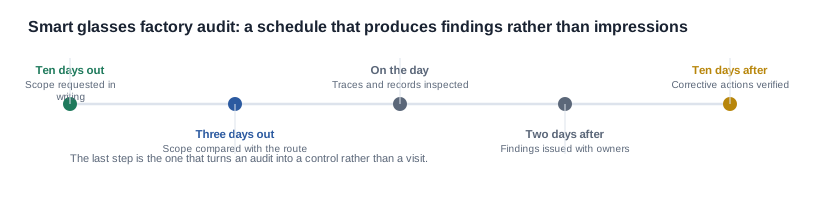
An audit that ends with a report and no follow-up is a document that will not be read. The schedule below is the minimum that makes the findings usable, and the last step is the one that decides whether the visit was worth the cost.
What we publish, and what a buyer has to ask us for
The short answer: the published material is the part of a specification we can stand behind, and the rest is a question for a supplier's own file. We publish what our documentation states, we mark the rows that are open, and we will not fill an open row with a typical figure taken from a supplier's general data. A buyer who builds a claim on an estimated number finds the error in the field rather than in the quotation, and the correction costs more than the question would have.
The rows we do not publish for any model in this range are these: the camera sensor model, the field of view, the frame rate, the defect rate, the production capacity, the yield and the line count. The unit weight is published for exactly one model, the MT6, at 158 g for the glasses body including the 265 mAh cell and the camera, with the foldable charging case excluded and the case weight itself not published. No other model in the range publishes a weight, and a buyer who needs one has to request it against the specific model rather than infer it from a sibling.
What we will not do is quote a process from a photograph, or fill a specification gap with a number that cannot be traced to a document. What we will do is take a configuration, a quantity and a market, and tell you which parts are settled, which are open, and which have to come from a sub-supplier. The factory audit glossary is the working vocabulary for the visit, the production capacity comparison table sets out the figures a buyer can check against, and the sourcing risk step by step article is what the visit feeds into. The factory audit section holds the wider framework.
Send us the models, the quantities and the target market, and we will tell you which configurations exist, which of them are open on the published data, and which of the five questions is the one that will decide the comparison for your programme.


