

Almost every smart glasses production capacity claim arrives in one of five shapes, and each shape answers a different question. A buyer who cannot tell which shape a claim is in will compare it with another claim of a different shape and conclude that one of the suppliers is either overstating or concealing something. Usually neither is doing either. They are simply answering different questions in different units.
So the useful skill here is not reading capacity figures. It is recognising the format of a claim, knowing what each format leaves out, and converting it into a form that can be compared with anything else. That is what this article sets out: the five formats, what each hides, how to convert each one, and which format is worth asking for when you want a date you can plan around.
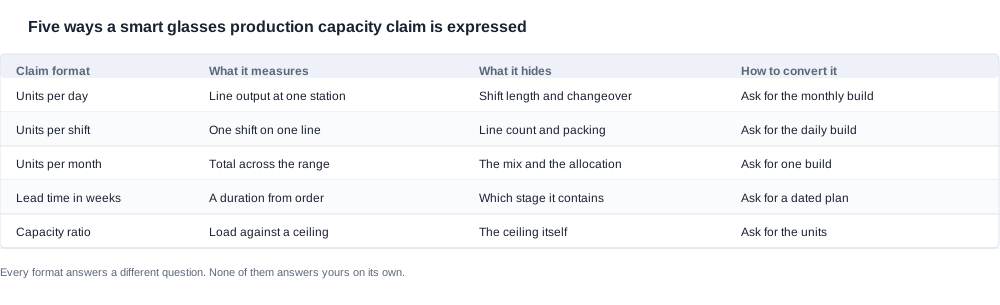
Smart glasses production capacity: five claim formats side by side
The five formats, with what each one actually measures and what it leaves unsaid:
- Units per day. Measures line output at one station on one shift. Hides the shift length and the changeover allowance inside the day.
- Units per shift. Measures one shift on one line. Hides the number of lines and whether packing sits inside the count.
- Units per month. Measures the total across everything the factory builds. Hides the mix and the allocation rule.
- Lead time in weeks. Measures a duration running from the order. Hides which stage the duration contains.
- Capacity ratio. Measures load against a ceiling. Hides the ceiling itself.
Only one of those five is a plan, and none of them is a position. A plan names dates; a position names a place in a queue. The five formats describe a factory's throughput in a way that is useful for the factory and largely irrelevant to a buyer, which is why a buyer who has not learned to convert them spends the first two rounds of a capacity negotiation negotiating about units.

What each format hides, and how to convert it
Units per day is the most common format and the least self-describing, because "per day" hides two variables that matter more than the number does. The first is the shift length. A factory running two eight-hour shifts and a factory running one twelve-hour shift can both say "per day" and mean different things, and the number only becomes usable when the shift structure behind it is stated. The second is the changeover allowance, which is the time the line is being set up rather than producing. The conversion question is simple: ask for the monthly build for this configuration, and the shift structure and the changeover allowance have to appear in the answer because a monthly number cannot be produced without both.
Units per shift has the same problem at a different scale, and it adds a third. It hides the number of lines, because a single line running at a rate and four lines running at a quarter of it produce the same shift figure with entirely different implications for a build that needs a lot of one configuration. It also hides where packing sits. An assembled count and a shippable count are different counts, and a shift figure quoted on assembled units overstates what is available to ship. The conversion question is: ask for the daily build for your configuration and your packaging, and let the answer show whether the number is assembled units or shippable units.
Units per month is the format that most often looks like the answer to everything and is actually the answer to nothing specific. It is a total across the range, so it contains a mix — a month of audio models and a month of camera models with charging cases produce different totals from the same line, and the figure quoted is an average over a period whose composition the buyer cannot see. Worse, it silently embeds an allocation rule: in a full month, the total is divided among whoever ordered first, and the buyer's share of that total is not the total. The conversion question is: ask for one build, for your configuration, in your packaging.
Lead time in weeks is the format buyers are given most often and understand least, because a duration reads like a commitment and is actually an average. It hides which stage the duration contains, and that is the only information that matters about it. Six weeks made of a three-week component wait and a three-week build is a completely different proposition from six weeks made of a two-week documentation wait and four weeks of assembly, and the remedy for the first is a component commitment while the remedy for the second is a file that already exists.
Capacity ratio is the format that sounds most sophisticated and is usually the least grounded. A ratio says "we are running at eighty per cent of capacity", which sounds like reassurance and is in fact a statement about a ceiling that has not been disclosed. It hides the denominator, the unit, the mix and the time window, all four of which are needed before the ratio can be converted into anything. The conversion question is: ask for the units. Once the units are named, the ratio either becomes a plan or becomes obvious that it was never one.
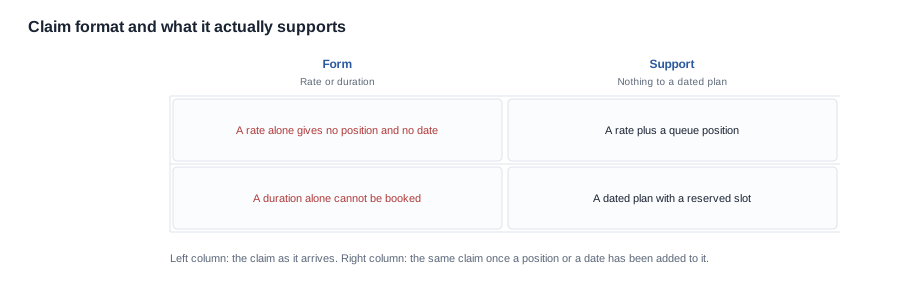
The matrix above is the shortest version of the whole argument. In the left column, a claim arrives on its own and supports nothing: a rate with no position, a duration that cannot be booked. In the right column, the same claim has been converted by adding one element — a queue position for a rate, a dated plan for a duration — and now supports a decision. The conversion is not a trick and it does not require the supplier to do more work. It requires the supplier to name one thing they already know.
Why the unit is the first thing to settle
Before any of the five formats can be compared, the unit has to be settled, and in this category the unit has more dimensions than a buyer expects. "Units" can mean pairs or units, assembled or shippable, per shift or per day, counted at one station or across the whole factory. Two claims that differ by a factor of two are frequently two claims about different units rather than two claims about different performance, and the difference is invisible unless the unit is named in the first sentence of the answer.
The order of questions that unwinds this is: what is counted, at what point in the process, over what period, and on how many shifts. That is not pedantry. A shift figure produced by a two-shift operation and a shift figure produced by a one-shift operation describe different commitments, and the buyer who accepts the second has no way to know that the first was possible. The same applies to a figure that counts assembled units when the programme plans in shippable units, which is a gap that only appears at the end of the month, when the units are finished and the packing capacity is not.
The cost of skipping this is disproportionate to the effort of asking, because the effort is one extra clause in the request. Name the unit in the question rather than extracting it from the answer, and the supplier is forced to state it rather than assume it. The published catalogue is a useful prompt here, because it supplies the vocabulary: a build with a 1400 mAh charging case and a build with a 1200 mAh folding case have different work content, and the rate that applies to each is a different rate, produced by the same line on the same day.

Which format is worth asking for, and why
If you could ask for one format, ask for a dated plan against your own configuration, and the reason is that it is the only format that contains a position.
A dated plan is not a sum of durations; it is a set of dates with the inputs behind them. It says when the materials are committed, when the line is booked, when the build starts, when the documentation is released and when the goods are handed over, and it names the input that each date depends on. That last part is what makes it usable, because a date without an input cannot be re-planned by anyone except the supplier.
The hierarchy of formats, in the order of usefulness to a buyer, runs from the plan down to the ratio. A plan is directly actionable. A rate with a queue position is actionable and tells you what happens in a constrained month. A lead time with a dated plan inside it is actionable and tells you where to look. A monthly total is informative about the factory and not about your order. A ratio is informative about nothing until its denominator is named.
The reason the hierarchy matters commercially is that the formats carry different costs of being wrong. A buyer who accepts a monthly total has no way to detect that the figure is an average over a favourable mix. A buyer who accepts a lead time cannot detect which stage it contains. A buyer who accepts a dated plan cannot fail to detect a missing stage, because the stage is the thing that carries the date. Asking for the plan does not make the supplier work harder; it makes the supplier's answer narrower and therefore more checkable.
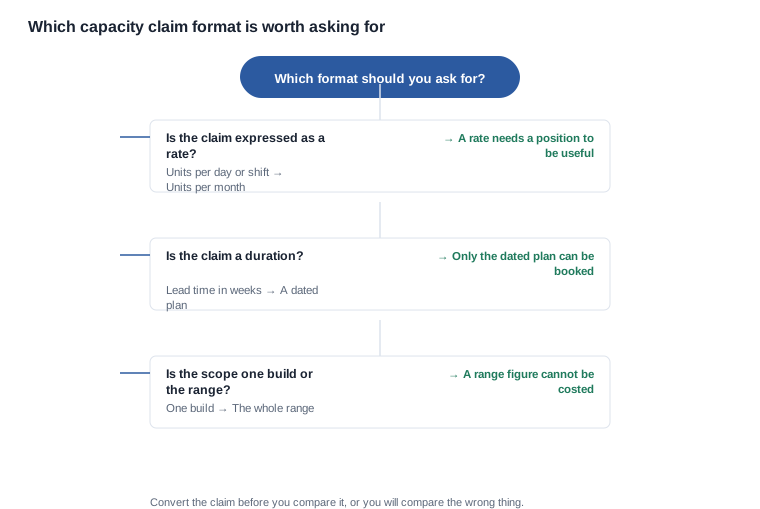
The decision tree above is the version of the hierarchy you can use in the meeting. The order of the questions matters, because a rate cannot be converted until the scope is fixed, and a scope cannot be fixed until the configuration is named. A supplier who will answer all three has a production system; a supplier who answers only the third has a rate.
There is one format that is worth having in addition to the plan, and it is the format most buyers refuse to ask for: the queue position. "Where is my order in the month, and what is booked ahead of it" is a strange thing to ask a factory that has not previously worked with you, and the strange answers are informative. A factory that knows its own queue will name what is ahead of you. A factory that does not will answer in terms of the rate instead, and the substitution tells you where the real weakness is.
When a ratio is the only thing on offer
Some suppliers will offer only a ratio, and the reason is not always evasion. A ratio is the format that a factory with genuinely variable output prefers, because it does not commit to a number and it survives a month in which the mix was unusual. Where a ratio is all you are given, there is a conversion path, and it has three steps.
Ask what the denominator is and what period it covers. A ceiling with a period attached can be compared with a dated plan. Ask what the load is counted in — units, shifts or order book — and insist on units, because a ratio measured in shifts is not a ratio measured in output. Then ask what the ceiling is in units for one build, which is the same as asking for the denominator, and which is the question that usually produces a number.
What to do when the ratio still cannot be converted is the interesting part. The honest answer is that you have a supplier who will not commit to units, and that is a fact about the relationship rather than about the factory. The right response is to take the plan elsewhere: ask for a dated plan against your order rather than a rate against a ceiling, and see whether the supplier will commit when the question is in that form. Suppliers that will not give a rate often will give a plan, because a plan is about one order and a rate is about the whole book.

Running the comparison yourself on two suppliers
Having decided which format you want, the mechanics of the comparison are simple enough to do properly in one round, and the mistakes are usually procedural rather than analytical.
Send the same request to both suppliers, in the same words, with the same configuration string and the same quantity attached. Not a summary of your request — the request. A shortened request for one supplier will lose a different item, and the comparison will fail on the item that went missing rather than on the answer.
Ask for the conversion explicitly, rather than inferring it. "Please give the monthly build for this configuration and this packaging" produces a better answer than "so what is your daily rate", because the second question invites a rate and the first invites the information the rate depends on.
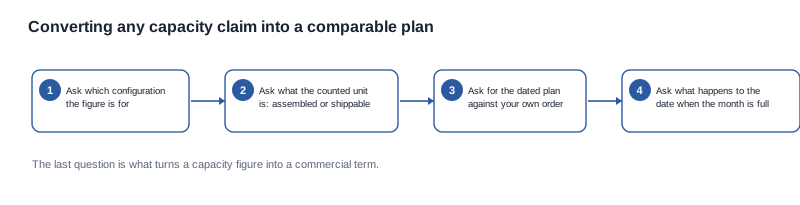
The four steps in the conversion are the minimum set. The configuration fixes the scope. The counted unit fixes the rate. The dated plan fixes the schedule. And the question about a full month fixes the position. A supplier who answers all four has given you a plan; a supplier who answers the first two has given you a rate and a scope, which is still enough to begin.
The red flags to watch for are format-specific. A monthly total with no configuration attached. A shift figure with no shift length. A lead time with no stage named. A ratio with no denominator. A rate that changes when the packaging question is added. Each of these is not a reason to disqualify a supplier and each of them is a reason to ask the conversion question rather than accept the number.
When the two suppliers have answered, the comparison that matters is not which figure is larger. It is which supplier's answer can be converted into a plan without a second conversation. That is usually the one with the less impressive-looking rate, and it is usually the one that will deliver.
When the two suppliers use different formats
The awkward case, and the one that catches buyers out, is when one supplier answers with a monthly total and the other answers with a lead time. There is no arithmetic that reconciles those two directly, and any attempt to do it produces a number that belongs to neither.
The way through is to convert both to the same form, and the form to convert to is a dated plan, because a plan is the only one of the three that carries both a duration and a position. For the supplier who gave a monthly total, the conversion question is which build that total was made up of and what the monthly build for your configuration is. For the supplier who gave a lead time, the conversion question is which stage the duration contains and what date the build would start. Both questions are answerable by a supplier with a production system, and both are refused by a supplier working from a figure.
Where one supplier converts and the other does not, the comparison is decided, and it is decided in favour of the slower-looking supplier. That outcome surprises people who have spent the round comparing magnitudes, and it is the reason the format analysis is worth doing before the price comparison rather than after it.
A second asymmetry is worth noting: the supplier who quotes in a plan format is also the supplier whose answer can be checked later. A plan can be compared against what happened; a monthly total cannot, because nobody recorded which month. That matters at the second order, when the question is no longer what the supplier claims but what the supplier did.
What our catalogue settles and what a claim has to carry
Our own position is narrow, and stating it is useful because it tells you which parts of a claim you can check without asking anybody.
We publish what the catalogue contains. It covers 28 models: eleven with a camera, eight audio models with a Bluetooth version published for each, and three sport models. The charging method splits three ways across the range — magnetic on seventeen models, a Type C port on seven, and no published charging-method row at all on the CY03 and the CY05, and the MT6 and the L1 Pro. Case capacities are 900 mAh, 1200 mAh and 1400 mAh, and the L2 Utral is published at two. The camera tier is two discrete classes, 8 megapixels across eight models and 13 megapixels across three. IP54 is marked on two models, the V06 and the S7. Charge time is published for all 28 models, with 26 at up to two hours and the D17 and the ZH12 at around one hour, and runtime is published for all eleven camera models. Those rows are the criteria by which a supplier's configuration string can be checked before a claim is even evaluated.
What we do not publish is a capacity figure in any of the five formats above. Not a daily output, not a shift rate, not a monthly total, not a lead time, not a ratio, and not a line count, a shift pattern or a yield percentage. The reason is exactly the one this article is about: every one of those is a rate without a position, and a rate without a position is a format that supports nothing.
We also do not publish a per-model certification row. The export certification material in our catalogue sits at company level, so the certification scope for a specific model is written material to request rather than a published fact. Buyers will ask about CE, FCC, RoHS and UN38.3 in every market, and those are attention items in a conversation rather than evidence in a file.
What a claim has to carry, then, is the configuration it covers, the unit it counts, the stage that binds, the position it holds, and the date it will be released. A claim that carries all five is a plan. A claim that carries two is a number in one of the five formats above, and the conversion questions are the work that turns it into something a buyer can act on.
The framework this assessment uses is set out in production capacity. For checking the scope of a claim in detail, see how to verify production capacity. For the typical range a lead time sits in, see lead time typical range. And for what a benchmark claim has to contain, see industry benchmarks.
Send the model codes, the option set, the quantity, the destination market and the required arrival date, and we will tell you which configurations exist, which published rows apply to them, and which format of claim is worth asking each supplier for.


