

What a smart glasses factory audit changes about quality, and what it leaves untouched
A smart glasses factory audit changes your commercial position in this category far more than it changes the product, and buyers who arrive expecting otherwise tend to leave disappointed. The product is the product. The published specification for a model does not move because you walked the floor: the V06 publishes an 8-megapixel camera, a 260 mAh cell, a five to eight hour rated use, a magnetic charging interface, a catalogue-marked IP54 and a detachable inner frame, and it will publish exactly that the morning after your visit.
What the visit changes is the confidence you can attach to four other things: the price you pay, the date you plan around, the documents you can file with a customer or a market authority, and the rate at which units come back. Those four are not in the datasheet, and they are where a quality problem actually costs money. This is the asymmetry that decides what a smart glasses factory audit is for. It is not a product inspection. It is a risk inspection, and the risks it prices are the ones that live outside the specification.
The corollary matters as much as the point itself. A finding that does not move any of those four things was probably not worth the day. There is a version of an audit that produces a pleasant report, confirms that the factory exists and the line runs, and changes nothing about the commercial position, and that version is more common than it should be because it is easier to write.

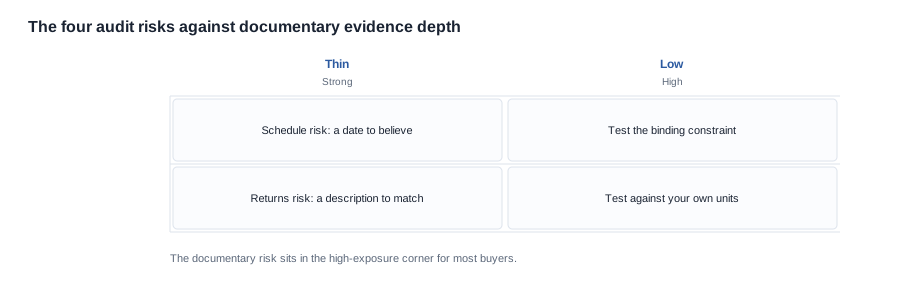
The four risks a smart glasses factory audit is actually pricing
The documentary risk is the largest in this category, and it is largest precisely because so much of what a buyer has to file is not published. Certificate numbers, issuing bodies and validity dates are not published for our range, and neither are most of the third-party report details that would sit behind them. The IP54 marking on the V06 and on the S7 is a catalogue marking with no third-party report number attached to it, and both of those models also carry the detachable inner frame and the sport feature set that makes the marking meaningful to a buyer. A factory with a genuine per-model document set can show you the file in a minute, and a factory without one will talk about certification in the abstract. The audit documentation requirements set out the request list in field-level detail.
The configuration risk is the second, and in this category it is unusually easy to price because the published options are specific and small. A charging case at 900 mAh against 1400 mAh, a magnetic interface against Type C, three colours on the V03 Pro against four on the V06, a detachable inner frame on the sport tier, a camera tier at 8 MP against 13 MP. Each of those is a line on a packing list, and each of them is a place where the finished unit and the paperwork can drift apart without anyone deciding to deceive anybody. The 900 and 1400 mAh case options on the L2 Utral are the clearest example in the catalogue: two configurations, one model name, and a case that a buyer can specify the wrong way on a busy afternoon.
The schedule risk is third, and it is the risk most often invisible because nothing published describes it. Production capacity, line count and lead times are not published, so the credibility of a date has to be established some other way, and a visit is one of the few opportunities to see whether a line exists that is set up for something like your configuration. The cost of getting this wrong is not a late shipment in the ordinary sense; it is a launch window, a retail commitment and a marketing plan that were all built on a date the factory was never going to hold.
The returns risk is fourth, and it is the one most often left to the end of the programme, which is exactly the wrong time. The returns that come back in this category are disproportionately description failures, and the description is written by the buyer. An audit tells you whether the product on the line matches the product you described. That is the half of the returns problem you can influence, and the other half is the description you write, and a factory that produces a unit matching your description on the day you visit is evidence about the half you can control.
A fifth risk sits behind all four, and it belongs to you. The specification risk is the risk that the configuration you asked for, as written, is not the configuration the factory built quotes for, and it is the one that generates the other four. A case at 900 mAh when you meant 1400 mAh is a specification error that shows up as a returns problem, a schedule argument and a document mismatch all at once. The audit does not fix it, because the defect is in the document the buyer issued. What the audit does is expose it while it is still cheap, and the way to protect against it is to make the configuration string the single reference used by every party: the quotation, the purchase order, the packing list, the inspection instruction and the file.
Matching a quality finding to the commercial consequence it creates
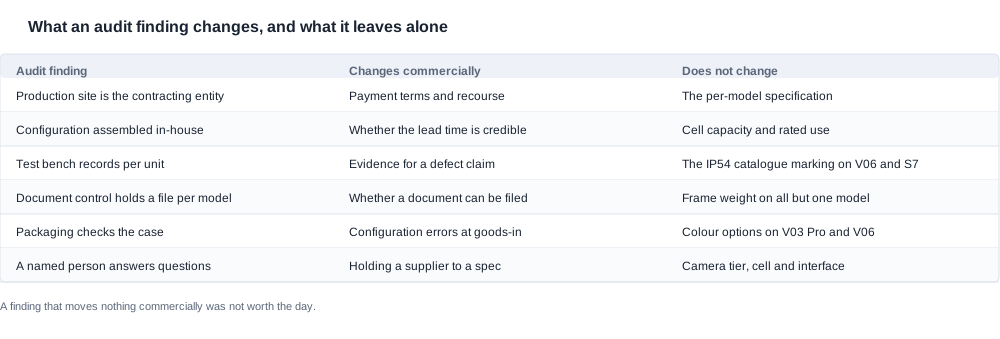
The table below is the working version of the judgement. Each row states what the audit found, what it changes commercially, and — just as importantly — what it leaves alone, because the third column is the one that stops an audit report turning into a list of complaints.
| Audit finding | What it changes commercially | What it does not change |
|---|---|---|
| The production site is the same legal entity as the contracting party | The confidence behind your payment terms and your recourse | The published per-model specification |
| The configuration is assembled in-house rather than bought in | Whether the quoted lead time is credible | The cell capacity, the rated use or the case capacity |
| The test bench records a result against each unit | The evidence you can give a customer who asks about a defect | The absence of a third-party report number for the IP54 marking |
| Document control holds a file per model | Whether a document can be filed against your order | The absence of a frame weight on every model in the range |
| The packaging area checks the case against the order | The rate of configuration errors at goods-in | The published colour options on the V03 Pro and the V06 |
| A named person answers the technical questions | Whether you can hold a supplier to a specification conversation | The fact that camera tier, cell capacity and interface are fixed by the model |
Read down the middle column and you have the commercial return on a visit. Read down the right-hand column and you have the part of the report that is worth reading slowly, because a finding that contradicts a published row is a reason to be careful, not a reason to be pleased. A factory that tells you a model has a third-party IP54 report, when the marking is a catalogue marking without a published report number, has shown you the limits of its own document control in a way that is easy to miss on a good day.
Pricing a quality finding without re-running the whole quotation
The instinct after a difficult visit is to reopen the entire quotation, and in most programmes that instinct is wrong, because a full requote costs weeks and it re-opens terms you had already settled. The right move is narrower: identify which part of the price the finding touches, and only that part moves.
A documentary finding touches the cost of issuing a file against the model, and — much more importantly for a buyer with more than one destination market — it touches the schedule cost of waiting for that file. That second effect is usually larger than the first, because a document that has to be issued after the order is placed pushes the delivery date, and a pushed delivery date carries a cost that nobody quotes because it is not a line on an invoice. It shows up as a missed retail window.
A configuration finding touches the cost of doing the wrong thing twice, and it should be priced as such: a unit built to the wrong specification is not a unit, it is scrap plus a rework slot plus a second unit. Ask what the rework path is and what it costs, rather than assuming the factory absorbs it. A supplier with a controlled rework route will quote it; a supplier without one will absorb it once and then tell you the date slipped.
A schedule finding touches the cost of the constraint, not the cost of the factory. If the binding constraint is a document or an artwork approval, the cost is administrative and belongs on your side of the table, and the fix is a deadline with an owner rather than a second supplier. If the binding constraint is a component, the cost is commercial and belongs in the price, and it should be quoted as a lead time rather than as a surcharge.
The general form of the rule is simple: price the risk where it sits, and do not spread a narrow finding across the whole unit price, because a buyer who re-quotes a programme on every visit trains suppliers to expect it and prices the next one accordingly.

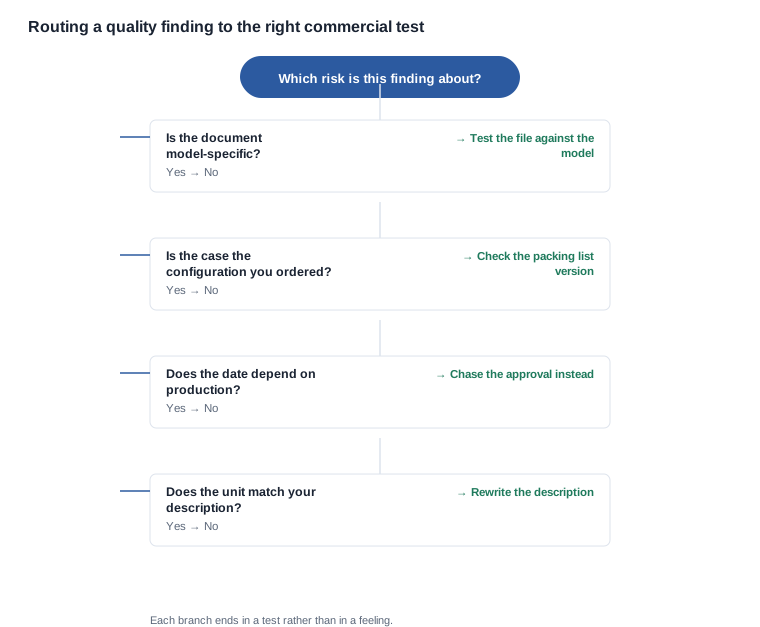
Deciding which quality risk to test first on a smart glasses factory audit
Testing everything on the day is how visits get stretched to two and how the important question goes unanswered. The order below is the one that works, and the reasoning is simple: each step either eliminates a supplier or converts a risk into a lower-priority one.
Start with the documentary risk, because it is the cheapest to test and the most decisive. A request for one document that names a specific model takes an email and settles whether the factory holds per-model files. A supplier that cannot produce one has told you something that a day's visit would have confirmed at considerable cost, and that you can now price into the quotation or use to remove them from the shortlist.
Move to the configuration risk next, because it is where the cheapest prevention lives. A configuration error caught at the packing bench is one scrapped unit; the same error caught in the channel is a returns episode with your brand on it, and the difference between those two numbers is large enough to justify a specific check. Read the configuration string aloud against the packing list on the day.
The schedule risk comes third because it is partly a factory question and partly a paperwork question, and the paperwork part is often faster. Ask what would make a date slip, and if the answer names something outside the factory — an artwork approval, a document to be issued against the model, a component replenishment cycle — you have a constraint you can manage rather than a mystery. Only then is a walk of the line worth something, because you will be looking for a specific setup rather than forming a general impression.
The returns risk is last, because it is the one that genuinely requires units of your own, and a first visit rarely has them. The part of it you can test on the day is the description question: does a unit on the line match the specification you wrote, and does the supplier produce the specification sheet the catalogue entry came from. The factory audit checklist is the item list for that part, and the factory audit myths article covers the assumptions that most often lead a buyer to the wrong conclusion on the day.

Turning a quality finding into something the contract can carry
A finding that stays in a report is a memory, and memories are unreliable in both directions: they decay on the buyer's side and they are contested on the supplier's. The value of a smart glasses factory audit is realised only when each finding is converted into something that changes a future decision — a clause, a purchase order line, an incoming inspection instruction, a price.
The conversion is mechanical, and it is worth doing it on the day rather than a week later while the visit is still clear in the mind. Take the finding, and write the consequence: this is what I will do when this happens again. If a cell batch is recorded at distributor level rather than at cell-maker level, the consequence is a cell specification written into the purchase order and checked at incoming inspection, because otherwise the tier is a request rather than a specification. If the packing list lagged the catalogue entry, the consequence is a version-controlled packing list and a check of one unit per finished batch against it. If a file is organised around the company rather than the model, the consequence is a written requirement for model-level coverage before the purchase order is issued.
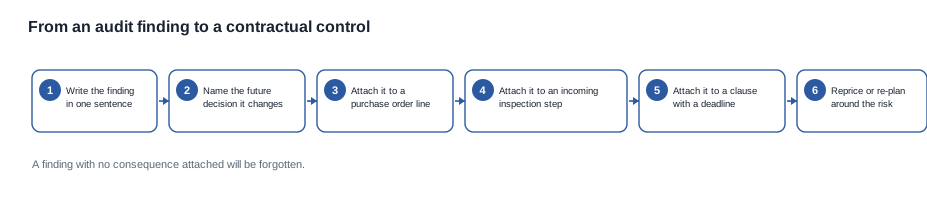
Two of these consequences are commercial rather than technical, and they are the ones buyers tend to drop because they feel like paperwork. The first is the price: where the visit has identified a risk your quotation did not price, the new number either carries that risk or you carry it, and only one of those is a decision. The second is the schedule: where the binding constraint is a document or an artwork rather than production capacity, the schedule problem is usually solved by an approval deadline rather than by a second factory. The audit margin discussion covers how findings like these move a landed cost, which is the number the commercial conversation actually turns on.
There is a third consequence that is easy to miss because it is not commercial at all, and it is the one that protects the programme after the first shipment: the control has to be owned by somebody. A corrective action with no owner is a wish, and a corrective action whose owner is a person who has left is a closed item that was never closed. Ask for the owner by name and role, ask for the closure evidence rather than the closure claim, and ask for the list of actions that are still open — because a supplier that shows you only the closed actions has told you, indirectly, which of the open ones is the interesting one.
The same discipline applies to the re-audit right. It is worth asking for it not because you expect to use it in a dispute but because its existence changes behaviour: a factory that knows you can come back and check does more of the things you asked about the first time. The cost of the right is small, and the behavioural effect is usually worth more than the cost.
The quality questions we will answer from a visit, and the ones we will not
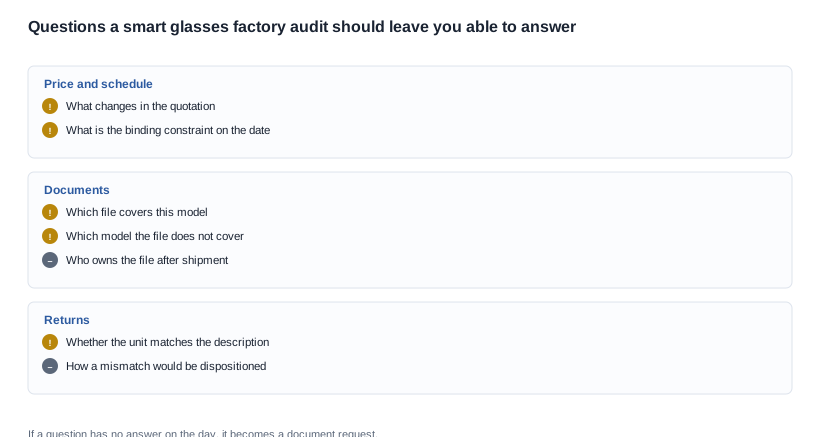
The working rule we apply: a smart glasses factory audit should be judged by the terms it changes, and the published per-model data is the fixed point around which the commercial conversation happens. We publish the camera tier, the cell capacity, the charge time, the rated use, the charging interface, the charging case capacity, the colour availability and the one complete-unit weight we hold, which is the MT6 glasses body at 158 g including its battery and its camera and excluding the folding charging case. We do not publish unit prices, minimum order quantities, production capacity or lead times, and the reason we do not is not squeamishness about numbers; it is that a figure we cannot evidence is worse than no figure at all, because it ends up in a comparison sheet as though it were tested.
We will also be direct about what a visit cannot tell you about quality. The honest answer to "will this factory make my product well" cannot come from a visit, and anyone who tells you otherwise is selling you a tour. A sample tested against a written list, with the list produced by you rather than by the factory, tells you considerably more about your specific order than an inspection of somebody else's. That is why the best factory audit in this category is the one that arrives with a written acceptance criteria and leaves with a test plan for the sample, rather than the one that produces the most photographs.
So the answer to a question we get often — can you tell me the defect rate, the yield, the on-time delivery, the number of lines — is that we do not publish those, and we would want the same discipline applied to us. We will tell you exactly which configurations exist, which of them are open on the published data, what we can evidence, and what we cannot. A buyer who builds a claim on an estimated number finds the error in the field rather than in the quotation, and the correction is always more expensive than the question would have been.
Related reading
- The documents to request on a visit — audit documentation requirements
- The longer item list for a first visit — factory audit checklist
- The assumptions that make audits expensive — factory audit myths
- What a finding is worth commercially — how it affects your margin
Send us the model, the configuration, the destination market and the annual volume, and we will tell you which of the four risks above is the one that most deserves your audit time on this particular programme.


