

Smart glasses for content creation battery for long sessions is a specification problem before it is a hardware problem. Every camera model in our catalogue carries a rated runtime — a band of hours attached to a cell capacity — and none of them carries the condition that produced the number. That one missing line is the difference between a power figure a buyer can schedule against and a power figure a buyer can only quote.
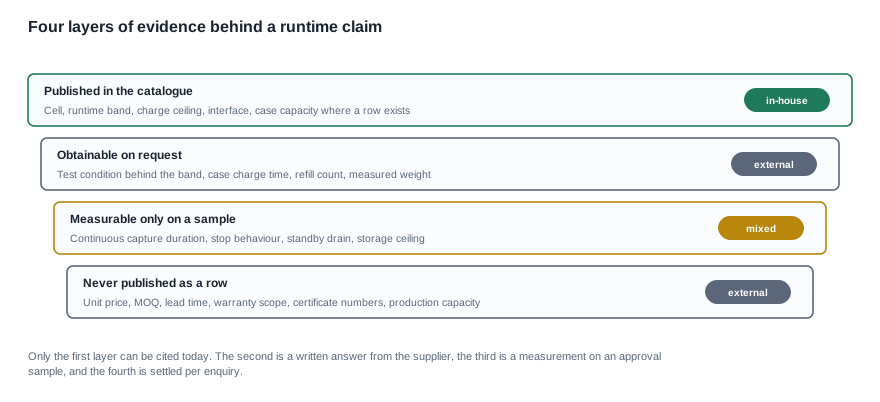
The eleven camera models publish enough for a first-pass shortlist: a cell capacity, a rated runtime band, a charge-time ceiling, a charging method on seven of them, and a charging case on seven of them in four different states. Everything that turns those rows into a working day — the load behind the rating, the charge time of the case, the storage ceiling, the number of refills a case delivers — is either obtainable on request or measurable only on a sample.
This article is written for a brand owner, a channel buyer or an e-commerce seller who has to defend a power claim to a marketplace reviewer, a channel partner or a customer, and who cannot defend it with a number that carries no condition. It sets out the published position model by model, explains why a rated figure and a working day are different quantities, identifies the rows that actually decide a long session, and turns the gap between a label and a measurement into a criterion that can be written into a purchase order.
What the camera models publish about power
The published electrical position of the camera group is short enough to reproduce in full, and that shortness is the point. A buyer can put every row on one page, quote the ones that carry a figure, and see exactly which cells are empty before the first sample is opened.
Eleven models publish a camera row, and each publishes the same set of electrical lines: cell capacity, rated runtime, charge time, charging method and charging case. A handful of narrow rows sit alongside them — a colour list on two models, an ingress marking on two, and one weight figure in the whole catalogue.
| Model | Cell | Rated runtime | Charge time | Charging method | Charging case | Colour row |
|---|---|---|---|---|---|---|
| V03 | 220 mAh | 5~8 h | ≤2 h | magnetic | no case row | not published |
| V03 Pro | 220 mAh | 5~8 h | ≤2 h | Type C | explicitly none | 3 colours |
| KY06 | 260 mAh | 6~8 h | ≤2 h | magnetic | case, capacity not published | not published |
| CY03 | 290 mAh | ~7 h | ≤2 h | not published | 1400 mAh | not published |
| CY05 | 290 mAh | ~7 h | ≤2 h | not published | 1400 mAh | not published |
| L1 Pro | 290 mAh | ~7 h | ≤2 h | not published | 1400 mAh | not published |
| L2 Utral | 290 mAh | ~7 h | ≤2 h | Type C | 900 or 1400 mAh | not published |
| MT6 | 265 mAh | ~7 h | ≤2 h | not published | 1200 mAh, foldable | not published |
| MT5 | 220 mAh | 6~8 h | ≤2 h | magnetic | case, capacity not published | not published |
| V06 | 260 mAh | 5~8 h | ≤2 h | magnetic | no case row | 4 colours |
| S7 | 260 mAh | 5~8 h | ≤2 h | magnetic | no case row | not published |
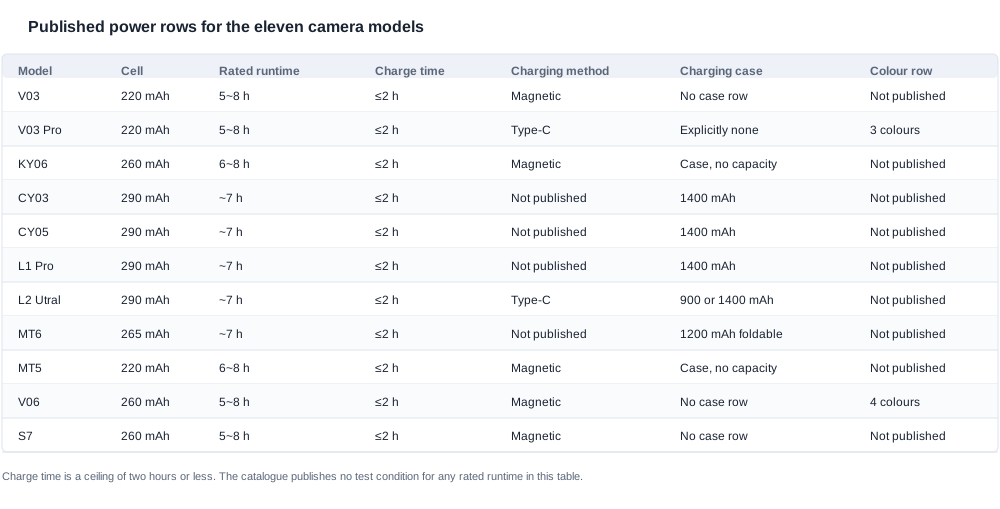
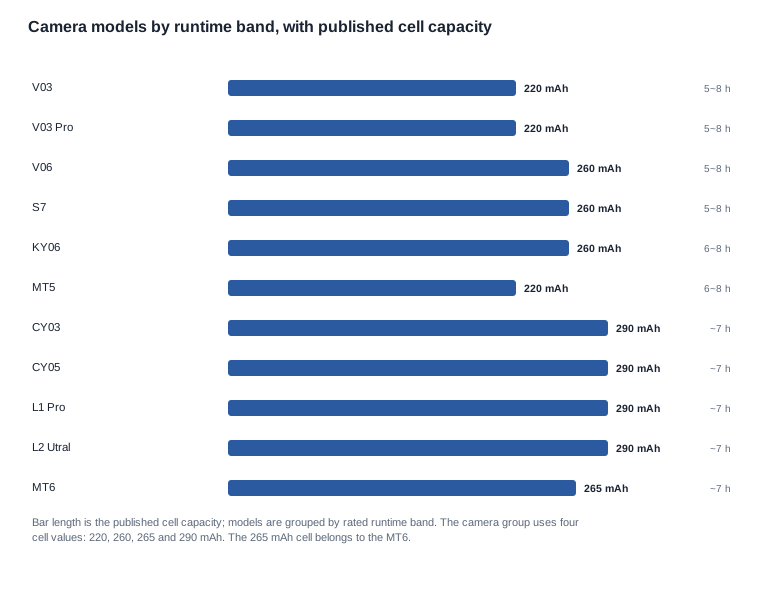
Read down the cell column and there are four values, not two endpoints. The MT5 and the V03 Pro, and the V03 publish 220 mAh. The V06 and the S7, and the KY06 publish 260 mAh. The MT6 publishes 265 mAh. The CY03 and the L2 Utral, and the L1 Pro and the CY05 publish 290 mAh. A shortlist written as "220 to 290 mAh" throws away the 265 mAh cell, and the MT6 is the only model that carries it — which makes it a separate line in any grouping built on cell capacity rather than a point on a line.
The runtime column splits into three bands. Four models publish 5~8 h: the V06 and the V03 Pro, and the V03 and the S7. Two publish 6~8 h: the KY06 and the MT5. Five publish roughly seven hours: the L1 Pro and the CY03, the CY05, the L2 Utral and the MT6. Read the way the catalogue writes it, 5~8 h is a span and ~7 h is an approximation; neither is a point value, and neither may be collapsed into a single hour figure without inventing precision the source never claimed. One practical warning belongs with the column: on the V03 and the KY06, and the MT5 pages the row that reads like a charge-time label is in fact the runtime row, and a separate charge-time row sits on the same page. Anyone transcribing these tables page by page will pull the wrong number on exactly those three models if they copy on the first pass.
Charge time is the one row that does not separate anything. All eleven camera models publish a ceiling of two hours or less, and it is a ceiling rather than a typical value — the distinction matters in a procurement file, because "two hours or less" allows a full two hours while "under two hours" does not, and only the first of those two is what the catalogue supports. No model publishes a charge time for the charging case, and no model publishes a figure for the glasses and the case together, so the turnaround time of a case-equipped configuration is unpublished for every model in the group.
Charging method splits three ways. Magnetic is published on five models — the S7 and the KY06, and the MT5 and the V03, and the V06. Type C is published on two — the V03 Pro and the L2 Utral. And four models publish no charging method at all: the CY03, the L1 Pro and the CY05, and the MT6. Those four are the ones where the packaging artwork, the printed instruction leaflet, the cable in the box and the spare-parts line all wait on one written answer, and it is the first thing a fulfilment centre asks about when a unit arrives with no visible port.
The charging case is where the four states earn their place, and mixing them up is the most common error in this group. Five models publish a case capacity: the CY05 and the CY03, and the L1 Pro — each at 1400 mAh, the L2 Utral with two capacities in one row — 900 or 1400 mAh — and the MT6 at 1200 mAh in a foldable case. Two models publish a case without a capacity: the KY06 and the MT5. Three models publish no charging-case row at all: the S7 and the V06, and the V03. One model states explicitly that it has no charging case: the V03 Pro. That last distinction is commercial, not editorial. "The catalogue publishes no charging-case row for this model" is a statement about the record and an invitation to ask; "this model has no charging case" is a statement about the product, and only the V03 Pro supports it in the catalogue text.
The L2 Utral page carries two variant names alongside the two case capacities, and the catalogue does not state which name goes with which capacity. A buyer who wants the lighter 900 mAh configuration therefore needs the assignment confirmed in writing against the model string before the order is raised, because the artwork, the packing list and the paperwork all carry that string.
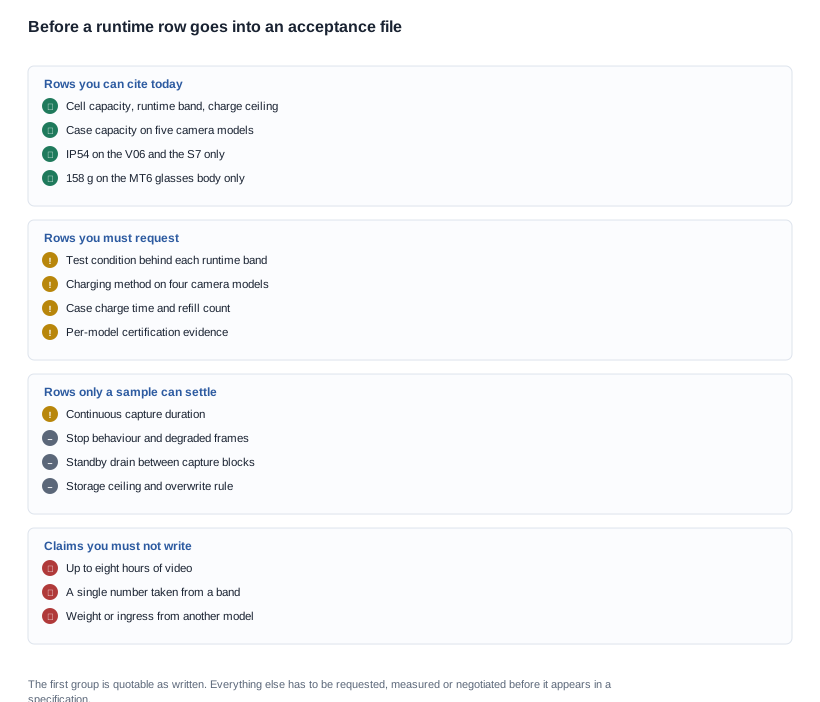
The narrow rows are worth separating out because each of them applies to a set, not to a model. Two camera models publish a colour list: the V03 Pro with three colours and the V06 with four. Two publish an ingress marking: the V06 and the S7, both at IP54. One publishes a weight: the MT6 at 158 g for the glasses body, excluding its foldable case, which is the only weight figure anywhere in the catalogue and cannot be moved to another model.
Nothing in the group publishes a test condition. The catalogue publishes no Bluetooth version for any of the eleven camera models, no sensor model, no field of view, no frame rate and no storage capacity. The certification position is equally narrow: there is a company-level export certification page whose content is images rather than text, the catalogue text contains no reference to CE, FCC or RoHS, and there is no per-model certification row anywhere, so evidence for a specific model has to be requested as written material. The frameworks a buyer may ask that evidence against are the Radio Equipment Directive (EU) 2014/53/EU and the EMC Directive (EU) 2014/32/EU. And the commercial block — unit price, minimum order quantity, lead time, production capacity, warranty scope and certificate numbers — is settled per enquiry rather than published.

Why a rated runtime is not a working day
A rated runtime is a laboratory-style quantity. It is the length of time a cell lasts under a stated load, from a stated start state, measured to a stated end condition at a stated ambient temperature. Strip out the condition and the number can still be compared with another number on the same page, which is useful, but it cannot be scheduled against a shoot.
That is the position across the eleven camera models: the catalogue publishes the cell and the resulting duration, and it publishes no load, no start state, no end condition and no temperature for any of them. The bands are therefore a comparison instrument rather than a plan, and a buyer who treats them as a plan is budgeting from a label.
The notation makes the same point from the other side. A band of 5~8 h is a span between a best case and a worst case; a figure written as ~7 h is an approximation of something the catalogue did not pin down. Both notations are honest about the same underlying fact, and both are vulnerable to the same conversion in a comparison spreadsheet: take the midpoint, quote six and a half hours, and the spreadsheet now carries a number that no page of the catalogue supports.
A working day is not that number, because a working day is a duty cycle and a duty cycle is a sequence rather than an average. A typical content day runs like this:
- A short capture block while the setup is arranged, followed by a gap of several minutes with the unit still powered.
- A longer block of continuous capture, which is the only part of the day a camera rating could plausibly have described.
- A review period in which material is pulled to a phone or a laptop over the radio.
- A second capture block, shorter than the first.
- A pause long enough to make the operator check the battery indicator, without the unit reaching the end of its charge.
The rating was taken under one of those states, not under a blend of them. If it was taken with the camera idle, the figure under continuous capture is lower. If it was taken at a lower frame rate or a lower resolution than the unit ships with, the gap widens again — and because the catalogue publishes no frame rate and no resolution detail beyond the tier, no one can calculate what continuous capture costs on this hardware.
Four draws sit under that sequence, and the catalogue publishes a figure for none of them. Continuous recording is the largest and the one most likely to be absent from a rating, because a rating is often taken with the camera idle or at a reduced duty cycle. Radio activity is the second: transferring material, previewing and any remote function draw from the same cell, and because no Bluetooth version is published for the camera models, the behaviour of the radio link is not on the record either — not its version, not how long a transfer takes, not what it costs in charge. Interface interaction is the third: whatever the control turns out to be, repeated use during a session is a draw, and the catalogue carries no capacitive-touch row for any model, so a buyer cannot describe any of these products as touch-controlled in either direction. Thermal load and standby are the fourth, and a unit left in a bag for an hour between blocks is being used differently from a unit left face-up on a desk.
There is a second ceiling that has nothing to do with the cell. Storage capacity, recording format and overwrite behaviour are not published for any camera model. A recording that stops because the storage filled is not a battery failure and has a completely different remedy, and until the overwrite rule is established, "how long can it record" is not a question the catalogue can answer at all — only "how long can the cell last" is on the record.
Temperature sits on top of all of it. Cold reduces the effective capacity of a lithium cell, so a creator working outdoors in winter will get a shorter session from the same unit than one working indoors in summer. That is chemistry rather than a defect, and it belongs in an acceptance file as an environmental condition to be met, not in a support queue as a fault to be disputed. A figure established at room temperature is not a winter figure, and the catalogue publishes no temperature condition that would tell a buyer which one it is quoting.
How we treat these numbers comes down to one rule: our position is that a band stays a band until somebody tests it, because a figure that survives only inside a comparison spreadsheet is not a figure a channel partner will accept. We publish the cell, the band and the ceiling, and we do not publish a test condition because we do not hold one.

The rows that decide a long session
Once the published position is clear, the useful question is which rows actually move a decision about a long session and which rows are listing attributes. Charge time is the clearest example of a row that does not: the same two-hours-or-less ceiling across all eleven models means it cannot separate a shortlist. Colour, ingress marking and resolution tier are in the same category — they belong in a listing and a channel conversation, and they do not change how long a unit runs. The rows that decide are the case configuration, the runtime band, the charging method and the cell capacity, in that order, because they decide whether the day is workable at all rather than how the product is described.
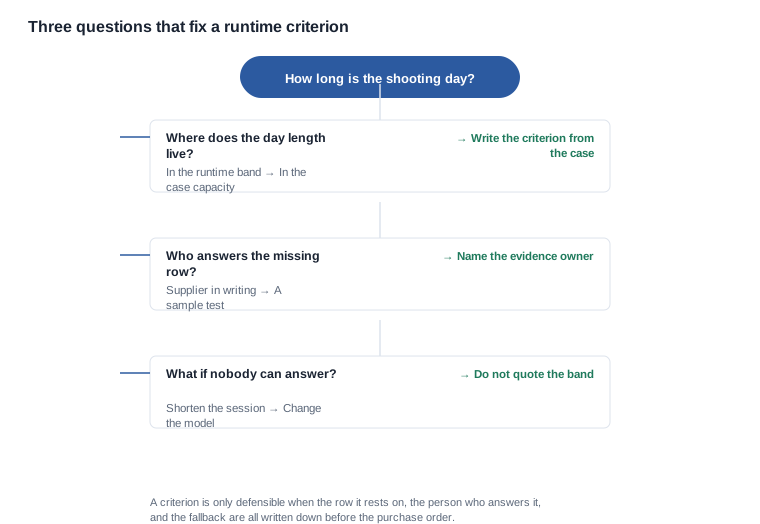
The length of the shooting day determines which of those rows has to lead, and there are three shapes of decision that cover almost every programme:
- A block shorter than the lower end of the band. Every model in the group is a candidate on runtime, because the shortest published band starts at five hours and no sensible capture block runs that long. Here the decision is made on charging method, case configuration, colour and ingress marking, and the runtime band is a tie-breaker rather than a filter.
- A full day away from a socket. The case decides this, and only the five models with a published case capacity can carry a quantified claim about it — the CY05 and the L1 Pro, the CY03 and the MT6, and the L2 Utral. The KY06 and the MT5 have a case whose capacity the catalogue does not publish, so a claim about shooting away from a socket cannot be quantified on them even though the hardware may well support it. The three models with no case row and the one published without a case are the configurations where the charging plan has to exist in the programme rather than in the box.
- An overnight turnaround between two sessions. The charge time of the set becomes the binding constraint. The glasses publish a ceiling of two hours or less; the case publishes nothing; the combination publishes nothing. A programme that shoots in the morning and again after dark is therefore planning against an unpublished number, and it has to be asked for before the schedule is set rather than discovered at the turnaround.
The case state also decides what may be written on a listing, and the four states produce four different outcomes. Where the capacity is published, a claim can carry the figure. Where a case exists but no capacity is published, the claim can say that a case is in the box and must stop there — no capacity, no refill count, no hours of extra shooting. Where no case row is published, nothing can be said about a case in either direction, and the listing has to describe the charging method and the band only. Where the catalogue states that there is no case, the listing can say so, and only the V03 Pro supports that sentence.
Three consequences follow for the physical configuration, and they are worth settling before a purchase order rather than after a carton is packed. A case-equipped configuration changes the carton, which changes the carton dimensions, the carton quantity per container and the freight quote that sits behind a landed cost. A case with a capacity of its own is a second lithium item inside the same box, which changes how the shipment is described on the packing list and on the carrier documentation. And the model string has to be fixed before any of it is drawn, because the L2 Utral page carries two variant names and two case capacities without stating which name goes with which capacity, and the KY06 and the MT5 carry a case whose capacity nobody has published.
The four camera models whose charging method is unpublished are the same four that publish a case capacity, so a case-equipped configuration can still arrive with an interface nobody has confirmed. That combination is the reason the interface question belongs on the first request for quotation rather than on the artwork schedule: it changes the unboxing, the instruction leaflet, the cable in the box and the spare-parts line simultaneously, and all four of those are cheaper to settle on paper than in a carton at a fulfilment centre.
The practical method here is a shortlist built on the case state first, because it is the only row that decides the shape of the day. Write down which models can carry a quantified claim, which can carry a qualitative one, and which cannot carry either. That list is short, it is verifiable against the published rows, and it tells a buyer before any sample is ordered which measurements will have to be closed by measurement rather than by reading.
Turning the difference into a written criterion
A rated figure becomes usable the moment it is written into a purchase order as an acceptance criterion, and a criterion has four parts: the condition under which the result is expected, the method used to obtain it, the result that confirms the configuration, and the tolerance accepted on a repeat delivery. A criterion missing any one of the four is either unenforceable or unfair, and both outcomes cost more than the sample that would have closed it.
The protocol below is not a catalogue test condition — the catalogue publishes none for any of these models. It is the measurement your own approval sample should follow, written down before the sample is opened so that the result can be compared against something.
- Write the session profile first. State the longest continuous capture you need, the length of the gaps between blocks, the total length of the working day, and the ambient conditions the unit will be used in. The longest continuous capture is the number that matters, and the ambient condition is the one that is easiest to forget.
- Fix the start state. A full charge means the glasses and, where the configuration includes one, the case, both at their full state, and the state is written down rather than assumed. A charge time of two hours or less tells you how long charging takes at the ceiling, not what the unit was carrying when you started the clock.
- Run the clock against continuous capture. Record from the start state without interruption, and log the elapsed time when recording stops.
- Record how it stopped. An abrupt end and a recording that degrades into unusable frames are different outcomes, and only the first is a clean runtime measurement. A degraded result is logged as a separate finding rather than folded into the number.
- Repeat the run with the case in the configuration. This is the measurement that describes the working day. Log how much the case restored and how many refills it delivered before it needed a socket, because the case charge time is not published for any model and the refill count is not published either.
- Repeat the run at the cold end of the environment. If the product will be used outdoors, in an unheated warehouse or on a winter shoot, the cold run sets the expectation that a customer will hold you to.
- Run it on more than one unit. Two samples of the same build are not identical, and one unit gives a reading rather than a range. Where the sample order covers more than one unit, use them.
- Write the result into the purchase order. State the configuration, the conditions, the observed result, the tolerance you accept on a repeat delivery, and which of the eight steps is re-checked on arrival and which is covered by the production record.
The tolerance is the part that converts a favourable sample into a repeatable product, and it is the part most often left out. A number without a tolerance gives the supplier room to deliver a unit that behaves differently and call it a new measurement. A number with a tolerance — stated against the configuration, the conditions and the batch — gives both sides something to apply when the first delivery arrives.
The written answers you need from the supplier are a different list from the measurements, and it is worth keeping them apart. These are the questions to ask, in the order that unblocks the most downstream work first:
- Which load, start state and end condition produce the published runtime band on this model, and can that condition be written into the quotation?
- Does the band describe continuous capture, intermittent use, or standby with the camera ready?
- Which end of the band corresponds to which use, and which end does the unit reach in a creator's normal working pattern?
- What is the charge time of the charging case, how many times can it refill the glasses, and how long does the complete set take to turn around?
- What is the case capacity for the KY06 and the MT5, and which case configuration ships with each model string?
- Which charging method applies to the MT6 and the CY05, and the CY03 and the L1 Pro, and is it confirmed for the production batch?
- What storage capacity, recording format and overwrite rule apply, and what is the practical ceiling on material per session?
- What is the measured weight of the glasses body for this model, and what is the packed weight per unit?
- Which certification evidence covers this exact model for the destination market, and can the technical file be provided?
- What is the warranty scope, and is the cell treated as a consumable or as a covered component?
There are also statements that must not appear in the specification at all, because the published rows cannot carry them. A claim of "up to eight hours of video" attaches a test condition that the catalogue does not publish. A single hour figure derived from a band manufactures precision. A weight taken from another model is a different product; so is an ingress marking, a colour list or a case capacity. A runtime band quoted without its condition is a number a reviewer can ask about and a buyer cannot answer.
The order of operations is what makes this work. Negotiate the specification before the artwork, negotiate the artwork before the purchase order, and never negotiate the acceptance criteria after production has finished. A buyer who has written the test condition, the measured result, the tolerance, the case configuration and the certification scope into the purchase order and the quality control criteria has already turned a catalogue label into a specification, and everything left on the list becomes a detail rather than a dispute.
The smart glasses for content creation battery for long sessions
Pulling the camera group together, the published position is a cell capacity in four values — 220, 260, 265 and 290 mAh — a runtime band in three forms, a two-hours-or-less charge ceiling on all eleven models, a charging method on seven, and a charging case in four different states across eight. What is absent is the one line that turns a label into a working day: the condition behind the rating. No test condition is published for any of the eleven models, so the honest starting point for a content programme is that runtime is a comparison row, not a schedule, until a sample establishes it.
That structure leaves a buyer with a clear order of work rather than an open question. Use the published rows to build the shortlist: the case state decides which configurations can carry a quantified claim about a day away from a socket, the charging method decides the packaging and the parts list, and the runtime band decides the order in which the models get tested. Ask the supplier in writing for the condition behind each band, the case charge time, the refill count and the per-model certification evidence, and keep those answers in one file against the model string. Then measure the shortlisted configurations on samples, in the ambient conditions the product will actually meet, and write the result and the tolerance into the purchase order before the artwork is drawn.
On our side, what we can confirm for a content programme is the published rows themselves, the case configuration on each model string, the difference between a case row that is absent and a case that is published as absent, and a written acceptance criterion that quotes the band with its condition attached rather than as a single hour figure. We will also tell you which questions in the list above are answered by the catalogue and which have to come from the supplier, because that split is what decides how much of the programme is waiting on a sample.
The wider power picture across the range sits in the AI camera glasses battery comparison, and the case configurations and what they change are set out in AI camera glasses charging case options. If you are still at the stage of ordering samples rather than measuring them, requesting smart glasses samples covers how to structure a sample request that comes back with answers instead of a box, and how to test smart glasses camera technology covers the wider test design. The content creation solution page sets out where a camera configuration sits in a creator programme once the power question is closed.
Send the session profile — the longest continuous capture, the total day length, the ambient conditions and the number of units — and we will tell you which published configurations reach it, which rows are still missing, and what the acceptance criteria would say.
Related reading
- AI camera glasses battery comparison
- AI camera glasses charging case options
- Requesting smart glasses samples
- AI camera glasses for content creation
- AI camera glasses range
Send the session profile and we will tell you which published rows reach it, and which criteria the acceptance file needs.


