

Most of the problems riders report in smart glasses for cycling are not faults. They are specification gaps that were carried into a product listing, a box insert or a channel conversation, and they arrive at the returns desk wearing the costume of a broken device. That is the useful conclusion, because a specification gap is cheap to remove before the order and expensive to remove after it, while a genuine fault is the supplier's problem and is handled by the quality process. The job of a problem list is therefore to sort the two before anyone writes a credit note. Of the eight symptoms below, six are decided before the order, one needs a sample and a test, and one is a genuine fault investigation that only happens when the reason codes are in place.
Who is reading this, and what they are defending. The reader is a brand owner building a cycling line, a procurement manager choosing between platforms, or a channel buyer writing the guidance that ends up in a store. All three are defending the same thing: a product page and a support inbox that say the same thing. The fear underneath the list is a returns cluster that nobody can classify, because the reason the customer gave is a symptom and the reason the unit came back is a cause, and the two are not the same sentence.
Smart glasses for cycling: most riding complaints are specification problems, not faults
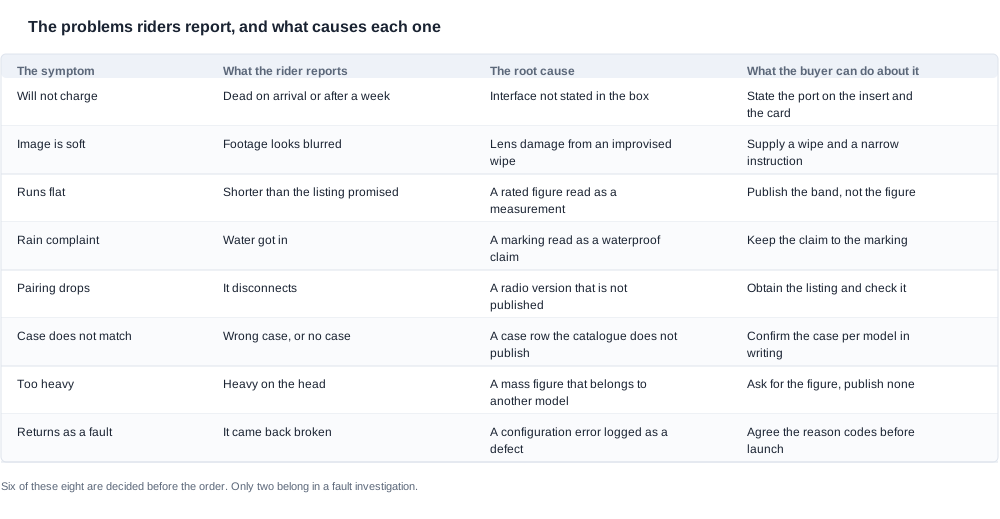
The table is arranged in the order a returns desk actually meets the problems, and the right-hand column is the part that matters to a buyer. A complaint about charging is fixed by stating the port in the box. A complaint about a soft image is fixed by supplying a wipe and refusing to describe a coating that is not published. A complaint about a short runtime is fixed by publishing a band rather than a figure. None of the three is a component problem, and treating any of them as one is what turns a returns rate into a supplier negotiation.
The three that are decided before the order
The charging complaint. A unit arrives and does not charge, and the rider concludes the device is broken. The catalogue splits seventeen models that charge magnetically, seven that use Type-C, and four camera models — the CY05, the CY03, the MT6 and the L1 Pro — that publish no charging method at all. A rider who assumed magnetic docking on a Type-C model, or who has no idea which interface their device uses because nobody said, has a dead-looking product on the first ride. The fix costs nothing: the port is printed on the insert, on the training card and on the listing, and the four models with no published charging method get their interface stated in writing before the order. The charging decisions across the range are at charging solutions.
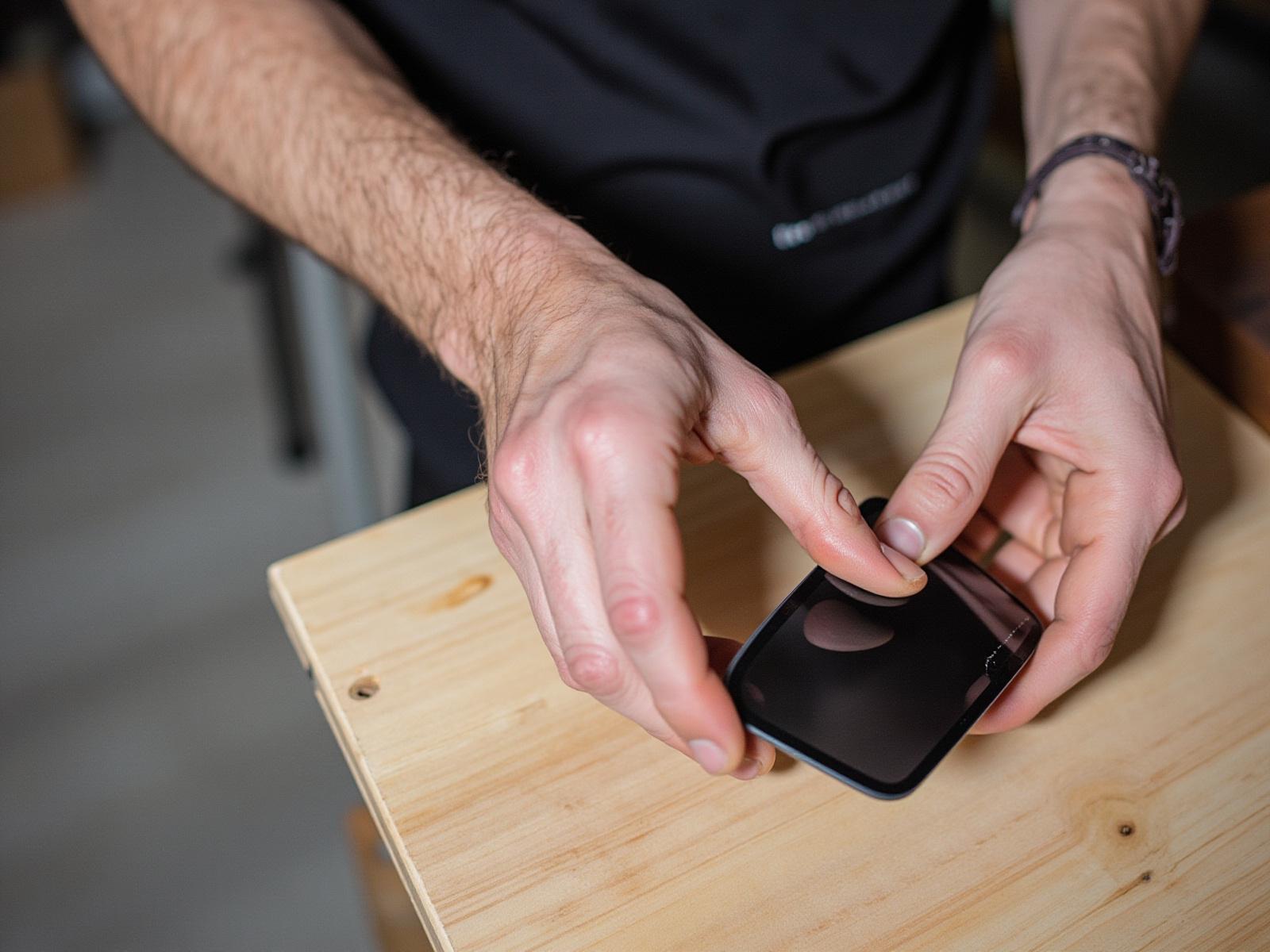
The soft image complaint. The footage looks blurred and the rider assumes the camera is low quality. The catalogue publishes the resolution class — eight models at 8 MP and three at 13 MP — but it does not publish the lens material or the coating for any model, so nobody can say how durable the surface is. What usually happens is that a lens is wiped with a sleeve, a buff or whatever is in a jersey pocket, and the damage is invisible at the moment it happens and permanent afterwards. The fix is a supplied wipe and a narrow instruction, at a cost of a few cents per unit, and it is the cheapest return reduction available anywhere in this category. The surface handling route is at outdoor care.
The runtime complaint. The device runs flat earlier than the listing promised, because the listing quoted a number instead of a band. The published runtimes are rated figures with no test condition attached: five to eight hours on the V06 and the V03, and the V03 Pro and the S7, six to eight hours on the KY06 and the MT5, roughly seven hours on the CY03 and the CY05, and the L2 Utral and the L1 Pro, and the MT6, and roughly six to eight hours across the audio models, with the G07 and the YK12 at the six-hour end. A camera workload also sits at the unfavourable end of whatever band applies. The fix is to publish the band, to publish the charge time alongside it, and to ask the supplier for the condition the band was measured under. The measurement background is at battery life.
The two that need a sample and a test
The wind and the microphone. The microphone sits in a temple, in moving air, and wind is broadband, so the intelligibility of a call at riding speed is not the same number as the intelligibility in a room. The catalogue publishes nothing that answers it: the microphone count, the pickup distance, the processing mode and the field of view are all unpublished for every model in the range. That makes this a sample problem rather than a specification problem, and it is the reason a buyer in this category should run one outdoor test before committing, because no document can substitute for it. The test procedure is at microphone testing procedure.
The frame under a helmet and under a cadence. Vibration at cadence, a helmet's retention cradle pressing on the temples, and a head shape that the frame was not drawn for are the three movement-related complaints that recur in this channel, and none of them is answered by a published row. The catalogue publishes an ergonomic design across the sport range and a detachable inner frame on the V06 and the S7, and a slim temple on the YK12, an ultra-slim detachable temple on the G07 and flexible temples on the V03 Pro — those are the published rows that exist, and they are structural rather than dimensional. There is no published adjustment range, no published head-size coverage and no published mass for the cycling models at all. The single mass figure in the entire catalogue is the MT6 glasses body at 158 g, which includes the cell and the camera and excludes the foldable case, and the MT6 is not a cycling model. So a buyer who needs a mass on a product page has to ask for it, and a buyer who cannot get it should publish none.
And the ingress claim, which is the fourth movement-related problem. Only two models in the range carry an IP54 catalogue marking, the V06 and the S7, and the marking covers splashing water and a dust protection level rather than immersion or a sustained downpour, with no third-party test report published behind it. A listing that says waterproof is making a claim the documentation cannot carry, and the customer in a downpour is the one who tests it. The digit reading is at IP ratings and the deeper question of what a marking establishes is at IP rating advanced considerations.
Triage: telling a fault from a design gap
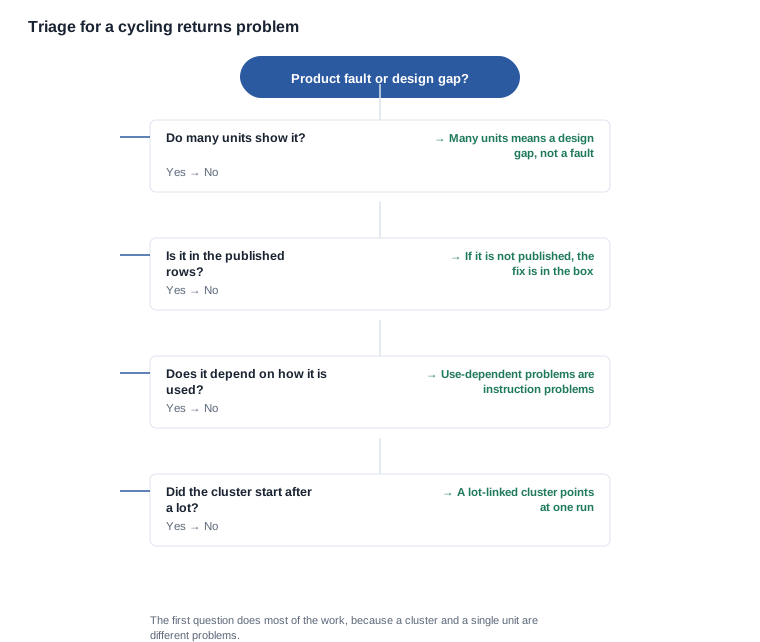
The triage has four questions, and the first one does most of the work. A problem that appears on many units is a design gap, because a design gap is systemic and a component fault is rarely systemic in a batch that passed a sampling plan. A problem that appears on one unit, on one lot, after a season of normal returns is a fault, and it belongs in the quality process. Everything else follows from that distinction.
The second question is whether the symptom contradicts a published row. If it does — the device is supposed to charge over Type-C and it will not — then the question is whether the fault is in the product or in the configuration, and the answer is usually the configuration. If it does not contradict a published row, then the problem is a gap: something the catalogue never said, which the product page or the insert filled in by implication. The gap problems are the ones the buyer owns outright.
The third question is whether the problem depends on how the device is used. A problem that only appears in rain, or only at speed, or only after the case has been in a bag all week, is an instruction problem, and the instruction is the cheapest thing in the programme to change. A problem that appears regardless of use is a product problem.
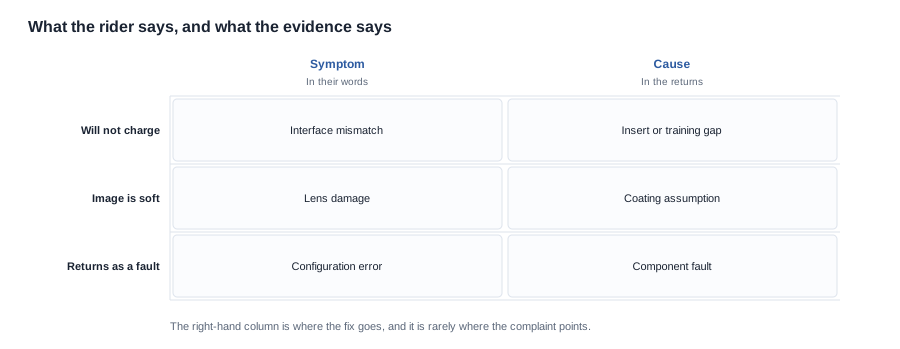
The matrix above is the mapping a returns desk actually needs, and it is worth reading as three pairs rather than as six items. "Will not charge" is a symptom; the evidence says interface mismatch or an insert and training gap, and both are in the buyer's control. "Image is soft" is a symptom; the evidence says lens damage or a coating assumption, and the second of those is a copy problem the buyer wrote. "It came back broken" is a symptom; the evidence says a configuration error or a component fault, and telling those two apart in month one is worth more than any credit note in month three.

The design-out loop

The loop is what turns a returns file into a specification rather than into a complaint, and the first step is the one that decides whether the loop runs at all. Reason codes, not counts. A count tells you that forty units came back in October; a reason code tells you that twenty-six of them said the same thing, which is a finding.
The second step is to separate the cluster from the single return. Those are two different problems with two different owners. A cluster is analysed against the configuration string, the insert and the training card, and the output is a change to one of those. A single return goes into the quality process against the lot reference, and the output is a disposition.
The third step asks which published row the symptom contradicts, which is what separates a design gap from a fault without needing a laboratory. The fourth step decides where the fix lives: in the product, in the box, or in the copy. Those three destinations have very different costs, and a buyer who does not name the destination before acting tends to change the product when the copy was the problem.
The fifth step is the change itself, and the sixth is the point. The change is written down — what was changed, in which document, in which print run, from which date — and the following season's returns are read against that change. Without the written record, the next season's programme starts from the same specification, because nobody can tell whether the last change helped. A programme that keeps a decision log through two seasons will have a specification that is visibly better; a programme that does not will have a newer catalogue and the same problems.
A closing note on the total cost of this loop. The loop is cheap. The wipe costs a few cents per unit, the insert is a print run the brand was going to do anyway, the training card is one page, and the reason code list is a conversation. What the loop costs when it is not run is the total cost of a returns cycle: the replacement unit, the freight, the channel's time, the review that lands on the product listing, and the second season's specification that was built on the same gaps. The criteria for whether the loop is worth running are simple — if a symptom appears twice in two seasons and has not been written down, it is not being managed, it is being absorbed.
Six questions to ask before you order
The problems above are all cheaper to design out than to answer afterwards, and the six questions below are the ones whose answers decide most of them. How to evaluate a supplier in this category is not by asking about the device; it is by asking how the device will behave when the rider is cold, wet and in a hurry.
- What is the charging interface for the exact model I am ordering, and for the exact case configuration? The four camera models that publish no charging method need this in writing, and the answer has to cover the case, because the case is what a rider holds at the end of a ride. What to ask for is a sentence naming both, not a family.
- What was the rated runtime measured under, and what does the figure exclude? The criteria for a usable runtime are a condition, a workload and a starting state. Without all three, the band is decoration.
- What is the lens material and the coating, and what does the supplier recommend for surface handling? A supplier that answers this question has a wiping and packing process worth copying into the insert. A supplier that does not has an insert waiting to be written by you.
- Does the model carry an ingress marking, and is there a test report behind it? Only the V06 and the S7 publish an IP54 marking, and no report is published behind it. Which model to ask about depends on the configuration, and the question about the report is the one that matters.
- What is the unit mass for the model, excluding any case? There is one published mass in the range and it belongs to the MT6, so this is a request rather than a lookup. Before you order, this is worth having in writing, because a mass that appears on a product page without a source is a false statement.
- What reason codes will the channel use, and which of them will be treated as configuration errors rather than defects? The trade-off here is between a channel that reports reasons and one that reports counts, and only the first gives you a design-out loop.
The red flags to watch in the answers. A runtime with no condition, an ingress claim with no report, a mass for a model the supplier does not make, a case capacity for a model with no published case row, and a conformity document that names a company rather than a model. None of these is unusual, all of them are cheap to ask about, and every one of them is a returns cluster waiting to happen. The pitfall is not making the buyer ask; the pitfall is making the rider find out.
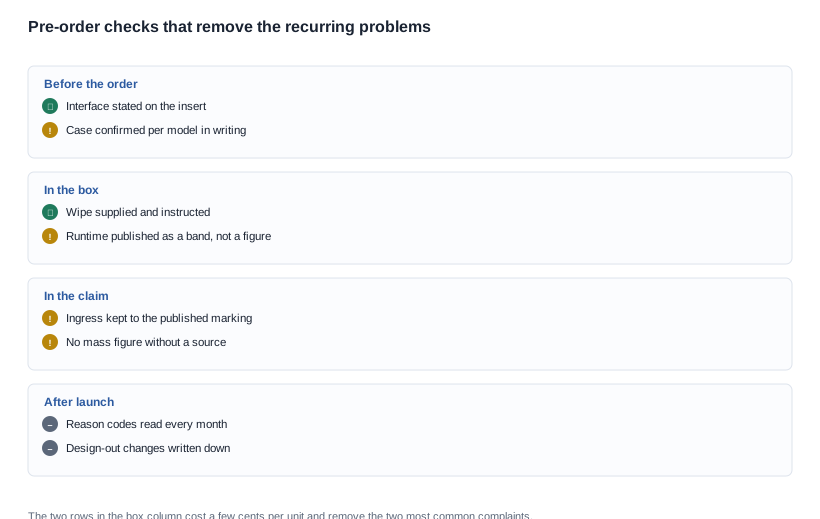
The three things that remove the most problems for the least money
State the charging interface in the box. It costs nothing and it removes the largest single category of first-week complaint in this channel. It also has to be true: the four camera models whose charging method is not published need the interface confirmed in writing, and the D17 and the ZH12 publish Type-C with a roughly one-hour charge, which is the figure worth putting on the insert because it changes what a rider can do between sessions.
Supply the wipe and write a narrow instruction. A supplied wipe with a narrow handling instruction is the cheapest return reduction available in this category, because the alternative is a lens complaint that is attributed to the camera.
Publish the band, and the charge time with it. A buyer who publishes five to eight hours and a charge time of two hours or less has given the rider a usable expectation. A buyer who publishes eight hours has given the rider a promise the product may not have made.

Where our own knowledge of these problems stops
The recurring problems in this category are specification problems, and the catalogue is more useful as a list of what a product does and does not say than as a set of marketing numbers. We publish the resolution classes with eight models at 8 MP and three at 13 MP, the cell capacities from 40 mAh on the A05 and A06 up to 290 mAh, the rated runtimes, the charge times, the charging interface per model, the case capacities where they exist with the L2 Utral published at either 900 or 1400 mAh, the detachable inner frame on the V06 and the S7, the slim temple on the YK12, the ultra-slim detachable temple on the G07, the flexible temples and the photochromic lens on the V03 Pro, the remote control photo feature on the D17 and the ZH12, the absence of any published touch row on every model, the IP54 marking on the V06 and the S7, and the Bluetooth versions where they are published.
What we do not publish, and will not estimate: the lens material, the coating, the microphone count, the pickup distance, the processing mode, the field of view, the adjustment range, the head-size coverage, the frame weight for any model other than the single 158 g figure for the MT6 glasses body, the runtime test condition, the radio version for the camera models, and the per-model certification scope. We will not describe the MT6 as a 158 g product with its case, because that figure is the glasses body including the cell and the camera and excluding the foldable case. We will not state that any model is tested to IP54, because no test report is published behind that marking.
What we will do is go through the claim with you before it is written. Send the product page, the insert copy and the training card, and we will mark every sentence that no published row supports, tell you which ones a supplier can support with a document, and tell you which ones have to be cut. The device families are at sport smart glasses and ai camera glasses, the scenario entry point is smart glasses for cycling, and the measurement discipline for a deployed programme is at how to measure results smart glasses for cycling.
What to send us next. Send the listing copy and the insert, and we will return the marked version, the row behind each surviving claim, and the list of sentences that have to go.
Related reading
- How the scenario opens — smart glasses for cycling
- The claim boundary — IP rating advanced considerations
- The accessory programme — smart glasses for cycling accessories
Send the listing copy and the insert, and we will return the marked version and the rows behind it.


