

Smart glasses for ecommerce: a spending sequence sheet for a launch budget
The short answer is this: a launch budget in this category is decided by the order in which money is committed, not by the proportions it is split into. The five commitments that consume a launch budget — samples, the market documentation route, packaging, inventory and the working capital between paying for goods and being paid for them — are not interchangeable, because three of them sit on the critical path and two of them can be deferred until the first shipment tells you something. Add two reserves — returns and support — and you have the whole shape of the decision. And because unit prices, minimum order quantities and lead times are not published on this site, the budget you build has to be a structure with named line items and named decision gates rather than a set of figures, which means the order of commitment is the only part of it you can actually control before the quotation arrives.
The decision tree in one paragraph. The first question is whether the programme can be evidenced at all, and the answer decides the first block of spending. If it can, the budget buys evidence before it buys volume: samples, the document route, and one model in one configuration. If it cannot, no amount of inventory helps, and the correct budget is a research budget. The second question is what the launch needs to exist — the documentation route and the packaging artwork are on the critical path whether or not the product sells. The third question is what the data will decide later: a second model, a second colour, a second case configuration, and any customisation beyond the logo are all deferred until the first shipment has produced a return-rate distribution and a conversion figure.
Who this is written for. The reader is a brand-side buyer, a channel buyer or an e-commerce seller who has been given a number and a launch date. The fear behind the question is not overspending. It is the specific failure of committing the big money first: ordering inventory before the listing has been tested, printing artwork before the configuration has been fixed, and paying for the second colour before the first one has a return-rate figure attached to it. That failure produces a launch that cannot be re-ordered at the right price point, which is the phrase a channel buyer uses for a channel that is finished.
Why the published data gives you cost drivers before it gives you prices. The catalogue publishes the rows that determine what a configuration is, and those rows determine what the configuration costs to ship, package, document and support, even though the prices themselves are confirmed per enquiry. The charging interface decides whether the case is structural, whether a cable is in the box and how many charge documents exist. The case position — published in four different forms across the camera models, and absent on three of them — decides whether the parcel carries a second lithium cell and what the transit file has to cover. The runtime band decides the endurance claim and therefore the size of the returns reserve. The camera resolution class decides whether the product is a first-person-content product, which has a different attachment rate and a different defect profile, or a documentation product, which does not.

The seven commitments and what each one buys
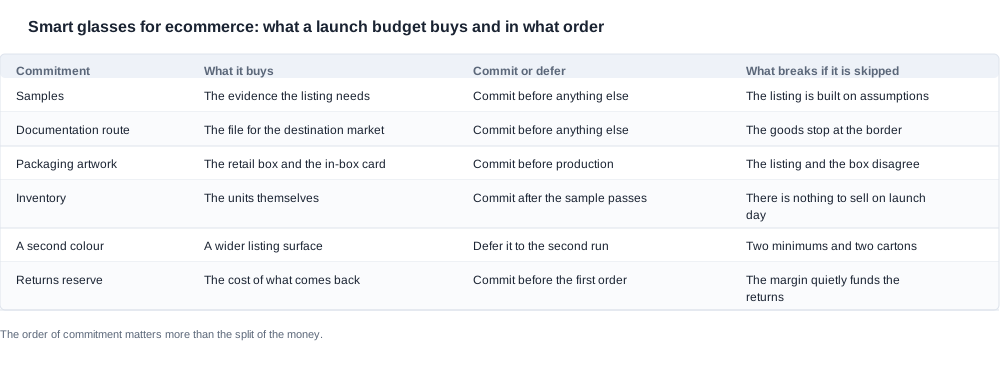
The table is the budget in the order the money should be committed. Two lines in it are routinely cut, and they are the two that decide whether the channel is viable after launch rather than at launch.
Inventory buys the units themselves, and it is the product. It cannot be deferred past the point where the launch date arrives, but it should not be committed before the sample has passed and the configuration has been fixed, because the minimum order quantity attached to it is the least flexible commitment in the whole budget. A mistake in the configuration is a new minimum, a new carton and a new artwork approval.
Packaging buys the retail box, the insert and the artwork, and it is where the case decision becomes physical: a configuration with a case has a different carton, a different parcel and a different label from the same device without one. Packaging is also where the two cheap return controls live — the cleaning cloth and the contact wipes that ride in the insert — and it is the reason a packaging budget of a few cents per unit can be the highest-return line in the entire cost structure.
Freight buys getting the stock to the fulfilment centre, and it is the line that the case configuration moves most. A parcel with a 1400 mAh case and a parcel without one are different freight bands, and the difference does not appear in a unit-price comparison because it appears in the freight line. This is why the freight estimate has to be rebuilt whenever the case configuration changes, and why a landed-cost model built once at the start of the programme goes stale every time the range widens.
Samples buy the evidence the listing is built from, and they are the only instrument that answers the questions the catalogue deliberately leaves open: the sensor model, the field of view, the video specification, the storage behaviour, the lens material and the coating, the per-model unit weight, and the per-model certification position. A sample converts a gap into an observation, and an observation is what a listing can be written on. The sample policy is at samples.
Working capital buys the gap between paying for goods and being paid for them, and it is a function of the payment terms rather than of the product. It is the commitment most often mis-sized, because it is invisible in a quotation and it is the first thing to break when a launch slips by three weeks.
The returns reserve buys the cost of what comes back, and it is the line that is almost never quoted by anybody. A hardware product sold to consumers will return units, and in this category the reasons are frequently a description that was never tested rather than a fault in the build. The reserve is what lets the description stay honest when the first bad review arrives, and it is what stops the margin from quietly funding a return rate nobody planned for.
The support reserve buys the time and the parts, and it is sized by the product, not by the volume. The first-session step is not published for any model in this range, no verified device list is published, and the AI behaviour — listed as a capability on twenty of the catalogue's twenty-eight entries — has no published model, language list, offline behaviour, subscription position or data location. Every one of those is a ticket generator, and the reserve that covers them is a line that grows as the range grows.

The commit-or-defer decision
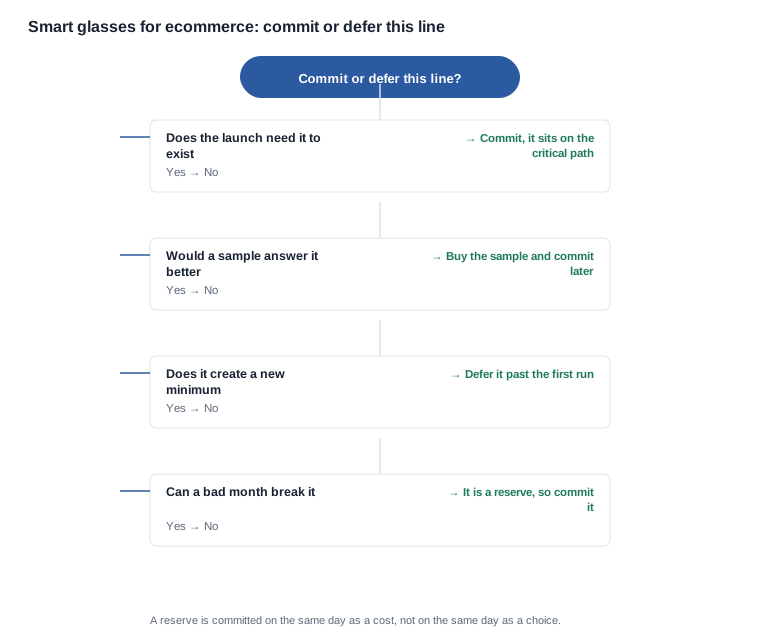
The four questions in the decision chart are asked in order, and each one can be answered by a buyer without asking anybody else. Does the launch need this line to exist at all? If the answer is yes, it is on the critical path and it is committed first, because the documentation route and the packaging artwork sit between the order and the shelf regardless of whether the product sells. If the answer is no, the next question applies.
Would a sample answer it better? This is the question that separates a research spend from a production spend, and it applies to every line the catalogue cannot price. If the open question is the camera's video specification, a sample clip answers it and a production run does not. If the open question is the charge time in the delivered configuration, the sample answers it. If the open question is the per-model certification position, only a document answers it, and the answer comes from the supplier rather than from a sample.
Does it create a new minimum? Every additional configuration creates a minimum order quantity, a carton, an artwork state and a return path. A second colour, a second case configuration, a second model and a logo customisation are the four that recur, and each of them multiplies the fixed cost of the programme without multiplying the demand. This is the trade-off that makes a narrow first range the right answer in most cases: a narrow range with two models is easier to reorder at a better price than a wide range with six, because the reorder is one purchase order rather than six.
Can a bad month break it? A reserve is the one line that must be committed even though nothing is bought with it, because a reserve that is set after the first bad month is not a reserve. Two of them are named in this article — returns and support — and both are sized before the first order. The useful discipline is to set the returns reserve as a percentage of the sell price at the moment the listing is written, then compare actual consumption against it after the first shipment. That comparison is what turns the reserve from a guess into a number.
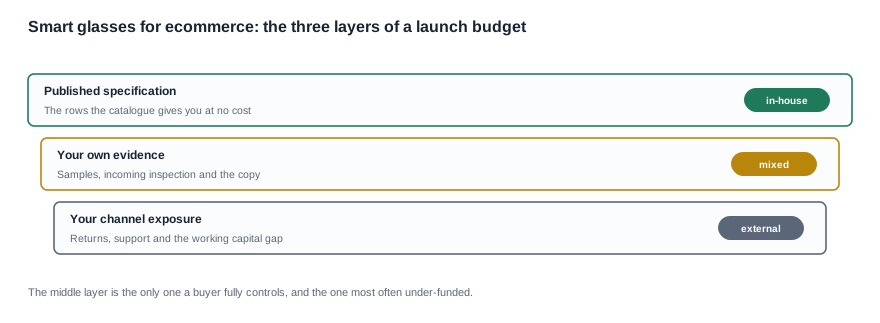
The three layers of the budget. The layer diagram makes the argument about what a buyer can and cannot control. The published specification layer is free and available now: the rows exist, the configuration logic follows from them, and the document list for a market can be defined before any money moves. The evidence layer is partly yours and partly ours — the sample, the incoming inspection and the copy are decisions you make, and they are the layer most often under-funded. The channel exposure layer — returns, support, the working capital gap and the cost of the documentation route — is where the real money sits, and it is the layer that only becomes visible once the listing is live.
What the published rows let you cost, and what they do not
The honest position is that the catalogue gives you cost drivers, not costs, and a driver is enough to build a budget structure. The interface decides whether a case is structural; the case position decides whether a second lithium cell has to be declared and how the parcel is built; the resolution class decides whether the product is a content product; the runtime band decides the endurance claim and the size of the reserve; the model count decides the number of configurations, and therefore the number of minimums and artworks. Unit prices, minimum order quantities, lead times, tooling and mould costs are all confirmed per enquiry, and they should be, because a published price would be a price for one configuration on one quantity.
The items that most often fall out of a first budget are the two per-unit consumables, the artwork, the freight band for the case configuration, the working capital gap implied by the payment terms, and the returns reserve. The items most often left in are the sample cost, the per-market document set, the incoming inspection, and the support reserve. That list is short enough to put in a budget template and specific enough to be checked.

When the money is actually spent
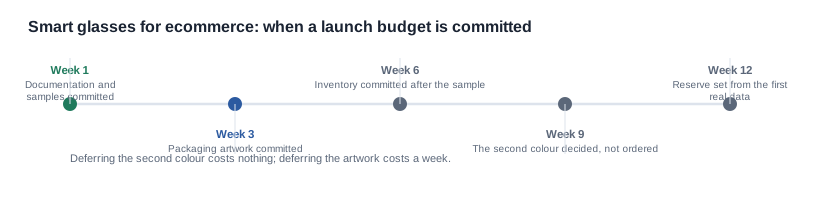
The timeline above is the commitment sequence, and it is worth noticing that three of the five points on it are decisions rather than purchases. Deferring the second colour costs nothing and buys a data-driven decision. Deferring the second case configuration costs nothing and buys a parcel decision. Committing the artwork early costs a week of schedule but saves a minimum order quantity if the configuration changes.
Week one: the documentation route and the samples. Both are committed together because both are on the critical path and neither depends on the product selling. The documentation route is per market — the radio equipment obligations for a Bluetooth product sit in the Radio Equipment Directive (EU) 2014/53/EU, and the general product safety regulation has applied since 13 December 2024, which brings an EU-established responsible party onto the online product page. The samples are the evidence that lets the listing be written from observations rather than from assumptions.
Week three: the packaging artwork. Artwork is committed after the configuration is fixed and before the inventory order, because artwork is the point at which a configuration becomes expensive to change. By then the case option, the interface and the in-box contents should all be settled, because every one of them is printed.
Week six: the inventory. The order goes out after the sample has passed and the document route is confirmed. The quantity at this point is the least flexible number in the plan, so the criteria behind it — a pilot share against a run share, and whether two models can share one purchase order — are worth more attention than the unit price.
Week nine: the second colour, decided but not ordered. The data from the first shipment is what decides it, and the decision itself is free. Ordering it is not free, and that is the whole point of separating the decision from the commitment.
Week twelve: the reserve, set from real data. The returns reserve is recalculated against the actual return-rate distribution and the actual mix of reasons, which is the first point in the programme where the budget becomes an instrument rather than a plan.
The working capital gap, and why it is the budget line nobody quotes
The five commitments above are all visible in a quotation. The sixth is not, and it is the one that most often decides whether a launch survives its own success.
Working capital is the difference between paying for goods and being paid for them, and in this category it is a function of the payment terms rather than of the product. A seller who orders at the factory's terms and is paid by a marketplace on a different cycle is carrying the gap, and the gap grows with every additional step in the chain. It is invisible in a unit-price comparison because no unit price contains it, and it is invisible in a margin calculation if the margin is computed on the sell price rather than on the cash position.
The line is easy to underestimate for three reasons. The first is that it looks like a finance problem rather than a sourcing problem, so it is owned by somebody who does not negotiate the payment terms. The second is that the first order is often small, and a small order has a proportionally large gap. The third is that it is invisible until it bites — usually when a second order is due before the first one has been paid for, which is exactly the moment when the second order should be placed at the best price.
The way to size it is the way the working capital line disappears. Three terms have to be fixed at the quotation stage: the deposit, the balance against inspection, and the moment the goods are paid for. Two structural options then do most of the work. The first is splitting the first run across two deliveries, which reduces the stock at risk before the first returns data exists and reduces the amount of cash tied up in one movement; the cost is one extra freight movement. The second is taking the share at the pilot tier rather than at the run tier, which reduces the first cash outlay and takes the supplier's own risk exposure with it; the cost is a slightly worse unit price on a smaller quantity.
The practical test of whether this line has been sized correctly is uncomfortable but simple: if the second order cannot be placed at a good price because the first one has not been paid for, the budget was wrong — and the fix is in the payment terms and the delivery split, not in the unit price. That is why the terms belong in the same conversation as the configuration rather than after it.
The budget review, and what it should contain
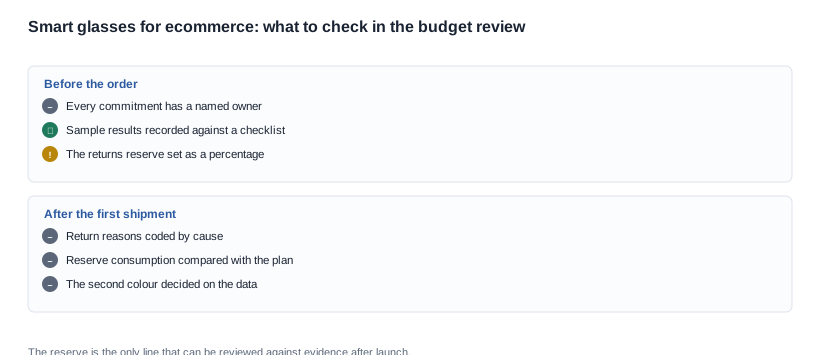
The review checklist has two halves, and the second half is the one that is usually skipped. Before the order, the questions are about ownership, evidence and the size of the reserve. After the first shipment, the questions are about the returns data, the reserve consumption and the decisions the data unlocks.
Three numbers worth tracking from the first shipment. The return rate by cause, coded against the fault taxonomy rather than in free text, because a rate without a cause distribution cannot be acted on. The reserve consumption as a percentage of the sell price, compared against the planned reserve, which is the earliest honest signal of whether the listing is accurate. And the defect share of returns, separated from the expectation share, because the two have different cost owners and completely different remedies.
The trade-off that has to be made explicitly. Money held back as a reserve is money not in inventory, and inventory is what makes a channel able to reorder at a good price. The reserve is not free money and it is not a way to improve the numbers — it is the cost of being able to keep selling the same listing next season. A seller that runs no reserve will have a better-looking month and a worse second season, and the second season is the one that decides whether the programme was worth doing.
How we work with a budget you have built
It is worth being precise: we will help a buyer build a budget structure before we help them build a budget figure, because the structure is what survives a change of supplier, a change of market and a change of configuration. So we will tell you which configurations exist for the models you are considering, which rows apply to each of them, what each configuration adds to the bill of materials and the freight, what the market document set costs in time rather than only in money, and which parts of the budget have to be committed before the first shipment is visible.
We will also be explicit about the boundary. We do not publish unit prices, minimum order quantities or lead times on this site, and we would rather negotiate them per enquiry than quote a number that a buyer might treat as a catalogue figure and build a business plan on. The same applies to tooling, mould costs and any non-recurring engineering charge. What we publish is the specification, the configuration logic and the case position, and those are enough to decide the order in which a budget should be spent.
What to send us. Send the target market, the price band you are working to, the volume you are considering, the number of configurations you expect to need, and the budget structure you have drawn. We will tell you which configurations exist at that level, which of your budget lines the published rows move, which lines have to be committed before the launch date rather than after it, and which published figures will need a condition in your listing. The commercial blocks are at MOQ, lead time, payment terms and pricing; the production side is at production capacity. The scenario entry point is smart glasses for ecommerce, the operational gate is at the ecommerce buyer checklist, and the accessory economics are at ecommerce accessories.
What you get back. A configuration list that exists rather than a hypothetical one, a budget ordered by commitment rather than by amount, a set of named gates for the decisions that the first shipment will unlock, and a list of the published figures your listing can carry without a condition.
Related reading
- The scenario entry point — smart glasses for ecommerce
- The operational gate — the ecommerce buyer checklist
- Commercial blocks — pricing, MOQ, payment terms
Send the market, the price band, the volume and the number of configurations, and we will return the configurations that exist and a budget ordered by commitment rather than by amount.


