

The first week after a smart glasses for ecommerce listing goes live is not informative, and the first month is misleading in a specific direction. What actually determines whether a listing works appears between week six and week twelve, when enough customers have used the product long enough to form a view of it and to write about it. Expect three things: a support spike in week one that measures your quick-start card rather than your product, a returns cluster in weeks two to four that is almost entirely an expectation gap rather than a defect, and a review set from week six onward that separates cleanly into complaints about what the device does and complaints about what your page said it does. The lever that moves all three is the same, and it is written before the first unit ships rather than after.
Smart glasses for ecommerce: where the listing decides the margin
Who this is for. The reader is an ecommerce buyer, a brand owner listing a hardware line for the first time, or a channel manager who has inherited a listing that is not converting and does not know why. The task in front of them is a margin decision disguised as a content decision: the page either matches the product or it does not, and the difference shows up in returns, in refund handling cost and in review scores that no advertising budget can repair. The fear behind it is a margin leak rather than a product failure — a listing that converts beautifully and then returns a fifth of what it sells.
Where the money actually sits in this scenario. A hardware listing has three cost lines that move independently: the unit price and the landed cost of getting it to your fulfilment centre, the cost of the listing content and the assets behind it, and the cost of handling a return. The third is the one most sellers model last, and it is the one most sensitive to a single sentence in a specification table. A return is not a refund: it is a refund, a return shipping label, a restocking and inspection step, a customer service interaction, a payment processing reversal, and a unit that has to be reworked or written off. That stack is why a two-point difference in description accuracy can move a listing from profitable to loss-making, and it is why the rows you can state and the rows you cannot are a commercial decision rather than a copy decision.
What the catalogue can and cannot support on a page. A listing for this category is a description of a partially published product, and the buyer has to know which half is which. Of the eleven camera models, every one publishes a sensor class, a cell capacity, a charge ceiling, a rated runtime band and a case status; seven of the eleven publish a charging-method row; four of the eleven publish no charging-method row; and the storage path, the field of view, the video format, the frame rate, the stabilisation behaviour, the low-light behaviour, the unit weight on ten of eleven models, and the ingress marking on nine of eleven models are unpublished. That is not a thin catalogue. It is a catalogue with a strong electrical envelope and an open imaging envelope, and the page you write has to reflect exactly that division — because the customer who buys against the open half is the customer who returns.
Why two listings for the same model can behave differently. The published specification is identical in both cases, so it cannot explain the difference. What explains it is the configuration and the description: whether a charging case was in the box, whether the listing named the charging interface that was actually shipped, whether the runtime was written as a band or as a promise, and whether the rows the catalogue does not publish were described as unspecified or quietly implied. Four choices, and they are made before the first unit exists.
Seven listing rows, and what each one is worth
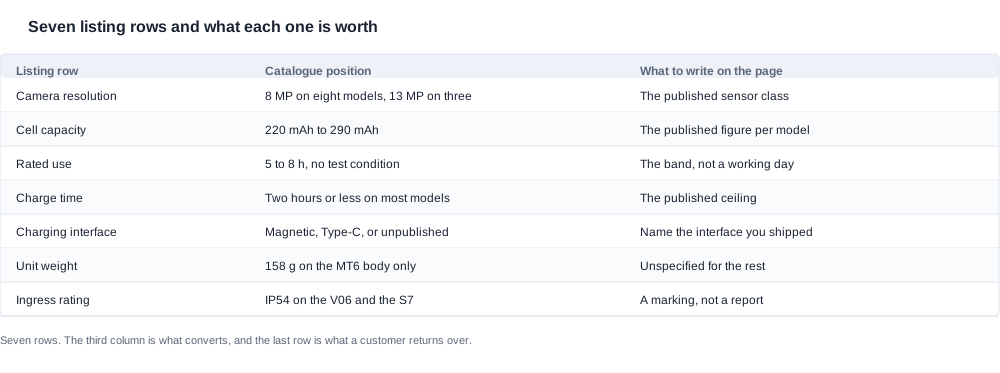
These are the seven rows that decide whether a listing keeps its margin. Each one has a published position behind it, and the third column is the sentence that belongs on the page. The chart below carries the same seven rows.
| Listing row | Catalogue position | What to write on the page |
|---|---|---|
| Camera resolution | 8 MP on eight models, 13 MP on three | The published sensor class |
| Cell capacity | 220 mAh to 290 mAh | The published figure per model |
| Rated use | 5 to 8 h, no test condition | The band, not a working day |
| Charge time | Two hours or less on most models | The published ceiling |
| Charging interface | Magnetic, Type-C, or unpublished | Name the interface you shipped |
| Unit weight | 158 g on the MT6 body only | Unspecified for the rest |
| Ingress rating | IP54 on the V06 and the S7 | A marking, not a report |
Resolution is the one row that a customer can verify from the outside. Eight of the camera models publish an 8-megapixel sensor class and three publish 13 megapixels. Write the class and the model name and nothing else, because the customer who buys on a megapixel number and then judges the image quality has been given a number that does not describe the picture. The camera models publish no field of view, no video format and no frame rate, so a listing that implies a resolution class but describes a viewing experience is describing a device that does not exist in the catalogue.
Cell capacity and rated use belong in the same sentence. The camera models publish cell capacities from 220 mAh on the MT5 and the V03 Pro, and the V03, through 260 mAh on the KY06 and the S7, and the V06, 265 mAh on the MT6, to 290 mAh on the L2 Utral and the CY03, and the CY05 and the L1 Pro. The rated use bands run from five to eight hours, six to eight hours and about seven hours, and no model publishes the test condition behind its figure. A listing that pairs a capacity with a runtime without that caveat converts well and returns badly, because the customer's actual camera workload is heavier than the duty cycle a rating usually describes.
Charge time is a ceiling and the wording has to show it. The catalogue publishes a charge time for every model in the range: two hours or less on all but the D17 and the ZH12, which publish about one hour. "Two hours or less" is the commitment; "under two hours" is a different and stronger claim, and a listing that overstates the ceiling creates a customer expectation the catalogue does not support. Write the ceiling as published.
The interface row is the one sellers routinely get wrong. Four of the eleven camera models publish no charging-method row at all: the CY03 and the CY05, and the MT6 and the L1 Pro have cell capacity, charge time, runtime and case capacity published, and no interface line. Their case capacities are published — 1400 mAh for the first three and a 1200 mAh foldable case for the MT6 — so "the charging method is not published for this model" is a different statement from "this model has no charging case", and the second one applies to no model in the range, because four camera models publish no charging-case row at all rather than a row that says there is no case. If your page says "charge it in the case" on a model whose interface row is unpublished, you have described a charging behaviour nobody has published.
Weight and ingress are the two rows where honesty is cheapest. A unit weight is published for exactly one model in the catalogue: 158 g for the MT6, and that is the weight of the glasses body including the 265 mAh cell and the camera, excluding the foldable case. No bare frame weight is published for any model. Ingress is published for exactly two models: the V06 and the S7 carry an IP54 marking, which covers splashing water and a dust protection level and does not cover immersion, and it is a catalogue marking with no third-party test report published behind it. The digit reading is at IP ratings. Writing "unspecified" on those two rows costs a sentence; writing a typical figure on them costs a return and a review.
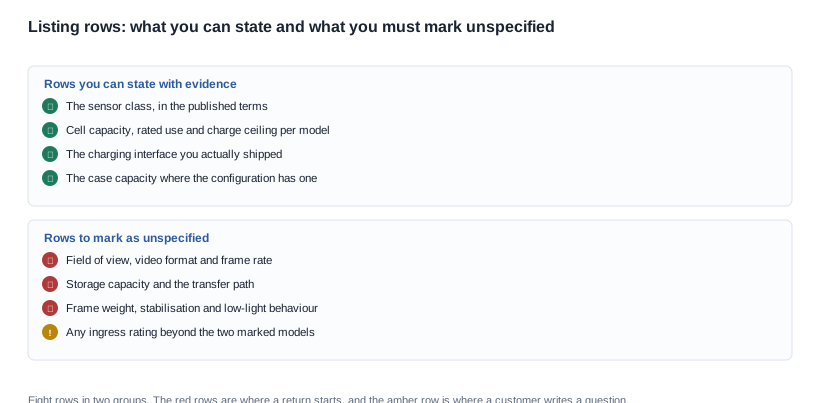
The split above is the operational version of the same point: four rows a page can state with evidence, and four rows it has to mark as unspecified. The second group is where a return starts, because a customer who bought against an implied row will return against it.
What happens when a listing is thin. It converts worse than a listing with a full specification table, and that is the trade the seller has to price. The cost of the conversion difference is measurable against a single month's returns on a product where the deciding rows are unpublished, and on most of the camera configurations in this catalogue the thin honest page is the cheaper option. That is a calculation, not a principle: measure the conversion difference and the return rate on your own traffic before deciding.

The measurement set for the first three months
The measurement problem in an ecommerce scenario is not that the data is missing; it is that the data arrives in the wrong order and gets read too early. The five points on the curve below are the order in which the signal actually becomes usable.
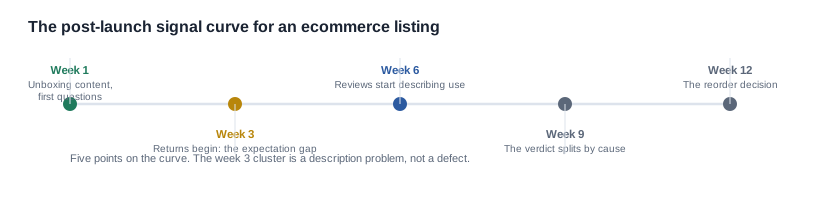
Week one measures your quick-start card. The volume of questions is highest relative to units sold, and the questions are almost entirely about connection and charging. None of that tells you whether the product works; it tells you whether your quick-start card exists, where it is, and whether its wording matches the listing. Treat the first week's ticket text as a document review, not as a quality signal.
Weeks two to four are where the expectation gap surfaces. This is where the returns begin, and the cause is nearly always the same: a customer bought on the basis of your listing and received something narrower than they inferred from it. The rows most often responsible are the ones a seller adds to make a specification table feel complete — video resolution, night capability, water resistance. For our camera models the field of view, the video format, the stabilisation behaviour, the storage path, the unit weight and the ingress rating are all unpublished, so a page that implies any of them describes a product that does not exist, and the customer who buys on it is the customer who returns.
Weeks six to twelve are where the reviews become evidence. By then the reviews describe use rather than unboxing, and they cluster. Battery complaints cluster on camera configurations, because the cell capacity runs from 220 mAh to 290 mAh against a rated use stated without a test condition. Weight complaints cluster where the weight is unstated, which in this catalogue means every model except the MT6. Charging complaints cluster on configurations shipped without the case the listing implied. None of these are defects. All of them are description errors, and all of them are fixed on the page rather than in the product.

The two numbers worth watching, and why they are two. The first is the return rate broken out by the customer's stated reason, classified from the sentence they wrote rather than from a category code assigned afterwards. The sentence contains the cause; the category you assign it to is your interpretation, and interpreting the evidence before you have read it is how a returns problem stays a returns problem for six months. The second is the share of reviews that describe a capability rather than a build. A review saying the video quality is poor describes the product. A review saying it does not do what the listing says describes the listing. They need different fixes — one needs a supplier conversation, the other needs an edit — and collapsing them into one number is what makes a returns review useless.
The operational set around them. Four more measurements complete the picture and cost nothing to collect: support tickets per hundred units by topic; the proportion of tickets that are answerable from the quick-start card alone; the refund handling cost per return, including inspection; and the days from a customer posting a review to the page being corrected. The last one is the one that decides whether the second quarter is better than the first.
The measurement discipline itself. The larger framework sits at measuring results, and the longer-horizon behaviour of an owned unit is at long-term use. The accessory bundle that belongs in the box is at the gear checklist — and the contents of that bundle matter to the returns number for the same reason the specification table does.

What a channel buyer can negotiate and what is fixed
Open for negotiation, in the order the room appears. The bundle contents and the insert artwork, because they are per-unit costs you can change between runs and cheap to change before the artwork is printed. The packaging format and the box dimensions, because they determine the freight bill and the fulfilment cost per unit. The price tier and the order threshold, and above all the quantity held at pilot level, because that is the exposure the factory carries on its own. The payment structure and the shipment split, because a split delivery suits a channel being built in stages and moves the risk off your balance sheet. The warranty length and the returns policy terms, including who pays the return shipping. The sample order cost against the first order, and whether the sample cost is credited. And the artwork, colour and logo treatment, which are cheap between runs and expensive after the print run is committed.
Fixed before the negotiation and not worth spending time on. The sensor class, the cell capacity, the charge ceiling, the rated runtime band and the charging interface where it is published. The certification cost and the certification lead time. The tooling cost, amortised across the first order and quoted as a separate line rather than folded into the unit price. The battery transport documentation for a configuration containing a charging case, and the lead time of the transit file. And the per-model certification status itself, which we do not publish: the catalogue carries a company-level export certification page with image content rather than text content — ten patent certificates, eight appearance-design patents and two utility-model patents — the catalogue text contains no reference to CE, to FCC or to RoHS, and there is no per-model certification row anywhere. That is a document to request, not a row to read, and the route is at certification checklist.
Where the returns policy belongs in the negotiation. A warranty length is a number; a returns policy is an operational commitment that the factory has to be able to service. If your channel's policy allows a customer to return a unit after a long period of use, that is a stock and inspection decision as much as a commercial one, and it is worth asking what the factory's own acceptance criteria are for a returned unit, what happens to a unit that fails inspection on arrival, and how long the credit takes. Those three answers determine whether your returns policy is a margin line or a trap.
A worked example, written as a scenario. Take a marketplace seller who has decided to list two camera models and one audio model. The first decision is the description set: the listing states the sensor class, the cell capacity, the rated use band, the charge ceiling and the interface for each model, and it states explicitly that the field of view, the video format, the storage path and the unit weight are unspecified except where published. The second decision is the bundle: a lens cloth and a contact item in the insert rather than a case in the box on a model whose interface is magnetic, which keeps the freight weight down and removes a second lithium cell from the transit file for that configuration. The third decision is the measurement set: returns are classified from the customer's own sentence, and reviews are split into capability complaints and build complaints, so the two weeks-to-four returns cluster is read as a description problem and fixed on the page in days rather than in the next product revision. The outcome is a thinner specification table, a measurable conversion difference, and a returns rate that a single quarterly review can explain.
Where our published rows stop and a listing has to start
We publish the rows a buyer can order from, and we will not fill the gaps with industry averages. For an ecommerce listing that means the resolution class, the cell capacities, the rated runtime bands, the charge times, the charging interface where it is published, the case capacities where they are published, the published structural features and the colour options. We do not publish the field of view, the video format, the frame rate, the stabilisation behaviour, the storage capacity and transfer path, the low-light behaviour, the per-model unit weight beyond the single published 158 g whole-unit figure for the MT6, the runtime test conditions, or the ingress test report numbers. We will also not state that any product in our range is tested to IP54, because no test report is published behind that marking, and we will not extend it beyond the two models that carry it. We do not hold return data, review data or conversion data, and we will not present an industry figure as our own.
What to send us next. Send the models you plan to list, the channel you are listing through, the destination markets, the volume behind the first order, and the configuration of each model — in particular whether a charging case is in the box. We will tell you which published rows exist for each, which rows are gaps, what the case options are, where a listing built from those rows will create an expectation it cannot meet, and the documentation that has to be settled before a purchase order. The channel framework is at smart glasses for ecommerce, the per-model figures are at AI camera glasses and Bluetooth audio glasses, the commercial structure of a first order is at pricing, and the incoming inspection criteria are at quality consistency.
Related reading
- The opening point of the scenario — smart glasses for ecommerce
- The measurement framework — measuring results
- The rows in the catalogue — battery life
- The bundle decision — the gear checklist
Tell us the models, the channel and the configuration of each, and we will return the published rows that cover them and the rows a listing has to mark as unspecified.


