
A classroom or campus deployment puts a specific set of demands on the build, and a buyer who treats it as a general product decision pays for the wrong configuration. What follows is the four-mistake view of that decision, written so each mistake can be traced to the one line in the order that prevents it.
Smart glasses for education: four mistakes that show up after the invoice
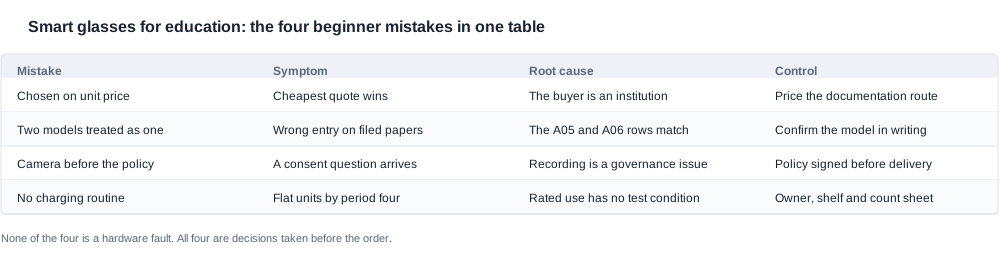
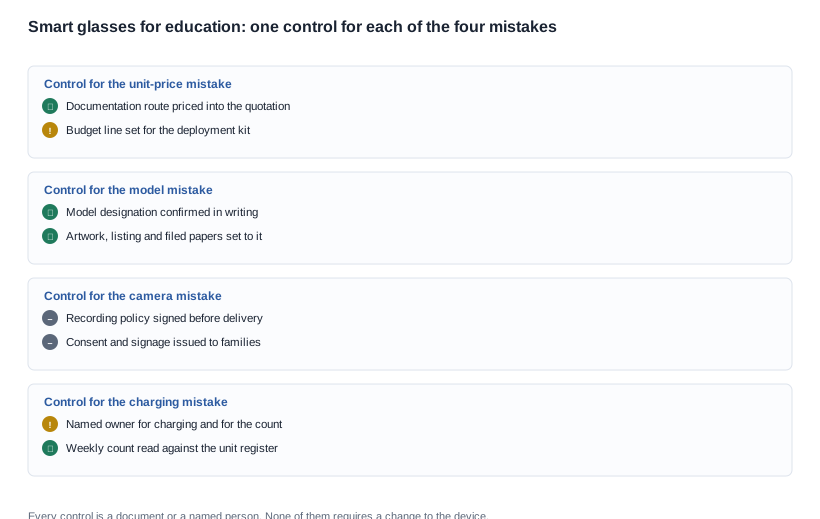
The conclusion first. None of the four mistakes below is a hardware fault, and none of them is fixed by changing supplier. They are all decisions taken before the order, and all four of them surface between the acceptance of the delivery and the end of the first term. The first is choosing on unit price when the buyer is an institution rather than a shopper, which pushes the documentation route out of the budget. The second is treating the A05 and the A06 as one model because the catalogue publishes identical parameters for them, which puts the wrong entry on every document the school has to file. The third is putting a camera in a classroom before the recording policy exists, which turns a parent question into a deployment stop. The fourth is reading twenty hours of rated use as no charging routine at all, which produces flat units by the middle of the morning and a fleet that is quietly abandoned.
Who this is written for. The reader is a brand-side buyer, a channel buyer or an e-commerce operator opening a first education programme. The situation is usually a quotation to compare, a new programme to open, or a market to enter, and in each case the question behind the decision is the same one: which of the two or three suppliers in front of you can actually build what you have written down, and what happens to your schedule when they cannot. The fear underneath the enquiry is not a bad price. None of the three is exotic: goods that do not match the approved sample, a customs route that holds the consignment up at a border, or an opening batch that becomes a returns burden nobody costed.
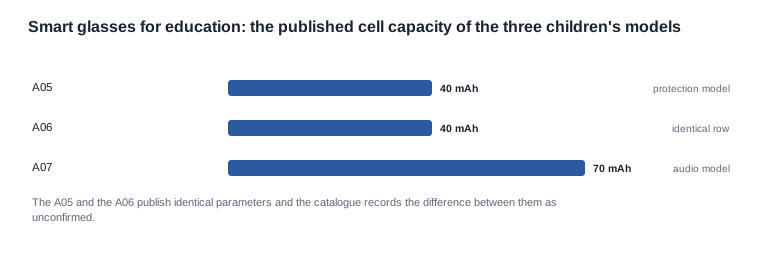
Why the education segment behaves differently from a retail one. The buyer is a fixed institution with a budget cycle, a procurement route and a set of documents it has to file before it can pay. That changes the shape of the commercial conversation completely. A retail buyer compares two product pages; an education buyer compares two answers to the same requirement list, and a supplier who cannot say which requirements it meets and which it does not is disqualified before price is discussed. The published configuration for the children's range is narrow and specific — the A05 and the A06 publish a 40 mAh cell, a charge time of two hours or less, roughly twenty hours of rated use and magnetic charging, and the A07 publishes Bluetooth V5.4, a 70 mAh cell and the same rated use — and almost everything that decides the outcome of an education order sits outside those rows.

Mistake one: choosing on unit price where the buyer is an institution
The symptom. Two quotations arrive, the unit prices differ by a few per cent, and the cheaper one wins. Three months later the programme stalls on a document nobody asked for, and the channel discovers that the price difference it saved was smaller than the cost of the delay it created.
The root cause. The unit price is the only line both buyers can see, and in education it is close to the least important one. What actually decides an education order is the documentation route: which model-level conformity documents exist for the destination market, who holds them, and whether they can be transferred to the institution in the form the institution's own process requires. A school or district will ask for a document with a holder named on it, and if the answer is that the evidence sits with a sub-supplier, you need to know how it reaches you and in what form. That is a supply chain and documentation question, and it belongs in the quotation as a priced line rather than as a promise to sort it out later.
The second half of the same root cause is the deployment kit. The unit arrives with a cell and a charging interface, and then the classroom discovers it needs one magnetic cable or dock per device, a place to charge them, wipe-down material and a printed card. None of that is in the device quote, so a unit-price comparison quietly compares two different projects.
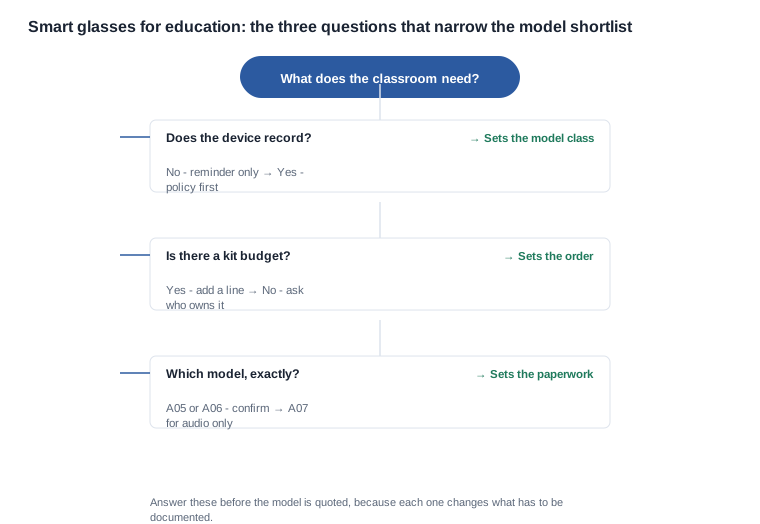
The control. Price the documentation route into the quotation as a named item with a schedule, and price the deployment kit as a separate line with its own quantity rules. Then ask what the buyer has to file before it can raise a purchase order, and require the quotation to answer that list rather than a generic requirements list. The question to the supplier is narrow and specific: which requirements apply to this configuration in the market we are shipping into, who holds the evidence, and how does it reach the institution. A supplier who answers that in the first round has shown you the whole commercial shape of the order.
The commercial terms that travel with these decisions. A documentation line with a schedule is only half of it; the other half is what the terms do to the programme. The minimum order quantity for an education order is often set by the kit rather than by the device, because a printed card and a tray are ordered per class while the devices are ordered per unit, and a supplier who will not split the two deliveries will hold the card until the devices are ready — which means the card arrives after the week it was supposed to protect. The lead time on the documentation route should be asked for separately from the lead time on the hardware, because a file that lands after the teaching term has started is worth very little. And the payment structure — a deposit, a balance on inspection, a split against a staged delivery — is the lever that lets a smaller first shipment happen without a discount conversation. None of these terms are published for this range, and all of them belong in the first round rather than in the negotiation that follows a pilot.
Mistake two: treating the A05 and the A06 as one model
The symptom. The order is placed, the units arrive, and the artwork on the packaging names one model while the paperwork and the listing name the other. A school that has to file a model designation for a device it has been given cannot resolve it, and the channel ends up carrying a units backlog it cannot ship because the designation does not match.
The root cause. The catalogue publishes identical parameters for the A05 and the A06: 40 mAh, a charge time of two hours or less, roughly twenty hours of rated use, magnetic charging, a lens-type electronic atomiser module and the posture and distance detection reminder. It also records the difference between them as unconfirmed. Two rows that look the same and a catalogue that will not tell you how they differ is a trap for anyone working from a spreadsheet, because the spreadsheet cannot show the difference that does not exist in the published data.
The control. Ask which model is being supplied, in writing, before the artwork, the listing and any document the school has to file are set to it. It is a two-minute question that protects three downstream decisions. The published cell capacity is the same on both rows, so the electrical behaviour is not what distinguishes them; the published difference between the A05 and the A06 is simply not settled, and the resolution has to come from the company rather than from a comparison of the catalogue entries.
The wider lesson is about how the children's range should be quoted. The A07 is a different model with a different cell at 70 mAh, Bluetooth V5.4 and the same rated use, and the A05 and the A06 are the same size of configuration with an unconfirmed distinction between them. A quotation that offers "the protection model" without naming the entry is a quotation that cannot be turned into a compliant document later, and the cost of that is a programme delay rather than a price difference.
What the model designation is actually used for. It is not a catalogue detail; it is the key that ties the physical unit on the shelf to the document the institution files. The serial, the model entry and the firmware build together are what a school needs when it has to answer a question about which device a recording came from, or when a device is reported missing and the channel has to decide whether it is a loss or a transfer. A deployment whose register carries only a customer name on a platform cannot answer either question, and the party who ends up absorbing the answer is the teacher standing there holding the broken unit. That is why the confirmation of the model designation belongs before the artwork is printed rather than before the shipment is booked: artwork is the expensive thing to change, not the shipment.

Mistake three: putting a camera in a classroom before the policy exists
The symptom. The devices have been in the classroom for a fortnight. A parent asks whether the glasses record. The teacher's honest answer is that the catalogue does not publish a recording indicator specification and nobody in the institution has written the policy. The question then travels, and the deployment pauses while it is answered.
The root cause. A camera on a child's face in a school is a governance question, and in this category the relevant published rows are all silent: the catalogue publishes no recording indicator specification, no data path and no retention position for the range. What it does publish for the camera models is the resolution class, the cell capacities, the rated use figures, the case capacities, the charge times and the charging interfaces — and the two models with a published ingress marking are the V06 and the S7, which are sport camera models rather than the children's range. A school that deploys a camera model for staff has therefore bought a device whose documentation supports a hardware specification and nothing about its governance.
The control. Write the recording policy before the delivery, not after the first question. It needs four things: whether recording is permitted on campus at all, and if so under what conditions; what the signage says and where it is placed; how consent is obtained from staff and families; and how long any stored material is kept and who can reach it. Where the institution will not permit a camera on campus, that decision is cheaper than any technical control. Where it will permit one, the policy is what makes the purchase defensible, and the policy cannot be written after the first parent question because by then it is being written under pressure.
Mistake four: reading twenty hours of rated use as no charging routine
The symptom. Units are flat by the fourth period. The teacher assumes the device is faulty and writes it off, and the class concludes the product does not work. Meanwhile the charger in the cupboard is a single shared cable that has been failing intermittently for a week, and the flat units are a charging problem being reported as a product problem.
The root cause. Roughly twenty hours of rated use on a 40 mAh or 70 mAh cell sounds like a term. It is not, because the published figure comes without a test condition and a child in a full teaching day with the detection features active is running a different load from a passive standby test. The catalogue also publishes a charge time of two hours or less, which is a ceiling rather than a fixed duration and has no published starting state or end point, so the timetable cannot be built on it as though it were a guaranteed turnaround.
The control. Name an owner for charging and a second owner for the count — they do not have to be the same person — and give the fleet a physical home. Magnetic charging means one cable or dock per device, so the charging hardware is an equipment line that scales with the fleet rather than a shared accessory. A weekly count of five minutes against a register is what distinguishes a low-adoption reading from a missing-unit reading, and a flat unit that has been returned to the right place on the right shelf is a very different problem from one that has been left in a drawer for a week.
This is also the mistake with the longest tail, because it decides whether the programme is judged on hardware. A deployment that reaches the end of a term with an unresolved charging problem concludes that the devices are unsuitable, and no amount of evidence about the cell capacity will change that conclusion.
What to measure instead of the published figure. The published runtime tells you what a cell can do under a condition nobody has described. What a school needs to know is different, and it is cheap to produce: the time between charges under normal use, the number of units flat at the end of a teaching day, and the number of units returned to the wrong place. None of those requires a laboratory. All three require the count sheet to be filled in honestly, which is exactly why the count is a control and not an administrative chore. The same sheet answers the seasonal question as well: units stored charged and warm over a long break show their condition in the first charge back, so the storage plan — discharged, cool, and logged out and back in — is part of the charging routine rather than a separate document nobody opens. Cell life over years is not published for this range, so the replacement budget has to be an agreed estimate rather than a figure anyone can quote, and an agreed estimate is still better than no estimate in a proposal that has to be defended.
What reversing these four mistakes actually costs
Reversing them is a document exercise, not a hardware exercise. The unit price does not change when a buyer adds a documentation line to a quotation; the schedule does. The model designation confirmation costs a written answer from the company. The recording policy costs a meeting with the institution before the delivery date rather than a crisis meeting after it. The charging routine costs one cable or dock per device and five minutes of counting each week.
| Mistake | What it costs to reverse | Who has to act | When |
|---|---|---|---|
| Chosen on unit price | A documentation route priced and scheduled | Buyer and supplier | Before the order |
| Two models treated as one | A written confirmation of the entry | Supplier | Before the artwork |
| Camera before the policy | A signed policy and a consent process | Institution | Before delivery |
| No charging routine | Equipment per device and a count routine | Institution | Before the first term |
The honest part of the recommendation. There is a fourth thing to reverse, and it is the habit of asking for a price before asking for a document. In this category the published rows are narrow: cell capacity, charge time, rated use, charging interface, and a handful of structural features. Everything that decides whether an education order completes is a document, and a document is cheap to request and expensive to be missing. A buyer who asks for the conformity position, the model designation, the recording policy requirement and the charging arrangement in the first round is doing due diligence before committing, and the supplier who answers all four has demonstrated something more useful than a discount.
What we will and will not do. We publish the configurations an education order is built from, and we will mark the open rows as open rather than fill them. We will not provide a conformity position we do not hold, we will not publish a data path or a recording indicator specification for a range where we do not have one, and we will not help build a health claim of any kind. The deployment framework is at smart glasses for education, a pilot that failed informatively is in the case study, the working pattern from another setting is at office real world, and the charging constraint in a harsher environment is at outdoor charging.
What to send us. Four items: the models you are comparing, the quantity and the number of classrooms, the destination market, and the date by which the programme has to be running. We will tell you which of the four mistakes your current plan is exposed to, which published rows apply to the configuration you have in mind, and which of the open rows have to be closed with a document before the order rather than after it. Where the difference between two models cannot be settled from published material, we will say so plainly rather than choose on your behalf, because a model designation we have guessed is one more document to fix later.
- Case study — a pilot that failed informatively
- Office real world — the same pattern elsewhere
- Outdoor charging — the case and cold variable
Send the model, the quantity, the destination market and the delivery window, and we will tell you which of the four mistakes your current plan is exposed to.


