This is a hypothetical reconstruction of a classroom pilot, written from a pattern that recurs rather than from any named institution or client project. It is included because the pilot failed in a way that was fixable, and because the fix was not the one the evidence initially pointed at.
Smart glasses for education: what stops working when a pilot looks successful
The conclusion first. The pilot in this reconstruction failed because the deployment model and the category's charging behaviour were not compatible, and because the evaluation metric was chosen before anyone knew what it would reward. It did not fail because the hardware was unsuitable, and it did not fail because of a supplier. A buyer who reads it as a product verdict will draw the wrong conclusion, which is why this account is written out step by step rather than summarised.
Who this is written for. The reader is a buyer, a programme manager or a channel partner who is about to run a pilot and will have to write the evaluation criteria before the devices are delivered. The question in front of them is rarely "is the product good". It is "what will I measure, who will own it, and how will I know by the end of the term whether the programme should continue". The fear underneath the enquiry is that a pilot will be judged on a signal that flatters it, and that the programme will be extended on the basis of evidence that was never about the programme.
Why the education segment makes this worse than it looks. The published configuration for the children's range is narrow: the A05 and the A06 publish a 40 mAh cell, a charge time of two hours or less, roughly twenty hours of rated use and magnetic charging, and the A07 publishes Bluetooth V5.4, a 70 mAh cell and the same rated use. The two identical entries carry an unconfirmed difference between them. The rated use figures come without a published test condition. There is no per-model conformity row, no data path and no recording indicator specification published for the range. In other words, the published data is enough to build a charging plan and not enough to settle whether a deployment worked, which means the measurement has to be designed rather than inherited.
How to use this reconstruction in a procurement file. A buyer cannot quote a hypothetical pilot, and nothing in this account should end up in a proposal as a performance claim. What it can do is serve as a risk review, which is a more useful document and a defensible one. Before the pilot order, the buyer can read it against four questions and write the answers into the purchase order: who owns the charging task and where the equipment comes from, what the evaluation criteria are and who signs them off, what happens to a unit that comes back out of service, and what the exit terms are if the pilot does not produce evidence. Each of those is a commercial term the supplier and the institution have to agree, and each of them is a line that protects the buyer if the pilot repeats the pattern described here. A pilot tier priced separately from the rollout tier, with a sample order to test the charging routine before the fleet is committed, is the structure that makes those answers cheap to obtain.

What the usage numbers hid in the first three weeks
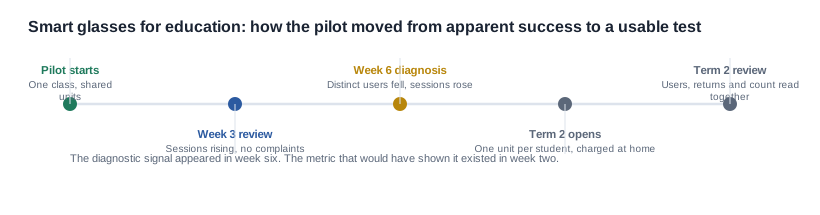
An institution put one class on shared units for a term. Usage data looked encouraging — daily sessions, growing throughout the period, no complaints logged by teaching staff. On any reasonable reading the pilot had worked, and the week-three review confirmed it in writing.
What the usage data could not show was who was using them. A review of the session records found that a single confident user accounted for most of the sessions, and the class as a whole had largely stopped after the novelty period. The measurement was real; it was measuring the wrong thing, and it was doing so in a way that flattered the pilot.
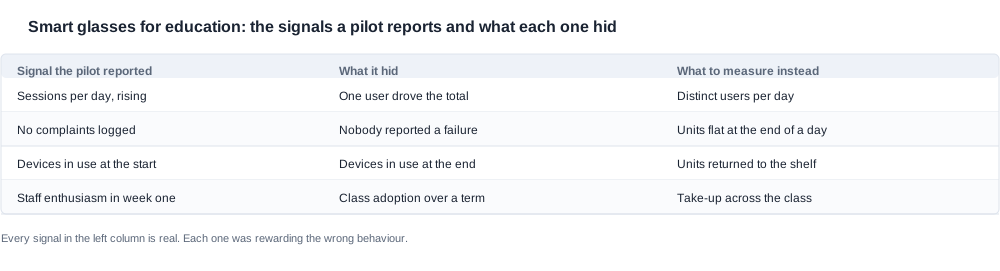
The three signals that did the flattering. Sessions per day rose steadily, which is what a single determined user produces. No complaints were logged, which is what a fleet of units nobody opens produces. And the devices were in use at the start of the teaching week, which says nothing about whether they were in use by the end of it. Each of those signals was accurate. Each of them rewarded a behaviour that had nothing to do with whether the class had adopted the product.
The thing nobody asked. Nobody had written down, before the pilot started, what "working" would mean. There was no agreed take-up figure, no agreed count, no agreed point in the term at which the evaluation would happen and no agreed owner of it. The evaluation criteria were settled in week four, after the data had already started telling a story, and they were settled by whoever read the numbers first. That is the structural failure, and it is the part a buyer can fix without changing a single line of the product specification.
The cause was ownership and charging, not the hardware
Once the class stopped, the natural conclusion was that the hardware was unsuitable for the setting. That conclusion was wrong, and the evidence for it was in the numbers that had already been collected.
Shared units in a class of twenty create a charging problem before they create a usage problem. Twenty units, a handful of sockets, and a lesson timetable that gives nobody a charging window. Units were flat by the fourth period, and a flat unit on a desk is indistinguishable from a rejected one — the student cannot tell the difference, so the student stops asking, and the teacher records the session as unused.
How that becomes an ownership problem. The charging task had no owner. It was implicitly assigned to whoever was nearest the shelf at the end of the day, which in practice was nobody, because no adult in the room had been given the task or the authority to do it. The published figures make this harder rather than easier: roughly twenty hours of rated use sounds like a term, but the figure comes without a test condition, and a unit in active use through a teaching day is running a different load from a passive standby test. Magnetic charging means one cable or dock per device, so the school needed twenty charging points and had, as is common, a small number of sockets.
What the evidence actually supported. The published configuration says that the A05 and the A06 draw from a 40 mAh cell, charge in two hours or less, and are rated for around twenty hours of use, and that the A07 differs in cell capacity and radio but not in the runtime figure. That data is consistent with a fleet that needs one nightly charge per unit and a shelf where those units can be reached. It is not consistent with a fleet of shared units charged opportunistically. The diagnosis was therefore about the operating model, not about the device, and the devices had not been the problem at any point.
What that diagnosis means for the supply agreement. The operating model is a procurement decision before it is an operational one, and it is where the commercial terms attach. Four clauses do the work, and all four should be settled before the pilot order rather than discovered during it.
- The charging equipment line. Magnetic charging means one cable or dock per device, so the quantity follows from the unit count and has to be quoted as its own line with its own lead time. A pilot that is quoted devices only, with the docking equipment assumed, is a pilot that will stall on the first Monday.
- The evaluation criteria as a schedule item. The criteria, the count sheet and the weekly review have to be agreed with the institution before delivery, and the review date has to be in the delivery schedule rather than in somebody's intention.
- The replacement and defect route. A unit that comes back out of service in a teaching week needs a route, a response time and a freight allocation, and none of that is published as a standard table, so it has to be agreed for the pilot order and carried forward.
- The exit terms. If the pilot does not produce evidence, what happens to the balance of the order, to the tooling and artwork already committed, and to the packaging that was printed for a programme that did not start. Exit terms agreed at the beginning are the difference between a supplier who solves a problem with the buyer and a supplier who solves it against the buyer.

What changed between the first term and the second
Three things moved, and all three were operating-model changes. None of them involved a different model, a different supplier or a hardware change of any kind.
Charging moved into the home. Each student held one unit for the term and charged it at home. That removed the twenty-units-in-a-classroom logistics problem entirely, and it moved the school's infrastructure requirement from twenty charging points to a small number of spares for the units that came back flat. It also meant the school was no longer providing infrastructure it had never budgeted for, which was the hidden cost in the first term.
Storage moved to a named place per student. A drawer or a box per student, rather than a shared tray, changed the count from a communal task into a personal one, and it made a missing unit visible immediately rather than at the end of the term.
The evaluation metric moved from sessions to distinct users. Sessions had proved capable of flattering a pilot that was not working, so the metric changed to the thing the pilot was supposed to be about. The data was already being collected; it was simply being read through the wrong column. The same lesson appears elsewhere in the same category of deployment, where the working pattern is described in office real world, and the charging constraint shows up in a harsher setting in charging for content.

The pilot as a commercial instrument, not only a test. A pilot that is bought at the rollout price, on the rollout minimum order quantity, with the rollout payment terms, has given away the only leverage the buyer will have. The structure that works is a pilot tier with its own quantity, its own unit price and its own payment terms, agreed as a distinct tier of the same agreement with the rollout, so that the evidence from the pilot converts into a commitment rather than into a new negotiation. Three commercial details make that work.
- The price tier and the minimum order quantity. A pilot that sits above the supplier's minimum order quantity is a rollout by another name, and the supplier will price it accordingly. Asking for a pilot quantity that is genuinely smaller is worth more than asking for a discount on a quantity nobody needs yet.
- The payment terms against the evidence. A deposit, a balance on the pilot's evaluation point, and then the rollout against the first term's data is the structure that keeps the commercial risk aligned with the uncertainty. It also gives the buyer a natural point at which to walk away without having paid for the whole fleet.
- The packaging and artwork commitment. Artwork for an education programme carries the school or brand identity, and printing it before the pilot has produced evidence is a sunk cost the buyer cannot recover. A pilot that ships in neutral packaging, or that defers the printed card and the tray until the evaluation point, keeps that money in the buyer's pocket where it belongs.
What none of this changes is the measurement itself. The commercial structure decides who carries the risk; the criteria decide whether anybody learns anything.

The evaluation design that would have caught it in week two
The useful part of a failed pilot is that it shows what the successful version of the process would have looked like. Four items, and all four are available before the first session.
Write the criteria before the first session. Not after the first review, not after the term. The criteria are: what counts as adoption, what number of distinct users in what proportion of the class constitutes a pass, what will be counted as a failure, and who reads the result at the end of the term. A pilot with no written criteria ends with a qualitative impression, and a qualitative impression is what the enthusiastic user produced in week three.
Baseline the count sheet and the charge times in week one. Two numbers: how many units are charged and in the shelf at the start of a day, and how long each unit takes to reach a usable charge from its state at the end of the previous day. These are the numbers that expose a charging failure as a charging failure, and they are the numbers that turn "the class stopped using them" into "the units are flat by the fourth period". They cost five minutes a day and they are the only hardware-related measurement in the whole evaluation.
Measure distinct users from the start, not from the second term. The metric has to be fixed before the data arrives, otherwise the choice of metric becomes a function of what the data happens to say. Distinct users per day is the measure that survived the diagnosis in this reconstruction, and it is available in week two.
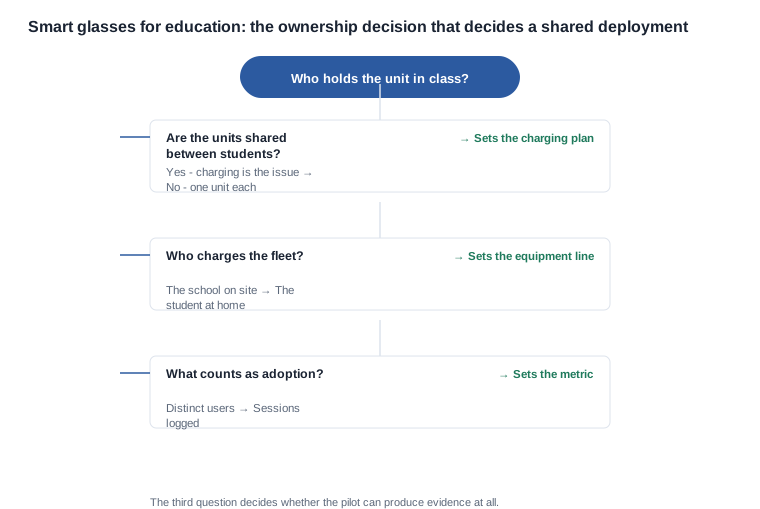
Decide the ownership model before the first device is delivered. Who holds the unit during the lesson, who charges it, where it lives overnight, and who counts it. Those four questions are the difference between the two terms in this reconstruction, and they cost nothing but a decision. A pilot that answers them before delivery can also be quoted for the right kit, because the charging equipment count follows from the ownership model rather than from the device count alone.
What this reconstruction cannot tell you
It cannot tell you what a real pilot would have produced. The account is a hypothetical reconstruction built from a pattern that recurs in this category. It has no institution, no class, no supplier and no order behind it, and the numbers in it are not measurements. It should be read as a structure for thinking about a pilot, not as evidence about how a pilot turns out.
It cannot give you an expected adoption rate. We publish the cell capacities, the charge times, the case capacities, the charging interfaces and the rated use figures where they exist, and we will state them so a charging model can be built from them. We will not publish an expected classroom usage rate, because we have no basis for one, and a number like that would be borrowed from a setting that is not yours. Case capacity is not published for every model, and where a shared-unit model depends on cases, that gap needs closing before the pilot rather than during it.
It cannot tell you whether the hardware is right for your classroom. The published configuration tells you what the devices do under conditions nobody has described. Whether they suit a particular room, a particular age group and a particular timetable is the question a pilot answers, and it is answered by the criteria you wrote before the pilot started rather than by the specification sheet.
What to take from it. The first question for a pilot is not which configuration to buy. It is how the units get charged, by whom, and out of whose budget. That answer determines more about the outcome than the model choice does. The second question is what will be measured, and by whom, and when. A pilot that has both answers is a pilot that can produce evidence; a pilot that has neither is a pilot that produces a story. The avoidable versions of the same problem are collected in beginner mistakes, and the deployment framework is at smart glasses for education.
What to send us, and what to ask the supplier. Send the class size, the unit count, the destination market, the term dates and the delivery window, and we will tell you which published rows apply to the configuration you have in mind, which lines have to be closed with a document before the order, and what we will not be able to evidence for this range. The questions worth putting to any supplier in this category are these: which requirements apply to this configuration in the destination market and who holds the evidence; which catalogue entry is being supplied, given that two children's models publish identical parameters; what the charging equipment quantity and lead time are for this unit count; what the replacement route is for a unit that fails during a teaching week; and what the defect and return terms are for a pilot quantity. A supplier who answers all five has given you a channel you can put in front of an institution. A supplier who answers with adjectives has not, and no amount of pilot data will fix that.
Related reading
- Beginner mistakes — the avoidable versions
- Office real world — a working pattern for comparison
- Charging for content — the same constraint elsewhere
Write the criteria, the count sheet and the ownership model before the first session, and the pilot will produce evidence rather than a story.