

Smart glasses for office: where the catalogue ends and the deployment starts
A catalogue describes products and a deployment describes use, and the gap between the two is where office smart glasses for office programmes succeed or fail. The published rows are perfectly good at describing the product — a resolution class, a cell capacity, a charging interface where it is published, a charge time, a rated runtime, a case capacity where it is published. What the published rows cannot do is tell a buyer which of those rows will decide the deployment, and the answer is usually not the row the buyer expected to be deciding it.
This article takes nine lessons that recur across office deployments and states, for each one, what it changes in a purchase order. The lessons are not anecdotes and they are not opinion. Each one is a behaviour that follows from something the published rows already say, and each one has a counterpart in a specification, a case decision or a line in the acceptance criteria. The point of the exercise is that the specification of a second deployment can be written from the lessons of the first, and that the lessons cost nothing to learn in advance because they are all visible in the published data.
Two of the nine are the ones that surprise buyers most often, so they are worth naming at the start. The first is that the case matters more to adoption than the resolution class does, because the case decides whether a unit is put away between uses. The second is that the question users ask in the first week — can it see the whole of the thing I am pointing at — is exactly the question the catalogue cannot answer, because no field of view is published for any model in the range. A buyer who does not measure it will be asked it anyway, and will be asked it by the people doing the work rather than by the procurement team.
Why a deployment is a different object from a product
The reason these lessons are worth writing down is that the two things being managed are on different timescales and different clocks. A product evaluation asks whether the specification is right, and the specification is fully described by the published rows. A deployment asks whether people will keep using the thing, and that is decided by a workflow, an issuing routine, a charging point count and a habit — none of which is a product attribute.
The consequence for a procurement team is that the published rows can tell you what you are buying and cannot tell you whether it will be used. So the specification is settled early and correctly, and then the deployment is won or lost in the parts of the programme that the specification does not cover. A buyer who has ordered a well-specified configuration can still end up with a fleet that sits in drawers, and the reason will not be visible in any of the published rows, because the reason is that nobody ever wrote down what the records were for.
That is the gap this article closes. The nine lessons are stated as behaviours, and each one is attached to the specification or the kit decision it changes.
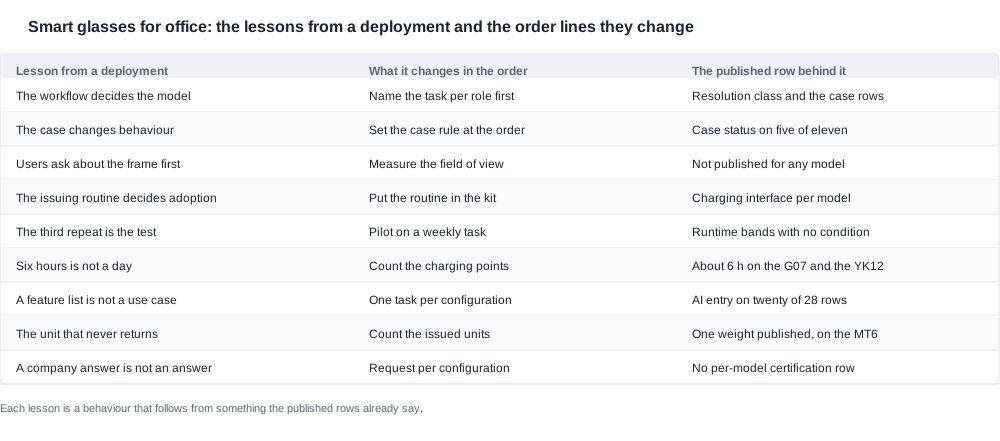

The lessons about what actually gets used
The workflow decides the model, not the feature list
The feature list in this range is long, and length is exactly the problem. The catalogue publishes an AI voice assistant entry on twenty of the twenty-eight rows, no touch row on any model, surround sound on the YK12, the D11 and the ZH12, the remote control capture on the D17 and the ZH12, ultra-slim detachable temples on the G07, a removable inner frame on the V06 and the S7, a photochromic configuration and a bone-conduction configuration. A buyer who builds a specification from that list builds a specification of twenty features and no use, and the deployment discovers the absence of a use rather than the absence of a feature.
What replaces it is one line per role: what this person's record is for. The record for a weekly progress note and the record for a training sequence have different requirements, and the requirements that differ are the review distance, the environment and the retention period. A configuration that is specified against a named task can be justified on the published rows; a configuration that is specified against a feature list can only be justified by repeating the feature list, and it will not survive the first question from the IT team that receives it.
The case changes behaviour more than the resolution class does
The published case position splits the camera tier in a way that matters more than the resolution split does. Five models publish a case capacity — 1400 mAh on the CY03 and the CY05, and the L1 Pro, 900/1400 mAh on the L2 Utral and a 1200 mAh foldable case on the MT6. Two models indicate a case with no published capacity, the KY06 and the MT5. Four publish no case row at all — the S7 and the V03, and the V03 Pro and the V06 — and what the box carries for those four is an open item.
Behaviourally, the case is what decides whether a unit is put away. A unit that can be put away is a unit that will be, and a unit that has to go back to a charging point to be ready is a unit that stays visible. So a buyer who has chosen a model on the resolution class and has not chosen a case rule has not actually made the decision that governs the deployment. The rule belongs in the order, it belongs in the kit, and it also has a transport-file consequence, because a case is a second lithium cell.
The first question from the users is the one row nobody publishes
The question that comes up in the first week, from the people doing the work rather than from the procurement team, is whether the unit can see the whole of the thing being pointed at. A whiteboard, a machine panel, a drawing, a person at the far end of a table. It is a field of view question, and no field of view is published for any model in the range — not for the camera tier, not for the audio tier, and not for any of the eleven camera models individually.
The catalogue publishes a resolution class and nothing else about the image: no sensor, no field of view, no video resolution, no frame rate, no stabilisation figure and no low-light performance. So a buyer who has ordered on the resolution class has ordered a number and has not answered the question. The question is answered by handling a sample and looking, which is why the sample and the acceptance checks belong in the same request as the order documents rather than after the first shipment. The imaging behaviour that a deployment document has to describe is at camera imaging.
The lessons about how the deployment is actually run
The issuing routine, not the product, determines adoption
The person who hands the unit to the user at the start of a shift decides whether the unit is clean, charged and in a known condition, and that person is not the buyer, is not the factory, and is usually not the person who wrote the specification. In an office the information does not travel with the product the way it does in a consumer channel, so the issuing routine has to be specified rather than assumed.
What that specification contains is short: a charging point at each desk, a contact hygiene item in the box, a case where the configuration has one, and a line in a register so the unit is accounted for. The published rows that bear on it are the charging interface — magnetic on the V03 and the MT5, the V06 and the S7, and the KY06, Type-C on the V03 Pro and the L2 Utral, and not published at all for the CY05 and the CY03, and the L1 Pro and the MT6 — and the case capacity where it is published. The kit structure is in the office gear checklist.
The deployment fails at the third repeat, not at the first use
A demonstration succeeds. A first use succeeds, because the person doing it is being watched and is trying. The point at which a deployment reveals what it really is the third or fourth time somebody does the same task with the same unit, because by then the novelty is gone and the friction is all that is left.
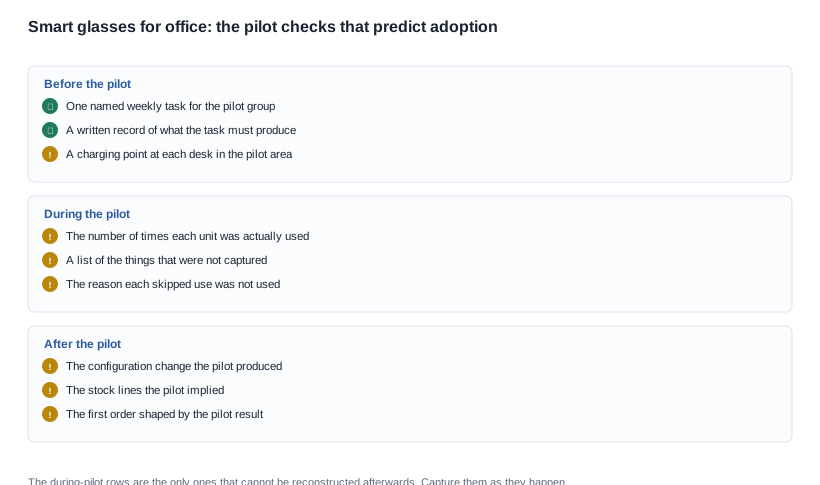
That is the argument for evaluating a configuration on a repeated task rather than on a showcase, and it is a specific instruction for a pilot: pick one task the group will do at least once a week, run it three or four times with the same people, and record what was not captured and why — without prompting anyone, because a prompted answer is a politeness and an unprompted one is a finding. A pilot that runs once produces a configuration that has been demonstrated. A pilot that runs three times produces a configuration that has been evaluated.
Six hours is not a day, and the charging point count follows from it
The audio tier publishes three runtime bands: about eight hours on the K01, the K02 and the LC-105 pair, about seven hours on the D11 and the D12, and about six hours on the G07 and the YK12. Against a conventional eight-hour office day, a six-hour model does not reach the end of it, and the deployment consequence is not a complaint about the product but a quiet accumulation of unrecorded second halves of days.
The remedy is a second charging point at the desks where the G07 or the YK12 is issued, which is a per-location kit decision rather than a per-unit one, and it is a decision that costs almost nothing at the order stage and a great deal at the three-month stage. The same arithmetic applies to the camera tier, where the published bands are 5~8 h for the V03 Pro and the V06, and the V03 and the S7, 6~8 h for the KY06 and the MT5, and about seven hours for the CY03 and the CY05, and the L2 Utral and the L1 Pro, and the MT6. The published rows are at battery life.
The unit that is never returned is the real loss
A unit that is issued and not returned is a unit that has been lost, but a fleet that does not count issues cannot tell a lost unit from an unused one, and the two are treated very differently. The first is an asset problem with a known remedy. The second is a programme problem that presents as a successful deployment for exactly as long as nobody counts.
The count is a single line per unit in a register, and it is also the denominator that makes a failure rate meaningful at the renewal. A defect rate computed against units returned is a rate of returns, which flatters the product; a rate computed against units issued is a real number, and it is the number a renewal negotiation needs. The only published weight in the range is the MT6 at 158 g for the glasses body including its cell and camera and excluding the foldable case, which means the fleet's physical characteristics are largely unmeasured, and a fleet that is unmeasured is a fleet whose replacement rate is also unmeasured.

The lessons translated into a purchase order
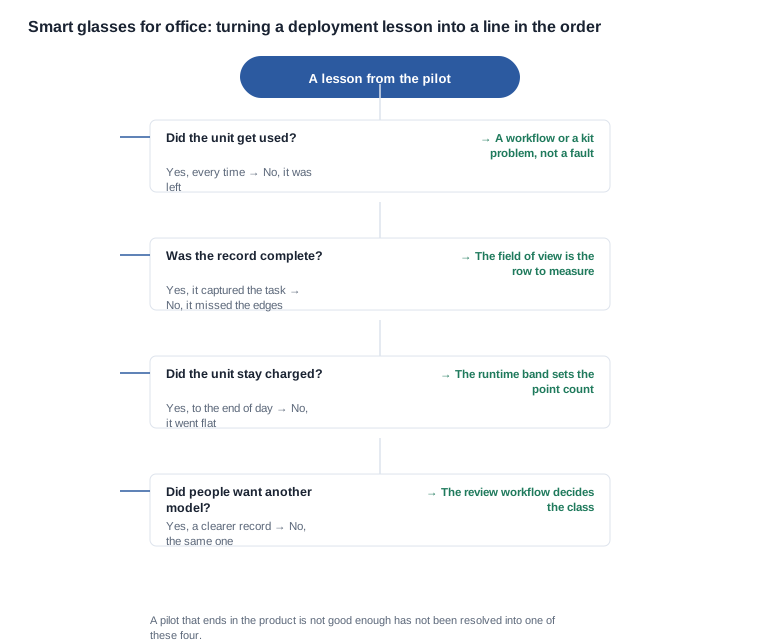
The decision diagram above is the mechanism. Each lesson resolves into one of four outcomes: a workflow problem, a measurement to make, a kit change, or a change of configuration. A pilot result that ends in "the product is not good enough" is almost always a result that has not been resolved into one of the four, and that is the sign that the pilot was run as a demonstration rather than as an evaluation.
The commercial lessons, and the terms they change
A pilot is also a pricing exercise, and the buyer who treats it only as a technical test leaves a commercial result on the table.
The first result is volume. A pilot produces a measured issue count rather than a forecast of one, and a measured count is what a price tier should be quoted against. A buyer who opens a procurement conversation with the volume the pilot produced, and with the usage figure that justified it, is negotiating from a number the supplier cannot dispute, which is a better position than a number taken from a planning document. It also produces the spare ratio, because the withdrawal rate is visible in a pilot and invisible in a budget.
The second result is the configuration itself, and it matters more than the volume because a quotation against the original configuration is not a quotation against the changed one. If the pilot changes the case structure, the charging point count or the model, then the unit price, the packaging, the freight weight, the transport file and the tooling position all have to be re-quoted, and a procurement team that carries the old quotation forward is ordering the pilot's configuration and being invoiced for something else. The request is a fresh quotation against a written configuration, which is a small thing to ask for and an expensive thing to discover.
The third is the warranty position, and it is the one most often left implicit. A pilot produces a failure record with a small denominator, which is enough to establish the defect remedy and the time to replacement but not enough to calculate a rate, and the agreement should say so rather than leave the rate undefined. A clause that names the denominator and the remedy is a clause a procurement team can defend; a clause that says the supplier will handle failures is a clause that becomes a conversation at the worst possible moment. The clause language is at contract terms, the commercial structure of a first order is at pricing, and the sample that starts the whole process is part of the same request as the order documents.


A ten-week deployment, and what it changed
Walking the lessons through one deployment, the sequence in the timeline above is what a programme looks like when the specification was settled from the published rows and the adoption questions were handled as a pilot rather than as a rollout.
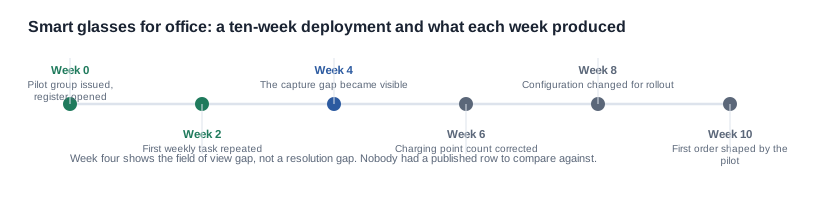
In week zero the pilot group is issued and the register is opened, with one named weekly task per person. In week two the task is repeated, and the first-use polish is gone. In week four the capture gap becomes visible — not as a complaint but as a list of things that were not captured, and it is the field of view question rather than the resolution question, because nobody had a published row to compare against. In week six the charging point count is corrected, because the units issued to the group with the shorter published runtime band are not surviving the afternoon. In week eight the configuration changes for the rollout, and the change is the case structure and the charging point count rather than the model, because the model was specified correctly from the published rows in week zero. In week ten the first order is shaped by the pilot result, and it is shaped by two numbers — the units actually used and the units not returned — rather than by the number of people in the pilot group.
The net effect of the ten weeks is that the first order is a better order, and the reason is that the programme produced two numbers that a catalogue cannot produce. The first is the one that the deployment is judged on. The second is the one that the renewal is negotiated on.
The rows we publish, and the deployment brief to send us next
We publish the rows a buyer can order from, and we will not fill the gaps with typical figures or with the outcome of somebody else's deployment. For the camera tier that means the resolution class, the cell capacity, the charging interface where it is published, the rated runtime, the charge time, the charging case capacity where it is published, the structural features that are published, the colour counts, and the IP54 marking on the V06 and the S7 stated as a catalogue attribute. For the audio tier that means the Bluetooth version, the cell configuration, the charge time, the rated runtime, the charging mode, the absence of any published touch row, the surround sound published on the YK12 and the ultra-slim detachable temples published on the G07. For the sport tier that means the Bluetooth version, the cell configuration, the charge time, the rated runtime, the charging mode, the remote control capture and the surround sound published on the D17 and the ZH12.
There is one list we hand to every deployment team, and it is the same list every time, and it is the list of what a deployment has to find out for itself. We do not publish and will not estimate the frame material, the lens material, the coating, the hinge specification, the unit weight beyond the single 158 g whole-unit figure for the MT6, the field of view, the video specification, the storage and overwrite behaviour, the operating temperature range, the cycle life rating, the runtime test condition or the standby draw. A team that has read that list knows that its own pilot is not an optional extra: the field of view has to be measured on a sample, the runtime has to be observed on the units actually issued, the weight has to be checked on the configuration, and the certification position has to arrive as a document. We also will not state that the range is certified to CE, FCC or RoHS, because the catalogue text contains no reference to those standards and there is no per-model certification row, and we will not extend the IP54 marking beyond the two models that carry it.
Send us the task the unit has to do, the people who will use it, the environments and the number of units, and we will return the published rows for the configurations that fit, the case and charging-point decisions the task implies, and the pilot checks that would tell you whether the configuration is right before the first order rather than after it. The selection logic is at how to choose smart glasses for office, the gate structure that catches the specification gaps is at the deployment gate checklist, and a comparable deployment in a different environment is at the education case study. The supporting material for a pilot is at the support resources for outdoor deployments and the accessories for security deployments, and the scenario entry point is smart glasses for office.
Related reading
- Where this scenario begins — smart glasses for office
- The decision logic — how to choose smart glasses for office
- The published data rows — battery life and camera imaging
- The kit the deployment needs — the office gear checklist
Send us the task the unit has to do, who will use it and the environments, and we will return the published rows and the pilot checks that would tell you whether the configuration is right before the first order.


