
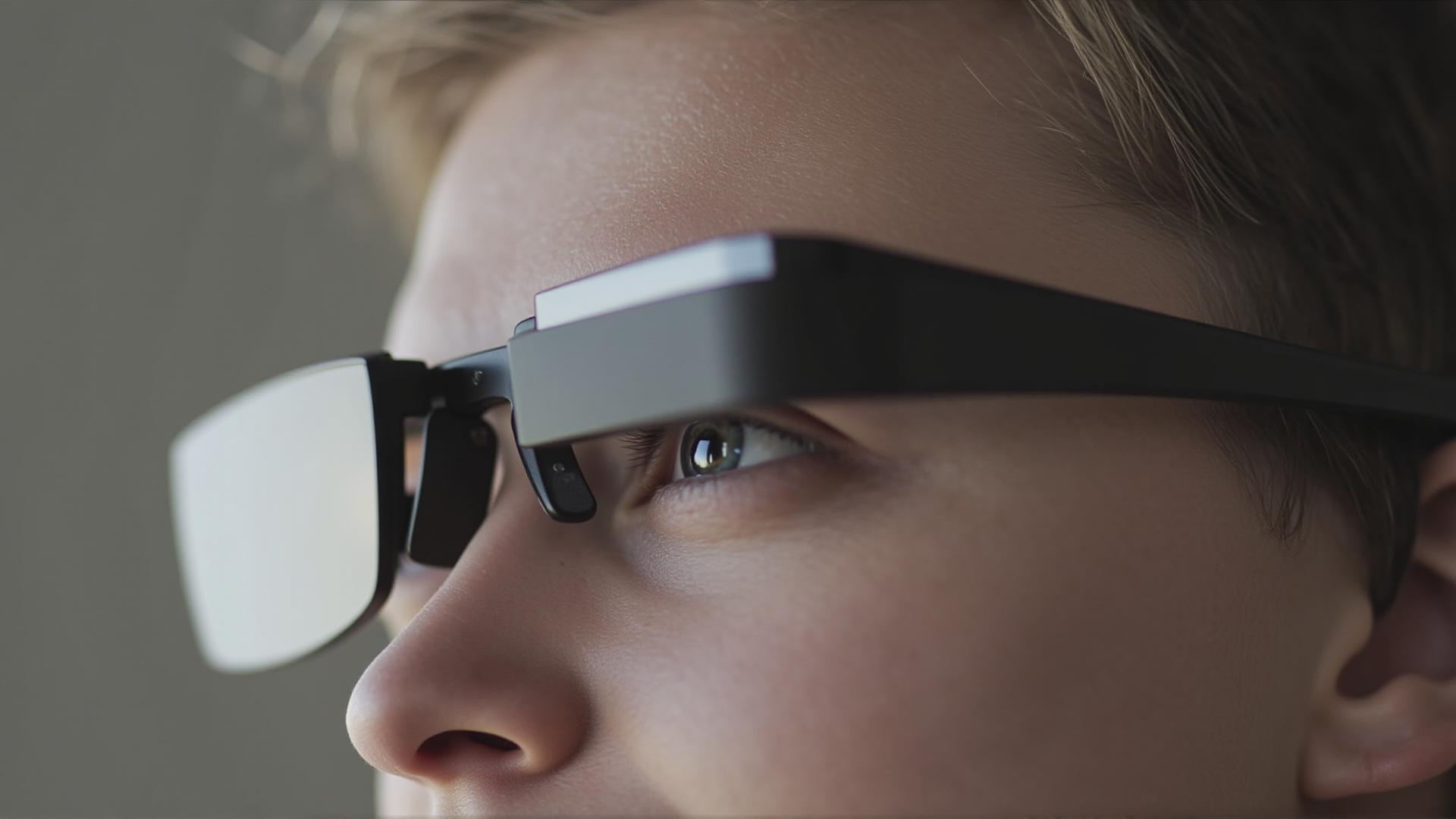
What to expect from smart glasses for education is a short, specific set of things, and a buyer who expects something else will be disappointed in a way that could have been avoided in a single meeting. Three models are in scope for children's use, and they publish a very short specification: a cell capacity, a charge ceiling of two hours or less, roughly twenty hours of rated use, a magnetic charging interface, a lens-type anti-fog arrangement, and posture and distance detection. Everything a school actually asks about in writing — the conformity file, the radio documentation, the notification path, the unit weight — is not in that specification. Expect the pilot to be a documentation project with a small hardware trial attached to it, and expect it to be worth running only if it settles three specific questions.
Smart glasses for education: the pilot is a compliance project
What the buyer is actually purchasing. Not a device for a class — a notification service with a device attached to it, sold into an institution that will be asked to justify it. That framing decides everything downstream: the hardware has to behave, the notification path has to work, the data handling has to survive a parent's question, and the file has to exist before anyone signs. A buyer who treats this as a hardware resale with an education label ends up owning all four problems at once, and the first one to fail is usually the file rather than the device.
Who this is for. The reader is a brand owner or a channel buyer selling into schools, training providers or learning institutions, or an education supplier building a programme that will be resold as a service. The task in front of them is a sourcing decision with an unusual constraint: the customer is an institution rather than a consumer, and an institution buys on documents. The fear behind it is that a programme is launched, the hardware works, the notification behaviour is wrong, and the institution stops the programme after one term with a conclusion that cannot be defended to a parent or a board.
Why education procurement is different from every other channel in this catalogue. Three things change at once. First, the decision maker is not the user: a procurement office, a head of department and a parent are three different stakeholders with three different vetoes, and the only one who can stop a pilot is the one who has to answer for it. Second, the buying cycle runs on a term boundary rather than a quarter, so a programme that starts after the paperwork is ready misses a year. Third, the documentation set is larger than the hardware set, because the questions that decide the sale are about the file and not about the device.
Where the cost actually sits. Not in the unit price. In the class set, in the charging logistics, and above all in the support cost, because support in a school is not a ticket queue but a named person. A programme of twenty devices for one class and a programme of two hundred devices across a school have the same documentation burden, the same compliance file and the same training curve, but completely different economics, and the breakpoint is almost never where buyers expect it to be.

The three children's models and what separates them
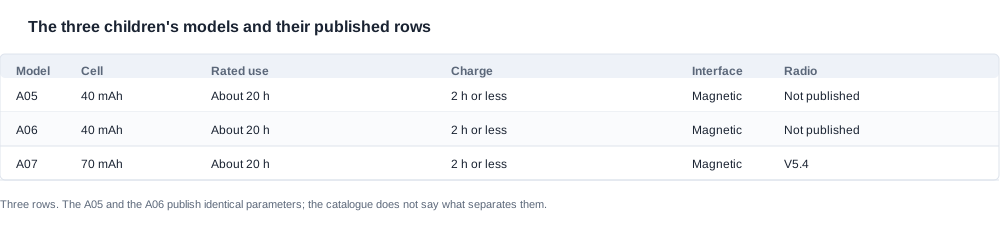
The catalogue publishes three models in the children's tier, and the table below is the whole of what it publishes for them. The second chart plots the same three cell capacities. This is a short specification, and the shortness is itself the finding: the electrical envelope is published and the behavioural envelope is not.
| Model | Cell | Rated use | Charge | Interface | Radio |
|---|---|---|---|---|---|
| A05 | 40 mAh | About 20 h | 2 h or less | Magnetic | Not published |
| A06 | 40 mAh | About 20 h | 2 h or less | Magnetic | Not published |
| A07 | 70 mAh | About 20 h | 2 h or less | Magnetic | V5.4 |
The A05 and the A06 are published identically, and the catalogue does not say what separates them. Same 40 mAh cell, same charge ceiling of two hours or less, same roughly twenty hours of rated use, same magnetic charging interface, same published features. A buyer who quotes a difference between these two models is quoting something the catalogue does not contain, and the difference is exactly the kind of row that a school procurement file asks for. The honest position is that the two are indistinguishable on the published rows and that the distinguishing feature, if there is one, has to be established from the supplier in writing.
The A07 is the only one of the three with a published radio row. It publishes Bluetooth 5.4, a 70 mAh cell, the same charge ceiling and the same roughly twenty hours of rated use. The A05 and the A06 publish no radio version row at all. For an institutional buyer, that is a bigger deal than it looks: a device with no published radio version is a device whose conformity documentation has to be requested and read before it can go into a school, and the documentation is per-model.
Read the runtime figure for what it is. Twenty hours of rated use is a published figure with no test condition attached, and it is measured on a device that is not in continuous use. A child carrying the device through a teaching day with the detection features active is a different load from the one a rating usually describes. The prudent expectation is a daily or twice-daily charge in practice, which in an institutional setting means one charging point per device and somewhere to put it at the end of the day.
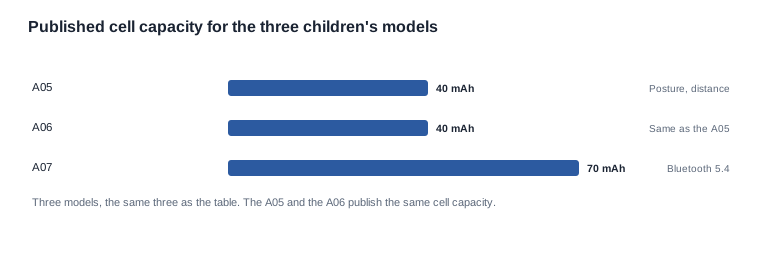
The chart above plots the same three cell capacities, and it shows why the A07 is the one to interrogate: 70 mAh against 40 mAh on the other two, which is the only published hardware difference between the three models in scope.
What the published features are, and what they are not. The published features for this tier are a lens-type anti-fog arrangement, posture detection and distance detection, and for the A07 the radio version. Those are hardware and behaviour features. They are not a vision-protection feature, and the published material carries an explicit restriction on efficacy claims for this tier. Expect a behavioural product, describe it as one, and do not let a seller's slide convert a distance-detection feature into an eyesight claim — in this category that is both a regulatory problem and the fastest way to lose an institution's trust. The children's product compliance position is set out at child product compliance.
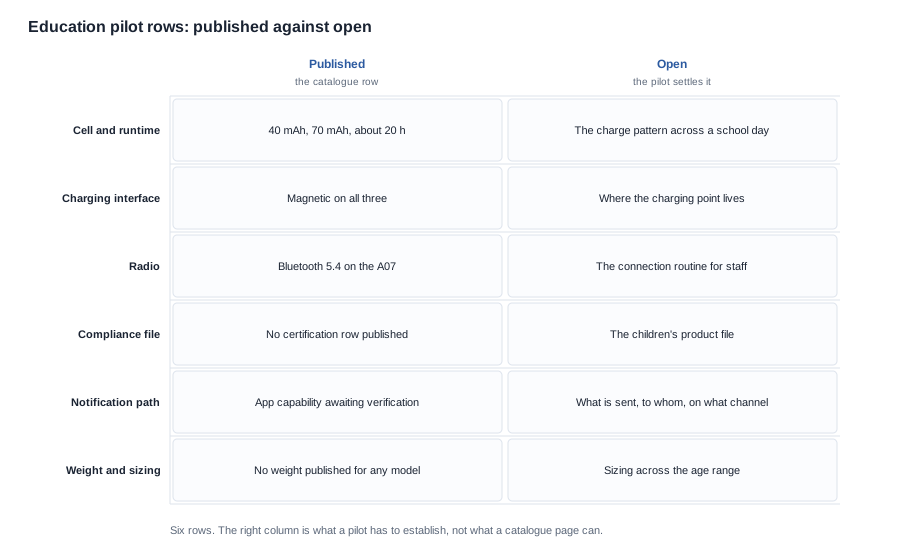
The chart above sets out the same split for a pilot: what the catalogue publishes for these three models, and what only a pilot can settle. The right-hand column is the pilot's job, and two of its six rows — the compliance file and the notification path — decide whether a programme is viable at all.
What the catalogue does not publish for this tier. The unit weight for any of the three, the frame material, the lens material, the field of view for the camera entries elsewhere in the range, the application behaviour, the data handling and the certification status. The app and firmware customisation capability for this tier is recorded as awaiting verification rather than published, which means an institutional programme that depends on a branded application has to establish that capability before it is promised, not after it is bought.

What a school procurement file has to contain
An education sale is won or lost on a document set, and the set is longer than the specification. The two groups below are what a procurement process will ask for; the red rows are the ones that most often stall a programme.
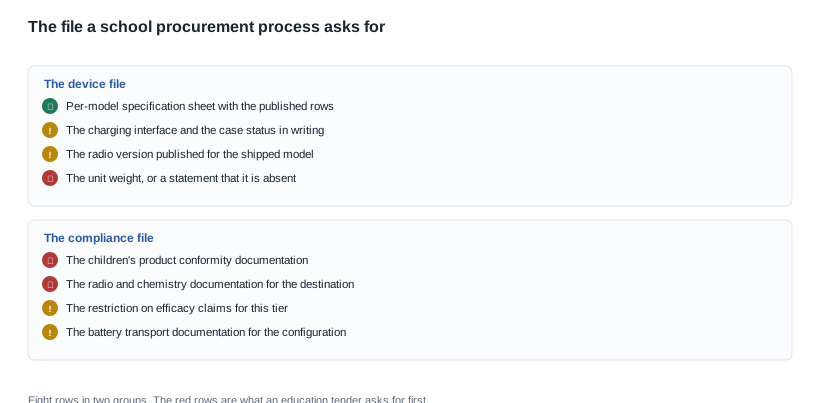
The certification position, stated honestly. For the A05, the A06 and the A07, the certification position is not provided to us. That is the sentence an education buyer has to work from, and it is a weaker position than a buyer in another channel would accept. Our catalogue carries a company-level export certification page whose content is images rather than text — ten patent certificates, eight appearance-design patents and two utility-model patents — and the catalogue text contains no reference to CE, to FCC or to RoHS, and no per-model certification row anywhere. Children's products carry requirements on top of the radio and chemistry ones, and we have not confirmed a single requirement for this tier. The route is at certification checklist and the destination-specific pages sit under the compliance section.
The notification path is the product. Posture and distance detection only does something if the result reaches someone, which means a parent-facing application, which means a data path, a consent model and a channel. The app and firmware customisation capability for this tier is recorded as awaiting verification, so expect to establish the notification behaviour during a pilot rather than to read it from a document. Four things have to be answered before a pilot starts: what is detected, what is transmitted, to whom it is transmitted, and what the school does when a parent declines. That last one is a school policy question, not a hardware question, and it is the one that most often ends a programme.
What a pilot has to prove, and what it must not try to prove. A pilot is worth running if it establishes three things and nothing else: the notification behaviour; the daily operational cost, meaning how long the charge takes across a class, who performs it and where the devices live overnight; and the fit across the age range, because the A05 and the A06 publish no weight and a device that comes off halfway through a lesson is not solving a problem. Everything else can wait for a second phase. A pilot that also tries to evaluate long-term learning outcomes will produce nothing usable, and it will produce a result nobody can defend to a parent or to a board.
How to run the pilot so the answer is usable. Keep the class set small enough to manage and large enough to be meaningful — a single class in one age band is the usual starting point. Record the charge time per device across a full teaching day rather than trusting the rating. Log every device that comes off, with the reason, because fit failures cluster by age band and that is the only way to find out. Log every notification, with the delay between the event and the message, because a notification that arrives twenty minutes late is a different product from one that arrives in a minute. And agree in advance what result would stop the programme, because a pilot without a stopping rule becomes a pilot that continues.

The class set economics nobody models
Two things decide whether an education programme works commercially — the minimum order quantity tier and the support arrangement — and neither of them is the unit price.
The minimum order quantity is the first commitment. It is not published for our models, so you will be told the threshold rather than read it, and in this category it applies per model. A school set of twenty devices therefore carries the same commitment profile as a retail launch of twenty thousand units, which is why the pilot tier and the run tier are priced differently and why the share of units taken at the pilot tier is worth negotiating explicitly. A school programme is also a multi-year relationship, so the second order is more important than the first, and a supplier who will not move on the pilot tier is telling you something about the second order.
Support in a school is a person, not a queue. Every device raises questions the published material does not answer: the connection dropped after a firmware update, a charge that did not take overnight, a parent who wants to know what the device is doing. In a commercial channel these are tickets. In a school they land on one named member of staff, and that person has a teaching job. The support cost is therefore a per-device recurring cost that does not scale linearly — a class of twenty devices is manageable by one person, a school of two hundred is not, and the breakpoint sits somewhere between. The question to ask a supplier is narrow and practical: who answers the questions, in what language, within what time window, and what the school is expected to do first.
The charging logistics are an operational decision with a capital cost. A magnetic interface means a charging point per device, and with roughly twenty hours of rated use measured under conditions nobody has published, a daily or twice-daily charge in practice means the devices need somewhere to go at the end of the day and someone to do it. That is a table, a cable count and a duty roster, and it is the line most often missing from the programme budget. The buyer who plans for it early treats it as an operating cost; the buyer who plans for it late treats it as a surprise in term three.
The consent and data questions have to be answered before the hardware arrives. A notification that leaves the device contains something about a named child, which means a lawful basis, a retention rule and a named controller. None of those are hardware questions, and none of them are published for this tier, so they belong in the file the buyer requests rather than in the pilot plan the buyer writes afterwards. The order matters: the consent model decides what the notification path is allowed to send, and the notification path decides what the device needs to do, so a programme that designs the notification first and the consent model second usually has to rebuild the notification. Ask the supplier for what the device transmits and where it goes, and ask the institution for its own rule, and reconcile the two in writing before the pilot.
Model the programme as four costs, not one. The device cost is the smallest of them and the easiest to quote. The class set cost — the units, the charging points, the storage, the packaging — is the second. The documentation cost, including the time a compliance file takes to assemble and review, is the third and is usually underestimated, because it is paid in weeks rather than in currency. The support cost, which is one named person per site, is the fourth and is the only one that recurs every term. A programme that models the first two and underestimates the third and fourth will show a margin that survives the pilot and disappears in year one, and the most common reason is that the support cost was treated as a headcount assumption rather than a per-device recurring cost.
A worked example, written as a scenario. Take a regional training provider that has decided to pilot a posture and distance notification device with one class in a single school. The first decision is the model: the A05 and the A06 publish identical rows, so the provider asks for the distinguishing feature in writing and takes the A07 only if the radio version published for it matters to the institution's own device policy. The second decision is the file, and the provider asks for the children's product conformity documentation, the radio and chemistry documentation for the destination, and the restriction on efficacy claims for this tier before the pilot is scheduled rather than after. The third decision is the pilot design: one class, one age band, three things to establish, and a stopping rule agreed in advance. The outcome is a twenty-device set bought at a pilot tier, a notification path that works, a charging roster that exists before term starts, and a result the provider can put in front of a second school.
Where our published rows stop for an education buyer
Concretely, the honest expectation for education is a well-behaved notification product with an open compliance file, and a project which starts by closing the compliance position is far more likely to succeed than one that starts by fixing the unit price. We publish the children's model specifications — the cell capacities of 40 mAh on the A05 and the A06 and 70 mAh on the A07, the charge ceiling of two hours or less, the roughly twenty hours of rated use, the magnetic charging interface, the published Bluetooth 5.4 row on the A07, the lens-type anti-fog arrangement, the posture and distance detection, and the colour and packaging customisation that is recorded as available. We do not publish the certification position, the application behaviour, the per-model unit weight, or any efficacy claim, and we will not write one into your materials or into a school's.
What is fixed and what is open. Fixed: the cell capacity, the charge ceiling, the rated runtime band, the charging interface, the published radio version where one exists, the certification cost and lead time, the tooling cost amortised across the first order, and the battery transport documentation for the configuration. Open: the minimum order quantity tier and the split between the pilot tier and the run tier, the colour and logo treatment, the packaging and the insert contents, the payment structure and the shipment split, the warranty length, the application customisation scope once the capability is confirmed, and the support arrangement described above.
What to send us next. Send the market, the class size, the age range, the destination country and whether the notification path has to reach parents, and we will say which of the three models are in scope, what the published rows cover for each, which of the documents have to be settled before a pilot is scheduled, and which questions are most likely to be tested first. The education buying checklist covers the selection, the kids range lists the published figures for the three models, and the scenario entry point is smart glasses for education.
Related reading
- The scenario entry point — smart glasses for education
- The published figures — kids smart glasses
- The compliance route — child product compliance
- The selection checklist — education buying checklist
Tell us the market, the class size and the age range, and we will return the published rows that cover those models and the file that has to be settled before a pilot is scheduled.


