

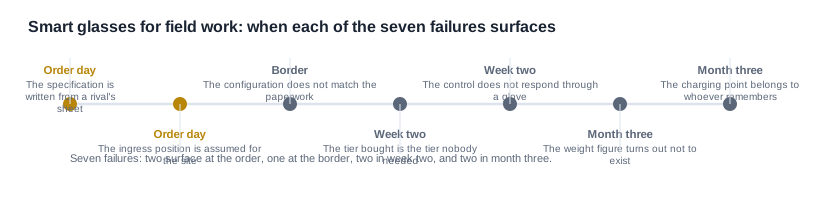
Seven things a field buyer should not do, and none of them is technical. Three of them are documentation failures, three are deployment decisions, and one is a selection error. What makes them expensive is not the failure itself but the date it surfaces on: two of them surface at the order, one at the border, two in week two, and two in month three, and the two that surface in month three are the two that have already been paid for twice.
The reason field work differs from every other scenario in this category is that the device leaves the building. An office product that fails a test fails a test. A field product that fails a test fails in a place where the crew is depending on it, where nobody is watching, and where the feedback arrives as a workaround rather than as a ticket. That is why the whole of this article is about sequence rather than specification: the specification failures in this list are cheap to fix while they are still rows on a page, and expensive to fix once they are in a contract.
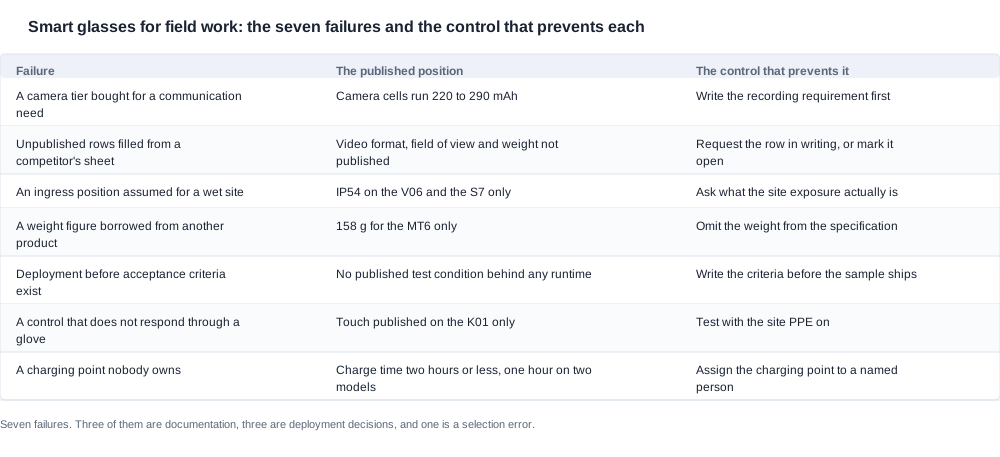
Smart glasses for field work: the seven failures and the control for each
| Failure | The published position | The control that prevents it |
|---|---|---|
| A camera tier bought for a communication need | Camera cells run 220 to 290 mAh | Write the recording requirement first |
| Unpublished rows filled from a competitor's sheet | Video format, field of view and weight not published | Request the row in writing, or mark it open |
| An ingress position assumed for a wet site | IP54 on the V06 and the S7 only | Ask what the site exposure actually is |
| A weight figure borrowed from another product | 158 g for the MT6 only | Omit the weight from the specification |
| Deployment before acceptance criteria exist | No published test condition behind any runtime | Write the criteria before the sample ships |
| A control that does not respond through a glove | No touch row published for any model | Test with the site PPE on |
| A charging point nobody owns | Charge time two hours or less, one hour on two models | Assign the charging point to a named person |
Who the reader is and what is at stake. The reader is a procurement lead or a product manager deploying devices into a working environment: a utility crew, a survey team, a warehouse, a field service operation. Their exposure is not a returns rate. It is a shift where a person cannot do their job, a crew that quietly stops using the device, and a supervisor who has to decide whether to press for a replacement or to drop the programme. The most expensive outcome in this category is not a failed device; it is a device that is returned once, never reported, and quietly retired, because the crew decided it was not worth the trouble.
Why the failures cluster where they do. Three of the seven are rows that the catalogue does not publish, and a buyer under schedule pressure fills them from somewhere. The nearest thing to hand is a competitor's specification sheet, and that is exactly the wrong source, because the fill is invisible afterwards and the device that arrives is not the device that was specified. The next three are decisions that are technically available at the order and are normally taken at the rollout, because a rollout is where the people are and the order is where the paperwork is. The seventh is a selection error that nobody can see from a specification.
The three rows that cannot be evidenced
Filling an unpublished row from a competitor's sheet. The video format, the frame rate, the field of view, the storage behaviour, the sensor model and the unit weight are all not published in our documentation. A field buyer who fills them from a competitor's specification is buying a product that does not exist, and will find out during a shift rather than in a meeting — which is the worst possible place to find out, because the crew has already changed their procedure around the device.
The rule that prevents it. Three ways to close an unpublished row, and each of them is legitimate. The supplier can be asked for the figure in writing, and the answer goes in the file. The buyer can measure it on a sample and record the measurement as a buyer-owned figure with its conditions attached. Or the row stays open and is written into the specification as open, with a test plan attached. What is not legitimate is the fourth option, which is the one that happens by default: the row is filled from a document that describes a different product, and nobody records that it happened.

Assuming IP54 covers the site. The IP54 marking is published on two models in the range, the V06 and the S7, and both of them are camera models. The three sport-positioned models that do not carry a camera — the YKC02, the D17 and the ZH12 — carry no ingress marking at all. The second digit of the marking describes protection against water splashing from any direction and the first is a dust protection level; it is not an immersion rating, not a jet rating and not a downpour rating. No third-party test report number is published behind it. A site with standing water, a wash-down bay or an open-weather exposure is outside what that marking supports, and the assumption is the one that gets made, because a site is wet and a marking exists somewhere in the range.
The question to ask instead. Ask what the site's actual exposure is — splash, spray, standing water, dust, or a combination — and then ask the supplier which models, if any, have a published position for that exposure. A site that is genuinely wet has a short model list, and that is a better outcome than a long list with a wrong expectation on it. The IP rating discussion covers what the digits mean, and it is worth reading before the site visit rather than after it.
Buying a weight figure that does not exist. Unit weight is published for one model in the whole catalogue, at 158 g for the MT6, and that figure is the whole unit including its 265 mAh cell and its camera, excluding the foldable case. Every other model's weight is not published. All-shift comfort is a weight question and a fit question, and our documentation answers neither for most models. A field specification that carries a borrowed weight is a specification that will be checked by the people who wore it, on a long shift, in the sun.
What to do with the weight row instead. Leave it out of the specification and put it in the sample test. Ask the supplier for the figure in writing for the models on the line, and if the answer is that it is not published, record that as the answer. Then run the sample for a full shift and treat the crew's verdict as a measurement. That is a slower route than copying a number, and it is the only route that produces a figure the buyer can put in a tender.

Buying a camera tier for a communication need
The selection error in this list is the most expensive one, because it is invisible in the specification and obvious on the invoice. A team that only needed hands-free calls buys a camera configuration, and the extra capability arrives with a workload attached: our camera configurations carry cells from 220 mAh to 290 mAh, and the audio range carries cells of 55 mAh to 100 mAh, with the D11 and the D12 holding theirs as a single cell rather than as a pair. A team that ends up with a mid-shift charge problem reports it as a battery fault, and the battery fault is not a battery fault.
What the recording requirement actually decides. Three things, and they should be written before a model is shortlisted. Whether a recording is needed at all, and for what purpose — a photo record of a site condition, a video record of a procedure, a voice note, or nothing. If a recording is needed, what has to be true about it: how long a clip, how it leaves the device, and who holds it. And whether the recording has to survive a site with no connectivity, which is a different question from whether it has to survive a shift.
The case for the audio class on a communication-only deployment. Not that it is lighter — the weight is not published for those models either, so that argument cannot be made — but that the audio configurations remove a class of site risk. There is no storage path to manage, no file to transfer, no footage to hold and no question about who owns the data. On a site where the device is issued and returned, that removal is worth more than a capability nobody asked for. It is also worth noting that the audio range publishes a capacitive touch control on no model at all, and that the interaction method on the camera models is not published either.
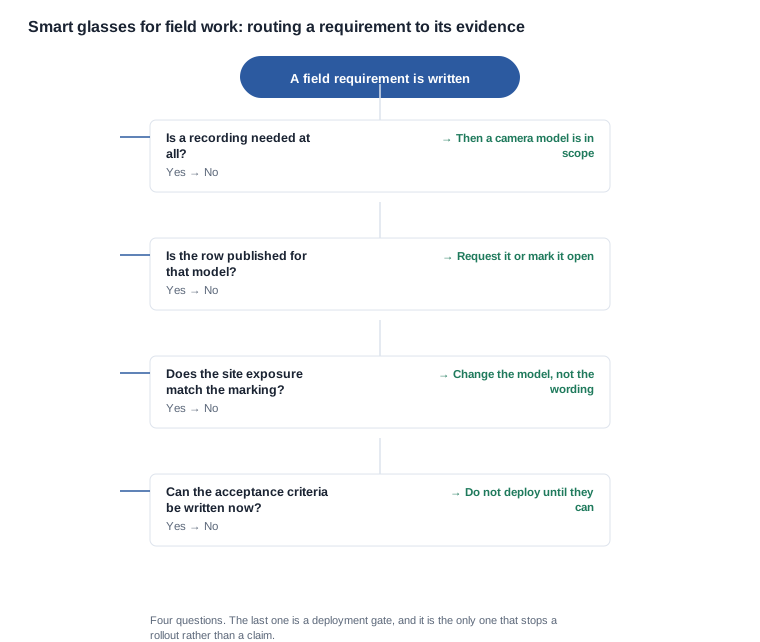
What to write in the requirement. The recording requirement, in one sentence, at the top of the specification. If the sentence is empty, the camera class is out of scope and the decision is made. If it is not empty, it is the sentence the acceptance criteria will be built from, because a device that is supposed to record has to be tested on whether it recorded, and that test needs a criterion.
What it costs to get wrong. The commercial cost is the price difference between two tiers, which is not published and which a buyer will see in the quotation. The operational cost is larger and does not appear on any invoice: the charge management, the storage, the transfer, the data handling, the support questions and the mid-shift failures. A field programme that adds a camera class to a communication need has added five support surfaces to a team that is already working in the rain.

Acceptance criteria, gloves and the charging point
The three deployment decisions have one thing in common: they are all available at the order and all normally taken at the rollout, because the rollout is where the people are. Each of them, taken late, is unrecoverable in a way that the specification problems are not.
Deploying before the acceptance criteria exist. A field deployment without criteria has no basis for a defect claim and no basis for a return. The criteria that most often lack a method are charging function on a sample and pairing across more than one handset model — both free to define and expensive to argue about later. The reason to write them before the sample ships is that a criterion written after a rollout describes whatever happened to be tested, and a criterion written before the sample ships describes what was required.
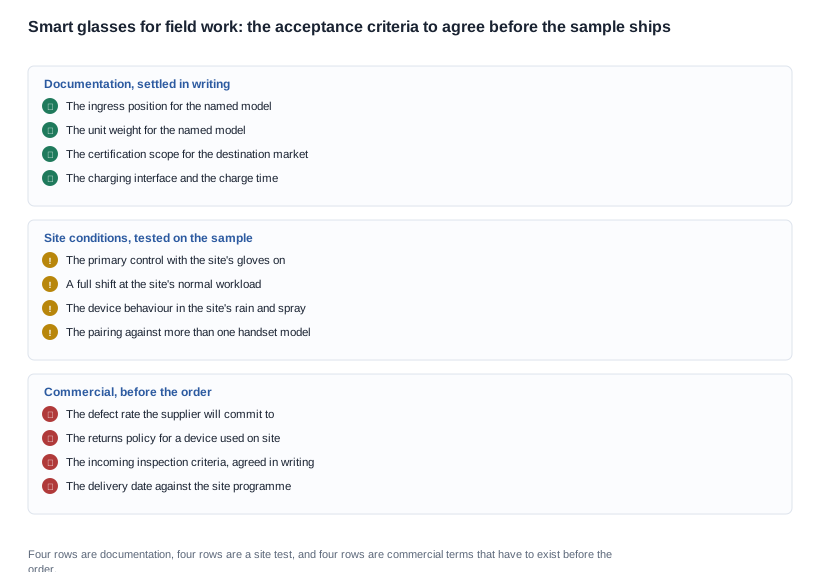
What an acceptance criterion has to contain. Three parts, and the third is the one usually missing: the method, the threshold, and the condition. "The device pairs" is not a criterion. "The device pairs with the two handset models named in appendix one, on first attempt, after a full power cycle" is a criterion, because it has a method, a threshold and a condition. Applying that shape to a handful of rows is what turns a rollout from an opinion into a process.
Skipping the glove test. The primary control on most products in this category is capacitive, and capacitive controls respond inconsistently through gloves. That statement is about the general behaviour of the technology; about our own range the published position is narrower, and the distinction matters, because a buyer who assumes a control method and gets a different one has a procurement problem. No model in the range publishes a capacitive touch control, and the interaction method on the camera models is not published. So the test is not optional for any model where the buyer is relying on a touch interaction: a device whose record button needs a bare fingertip produces a device that comes back unrecorded, and the team stops using it without reporting anything.
The test itself. Put on the site's actual PPE, with the actual gloves, and perform the operation the device is there for — not a menu navigation, the operation. Do it in the cold, because a capacitive control on a cold hand is a different measurement from one on a warm hand. And do it at the end of a shift, because the field that matters is the one a tired hand produces. Two failures in this list in week two are the tier nobody needed and the glove test, and both of them are visible in a single afternoon on site.
Leaving the charging point to whoever remembers. A product in a drawer is charged by whoever remembers; a product next to a charging point is charged by everyone who passes it. In a field deployment with vehicles and sites, the charging point is the whole plan, because the runtime figures are bounded and a device that is not charged is a device that is not used. The published charge time is two hours or less across the range, with roughly one hour published on the D17 and the ZH12, and the practical consequence is that the charging point has to be somewhere people actually are, not somewhere the logistics team decided.
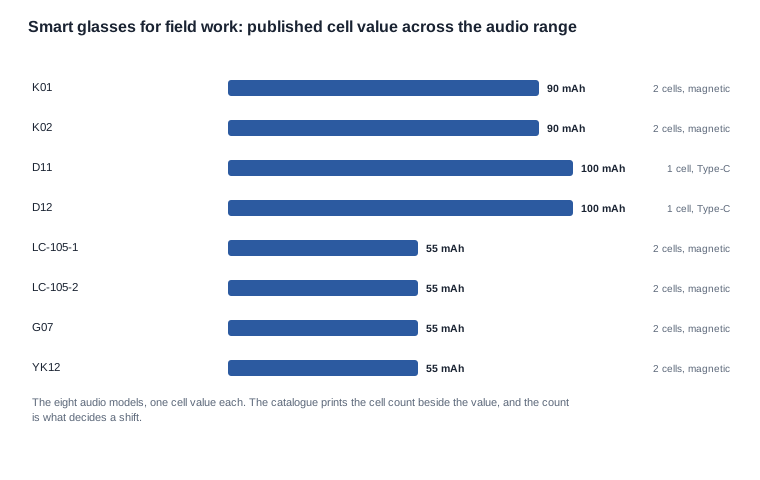
Why the cell count is the number that decides a shift. The eight audio models publish their cell value together with the number of cells, and the two are published in the catalogue as a pair — 90 mAh across two cells on the K01 and the K02, 100 mAh in one cell on the D11 and the D12, and 55 mAh across two cells on the LC-105 pair, the G07 and the YK12. The chart above shows the per-cell value; the count sits beside it, and it is the count that changes how many hours a device covers a site. The camera models sit in a different band entirely, at 220 mAh to 290 mAh per unit, which is why the choice of class is a shift-length question and not a feature question.
The three answers a field deployment needs. Who owns the charging point, by name. Where the devices live between shifts, and who counts them. And what happens to a device that comes back flat — whether it is quarantined, tested, recharged, or retired, and who decides.
- The charging point needs a named owner and a physical location people pass every day.
- The storage point needs a location and a count, reconciled against the issue log.
- The flat-device rule needs a decision tree and a deadline, so a device that arrives empty is not left on a desk for a week.
A field programme that has not answered those three has a device-loss rate it cannot see, and the first sign of it is a budget that does not reconcile.
The commercial conditions that make the sequence affordable
The sequence in this article is not free, and a buyer who has been told it is will not repeat it. Four commercial terms carry most of the cost and most of the value.
The terms that can be negotiated. The minimum order quantity tiers and whether the pilot quantity can be bought separately from the run quantity, because a pilot that is a scaled-down order is the cheapest possible test programme. The pilot tranche of an order, which is where the widest price gap sits, because that is the exposure the factory carries itself. The price tier each configuration lands on. The payment terms and the deposit, and whether a first order can be split into two deliveries against a staged payment. And the tooling and new tooling expense for private label packaging, which has to be quoted as a separate line rather than folded into the unit price.
The terms that cannot be negotiated, and why a buyer should stop trying. The certification cost and its lead time, which are set by the destination market and not by the factory. The factory's production capacity and the committed lead time, which are a function of its own loading. And the charge time and the runtime figures, which are published rows rather than commercial variables. A buyer who presses on any of these gets a commitment that cannot be kept, and in a field programme the failure of a committed delivery date is a failed programme.
The two terms that decide the category. The defect rate the supplier will commit to in writing, because a field programme with a high defect rate discovers it through its own crews and the discovery is expensive. And the returns policy for a device that has been used on site, which is a different object from a shelf product and which has to say what condition a returned device is expected to be in. A policy written for a domestic product is the clause most likely to make a field programme unprofitable, and it is the clause most often written by default.
How to verify a supplier before the order. Four checks that cost a week and save a quarter. Verify the model designation on the unit against the paperwork, so that a loss is traceable. Verify the published rows against the sample you received — the cell capacity, the charging interface, the case configuration — because a configuration mismatch is the most common finding in incoming inspection. Verify the certification position against the issuing body's own register rather than against a photograph of a document. And compare the production sample against the approved specification sample, because the only control that catches a change in the bill of materials is a physical comparison. The factory audit page covers the audit side, and the quality consistency page covers the incoming inspection criteria.
The four checks, in the order they catch problems. The order is not arbitrary, because the first two are free and the last two cost a week:
- Designation against paperwork — a desk check against the shipment file, before the goods are opened.
- Published rows against the unit — cell capacity, charging interface and case configuration, against the specification sample.
- Certification position against the register — a lookup at the issuing body, not a copy of a certificate.
- Production sample against the approved sample — a physical comparison, and the only one of the four that catches a change in the bill of materials.
Our position, and where we stop. We will tell you the published configuration and mark the rows we do not hold, and we will say plainly when a row decides a field deployment and is not published. Cycle life, thermal limits, the standby draw, the operating temperature range and any ingress beyond the published marking are not published in our documentation. We will not state that any product in our range is tested to IP54, because no test report is published behind that marking, and we will not extend the marking beyond the two models that carry it. We will not publish a weight for a model whose weight is not published, and we will not supply a typical figure to make a frame sound lighter than it is.
What to send us next. Send the use case in one sentence, the site conditions, the number of handsets in use, the destination market and the expected volume, and we will return the published rows that cover the shortlist, the questions that have to be settled in writing before a purchase order, and the acceptance criteria we would expect the configuration to meet. The field work application page carries the wider framework, the testing protocol covers the sequence in detail, and the safety considerations covers the constraints that are not hardware.


