

The safety question for a field deployment of smart glasses for field work is not a question about which model to buy. It is a question about what the device is allowed to do in the safety argument, and the answer is narrower than most buyers assume. A smart glasses device is an administrative control. It is not eye protection, it is not hearing protection, and it is not a substitute for any item on a site's personal protective equipment list. Once that is settled, the useful work is short: five hazards, what the catalogue publishes about each, what it does not, and the control that has to be written down for the parts it does not answer.
Smart glasses for field work: the device is an administrative control, not protective equipment
The conclusion. A smart device belongs in the administrative and engineering layers of a site's control hierarchy, and it belongs nowhere else. It cannot be counted as eye protection, because the catalogue publishes no eye protection standard for any model and the only ingress marking in the range is an IP54 attribute on the V06 and the S7 with no test report behind it. It cannot be counted as hearing protection, because the catalogue publishes no acoustic figures for any configuration, and an open-ear audio device that masks an audible alert is a hazard rather than a control. And a device that adds a hazard of its own — by diverting attention, by capturing people who did not agree to be imaged, by heating a cell in a parked vehicle — cannot be used as a control for the hazard it introduces. Every one of those is a documentation question, and the documentation is the buyer's to produce.
Who is reading this. The reader is a brand owner, a channel buyer or an integrator whose customer will place the device into a site that already has a safety regime: a permit to work, a personal protective equipment rule, an incident procedure, possibly a hearing protection rule and a site induction. The buyer's need is to understand what the device can be relied upon for, because a customer will ask, and the answer has to be defensible. It also has to be defensible in a way that survives the question being asked again six months later, after something has gone wrong, by somebody who was not in the original conversation.
Why the published rows cannot answer the safety question by themselves. The catalogue is strong on electrical rows and thin on everything else, and safety runs almost entirely on the thin side. There is no published frame material, no lens material, no coating, no hinge specification, no field of view, no video specification, no storage behaviour, no operating temperature range, no drop or shock tolerance, no cycle life rating, no standby draw, no acoustic figure and no frame weight for any model other than the MT6. The one published weight, 158 g for the MT6 whole unit excluding its folding case, is a mass and not a load rating. So a safety file built on catalogue rows would consist almost entirely of capacity, runtime and interface — which is enough to write a charging procedure and not enough to write a safety case.
The hierarchy question, answered once
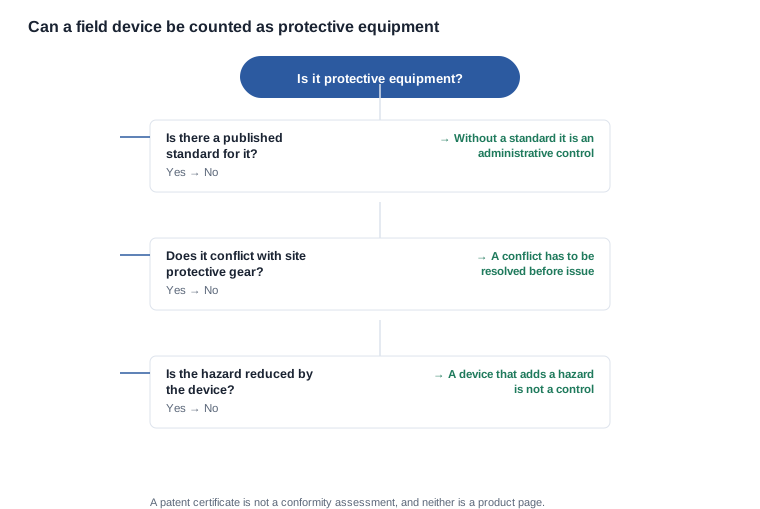
The decision chart above is the one question to settle before anything else, because it determines where the device goes in the safety file. If there is no published standard for the device, it is an administrative control, and an administrative control cannot appear on a personal protective equipment list. If it conflicts with the site's existing protective equipment, the conflict is resolved before the device is issued, not after a technician has decided to take the ear protection off. And if the device introduces a hazard of its own, it is not a control for anything.
One point deserves emphasis because it is a common misreading. A single company-level export certification page appears in the catalogue with images rather than text on it, and no CE, FCC or RoHS reference appears in the catalogue text. That page presents ten patent certificates — eight appearance-design patents and two utility-model patents. A patent certificate is evidence that a design is registered; it is not a conformity assessment, it does not describe a performance level, and it cannot be entered into a safety file as a protective capability. There is no per-model certification row anywhere in the catalogue, so the conformity evidence for a named model and configuration is a document to request, and the request list is at the certification checklist.

Five hazards in field work, and what answers each
Hazard one: attention diverted by the device itself
A device that notifies, displays or captures is a device that changes where a person's attention goes. In a live site — a roadway, a plant floor, a structure under load, a vehicle route — attention is a safety resource, and anything that redirects it has to be assessed like any other control on the site.
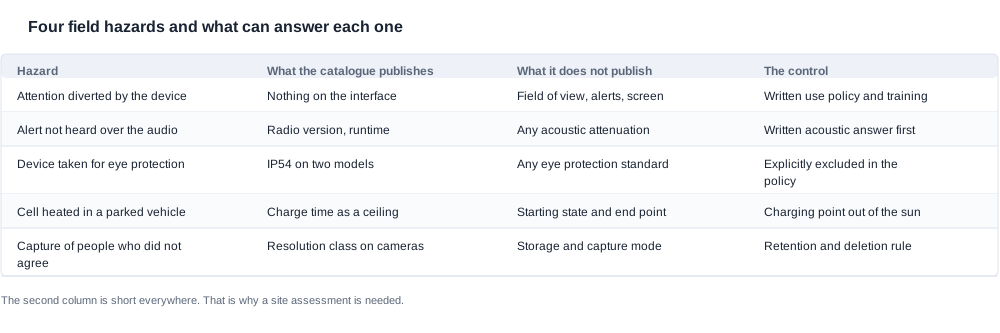
The catalogue publishes nothing about this: no field of view, no screen specification, no alert behaviour, no notification model, no published description of how a capture is triggered. The first row of the hazard table is therefore almost entirely empty, and the consequence is that the control cannot be written from the specification. It has to be written from the deployment: which modes produce a notification, what the operator does when it fires, whether the operator can suppress it, and whether suppressing it is permitted. The controls that follow from that are procedural — a use policy that says when the device is in use, training that covers the response to a notification, and an acceptance test in the site conditions rather than in a demonstration. The verification is an observation of the operator at work, with the notification behaviour included, because a device that behaves well in a quiet room and badly next to a moving vehicle has not passed anything.
Hazard two: an audible alert masked by the audio
The connected models in this range publish surround sound, and the configuration choice interacts directly with a site that has an audible-alert regime: reversing vehicles, alarms, whistles, radio traffic, site instructions. The catalogue publishes no acoustic attenuation figure for any configuration, no output level, and no leakage figure. That silence is the whole of the risk argument, and it has to be closed with a written answer before the device is issued to a crew working near vehicle movement.
The controls here are specific. The written answer has to state the attenuation at the relevant frequencies and the leakage with the device in the configuration it will be used. The site rule has to state whether the device may be used in a zone where audible alerts are relied upon, and what the alternative is if it may not. The verification is a site test — a crew carrying the device in the actual alert environment, with the alert actually sounded. The device comparison procedure is at comparing models for field work, and the advanced side of the ingress question is at IP rating considerations.
Hazard three: the device taken for eye protection
The instinct on a site is protective: a device that sits in front of the eyes and carries an IP54 marking on two models is a device people will reach for in a hurry when a fragment hazard appears. That instinct is the hazard. The V06 and the S7 are the only models in the range that carry the marking, and the marking is a catalogue attribute with no published test report; and neither model is published against an eye protection standard. The control is a single explicit line in the use policy — the device is not eye protection and does not satisfy any eye protection requirement — plus a physical separation from the site's protective equipment storage so it is never the item grabbed in a hurry. The verification is an audit of what the site actually issues and what the crew actually reaches for, and the second of those is the one that matters.
Hazard four: the cell heated in a parked vehicle
The published charge time for every model is a ceiling rather than an estimate — two hours or less for twenty-six of the twenty-eight catalogue entries, and roughly one hour for the D17 and the ZH12. What it does not state is the starting state of the charge or the point at which a charge counts as finished, so a buyer cannot convert it into the time a device occupies a charging point, and cannot convert it into a figure for a hot vehicle interior either. A cell left in a vehicle in summer is exposed to a temperature the catalogue does not publish a range for, and a cell brought in from that vehicle and put on charge is charging across a temperature swing the published rows do not describe.
The controls follow from ordinary practice and from the published rows. A charging point that is not in a parked vehicle. A case that is charged separately from the device rather than in a hot vehicle. A written procedure that states the starting state the charge time assumes, once the supplier has answered it. And a battery transport position, because a case is a second lithium cell and a field fleet with cases in every vehicle has a shipping and handling profile that has to be documented. The battery figures are collected at battery life.
Hazard five: capturing people who did not agree to be imaged
The camera models publish a resolution class — 8 MP on eight of them and 13 MP on three — and publish no storage behaviour and no capture mode. A device that records in a public place, or in a staff canteen, or in a meeting that a camera walks into, creates an exposure that is not about the device at all. The controls are the ones that belong in a use policy: where the device may be carried and where it may not, that the site owner is responsible for the lawful basis, a retention and deletion rule, and a notice for the workforce and for visitors. The legal framework for that sits in a separate discussion, and the procurement point here is narrower: the catalogue does not publish the capture behaviour, so it has to be obtained in writing before the device is issued.

Building the safety file: assessment, control, verification
The assessment is a short document, and it is a buyer's document rather than a supplier's. The sequence below is what produces one that survives a later question.

The important discipline is in step three. The published rows are checked against each hazard and the gaps are marked, and the marks are not treated as failures of the product. They are the items the buyer's own site has to answer, and each one needs an owner and a verification. A hazard that has no control and no verification is an open item, and an open item in a safety file is worse than a hazard that was never listed, because it has been noticed and not closed.
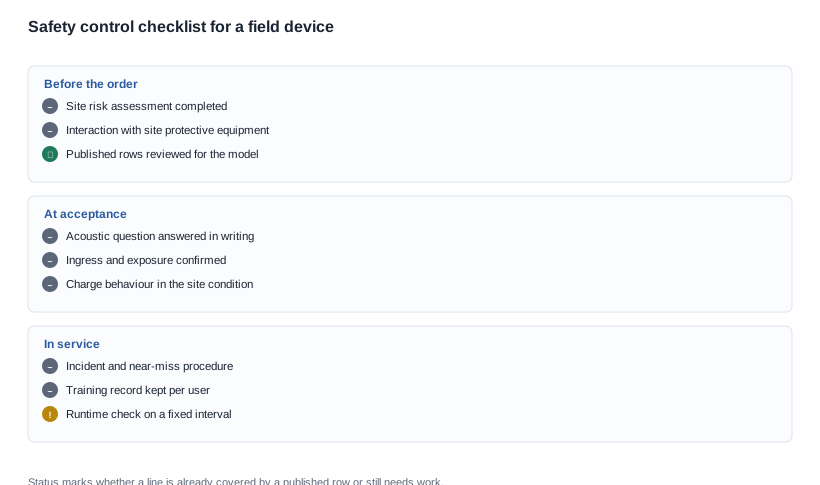
The nine questions the safety file has to answer, in the order they usually block a deployment:
- Which model codes are permitted on this site, and which configurations of each are excluded
- What the device is explicitly not, in language the crew will understand
- What the operator does when the device notifies, and where that is permitted
- What the acoustic answer is, and which zones the device is barred from
- Which ingress marking applies to which model, and where the report behind it is filed
- What the charge time is measured from, and how a completed charge is determined
- Where devices are charged, and who owns that point
- What the retention rule is for captures, and who deletes them
- What triggers a re-assessment, and who signs it off
Each of these has a verification attached — a document, a test or an observation — and a verification without a named owner is a line that will not survive the first audit. The list is deliberately short, and that is the point: a safety file that is long is a safety file that nobody reads, and a file nobody reads is indistinguishable from no file at all.
Two of the lines in the checklist carry a different status from the rest, and both are worth understanding. The published-rows review is already covered, because the rows exist. The fixed-interval runtime check is a warning rather than a gap, because it is the one verification that has to be built into the fleet's routine rather than into the acceptance test — and it is the one that catches a cell degrading in storage, which is a condition no report will ever describe because nothing looks wrong until the runtime no longer reaches the shift.

What the safety decision changes commercially
A safety assessment is often treated as a document that sits beside the commercial work rather than inside it. In this category it is inside it, and it changes three things that a buyer should expect to move.
The configuration. The hazard assessment usually narrows the choice before the model comparison starts. A site with an audible-alert regime in a vehicle route may rule out the connected models entirely, which leaves the camera group. A site with a wet environment narrows the range to the V06 or the S7 on the strength of the only published ingress marking, and even then only with a test report behind it. The selection procedure that follows from those exclusions is the one set out at the field work product recommendations, and it is worth reading before the shortlist is fixed rather than after.
The cost. The safety file is not free. It needs an acceptance test in site conditions, an acoustic answer, training records per user, an incident procedure and a periodic review. Those costs are real and they belong in the quotation rather than in the overhead, because a deployment that has not budgeted for them will have a safety file that exists on paper and not in practice. The trade-off is between a formal assessment that costs time and money and an informal practice that costs a claim, and the total cost of the second is not knowable in advance — which is an argument for buying the first cheaply rather than for skipping it.
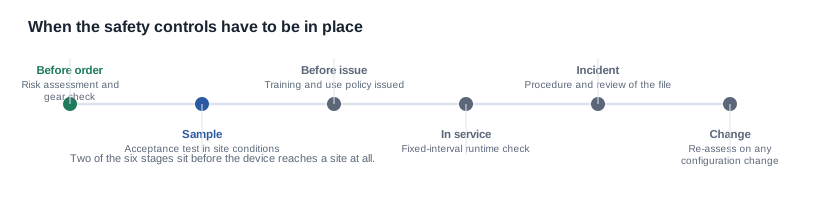
The contract. Three clauses follow directly from the assessment and are worth adding at the order. The first is that the device is not represented as protective equipment in any channel material, which protects the brand owner from a claim about a hazard the device was never assessed for. The second is that conformity evidence and the test reports behind any published marking are supplied for the model and configuration actually shipped, because the safety file references them by name. The third is the configuration control: a change of model, case, interface or supplier triggers a re-assessment, and that trigger belongs in the purchase order rather than in a good intention. The way to negotiate these is the same as for any other clause — ask what to ask, and put the answer in the document, before you order.
What we can support, and what we will not claim
The boundary we hold: the honest answer to a safety question about this range is short and specific. We publish the cell configuration, the charge time as a ceiling, the rated runtime, the charging interface where the catalogue states it, the radio version where it is published, the resolution class on the camera models, the case capacity and case status where they are published, the detachable part terms, the remote control terms, the ingress marking on the V06 and the S7 stated as a catalogue attribute, and the 158 g whole-unit weight for the MT6. Those rows support a charging procedure, a runtime plan and a configuration comparison. They do not support a safety case on their own, and we would rather say that than imply a coverage we do not hold.
It is worth being explicit about one consequence, because it is the consequence buyers most often discover late. A safety file that is assembled from published rows alone will be assembled from rows that describe electricity, and the hazards in field work are mostly not electrical. The published rows will tell a site how long a charge takes and how large a cell is, and they will not tell it what the device does to a person's attention, what it does to an audible alert, or what it does to the person who walks into frame. Those three are the safety argument, and they belong to the deployment, not to the catalogue. The honest way to describe this to a customer is that the device is an administrative control whose behaviour in a live site has to be established by the site and documented, and that a specification which claims otherwise is claiming something no test report in this range supports.
We do not publish frame and lens materials, the coating, the hinge specification, the field of view, the video specification, the storage behaviour, the operating temperature range, the cycle life rating, the standby draw, the acoustic figures, or the weight of any model other than the MT6. The catalogue text contains no reference to CE, FCC or RoHS, there is no per-model certification row, and the export certification page presents patent certificates rather than conformity assessments. Nothing in this range is presented as eye protection, as hearing protection, or as a medical device, and no such claim will be made in any material we supply. Send us the site description, the hazards you have identified and the models under consideration, and we will return the published rows for each model, the gaps that a site assessment has to close, and the questions we can answer in writing about the configuration. The scenario entry point is the field work application page.


