

Smart glasses for kids parenting: five groups to pack, and one that is not an object
What to bring when buying smart glasses for kids parenting is a short list, and the reason it is short is that the published data has already fixed most of what a household needs to carry.
That is a strange place for this application to start, because the rest of the site treats a first-person camera as an imaging product with a runtime and a resolution class. In the children's tier there is no camera, and the things that decide whether the device is still in use in a month are a dock, a routine and a decision about data. The list that follows is built on the published position for the three children's models, and it is aimed at whoever is specifying the purchase — a brand putting a parenting SKU on a shelf, a channel buying it in volume, or a family working out what they are actually taking on.
Five groups of things go into the pack. The sixth item is not a thing at all, and it is the one that decides the outcome.
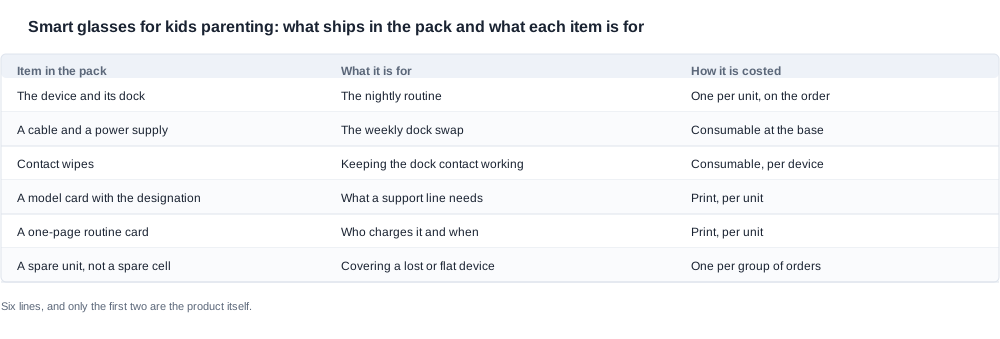
The same list, when the order is in volume
A household buys one device and a brand buys ten thousand, and the list above is the same list — but the questions behind it change. A household asks what it needs to carry; a brand, a channel or a distributor asks what the pack has to contain for the unit price to hold, and what the supplier has to put in writing before the bulk order is released.
The pack is where the unit price is decided, because everything in it is either a cost or a claim. The device and the dock are the product. The cable, the power supply and the wipes are a consumables line that scales with volume and with time rather than with despatch. The model card and the routine card are a print cost, cheap per unit and entirely dependent on artwork that cannot be changed after it is printed. And the claim boundary is not a cost at all, which is exactly why it gets left until the artwork is locked.
For a buyer, that produces three questions worth settling before the quotation rather than after it. Which of the six lines is included in the quoted unit price and which are billed separately, because a consumable line that is quietly excluded becomes a supply problem in month three. Whether the routine card and the model card are supplied by the supplier as artwork or as a print file the brand has to manage itself. And what the sample order actually proves, because a sample order proves the device and the pack, not the carton, and the carton is what a fulfilment centre receives.
A brand owner working to a landed cost needs to know that shipped weight and carton dimensions are not published for any model in this tier, so the freight model has to be built from measured samples rather than from a catalogue row — and that the three children's models sit at the light end of the range while the dock is what adds volume to the parcel. Those two facts together decide the packing design, and they are decided before the print run, not after it.

The children's line is narrower than the marketing suggests
The catalogue publishes three children's models and nothing else in this tier. Two of them print identical rows.
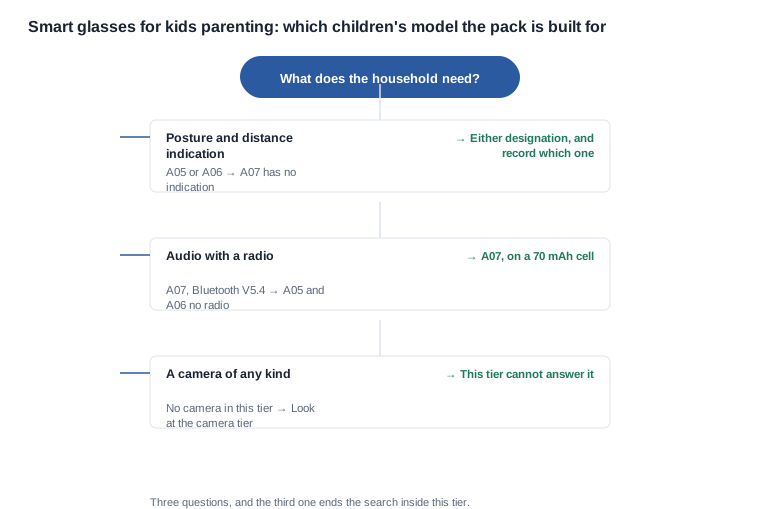
The A05 and the A06 are published with a 40 mAh cell, a charge ceiling of two hours or less, roughly twenty hours of rated use and magnetic charging. Both pages show a lens-type electronic atomiser with a clear-versus-fogged lens state, and a posture-and-distance indication separating a correct posture and distance from an incorrect one. Neither page publishes a Bluetooth version, a frame weight, a frame size, an application row or an efficacy figure, and no printed row separates the two designations. We will not infer a difference from the naming.
The A07 publishes a 70 mAh cell, the same charge ceiling, the same roughly twenty hours of rated use, magnetic charging and Bluetooth V5.4. It publishes no atomiser row and no posture-and-distance indication. On its own terms it is an audio model with a larger cell and a published radio version.
The third thing worth saying plainly is what the tier does not contain. None of the three children's models has a camera row, so a page that presents a children's device as a recording product is describing something the catalogue does not contain. A buyer who needs capture has left this tier, and the camera tier is the only place to look — at eleven models with a resolution class, a charging case in four different states and a considerably different cost base.
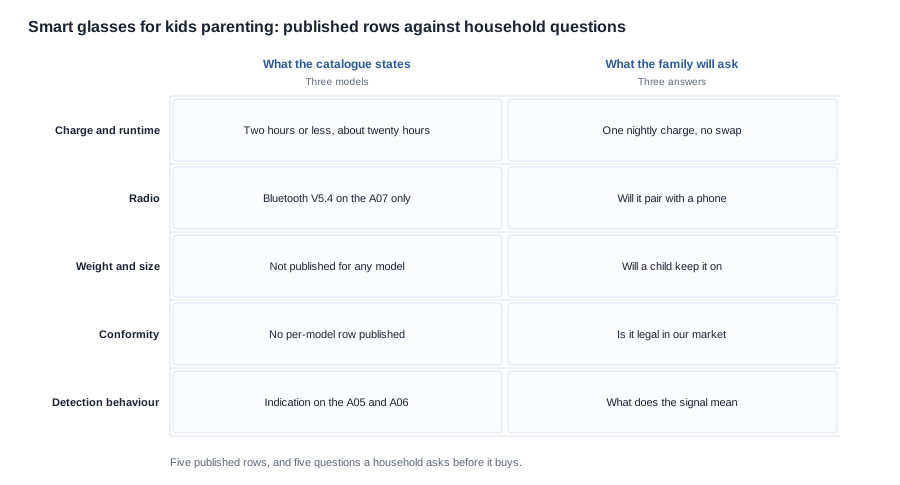
The claim boundary for this tier. The catalogue product names for these models are children's smart protection glasses and children's smart audio glasses. Those are catalogue names, and we publish no claim about what any of them does for a child's vision, because we hold no evidence for one and because the requirements behind such a claim have not been assessed for this range. The published posture-and-distance indication is a published feature, not a clinical or educational outcome. The compliance framework a market applies to children's products is collected at children's product compliance.
The retail pack: what ships in the box and what it does to the parcel
1. The device and its dock. A magnetic interface and a charge ceiling of two hours or less means the dock is part of the product, not an accessory that happens to be in the box. The catalogue publishes the charging interface for all three children's models and publishes no dock identifier, so the dock belongs on the order as its own line with its own quantity, and the quantity is one per device rather than one per order.
2. A cable and a power supply. The dock is what the device sits on; the cable and the supply are what the dock connects to. Those are consumables at the base rather than per-unit items, which is where the cost treatment differs from everything else in the pack.
3. Contact wipes. The lens material and the coating are not published for the children's models, so the instruction has to be restrictive rather than permissive — a dry cloth first, no solvent. The contacts matter as much as the lens, because a dirty contact produces a device that does not charge, and a child who is not being supervised is not going to wipe a contact. The consumption rate to negotiate is the number per device per week, because that is the number that turns a wipe into a managed supply instead of a line item.
4. A model card with the designation. The designation and the charge time, written down. It is what a family quotes to a support line, and it is what tells a second adult what the device is and which of the two identically specified models it is. On a range where two designations print the same rows, the card is the only thing that resolves the question.
5. A one-page routine card. When it is charged, who does it, what happens if it is missed, and what the family is told when a notification arrives. The parenting template is the version to copy, and the parenting support resources article is the longer form.
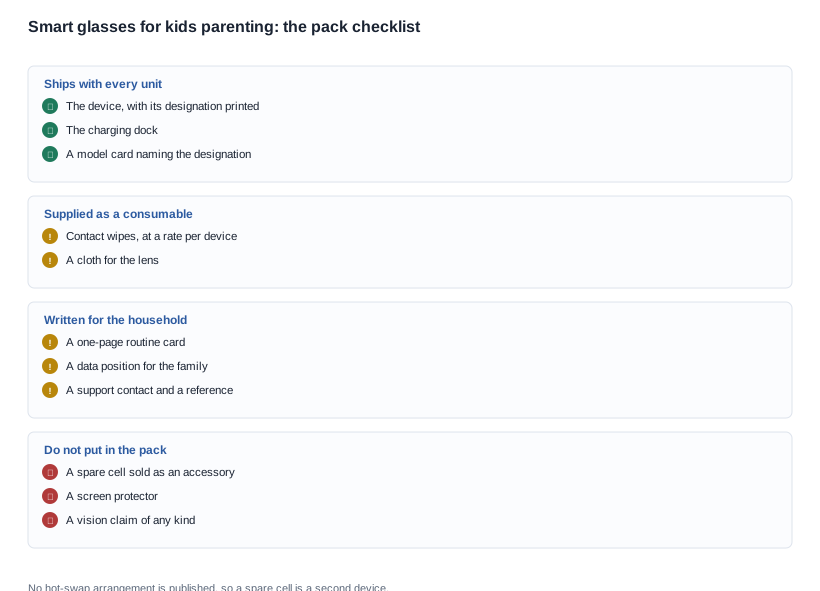
What the pack does to the parcel. Carton size and shipped weight are not published for any model in this range, so the freight model has to be built from measured samples rather than from a catalogue row. The three children's models are the light end of the range and the dock is the part that adds volume, which means the pack decisions above are parcel decisions as much as they are household decisions: six lines in the pack is six lines in the carton, and the consumables are the ones that grow over time rather than at despatch.
What the pack does to the contract. A retail pack is the point at which a supplier's specification and a brand's claim meet, and the meeting has to be documented rather than assumed. Three lines belong in the agreement for this tier specifically. The pack bill of materials by layer — device, dock, consumables, printed material — with the consumable quantities and the restock interval, because "one wipe per device" is not a supply plan and "one per device per week" is. The designation rule, stating whether the A05 and the A06 may share a purchase order and how they are counted, which on a range with two identically specified designations is an inventory question and not a formality. And the conformity file for the model and the market, per model, because the catalogue publishes a company-level export certification page whose content is images rather than text, and the catalogue text contains no reference to CE, FCC or RoHS anywhere, so a per-model position is a document to request rather than a clearance to assume.
The commercial mechanism follows the same logic. A sample order buys the evidence, a bulk order buys the price, and the right sequence is to release the bulk order against a measured sample rather than against a quotation. Where the agreement is doing its job, the unit price, the pack contents, the designation count and the conformity file are all visible before the payment milestone that depends on them — and a supplier who cannot supply those four things in writing is telling the buyer something worth knowing early.

Where a parenting purchase goes wrong
A spare battery ordered as an accessory. No hot-swap arrangement is published for any model, so a spare cell is a second device rather than an accessory. It has to be counted, charged, tracked, returned and kept in the same routine as the first one. The symptom is a household with two devices and one routine.
A screen protector in the pack. There is no display in this product category. It is the clearest signal that a pack was assembled by copying another category's bill of materials rather than by reading the specification.
A routine nobody owns. The routine is the product in this tier, and a routine without a named owner is a hope. The symptom is a device that is flat at the wrong moment, and the recovery depends on whoever is nearest.
A claim the documentation cannot carry. The symptom is a family describing the device in terms the catalogue never used, and a support line that cannot confirm what was said. The prevention is the claim boundary, written before the pack is printed.
A household not told what the data position is. Where the indication result goes, who sees it and what happens when a parent declines has to be answered before the purchase rather than discovered in week one. The kids legal considerations article is the boundary, and the parenting glossary defines the terms.
A pack approved on a sample that was not production-representative. Firmware revision, component lot, lens tint batch and packaging print run can all differ from the goods a bulk order receives. The acceptable answers to the question is this sample representative of production are a clear yes or a clear no with the differences listed, and the procedure is at sample evaluation.
A warranty and returns policy written for the wrong object. A pack with a dock, a consumable line and printed material has more ways to fail than a bare device, and a policy written around the device alone will leave the dock, the wipes and the printed card uncovered. A defect in the dock is not a defect in the product the family bought, and the agreement has to say which one it is.
A quotation that does not separate the pack lines. The symptom is a unit price that looks competitive and a margin that disappears once the consumables are added. The prevention is asking for the bill of materials by layer before the price is agreed, which is a due diligence question rather than a negotiating one.

The family routine is the product
Concretely, the family routine is the product in this segment, and the published specification makes it easy to build a routine around because the charge time and the endurance are both published. A charge ceiling of two hours or less and roughly twenty hours of rated use means the routine has one job, done once a day, at a fixed place, by an adult. That is a routine most households can hold, which is more than can be said for a device that has to be charged in the middle of a day.
Two things not to bring. A spare battery, for the reason above. And a screen protector, because there is no display in this product category.
The one to bring that is not an object. Time. A device that is charged at eleven at night by an adult who is also doing something else is a device that is charged at eleven at night on a good week. The routine is the thing, and the parenting what to expect article sets out what the first fortnight actually looks like.
One wording point that belongs on every document in the pack. The charge time is published as a ceiling of two hours or less, which permits exactly two hours. It does not mean under two hours, and a routine card, a product page or a support answer that says under two hours makes a promise the published row does not support. The same discipline applies to the rated-use figure: roughly twenty hours of rated use is a rating with no published test condition behind it, so it is the right number to design the routine around and the wrong number to put in a claim about how long the device will last on a particular day. Two hours or less allows exactly two hours, and roughly twenty hours is a band rather than a promise. The charging sequence is at charging guide for the parenting models.
Why a routine survives and a specification does not. A household does not evaluate the cell capacity. It evaluates whether the device was charged last night, and the answer to that question is a property of the routine and not of the hardware. That is why the pack has to contain the routine card and the model card, and why the two items that are not objects — the named adult and the time — sit at the centre of the category rather than at the edge of it. For a buyer specifying this tier, the commercial consequence is that the consumables and the printed material are what the brand actually sells alongside the device, and a channel that does not supply them has sold a device into a household that has no way to keep it working.
The commercial terms that are still open. Minimum order quantity tiers, and whether two of the identically specified designations can share a purchase order — they can, and they should be counted separately on the paperwork, because a range with two identical rows and one designation on the box cannot be reconciled at the end. The pilot quantity against the volume, which on a consumer-facing line is where the room sits. Whether the supplier supplies the model card and the routine card artwork, which on a device whose only published differentiator is a written indication is worth more than it sounds. Logo, lens tint and packaging, cheap between runs and expensive after the artwork is printed. And a split first run into two deliveries against a staged payment, which suits a channel that wants to read the returns before it commits.
Settled by the product rather than by the relationship: the cell configuration and therefore the rated-use ceiling, the charging interface and therefore the routine, the published indication and atomiser rows, and the cost and lead time of conformity testing. A mould charge is a one-time cost that belongs in a separate quoted line rather than folded into the unit price.
The published children's range and the claims we will not make
We publish the children's model specifications, and we publish them in full: the 40 mAh cell on the A05 and the A06, the 70 mAh cell on the A07, the charge ceiling of two hours or less on all three, the roughly twenty hours of rated use on all three, the magnetic charging interface on all three, the Bluetooth V5.4 on the A07, and the published detection and atomiser rows on the two protection models. We do not publish the per-model conformity position, the application and firmware behaviour, a frame weight, a frame size, or any efficacy claim, and we will not present a company-level page as per-model coverage.
What to send us next. Tell us the age band, the household routine, the channel and the volume, and we will say which of the five groups carries the purchase, which published rows apply to the model you are considering, and which rows have to be settled in writing before a purchase order. The kids range lists the published figures, the parenting buying checklist is the selection counterpart, and the charging sequence is at charging guide for the parenting models.
Related reading
- The charging sequence — charging guide for kids parenting
- The selection counterpart — kids parenting buying checklist
- The boundary — kids legal considerations
- The range itself — kids smart glasses
Tell us the age band and the household routine, and we will say which group of the five carries the purchase.


