
Smart glasses for kids parenting is a short-scope brief, and the scope is narrower than the marketing suggests. Three catalogue entries sit in the children's tier, and between them they publish a cell capacity, a charge time, a rated use figure, a charging interface, one Bluetooth version, a lens-type electronic fogging arrangement and a posture and distance detection row. What they do not publish is heavier than what they do: no frame weight, no size range, no lens material, no ingress marking, no per-model certification row, no description of how a detection result reaches a parent, and no statement anywhere in the catalogue text about CE, FCC or RoHS. For a buyer, that means the product specification is the easy half of the work and the children's conformity file is the half that decides whether the channel opens at all.
Smart glasses for kids parenting: the shortlist starts with a documentation gap
Who is buying this and what are they actually deciding. The reader is a brand buyer, a channel buyer or a category merchandiser who has a family-facing product idea and is deciding whether the range can carry it. The decision in front of them is not which model is nicest. It is whether a product worn by a child can be documented, listed and shipped into the destination market, and what the brand is prepared to write in the listing when the answer is that the documentation is still being assembled. The three risks behind that decision are specific: a product that cannot be listed for a family audience because the file is missing, a listing that makes an eyesight claim the file would never support, and a support load that arrives from people who did not choose the product.
Why this tier behaves differently from the rest of the catalogue
Two published facts put the children's tier in a category of its own. The first is endurance: the A05, the A06 and the A07 publish a rated use of about twenty hours, against the five to eight hours published across the camera rows and the six to eight hours across the audio rows. For a product that a family expects to charge overnight and use in short bursts, that difference is the whole commercial argument, and it is a real published number rather than a promise.
The second is that the children's tier is the one place where the regulatory question is genuinely load-bearing rather than procedural. A device sold to adults is a product; a device sold for a child is a product with a conformity file attached to it, and the standards a buyer is asked about in the European Union and in the United States — EN 71 in its parts, ASTM F963, and the consumer product rules administered by the CPSC — are documents, not claims. The catalogue contains none of them. That is the single most consequential difference between this tier and the rest of the range, and it is a sourcing task rather than a writing task.
What the three children's entries actually publish
The rows the three entries share
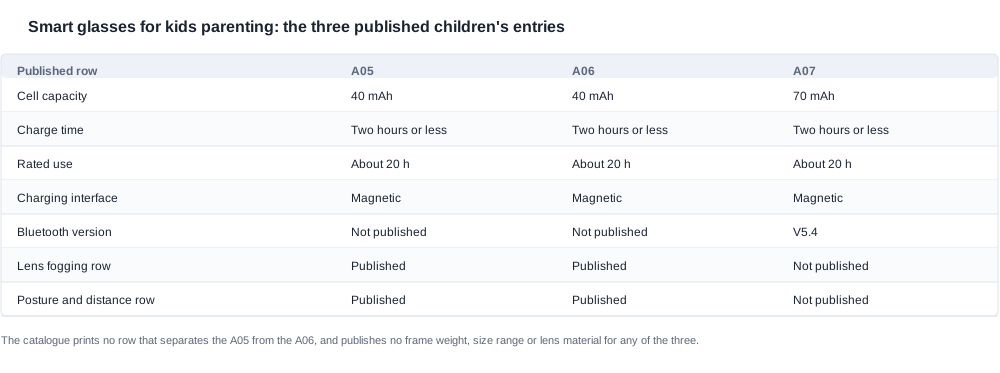
All three publish magnetic charging, a charge time of two hours or less and a rated use of about twenty hours. Two hours or less is a ceiling rather than an average, and for a product that is charged overnight that distinction is worth less than it would be for a travel unit, but it still belongs in the listing exactly as published. The A05 and the A06 publish a 40 mAh cell; the A07 publishes 70 mAh. The catalogue's own table of contents places the A05 and the A06 under the children's protective heading and the A07 under the children's audio heading, which is the only published distinction between the protective pair and the audio entry.
The shared feature rows are the interesting part. The A05 and the A06 publish a lens-type electronic fogging arrangement, with the lens shown in a clear state and a fogged state, and a detection row that distinguishes correct posture and distance from incorrect posture and distance. These are hardware and software behaviours, and they are the reason this tier exists. They are also the reason a careful buyer reads them narrowly: an electronic fogging arrangement on a lens is a lens feature, and a posture and distance detection row is a sensing feature. Neither one is a published eyesight outcome, and the catalogue does not publish a test result for either.
The rows that separate the A07 from the protective pair
The A07 publishes Bluetooth 5.4. Neither the A05 nor the A06 publishes a Bluetooth version at all, which is a difference a buyer should notice before assuming a companion app exists for either of them. The A07 publishes no fogging row and no posture and distance row, so the three entries are not three versions of one product — they are one audio entry and two protective entries with a shared row set.
That also means a shortlist built on "which is the better device" is the wrong question. The right question is which feature set the channel is selling, and then what the file has to cover. A buyer who wants the detection behaviour has two candidate entries and a documentation question attached to each. A buyer who wants audio has one entry, a published radio version, and the same documentation question.
The row that separates nothing
The catalogue prints identical rows for the A05 and the A06. There is no published difference between them anywhere in the product pages — not in the cell capacity, not in the charge time, not in the rated use, not in the charging interface, not in the fogging or detection rows. A buyer who lists them as two products is listing the same published specification twice, and the questions that follow from that are concrete: is the difference a hardware revision, a colour or packaging variant, an artwork set, a regional variant, or simply two entries in a product table? That is a question to put to the factory in writing before the shortlist is signed, because a channel that lists two identical SKUs under two names will be asked for a difference it cannot explain, and a channel that lists one SKU loses the second name it may have planned around.
The children's conformity file is the deliverable, not the accessory box
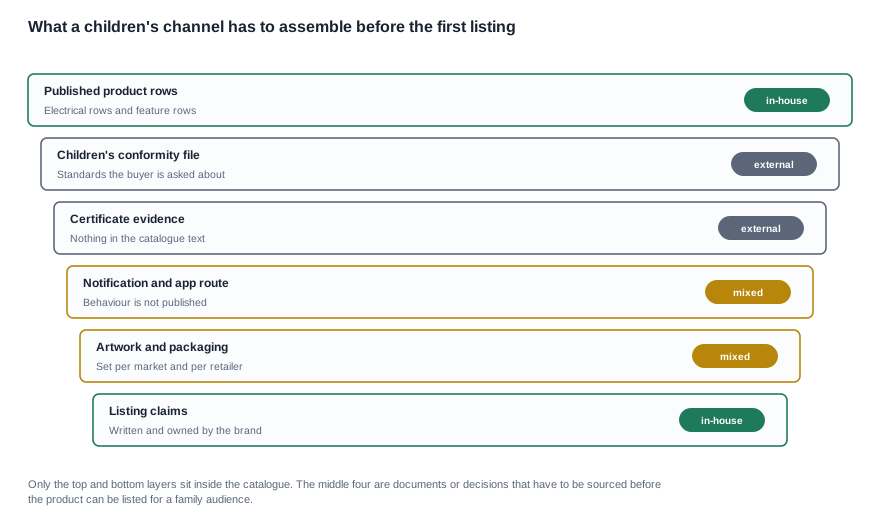
What the catalogue can answer and what it cannot. The catalogue carries a company-level export certification page whose content is images rather than text, and the catalogue text itself contains no reference to CE, FCC or RoHS. There is no per-model certification row anywhere in the twenty-eight entries, and no record of a certificate number for any model in any tier. For most of the range that is a documentation request a buyer makes once and files. For a children's product it is the gating item, because a family-facing listing in the European Union or the United States is a listing made against a conformity file.
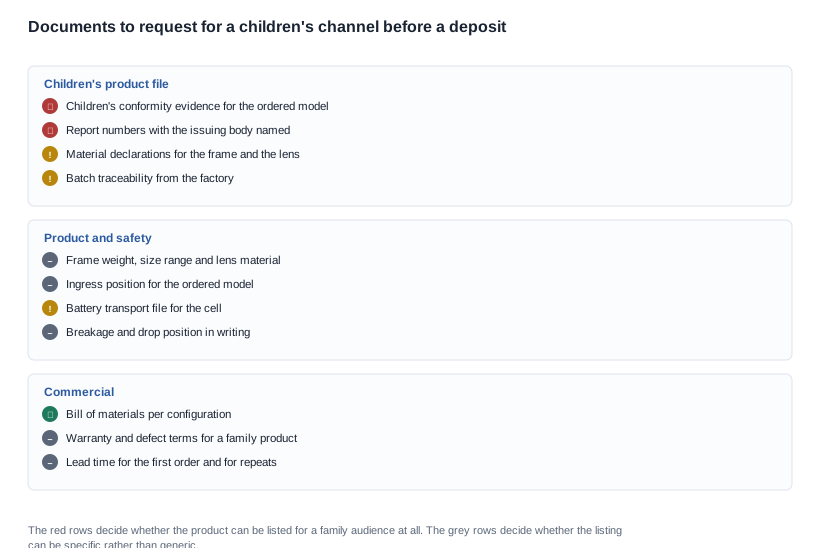
What a buyer should request, and how to check it. The request should be for the children's conformity file for the exact ordered model: the test reports behind it, the standards each report covers, the issuing body's name and the report number for each, the materials declarations for the frame and the lens, and the batch traceability from the production line. Each report number then goes into the issuing body's public register — the procedure is at certification checklist. A report number that cannot be found in a register is not a report, and a file assembled from documents whose scope does not cover the ordered model is not a file for that model. The child product compliance page sets out the framework, and the per-model articles for the A05, the A06 and the A07 set out where the gaps sit for each entry.
The claim boundary is the part that cannot be sourced later. A product for children attracts efficacy language by default — the catalogue's own protective heading invites it — and that language is the fastest route to a regulatory problem, because it converts a hardware feature into a health outcome. Our position is that the A05 and the A06 publish a lens-type electronic fogging arrangement and a posture and distance detection row, and that neither is a published eyesight result. We will not write a myopia prevention claim, a eyesight protection claim or a therapeutic claim into a listing, and we will not write one into a family description. The boundary is set out at does it actually prevent myopia, and the medical boundary for the wider range is at medical boundary.
The battery file is smaller and easier, and it still has to be asked for. A 40 mAh or a 70 mAh cell is a lithium cell that travels by air, and the transport requirements apply whatever the product's category. The requirements for the file are at battery transport. For a family channel this is also the point at which the charging design becomes a support question: a magnetic interface with a charging dock that has to be present at bedtime is a routine that has to be explained in the box.
What a parent's notification depends on, and what it does not
The posture and distance detection row is the feature most likely to be described as the product, and it is also the feature with the largest unpublished surface around it. What is published: the detection, and the fact that it distinguishes a correct state from an incorrect one. What is not published: how a result reaches a parent, whether that route is an application, whether the detection or the notification depends on a connection, what happens when the phone is not present, whether the detection history is stored and where, and whether a family can see anything at all beyond a single live result.
A buyer who sells this tier is selling a service the catalogue does not describe. That is not a reason to stop; it is a reason to establish the behaviour on a sample before the channel is built, and to write the listing around what the sample demonstrates rather than around what the feature name implies. The parenting troubleshooting article is the place where the behaviour questions live, and the firmware and app question is covered at can firmware and app be customised — a family brand that wants its own application is commissioning something with a maintenance tail, and that should be priced rather than assumed.
Two further unpublished rows matter more here than in the adult tiers. The first is the frame weight, the size range and the lens material: a child's head is not a single size, and a channel that sells this tier to families will meet sizing questions immediately. Nothing is published for any of the three entries, so this is a sample question and a supplier question, and the practical starting points are the age guidance, the small face question and the size question. The second is the ingress position: no entry in the children's tier carries an IP marking, so the listing cannot say anything about water at all, and the copy has to say nothing rather than something soft.

How to shortlist the three entries without guessing
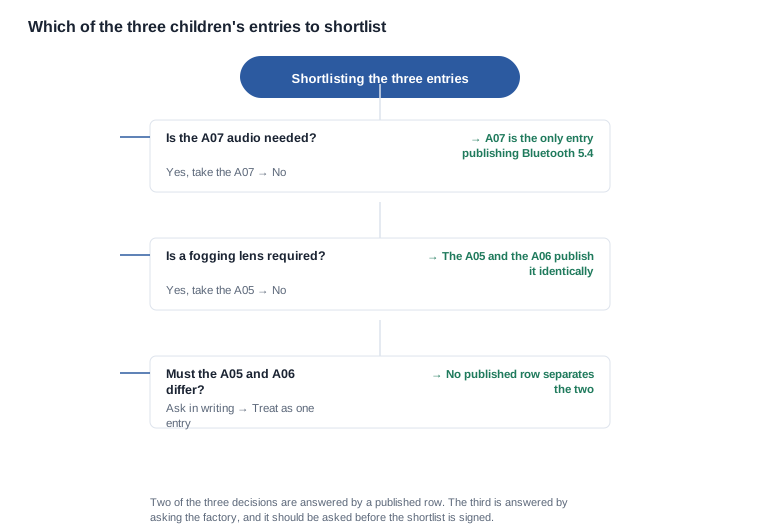
A shortlist for this tier is a two-part decision: which feature set the channel is selling, and what the file will cover. The first part is answerable from the published rows in an afternoon. The second part is answerable only by asking, and the question list below is the one worth sending with the first enquiry.
- Which model is being quoted, and is the A05 or the A06? The catalogue prints identical rows for both, so a quotation that names one of them has not yet established what distinguishes it from the other.
- What is the published difference between the A05 and the A06? A hardware revision, a colour set, an artwork set, a regional variant or a table entry are five different answers with five different commercial consequences.
- What is the children's conformity file for the ordered model, with report numbers and issuing bodies named? Not a brochure page and not a company-level capability statement.
- Which materials are declared for the frame and the lens? This is where a buyer learns whether the frame is moulded plastic, metal or a composite, and whether the lens is a standard lens.
- How does a detection result reach a parent, and what happens without a phone? Ask for the mechanism, the connection dependency and the history position.
- Is the app a configuration layer over the factory's application or a fork? A configuration layer survives an upstream release; a fork does not, and the answer changes who owns the maintenance.
- What does the charge routine look like in a family household? The charging guide is the practical version of that question.
- What are the defect and breakage terms for a family product? A child's product generates a different return pattern from an adult one, and the warranty and the defect terms are the commercial answer to it.
The red flags worth naming before the quotation arrives
- A quotation that lists two protective models without saying what differs between them. That is a packaging decision presented as a product decision, and it will surface in the retailer's category review.
- A claim about eyesight in the listing copy, however carefully worded. It cannot be supported by the published rows and it changes the regulatory profile of the product.
- A conformance statement with no report numbers. A statement without a number cannot be checked in a register, and a buyer who cannot check it cannot file it.
- An assumption that a fogging arrangement and a posture sensor produce a clinical outcome. They produce a lens state and a detection result, and the catalogue says nothing beyond that.
- A unit price that assumes the retail box is a packaging decision. For a family channel the artwork carries regulatory content, and that content has to exist before the print run.
Where a children's channel fails, and what the first order measures

The file is assembled after the artwork goes to print. Regulatory content in the retail box has to exist before the print run, and a print run has a minimum that does not depend on the order size. A channel that treats the artwork as a later task will pay for the artwork twice.
The sample is accepted without a file and the file arrives after the first shipment. The unit in the buyer's hand proves that the device works. It proves nothing about the market it is going into. The documentation request is a separate task with its own schedule, and it should be given one.
The A05 and the A06 are listed as two products. Two identical published specifications under two names create a category review question and a returns comparison that cannot be answered.
The detection feature is described as the product. It is a detection row with an unpublished notification route. Describing it as a behaviour the family will see is the single easiest way for this tier to generate a claim it cannot carry.
The sizing question is discovered by the customer. Nothing is published for weight or size, so the first customer to find the frame wrong generates the review, and a family channel reviews differently from an adult channel.
The commercial terms a buyer can move. Minimum order quantity tiers and whether two configurations can share one purchase order; the artwork and insert content, which is cheap to change between runs and expensive to change after printing; whether the packaging is supplied or customer-supplied; the warranty and defect terms, which for a family product are worth more attention than the usual consumer default; the replenishment interval for a channel with a long replacement cycle; and the split of a first run against a staged payment. The structure is at pricing and MOQ, and the clause language is at contract terms.
What cannot be moved. The cell configuration and the charging interface, and therefore the charge time and the rated use ceiling. The children's conformity file and its lead time, which is the reason to start the request before the sample rather than after it. The tooling, amortised across the first order and quoted as a separate line rather than folded into the unit price.
What the first shipment has to measure. Three ratios, and all three are answerable from the returns desk rather than from a survey: how many returns were sizing returns, how many were "the notification never arrived", and how many were "the claim in the listing is not what the product does". The third of those is the one that decides whether the copy survives the second production run, and it is the cheapest of the three to collect because the returns reason usually carries it.
A family product cannot be sold on an invented row
Stated plainly: we publish the rows we hold for the children's tier and we mark everything else as not published, because a family product sold on an invented row is a product that fails in the worst place to fail. We publish the cell capacities of 40 mAh and 70 mAh, the charge time of two hours or less, the rated use of about twenty hours, the magnetic charging interface, the Bluetooth 5.4 row on the A07, the lens-type electronic fogging arrangement and the posture and distance detection row on the A05 and the A06, and the catalogue's own grouping of the three entries.
What we do not publish, and will not estimate: the frame weight, the size range, the frame material, the lens material, the coating, the ingress position, the app and notification behaviour, the detection history and data handling, the per-model certification position, and any eyesight, myopia or protective efficacy claim. We will not state that any model in this tier holds CE, FCC or RoHS certification, because the catalogue text names none of them and carries no per-model certification row, and we will not treat a company-level export certification page as evidence for an individual model.
What we will do: take the model, the destination market, the family audience definition and the price band, and tell you which published rows apply, which claim set the listing can carry, what has to be sourced before the order, and which questions remain open for the factory. The range is listed at kids smart glasses, the scenario entry point is smart glasses for parenting, and the parenting buying checklist is the version to use before the order rather than after it.
Age range and the models compared
Send the age range you intend to serve, the destination markets, the two or three models you are comparing, the price band and the volume, and we will return the published rows that cover them, the documentation each one needs from the factory, the claim set the listing can carry without overreaching, and the questions that have to be settled in writing before a purchase order. The safety side is at the kids safety article, and the terms for a sample order are at sample policy.
Related reading
- The scenario's opening — smart glasses for parenting
- The product tier — kids smart glasses
- The compliance framework — child product compliance
- The published entries — battery life
Tell us the age range, the market and the models, and we will return the published rows that cover them and the documentation each one needs.


