

Smart glasses for office: five mistakes that are all procurement decisions made in the wrong week
Five office mistakes, and the three procurement decisions a buyer settles first
Five mistakes account for most office deployments that fail in their first quarter. None of them is a technology error, and all of them are made in good faith by people who have not run one before. The useful reframing is that every one of them is a procurement decision, and every one of them is made in the wrong week — the tier is chosen in the week it should have been verified, the policy is written in the week it should have been signed, the measure is agreed in the week it should have been chosen.
That reframing changes what a buyer can do. A mistake that sounds like behaviour is usually a missing clause. The deployment that collapses in month four because one person was doing three jobs is a deployment where nobody wrote down who owns what. The rollout that cannot proceed because nobody knew where the recordings went is a rollout where the data-handling answer was treated as a detail rather than as a condition of the order.
Three conclusions follow, and all three can be acted on before a single unit is bought. Name the three decisions that belong in the purchase order, because two of the five mistakes are made there and neither can be corrected afterwards. Give each of the remaining three a detection point — a week in the pilot when the evidence arrives — so that the mistake is found while it is still cheap. And fix the pilot size at the scale that exercises all five, which is not the scale that makes the evaluation appear representative.
The four roles that make each of them
Four roles in an organisation make these mistakes, and each one makes a different pair.
The buyer makes the first, because the buyer chooses the tier and a tier is chosen by the feature list rather than by the task. The legal or compliance adviser makes the second, because the recording question is answered after the hardware is chosen rather than before. The operations manager makes the third and the fourth, because the adoption measure and the charging arrangement are both theirs and both are usually inherited rather than designed. The champion makes the fifth, because the champion is the person who answers the questions, moves the dock and counts the units.
The cost of each mistake is different too, and the difference matters for who is asked to pay. The first two are sunk the moment the order is placed. The third is a measurement that gets rewritten to match the opinion it was meant to test, which costs a quarter of evidence. The fourth is a charging habit that a team forms or does not form, which costs a quarter of adoption. The fifth is the whole administration, which usually costs the deployment.
What to ask the supplier, and what to check before you order
Each of the five mistakes has a question that would have caught it, and asking all five in one message costs an hour and prevents a quarter of rework.
- What is the tier for a calling task, and what does the cell capacity do to the working day? A supplier who answers with the published rows has closed the tier question. A supplier who answers with a feature list has not.
- What is the charging interface for this model, and what does the charging point need to be? Four camera models publish no interface row at all, so for those four this is a question and for the rest it is a published row.
- What is the case configuration, and what does it change about the kit? Four different answers exist across the camera tier, and the answer decides whether the case is a desk fixture or an item that travels in a bag.
- What happens to the recorded data, and who owns that answer? Nothing about the storage path, the overwrite behaviour or the transfer method is published, so the answer has to arrive in writing before you order.
- What are the support terms, and who takes the first call? The warranty terms are not published until they are quoted, and whether the IT desk or the supplier handles the first call is what sets the realistic response time.
Two further questions close the pilot rather than the order: what adoption measure would you recommend, and what would a failed pilot look like. Neither has a published answer, and both are worth more than a figure supplied by a supplier, because they are the inputs to your own total cost model and the inputs to the replacement assumption inside it.
The questions to ask before you order are therefore short enough to put in one message, and the answers are worth more than the unit price by a wide margin. The red flags in the replies are specific: a tier recommended by feature count rather than by task, a charging interface asserted rather than quoted from a row, a case answer that assumes a case exists, and a data-handling answer that describes the feature instead of the behaviour.

The two mistakes that are made in the purchase order
Buying a camera configuration for a calling problem
The strongest case for this category in an office is hands-free calling, and the camera tier costs roughly three times the cell capacity — 220 mAh to 290 mAh against cell configurations from 55 mAh to 100 mAh across the audio models. That difference decides whether a unit survives a working day without a mid-day charge, and a mid-day charge is the thing that ends adoption.
The published rows make the gap visible. The camera models publish between 220 mAh and 290 mAh in a single cell, with rated runtimes of about seven hours on the CY03, the CY05, the L1 Pro, the L2 Utral and the MT6, a band of five to eight hours on the V03, the V03 Pro, the V06 and the S7, and six to eight hours on the KY06 and the MT5. The audio models publish 55 mAh per temple on the LC-105 pair, the G07 and the YK12, 90 mAh per temple on the K01 and the K02, and 100 mAh on the D11 and the D12, with rated use of about six to eight hours, about eight hours and about seven hours respectively.
The gap is what makes the mistake so common, because the camera tier publishes more features and the audio tier publishes fewer, and a feature list rewards the first. Buy the audio tier unless recorded evidence is a stated requirement. Then the compliance conversation disappears as well, because the storage path and the overwrite behaviour are not published for any camera model and a camera in an office raises that question by itself.
What makes this a procurement mistake rather than a preference is that the tier cannot be changed later. A configuration error in the hardware is not corrected by a firmware update, a policy document or a charging point; it is corrected by a second order. The prevention is a single line in the specification: the task is named, and the tier follows from it.
Deploying without a written recording policy
If cameras are involved at all, the policy conversation is a policy matter first and a technical matter second. In the European Union the product position runs through the Radio Equipment Directive (EU) 2014/53/EU, with the General Product Safety Regulation (EU) 2023/988 for traceability, and neither of them tells you whether your staff may be recorded. That is a question for your own legal adviser, and it is a question that cannot be deferred until after a first pilot because the deployment will have already produced recordings.
What makes it a procurement mistake is the order of operations. The catalogue publishes nothing about the storage path, the overwrite behaviour, the transfer method or the audio capture behaviour for any camera model, so the data-handling answer has to come from the supplier in writing and it has to be checked. A rollout that starts without that answer creates an incident that ends the project regardless of how good the audio is, and the incident is not recoverable because the recordings already exist.
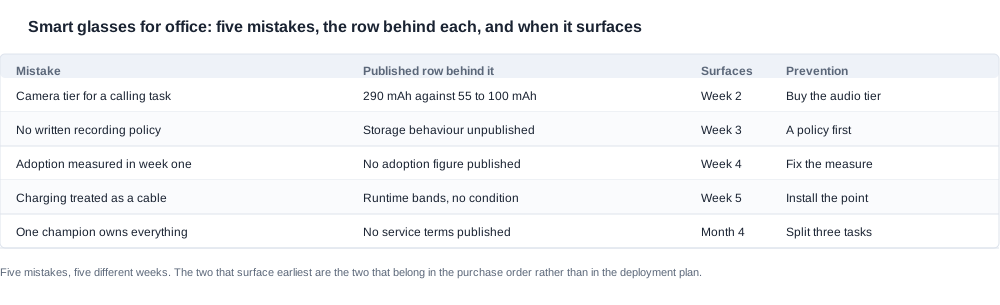
The prevention is procedural and it is cheap: the written answer and the written policy are both conditions of the order, not deliverables of the rollout. Two documents, one signature each, and both are items in the purchase order rather than items in the launch plan.
The three mistakes that are made in the first quarter
Measuring adoption in week one
Week one is the novelty peak and it overstates adoption permanently. The honest measurement points are week four, when users have self-selected by call profile, and week eight, when the charging habit is either established or it is not.
The mistake is not the timing, it is the ordering. A measure agreed after the first opinion has formed is a measure that gets rewritten to match the opinion, and by week four the budget conversation has already used the number. Decide the measure before launch and write down what counts. The written form matters more than the metric: "how many people used the device on three working days this week" and "how many people used it once" are different questions and they produce different numbers from the same population.
There is a published-data dimension to this as well. We do not hold an adoption figure, a productivity figure or an acoustic performance figure for this range, and we will not present somebody else's deployment as ours. A buyer who needs a benchmark has to run one, and the first shipment is where it comes from — which is another reason the pilot has to be big enough to produce a real number.
Treating charging as a cable problem
Most office charging failures are a location problem. A product in a drawer gets charged by whoever remembers it; a product next to the charging point gets charged by everyone who passes. The camera configurations publish rated use between five and eight hours without a stated test condition, so plan a mid-day charge for that tier and put the charging point where the mid-day charge happens.
The published interface decides what the charging point is. charging over Type-C is published on the V03 Pro, the L2 Utral, the D11, the D12, the D17, the ZH12 and the bone-conduction model, and magnetic charging is published on the K01, the K02, the LC-105 pair, the S7 and the G07, the YK12 and the KY06, and the V03 and the V06, and the MT5. Four camera models — the CY05 and the L1 Pro, and the CY03 and the MT6 — publish no charging-method row at all, so for those four the point cannot be specified until the interface is confirmed in writing.
A USB-C lead is the one cable every device in the building already owns, which means it gets used for everything and the glasses lose their charge to a phone. A dedicated, labelled dock avoids that, and the decision belongs to the site budget rather than to the unit price.
Assuming the deployment survives its champion leaving
The person who arranged the charging point, answered the connection questions and counted the units is usually one person. When that attention moves on — usually in month four — the deployment stops being administered. Distributing those three tasks in month one is cheap insurance and the single change that most reliably extends a deployment.
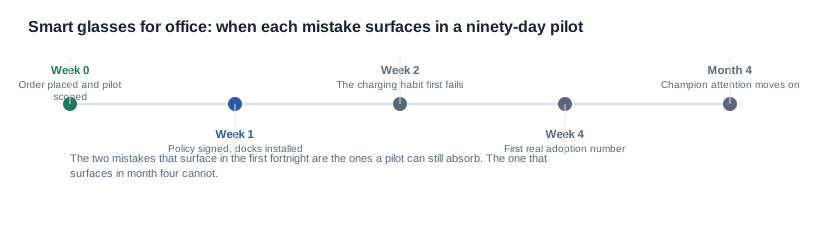
This is the mistake with the longest fuse and the worst ending, because by month four the deployment has a cost attached to it and the sunk-cost argument becomes the reason it is not fixed. The three tasks are small enough to write down on one page: who arranges the dock, who answers the connection questions, who counts the units and what they record. The warranty route is part of the same list, and the warranty terms themselves are not published until they are quoted, which makes the route a question rather than a document at this stage.
The published rows that make these five mistakes likely
The mistakes are not random. Each one is made more likely by a specific feature of the published data, and a buyer who reads the catalogue carefully will see each trap before it is sprung.
The camera tier publishes more features than the audio tier. Eight models at 8 MP and three at 13 MP, a removable inner frame on the V06 and the S7, a photochromic lens configuration and a flexible temple on the V03 Pro, case capacities of 900 mAh, 1200 mAh and 1400 mAh where they are published — while the audio tier publishes a Bluetooth version, a cell configuration, a charge time, a rated runtime and a charging mode. A buyer comparing two lists sees a long list and a short one, and the long one wins the comparison. The task does not.
The camera tier publishes the least about what it actually does. The storage path, the overwrite behaviour, the transfer method, the video format, the frame rate and the field of view are all unpublished for every camera model, while the audio tier publishes a complete electrical row. So the tier with the most features is also the tier with the least information about what those features do, and a recording policy cannot be written from a catalogue page.
No runtime in either tier carries a test condition. The camera models publish bands of five to eight hours, six to eight hours and about seven hours; the audio models publish about six to eight hours, about eight hours and about seven hours. Without a condition behind them, every one of those figures is a rating rather than a planning number, which is exactly why the charging point has to be designed rather than assumed.
Nothing in the catalogue is a service commitment. The warranty terms are not published until they are quoted, the support route is a contract term rather than a product attribute, and there is no published adoption figure to fall back on. Every administrative task in an office deployment therefore has to be owned by a named person, because there is no published process that can be inherited instead.

The cost of each mistake, and the week it surfaces
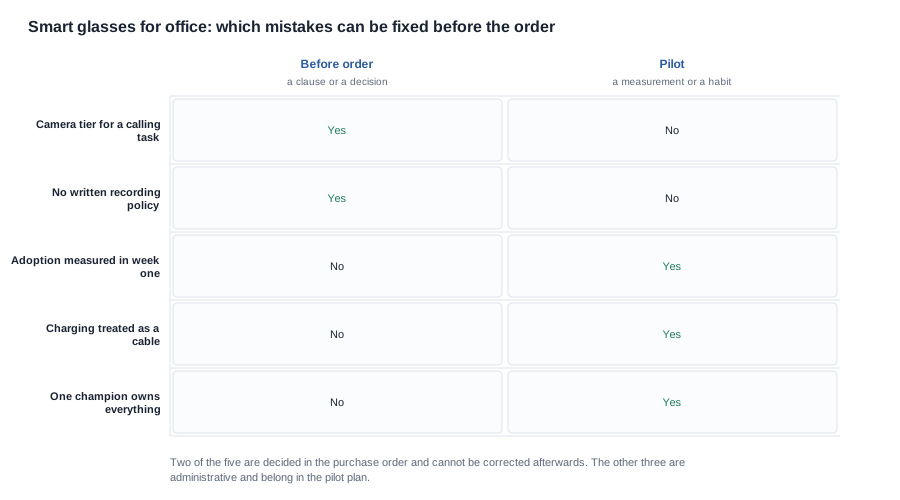
The table and the matrix together make the point that the five mistakes are not equal. Two of them are decided in the purchase order and cannot be corrected afterwards, and three of them are administrative and belong in the pilot plan with a detection point.
The cost of the first is a second order at the wrong tier, with the freight, the certification file and the shelf space spent once already. The cost of the second is a rollout that cannot proceed and a policy conversation that starts after the hardware has arrived. The cost of the third is a quarter of evidence that the budget conversation then relies on. The cost of the fourth is a quarter of adoption, because a device that is not charged is a device that is not used. The cost of the fifth is the administration, which is usually the whole deployment.
What none of them costs is the unit price. That is the point worth taking from the list: in this category the hardware is the smallest number in the decision, and every one of the five mistakes is made on a decision that the hardware price does not influence.

The one pilot that prevents all five
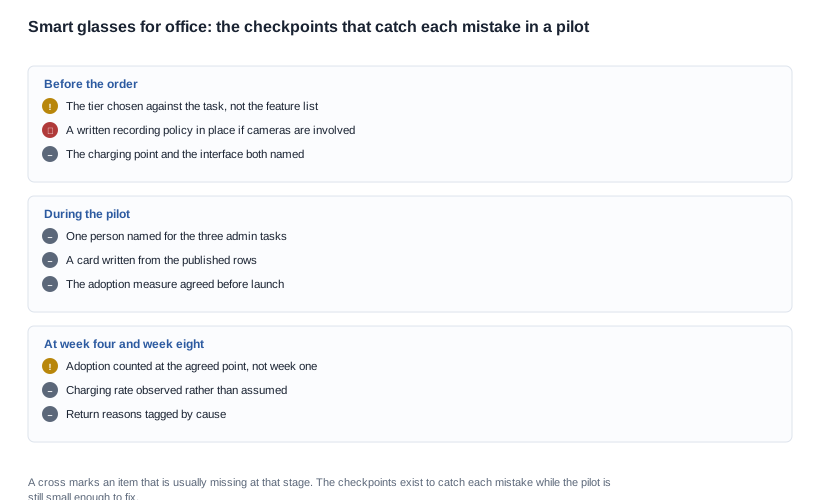
Scope the first deployment at ten to twenty units, one team, one stated use case, and a written acceptance measure agreed before anyone puts one on. That scope is small enough to be cheap if it fails, and it exercises all five mistakes in miniature — the charging rota, the champion, the measurement point and the policy question all appear inside a pilot, where they can be fixed for the cost of a few weeks rather than a year.
The temptation is to size the pilot at the eventual rollout size so the evaluation is representative. In this category that is a mistake, because the things that go wrong in month four are administrative and they scale with the number of people involved in the administration rather than with the number of units. A forty-unit pilot with four owners tells you almost nothing about a forty-unit rollout with one owner.
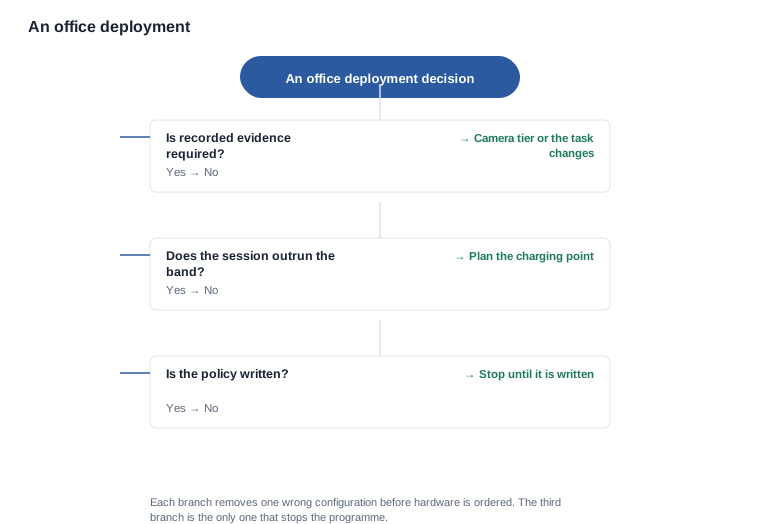
The three decisions that belong in the purchase order are named on the decision chart, and they are worth separating from the pilot plan because they are the only three that get more expensive if they are deferred. The tier follows from the task. The policy and the data-handling answer follow from whether cameras are involved. The charging point follows from the interface and the session length. Everything else in the five can be caught by a pilot with checkpoints, and the checkpoints cost nothing but attention.
The operational detail behind these five is in the IT gear checklist, the adoption curve over the first weeks is at what to expect in month one, and what changes as the kit ages is at long-term use.
What we publish, and what we will not put in a business case
The short answer: we will tell you which configurations exist, which published figures apply to which, and which rows are gaps. We will not supply an adoption figure, a productivity figure or an acoustic performance figure, because we do not hold them. Acoustic leakage, microphone pickup distance and frequency response are all not published in our documentation, and so is the per-model unit weight beyond the single 158 g figure published for the MT6, which is the weight of the glasses body including its battery and its camera and excluding the foldable case.
The published rows a buyer can order from are these. For the camera tier: the resolution class, with eight models at 8 MP and three at 13 MP, the cell capacity, the charge time stated as a ceiling of two hours or less, the rated runtime, the charging interface where it is published, the case capacity where it is published, and the IP54 marking on the V06 and the S7 stated as a catalogue attribute. For the audio tier: the Bluetooth version, with 5.3 on the K01 and the K02 and 5.4 across the rest, the cell configuration, the charge time, the rated runtime and the charging mode, plus the absence of any published touch row and the ultra-slim detachable temples published on the G07.
What is not published, and will not be estimated into a business case: the frame material, the lens material, the coating, the hinge specification, the field of view, the video format, the frame rate, the storage and overwrite behaviour, the operating temperature range, the cycle life rating, the runtime test condition, the standby draw, the verified device lists, the acoustic measurements and the AI implementation details.
We will also not put a certification position into a deployment plan that the document behind it does not carry. The catalogue has a company-level export certification page whose content is images rather than text, and the catalogue text contains no reference to CE, FCC or RoHS at all. There is no per-model certification row anywhere in it, so the certification position for a specific model is a document to obtain and check against the issuing body's register, not a line to copy. The page itself carries ten patent certificates — eight appearance-design patents and two utility-model patents.
What we will do: take the task, the headcount, the session length and the target market, and tell you which tier the requirement falls into, which questions our published rows answer, which need a sample on an actual user, and what has to be settled in writing before the order. The deployment framework is at smart glasses for office.
The task and the session length
Send the task, the headcount, the session length and the target market, and we will return the tier the requirement falls into, the published rows that cover it, the two decisions that belong in the purchase order, and the checkpoints that catch the rest during a pilot.
Related reading
- The deployment framework — smart glasses for office
- The IT decisions — gear checklist
- The adoption curve — what to expect in month one
- What changes over a year — long-term use
Send the task, the headcount, the session length and the target market, and we will return the tier, the published rows and the pilot checkpoints.


