
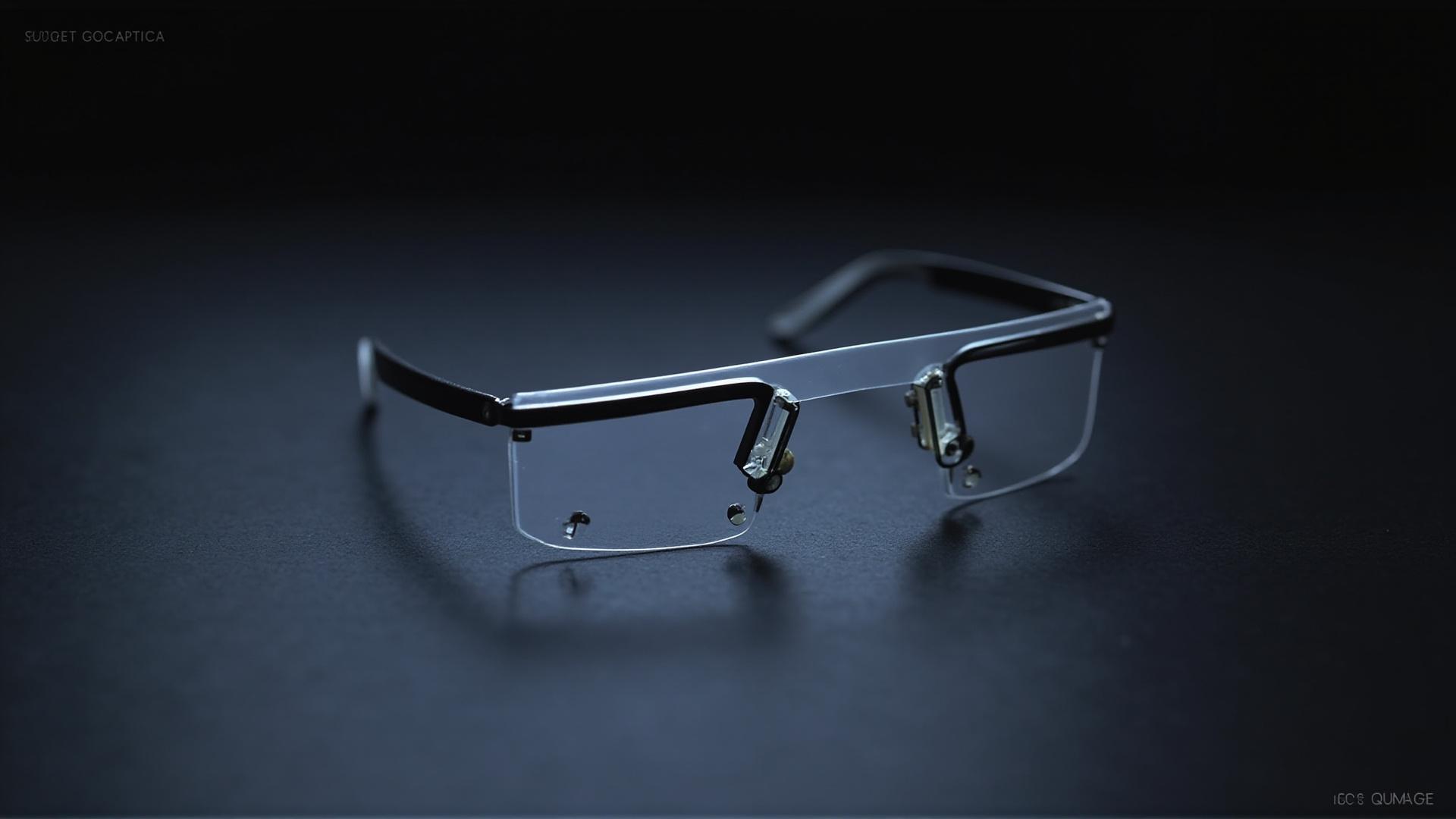
Smart glasses for office deployments divide into three honest outcomes, and a buyer who plans around a fourth one will be disappointed by the third. Hands-free calling improves noticeably for the people whose work keeps both hands busy. Note-taking improves modestly. Concentration does not improve at all, and nobody in this category publishes an adoption figure that would let you forecast it. Everything else an office deployment needs — the recording policy, the charging owner, the acoustic reality of the room, the compliance file and the support load — is decided before the device is switched on, and none of it comes from a catalogue row. This article is written for the procurement manager, the IT lead or the operations buyer who has to put those five decisions on paper before a purchase order goes out.
Smart glasses for office: the first decision is a policy, not a product
What the reader is actually buying. Not a productivity gain — nobody can sell that with evidence, and a supplier who claims one is selling a demo. What a buyer is buying is a device that makes a specific subset of calls hands-free, and the operational capability to keep a small population of devices charged, supported and compliant for a year. That second half is the larger part of the work, it is invisible in a unit price, and it is the part of the business case that determines whether the deployment survives month three.
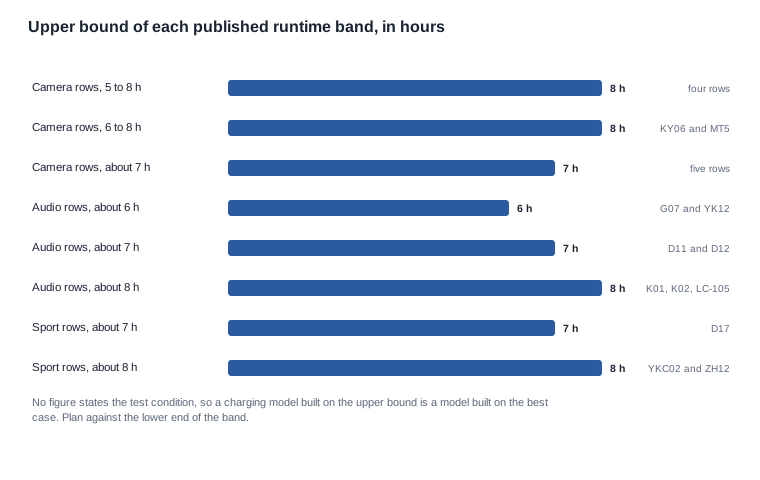
What the published rows settle and what they leave open. The catalogue publishes twenty-eight entries in three tiers: eleven camera rows, eight audio rows and three sport rows. The camera rows publish a resolution class, a cell capacity from 220 mAh to 290 mAh, a charge time of two hours or less, a rated use figure from 5 to 8 hours, and a charging interface on seven of the eleven. The audio rows publish a Bluetooth version, a cell capacity per cell from 55 mAh to 100 mAh, a charge time, a rated use figure from about 6 to 8 hours, and a charging interface. Beyond those rows the catalogue publishes no acoustic figure, no microphone pickup distance, no field of view, no weight for any office-relevant model, no runtime test condition, and no per-model certification row anywhere. It also publishes no adoption data, no productivity data and no return-rate data, because nobody in this category does.
The shortlist criteria for an office fleet, in the order a buyer should apply them
The criteria below are in the order they should be applied, and the order matters more than the criteria themselves, because two of them can rule a model out before its price is ever looked at.
- The recording policy decides whether the camera tier is in scope. This is a pass or fail criterion, and it is settled by the employer rather than by the supplier.
- The shift length against the published runtime band decides whether a charging routine has to exist. A shift longer than the lower end of the band means a named charging owner, and without one the fleet should be smaller.
- The acoustic acceptance in the actual room decides whether the model is placeable at all. No published row settles this, so the demonstration has to happen where the objection will be raised.
- The phone fleet decides whether the configuration works for the people who will use it. No camera row publishes a Bluetooth version and no verified device list is published for any model, so this is a test rather than a lookup.
- The destination market and the certificate file decide whether the configuration can be shipped and listed. A per-model file, checkable by number.
- Only then does the price tier, the MOQ and the lead time come into the comparison. They matter, but they are the criteria that cannot rescue a model that fails one of the five above.
A buyer who knows how to choose between two suppliers' quotations for this category is really asking whether the supplier will put the five unanswered questions in writing. The one who does has answered the harder half of the evaluation, and the unit price comparison that follows is the easy half.
What an office deployment costs beyond the unit price
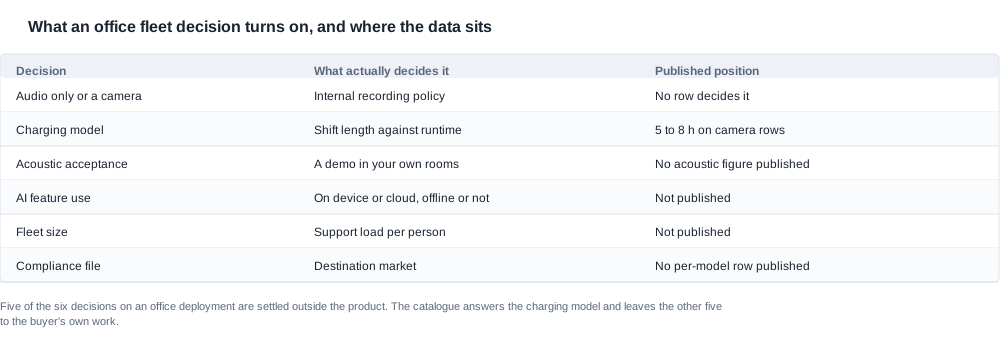
Five of the six decisions on an office deployment are settled outside the product. Only the charging model has a published row behind it. The rest are policy, acoustics, cloud dependency, support load and market compliance, and each of them has to be answered by the buyer's own work. A business case that starts from the unit price and adds a percentage for deployment will get the shape of the cost wrong in the direction that matters, because the policy work and the support work are fixed costs and the device cost is the only line that scales with the fleet size.
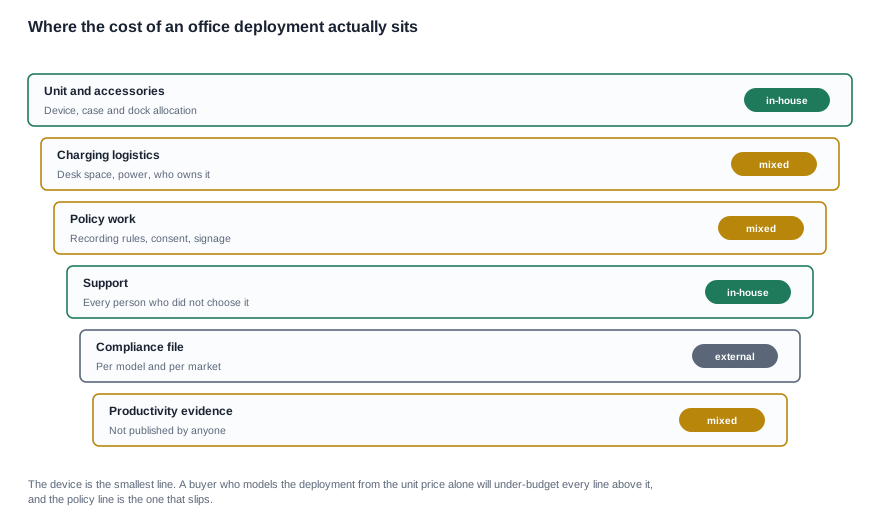
The charging model is the one line a buyer can build from published rows. The camera rows publish a rated use band of 5 to 8 hours and the audio rows publish about 6 to 8 hours, and no figure in either tier states the condition it was measured in. A camera configuration therefore implies a mid-shift charge and a named person or place to do it, while an audio-only configuration is the safer choice for a shift that outlasts a single charge. The commercial consequence is a line item that most office budgets do not have: dock allocation or a case per device, plus the desk space, the power and the rule about who may put a device back on charge.
The policy work is the line that slips. A camera in an office is an internal recording question before it is a hardware question, and the question has to be answered by the employer's own policy: where recording is permitted, how staff are told, whether consent is required, what happens to the footage, and who may review it. None of that is a supplier deliverable, and none of it can be accelerated by a faster lead time. A buyer who has not answered it before the order arrives will not be able to deploy the camera rows at all, whatever the quotation says.
The support load is per person, not per device. A device used by a group produces questions from people who did not choose it — how it pairs, what it charges from, what it does with the button, what the light means. The answer set has to exist before the first session, and it costs less to write once than to answer repeatedly. That is a line item in the deployment budget that most first-time buyers forget entirely, and it is the line that decides whether month three looks like infrastructure or like an unresolved ticket queue.
The productivity evidence does not exist and should not be budgeted as if it did. No supplier in this category publishes an adoption rate, a call-handling time saved, or a return rate for a deployment. A buyer who puts an unattributable productivity number in the business case will be asked to justify it later by someone who was not in the pilot. The honest approach is to measure the adoption curve inside the pilot, which is cheap, and to report it as a pilot result rather than as a category benchmark.
The camera fork, and the recording question behind it
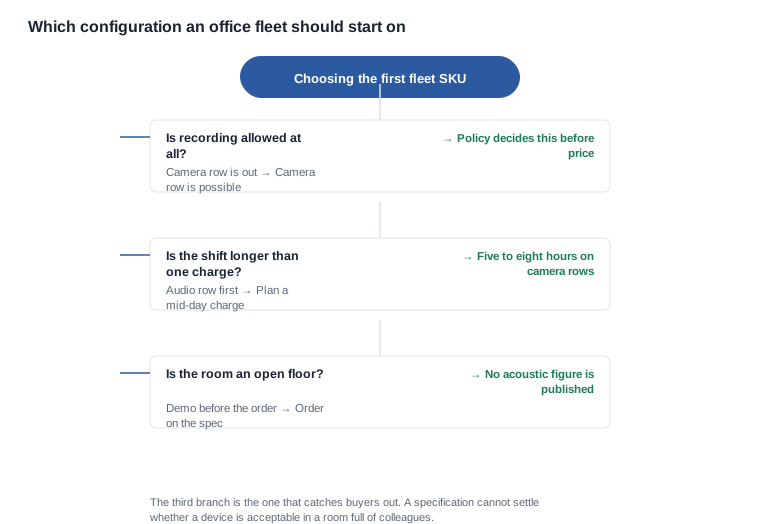
The fork is a policy decision and it comes before a price comparison. If recording is not permitted in the workplace at all, then the camera tier is out of scope and the comparison is between audio configurations and their price tiers. If recording is permitted under a written policy, then the camera tier becomes a candidate and the policy document becomes a deliverable of the deployment — it has to say where the footage goes, how long it is kept, and who may see it. A supplier's quotation does not answer any of that, and a buyer who asks the supplier to answer it has misidentified who owns the question.
The AI capability adds four more unknowns, and they are all questions for the factory. Twenty of the twenty-eight entries carry AI in the product designation, and for none of them does the catalogue publish the feature list, the language coverage, the latency, or the processing location. So four things are unstated: whether the processing happens on the device, whether it needs a subscription, whether it works without a connection, and where any data is held. A company with a data protection officer asks all four before a pilot, and the correct answer to a supplier who cannot answer is to wait for a written statement rather than to accept a demonstration.
The radio position has to be settled against the phone fleet. The catalogue publishes a Bluetooth version on fourteen entries and on none of the eleven camera rows, and no verified device list is published for any model. For an office deployment that means the compatibility test is a real piece of work against the actual phones the company issues, and it is a day of effort that has to be scheduled rather than assumed. The method is at Bluetooth connectivity and the qualification requirement is at Bluetooth SIG.
The acoustic acceptance is the factor no specification addresses. Leakage, driver size, frequency response and microphone pickup distance are all unpublished for every entry in the range, which is a normal gap for this category and an unacceptable one for an office. A device that is acceptable in a quiet one-to-one and unacceptable on an open floor is not a product flaw; it is a placement decision. The only way to settle it is a demonstration in the rooms where the work happens, with the phone models the company issues, and the open-ear audio page is the right vocabulary for the conversation with the supplier.

The adoption curve a buyer should measure
Week one is the novelty week and it should not be measured at all. Hands-free calls get attention on day one, everyone asks about the device, and the perceived benefit is at its maximum. A buyer who measures adoption in week one has measured the marketing effect and will overstate the result permanently, because the number will be quoted for years.
Week two is where users self-select. The people who keep the device are the people whose calls suit it — quiet one-to-ones, walking conversations, hands-busy tasks. The people who put it back are the people whose work does not. This is the most useful week in the pilot, because the drop reasons are the specification for the fleet. A reason that says "the calls I take are too noisy for it" is a placement decision, and a reason that says "it was flat when I needed it" is a charging-decision. These two reasons lead to completely different purchases.
Weeks three and four are the decision. Two questions get asked by everyone: is it charged, and does anyone object to seeing it. The second of those is the one that is frequently decisive and is never in a business case, because it belongs to the people who are not being measured. A device that attracts comment becomes a device that lives in a drawer, and a drawer is not a deployment.
The charge question is where a published row helps. The runtime bands are wide — 5 to 8 hours on the camera rows and about 6 to 8 hours on the audio rows — and the upper bound of a band is not a planning number. If the fleet's shift runs past the lower end of the band, the deployment needs a named charging owner and a place to charge, and if it does not have one, the fleet size should be reduced until the routine exists. The battery life page sets out how to read a rated figure without a condition, and the pros and cons article covers the case against as well as the case for.
What to demand in writing before an office fleet is ordered

A pilot designed as a measurement, not as a launch. The pilot is where the adoption curve, the charging routine and the acoustic acceptance are established, and a pilot that is run as a soft launch produces impressions rather than data. The sequence below is the one that produces numbers the buyer can put in front of a budget holder.
- Pick a group with a real call profile. People whose calls are unusual are a poor sample; people whose week looks like the target population's week are the right sample. Volunteers are the worst possible sample, because they are the people who were excited in the first place.
- Decide the recording policy before the configuration. It decides whether the camera tier is even in scope, and it is a document the employer owns.
- Demonstrate in the actual rooms on the actual phone models. The published rows cannot settle acoustic acceptance, so the demonstration has to happen where the objection will be raised.
- Run a four-week pilot with a named charging owner. Not a shared dock in a corridor. A named person, because the charging question is the one that ends deployments.
- Measure adoption weekly and log the reason for every drop. The drop reason is the data. Without it, the pilot produces a number and no explanation, and the number cannot be used to design the next fleet.
- Decide the fleet size on the measured curve rather than on the demo. A pilot that ends in an enthusiastic demo usually over-orders, because the demo week is the best week the product will have.
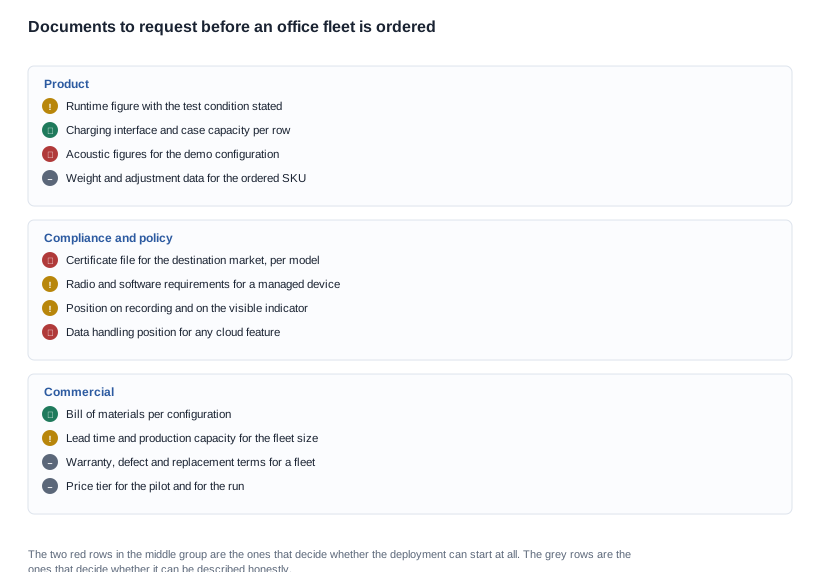
The questions that go with the pilot. Which model and which configuration is quoted. What the runtime figure was measured under. What the charging interface is and whether a case or dock is published for that row. What the acoustic behaviour is in the demo room. Where the AI processing happens and whether it needs a subscription. What the certificate file covers for the destination market. What the lead time is for the fleet size and what the production capacity looks like. The procedures are at sample policy and supplier verification.
The compliance file for a managed device. A radio-equipped device sold into the European Union sits inside the Radio Equipment Directive (EU) 2014/53/EU, and the general product safety framework applies through the General Product Safety Regulation (EU) 2023/988, applicable since 13 December 2024. The red directive and GPSR pages set out the route. For a device that also runs software and connects to a phone, the connected-device cybersecurity requirements in EN 18031 are the ones an IT lead will ask about, and the framework is at EN 18031. The catalogue text contains no reference to CE, FCC or RoHS and carries no per-model certification row, so the file is a request to the factory per model, and every number in it has to be checkable in the issuing body's register.
The commercial terms that move. Minimum order quantity tiers, and whether a pilot and a run can be separate purchase orders at different volumes. The price tier for the pilot against the tier for the run. Whether the fleet can be split across two deliveries against a staged payment. The dock and case allocation, and whether it is bundled or ordered separately. The warranty and defect terms, including how a failed unit is replaced and how quickly. The pricing, MOQ and lead time pages set out the structure, and the clause language is at contract terms.
Where an office deployment fails, and what the pilot has to prove
A business case with a productivity number in it. The number will be asked for and cannot be defended, because no supplier publishes adoption data and a pilot's own figure is not transferable. A business case built on the operational work — how many people, how many hours, what the support answer set covers — survives that question.
A camera configuration ordered before the recording policy exists. The order is not the problem; the deployment is. Once the policy is written, the camera tier may be perfectly acceptable, and until it is written it is not.
A fleet sized on the demo rather than on the measured curve. Over-ordering is the usual error and it shows up as a second-year budget line for devices nobody uses.
A charging routine with no owner. This is the single most common reason an office deployment ends in a drawer, and it is a management decision rather than a technical one.
An acoustic decision made on a specification. Nothing in the published rows settles whether a device is acceptable in a given room, and the people who decide it are the colleagues who are not in the pilot.
A compliance file assumed from the company's export page. The catalogue's export certification page is a company-level page whose content is images rather than text, and the catalogue text names no standard mark. A file for one model is not a file for another model, and neither is a file for a different destination market.
A support answer set that is written after the first session. It is much cheaper to write once, before, than to answer per user for a year.
The working rule: no productivity figure
The working rule we apply: we will not claim a productivity figure for this product class, because we hold no adoption data and neither does anyone else in this category who is being straight about it. We publish the rows a buyer can order from: the resolution class on the eleven camera rows, the cell capacities, the charge time of two hours or less with about one hour on the D17 and the ZH12, the rated use figures, the charging interface on the twenty-four entries that carry one, the Bluetooth version on the fourteen entries that carry one, the case capacities where they are published, and the structural features the catalogue names — the detachable inner frame on the V06 and the S7, remote photo capture on the D17 and the ZH12, the ultra-slim detachable temples on the G07, the slim temples on the YK12, and the four colours on the V06.
What we do not publish, and will not estimate: the acoustic figures, the microphone pickup distance, the per-model unit weight beyond the single 158 g whole-unit figure for the MT6, the field of view, the video specification, the runtime test condition, the standby draw, the cycle life rating, the AI feature list, the processing location and the data handling position. We will not state that any model holds CE, FCC or RoHS certification, because the catalogue text names none of them and carries no per-model certification row.
What we will do: take the team size, the shift pattern, the recording policy position, the destination market and the budget, and tell you which configurations exist, which published rows apply, which questions have to be answered before a pilot, and what the deployment will cost outside the unit price. The audio tier is at Bluetooth audio glasses, the camera tier is at AI camera glasses, and the scenario entry point is smart glasses for office.
Shift pattern and whether recording is allowed
Send the number of people, the shift pattern, the rooms involved, whether recording is permitted at all, and the destination market, and we will return the configurations that exist for that profile, the published rows that cover them, the questions that have to be settled before a pilot, and the parts of the budget that are not the device. The consumer-versus-industrial framing that matters for this decision is at consumer vs industrial.
Related reading
- Where this scenario begins — smart glasses for office
- The audio configuration — Bluetooth audio glasses
- The published data rows — battery life
- The compliance route — red directive and GPSR
Tell us the team size, the shift pattern and the policy position, and we will return the configurations that exist and the questions to settle before a pilot.


