
Smart glasses for office: the hardware line is the only one a buyer can forecast, and it decides the least
What a buyer can settle before the first shipment
Office budgets fail in one specific way: they are built on the unit price and then hit by the second-order costs nobody put in a line. Below is a worked structure for a three-stage rollout, with the costs we can talk about and the ones that are your own internal figures. Unit prices are not published in our documentation, so the structure below is deliberately a structure rather than a spreadsheet.
The reason the structure matters more than the numbers is that only one of the four cost families in this category can be forecast from a quotation. The hardware line can, because a supplier can quote it. The administration line cannot, because it is made of people-hours and policy work. The infrastructure line cannot, because it is made of whatever your building needs. And the replacement line cannot, because the rate at which devices are lost, damaged or not returned is a property of your deployment rather than of the model. Three of the four families are yours, and the one that is a supplier's is the one that decides the least.
Three conclusions follow. Put the three families you cannot forecast into the business case before you put the hardware in it, because a case that only survives on the hardware line has not been tested. Hold the volume decision until the deployment has produced a return rate, because that rate is the input that converts a recurring cost from a guess into a figure. And model the replacement assumption as a range rather than a point, because the range is what the business case has to survive and the point is what it will be argued about.
The four cost families, and how each one behaves
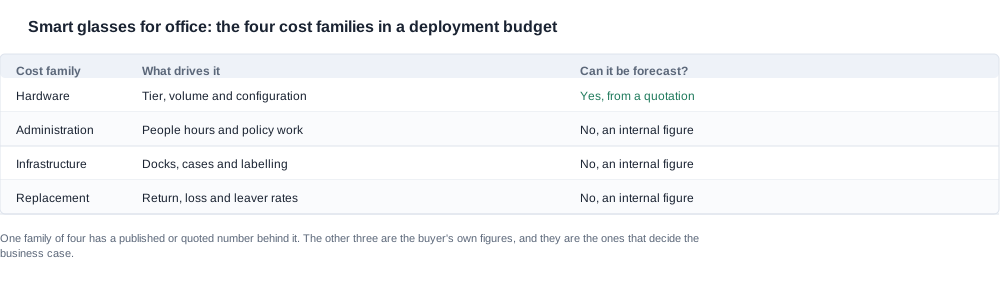
The hardware family is the one everybody quotes. Its published content is the configuration: the resolution class, the cell capacity, the charging interface where it is published, the rated runtime, the charge time, the case capacity where it is published, and the Bluetooth version across the audio tier. The unit price is not published, so the hardware line is whatever your quotation says, and it is the only line that can be compared between two suppliers without further work.
The administration family is made of people-hours and decisions. Someone has to write the recording policy, someone has to collect feedback, someone has to answer the questions the team asks about data, and someone has to count the units. This family is usually the largest one at stage one, and it is invisible in a quotation because it happens on the buyer's side of the contract.
The infrastructure family is small in money and large in consequence: charging points at the locations people actually pass, the labelled dock positions, the spare cases for the camera models, the printed cards. None of it appears on a bill of materials because none of it scales with the order, and that is exactly why it gets cut.
The replacement family is the one that decides whether the business case works, and it is the one with the least evidence behind it in either direction. It is made of three different rates — loss, damage and non-return at leaver — and each of them is a number your own organisation has to hold.

Stage one: the evaluation batch, where the internal time exceeds the hardware
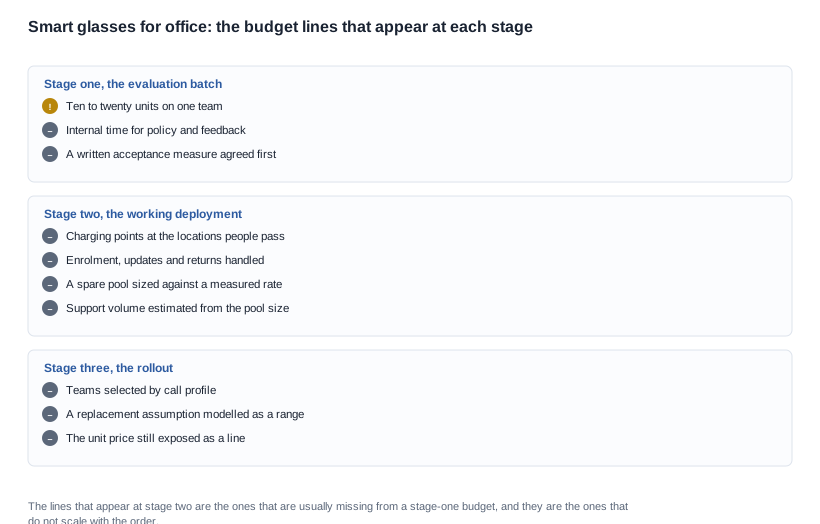
Ten to twenty units, one team, one stated use case. The budget line that matters at this stage is not the hardware; it is the internal time. Someone has to set the recording policy, someone has to collect feedback, and someone has to answer the questions the team will ask about data. The internal time typically exceeds the hardware spend at this stage, which is why stage one should be small enough to be cheap if it fails.
What stage one has to produce is worth stating as a list, because a pilot that does not produce these four things is a pilot that produced an opinion. A written acceptance measure, agreed before anyone puts one on. A measured return rate, which means return reasons have to be tagged from the first unit rather than reconstructed later. A charging rate observed rather than assumed, which is a count of how often the devices are actually on the dock. And a list of the published rows that turned out to be unusable in practice, which is the input to the next order's specification.
There is a second-order effect at stage one that belongs in the budget as well: the internal time is not only consumed, it is spent by specific people. If those three tasks are done by one person, the stage-one cost understates what a rollout will cost, because the rollout requires the same three tasks to be distributed across a larger group. Stage one is the cheapest place to discover that, and the discovery is worth more than the units.
How to evaluate a pilot budget before you commit to it
A pilot budget is evaluated against six criteria, and they are worth settling before the pilot is scoped rather than after it has run.
- Does it include the internal time? A pilot costed only in units is missing its largest line. Name the three roles, estimate their hours, and put them in the same table as the hardware.
- Is the hardware scope small enough to be cheap? Ten to twenty units on one team is a scope that is cheap if it fails. A pilot sized at the rollout size is not a pilot, because the failures that appear at month four scale with the number of people involved in the administration rather than with the number of units.
- Does it produce the four things the business case needs? A written acceptance measure, a measured return rate with reasons tagged, an observed charging rate, and a list of the published rows that turned out to be unusable. A pilot that produces none of these has cost a purchase order and bought an opinion.
- Is the compliance work inside the budget? If cameras are involved, the written data-handling answer and the recording policy are two documents with two signatures. They are cheap if they are written before the order and expensive if they are written after an incident.
- Is the exit decision defined? A pilot should end with a decision rule written in advance: what result moves the deployment to stage two, and what result stops it. A pilot without an exit rule becomes a permanent pilot and a permanent cost.
- What does it cost to stop? The number that makes a pilot safe is the cost of the alternative, not the cost of the pilot. If stopping costs the sunk hardware plus the internal time already spent, that is the number the business case should carry — and it is far smaller than a failed rollout.
Stage two: the working deployment, where the second-order costs arrive
At stage two the deployment is real, and the four cost families stop being theoretical.
Charging infrastructure. If the team is away from a desk for part of the day, a small number of shared charging points changes the adoption rate more than any specification does. This is the line where the published interface matters directly: charging over Type-C is published on the V03 Pro, the L2 Utral, the D11, the D12, the D17, the ZH12 and the bone-conduction model, magnetic charging is published on the K01, the K02, the LC-105 pair, the V06 and the MT5, the G07 and the S7, and the KY06 and the YK12, and the V03, and four camera models — the L1 Pro and the CY05, and the CY03 and the MT6 — publish no charging-method row at all. A Type-C point can be a standard USB-C dock; a magnetic point is a specific product.
Device management. Enrolment, updates and returns, which are usually underestimated because they are carried by a small number of people whose time is not counted. The volume of support tickets is a function of how many people share a small pool, and that number is worth estimating rather than discovering.
Replacement. We do not publish a cycle life rating, and specifically not a cycle life at eighty per cent retained capacity, so the number your business case needs has to come from a test report or has to be modelled as unknown. Modelling it as unknown is acceptable and modelling it as a typical figure is not.
Support. The volume of "it will not connect" tickets is a function of the pool size and of how well the card was written, and it is the line most often set to zero.

Stage three: the broad rollout, where the question stops being affordability
At stage three the question is no longer "can we afford it" but "which teams should have it". The answer follows the call profile rather than the job title: teams whose work keeps both hands occupied adopt, and desk-bound teams mostly do not. That is a deployment heuristic rather than a measurement, and the pilot in stage one is where you test it against your own teams rather than accepting it.
The configuration choice also settles at this stage, and it settles structurally. The audio-only configuration removes the camera module and the charging case from the bill of materials entirely, which changes the hardware line, the infrastructure line and the compliance line at once — no charging infrastructure to install for the audio tier beyond a dock, and no recording policy to negotiate. We do not publish unit prices, so we will not put a figure on how much that difference is worth, but the structure of the difference is a matter of what the bill of materials contains rather than what it costs.
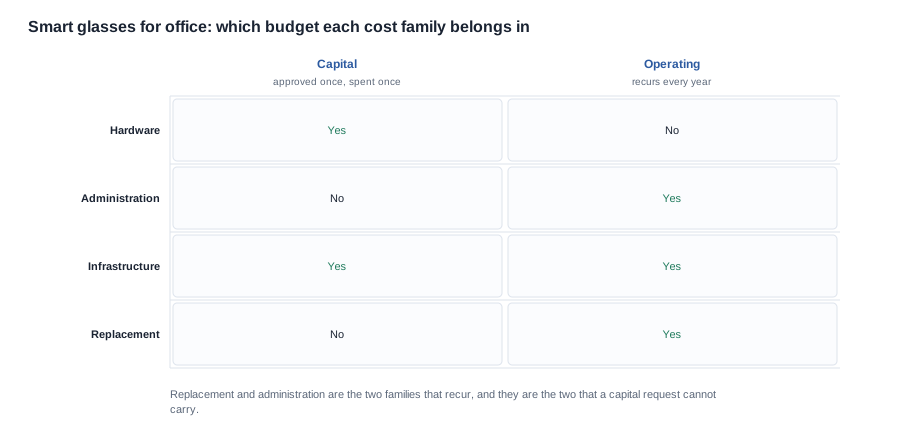
The budget question that replaces affordability at stage three is concentration. Which teams get the hardware, and what happens to the administration when the number of teams doubles and the champion does not. The families that recur — administration and replacement — are the ones that scale with people rather than with units, and they are the two that a capital request cannot carry.
How to select the teams at stage three
The selection at stage three deserves a method rather than a list of willing departments, because the first set of volunteers is not a representative set. Three criteria are worth applying, and each of them can be answered from information the stage-one and stage-two pilots already produced.
The first is the call profile. How much of the working day does the role spend in conversation? A role with several hours of scheduled calls is a role where the device is in use; a role with intermittent calls is a role where it sits on a desk and generates the uncharged-device problem.
The second is the room. Is there a charging point within reach of where the role works, and will it still be there in month four rather than only during the pilot? A team in a room without a permanent point will generate the location failure that the pilot did not.
The third is the existing device estate. The radio version is published for the audio and sport tiers — 5.3 on the K01 and the K02, 5.4 across the rest — but the camera tier publishes no radio version, and no verified device list is published for any model. The handset estate therefore has to be checked against the actual unit, and the result belongs in the order as a configuration note rather than in a budget assumption.
Each of the three criteria turns a rollout decision into a question the pilot can already answer, which is the point of running the pilot at all.

The replacement assumption, and why it decides the business case
The one number to get right before the business case
Almost every office budget for this category is wrong in the same place: it assumes the first purchase is the last purchase. Devices get lost, get damaged, do not come back at leaver, and get replaced. Some organisations plan with a low double-digit annual replacement assumption and some plan with a lower one; we do not hold a measured figure for this category and will not present one as ours, and neither should the budget be presented to a finance team as if it came from the supplier.
What we will say is that the replacement assumption is the most sensitive line in the model. If the business case works only at a low replacement rate and the real rate is materially higher, the case does not work, and the hardware price was never the deciding factor. The correct treatment is a range, taken at the pessimistic end, with the test being whether the case survives the pessimistic end rather than whether the pessimistic end is accurate.
The second-order point is that the three rates inside the family behave differently and only one of them is measurable from the pilot. Loss is measurable from the pool count. Damage is measurable from return reasons. Non-return at leaver is not measurable until somebody leaves, which is usually outside the pilot window. A budget that models the family as a single percentage is averaging three different behaviours together, and the averaging hides the one that has no evidence at all.
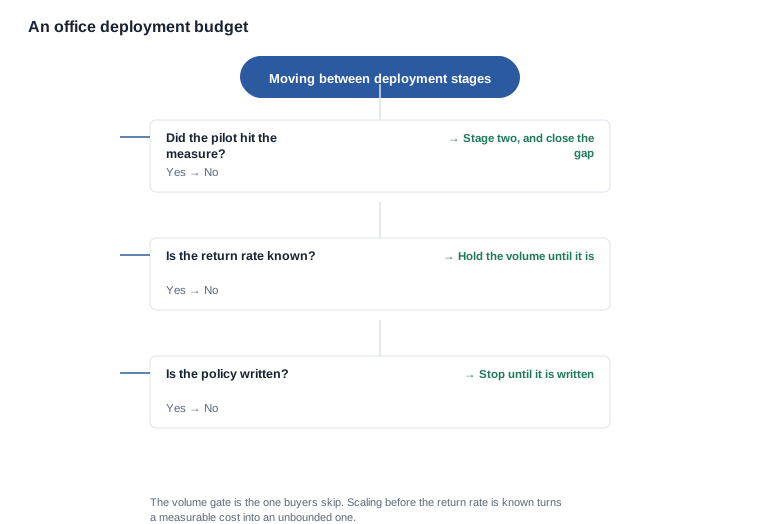
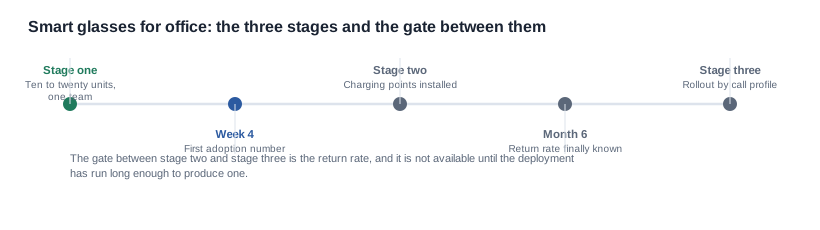
The stage gate chart carries the practical consequence. The volume gate is the one buyers skip: scaling before the return rate is known converts a measurable recurring cost into an unbounded one, and the cheapest point at which to hold volume is the point at which the pilot has produced its first real numbers rather than its first opinions. The adoption curve over the first weeks is at what to expect in month one, and the case against the deployment is set out at pros and cons for IT.
The total cost model, and the four inputs you have to supply
A total cost model for this category has four terms, and only the first is a supplier number.
The first term is the hardware: the configuration multiplied by the volume, taken from a quotation. The second is the administration: the people-hours that enrol, support, count and reconcile the deployment, scaled by the number of people involved rather than by the number of units. The third is the infrastructure: the charging points, the cases, the labels and the printed cards, installed once per site. The fourth is replacement, and it is the term that recurs for as long as the deployment runs.
Three of those four need an input you hold rather than one you buy. The number of people involved in the administration. The replacement rate, carried as a range with a pessimistic end. And the useful life of a unit in your own environment, which we cannot evidence for you because we publish no cycle life rating, and which therefore has to come from a test report or be modelled as unknown.
The way to model an input you cannot evidence is to carry it as a range and to write down the end that breaks the case. If the case survives the pessimistic end of every range at once — more administration, higher replacement, shorter useful life — then the accuracy of any single range matters much less than the fact that it was tested. If it does not survive, the honest conclusion is that the business case is not yet decidable and the next unit of spend should be the measurement rather than the hardware.
That last point is the one worth making explicitly. A total cost model in this category is usually used to justify a purchase. Used properly it does the opposite as often: it identifies which single measurement, if it came back badly, would change the decision. That measurement is usually the replacement rate at a realistic deployment size, and it costs one pilot to obtain.
What to negotiate with the supplier, and what each term moves in the model
Three terms in the supplier's quotation reach the total cost model directly, and they are the three worth settling before the order rather than after it.
The first is the price tier and the volume it applies to. The tier a buyer lands on is set by the volume written on the order, and the same configuration at a higher volume is quoted differently. That is why the stage-one volume should be small and the stage-two volume should be written as a conditional: the price at the pilot tier is known, and the price at the rollout tier is a quotation against a stated volume rather than an assumption carried in a spreadsheet.
The second is the lead time, because it decides when the hardware arrives relative to the period the budget assumes. A lead time longer than the interval between the order and the first deployment pushes the internal time into a later quarter and can put a stage-one budget in a period the business case never planned for. The lead time is not published and has to be quoted per configuration, and it is a commercial term rather than a courtesy.
The third is the packaging and freight line, because it is the per-site cost that arrives as a shipment rather than as a kit line. Master carton quantity, gross weight and dimensions set the freight quote, and a change after the carton is specified is a new carton.
Three other items sit outside negotiation. The tooling charge is fixed in nature and amortises across the first order, so it belongs as a separate quoted line rather than inside the unit price. The certification cost and the certification lead time are set by the issuing body rather than by the supplier. And the warranty terms are a contract term that has to be quoted before it can be costed into the replacement family, which is why the replacement assumption stays a range until the quotation exists.
What we can put in your budget, and what we will not
We can tell you the published hardware configuration per model — the charge time, the resolution class, the rated runtime, the cell capacity, the Bluetooth version, the charging method and the case capacity — and we can tell you which configurations exist and which do not. The audio family is at Bluetooth audio glasses with its published rows.
We cannot give you a unit price list, a deployment price, a lifecycle cost or a return-on-investment figure, and we will not invent one. Unit prices are not published, and neither is an adoption figure, a productivity figure or a support-ticket rate. The battery rows that would feed a runtime-based calculation are at battery life, but the runtime figures come with the caveat that no runtime in the range carries a published test condition, which means they cannot be turned into a number of charge cycles per year without an assumption of your own.
If your business case needs a number we cannot evidence, the honest approach is to model it as a range and say so, rather than to pick a figure that makes the case work. Buyers who do the latter end up defending the number rather than the decision, and the defence usually fails in the month the assumption is first challenged.
The deployment framework itself is at smart glasses for office.
The stage you are at, and the sites
Send the team size, the stage you are at, the configuration you are considering and the number of sites, and we will return the published rows that cover each configuration, the cost families that will apply at that stage, and the two or three inputs you will have to measure yourself because no supplier can evidence them for you.
Related reading
- The deployment framework — smart glasses for office
- The adoption curve — what to expect in month one
- The case against — pros and cons for IT
- The lower-configuration family — Bluetooth audio glasses
Send the team size, the stage, the configuration and the number of sites, and we will return the published rows and the cost families that apply at that stage.