

An office deployment is specified by IT rather than bought by a channel, so the specification looks different from a retail one. A retail specification describes a product and a price. An office specification has to carry the compliance position, the management approach and the support model, because the person approving it is not the person using it and the person using it is not the person who will be asked to justify the decision a year later. Six rows do that job, and each row is either published by the manufacturer or explicitly marked as a gap.
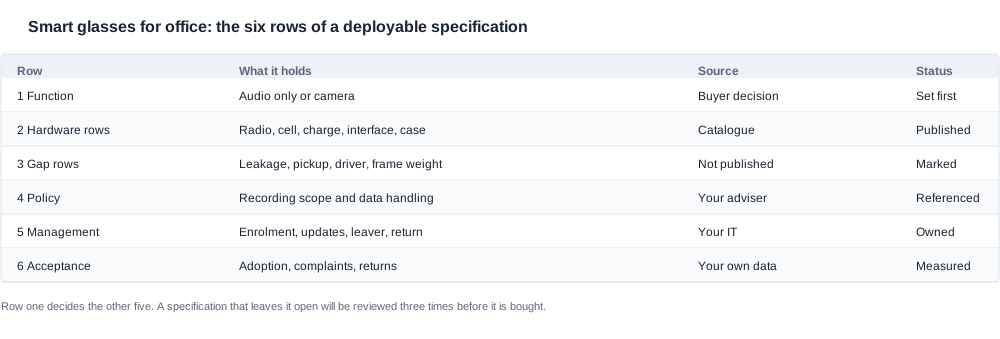
Smart glasses for office: a six-row specification that survives review
| Row | What it holds | Source | Status |
|---|---|---|---|
| 1 Function | Audio only or camera | Buyer decision | Set first |
| 2 Hardware rows | Radio, cell, charge, interface, case | Catalogue | Published |
| 3 Gap rows | Leakage, pickup, driver, frame weight | Not published | Marked |
| 4 Policy | Recording scope and data handling | Your adviser | Referenced |
| 5 Management | Enrolment, updates, leaver, return | Your IT | Owned |
| 6 Acceptance | Adoption, complaints, returns | Your own data | Measured |
Why six rows and not a product description. A product description answers "what is this". The six rows answer "what did we decide, on what basis, and how will we know it worked". Each row has a different owner, which is the point: row one is yours alone, row two comes from the catalogue, row three is deliberately empty, rows four and five are internal documents you reference, and row six is a measurement you have not taken yet. A specification where one person owns all six rows is a specification that will not survive the security review.
The order of review is fixed, and the rows are written in that order. A typical office specification is read by security, then by legal, then by the people who will actually use it. Row one decides whether legal has anything to review at all, so it comes first. The consequence for a writer is practical: if row one is left open, the specification is sent back three times, and each revision costs more than the hour it would have taken to settle the tier.
The specification is also the document that survives the supplier changing. Configurations move, applications are updated, and the person who ordered the units is often not the person running them two years later. A six-row document that says what was decided, on what published basis, with the gaps named is readable by someone who was not there. That is what makes a specification a durable artefact rather than a piece of correspondence.
What each reviewer looks for, and which row answers them. The security reviewer asks row four and row three, because the questions are what happens to captured content and what is not published about it. The legal reviewer asks row four, because whether recording is permitted is a legal question and the directive and the regulation that govern the radio and traceability position do not answer it. The eventual user asks row one, because the only part of the document they will ever see is the part that says what the device is for. A specification written so that each of those three readers can find their answer in one place is usually approved in one pass rather than three.

Row one, function, and why it comes before the hardware
Audio-only or camera. This row decides everything else, because the two tiers in our catalogue carry very different cells — 55 mAh to 100 mAh per temple across the audio configurations, against 220 mAh to 290 mAh across the camera configurations — and because it decides whether an internal recording policy is needed before day one.
What row one should actually contain. Four items, and all four are decisions rather than product facts: the task the device is bought for, the tier that has been selected, the number of people in scope, and the length of the pilot. The tier is the outcome of the other three, so writing it first is a shortcut that skips the reasoning and makes the document unreadable later.
The published evidence that supports the choice. The audio configurations publish cell capacities from 55 mAh per temple on the LC-105 pair, the G07 and the YK12, through 90 mAh per temple on the K01 and the K02, to 100 mAh on the D11 and the D12, with rated use figures between about six and eight hours and a charge time of two hours or less. The camera configurations publish 220 mAh on the MT5 and the V03 Pro, and the V03, 260 mAh on the KY06 and the S7, and the V06, and 290 mAh on the CY03 and the L2 Utral, and the L1 Pro and the CY05, with rated use between five and eight hours and the same charge-time ceiling. That comparison is the row-one argument in one table, and it is the argument a reader can check.
The decision that row one really forces. A camera tier adds an approval dependency, not a feature. It pulls the recording policy, the data-handling note and the privacy review into the critical path, and in most organisations those are the approvals that take weeks. An audio tier removes them. So the question a buyer should be able to answer in one sentence is not "which is better" but "what does the camera buy us that the pilot has to prove". If the answer is a specific workflow with a named user, row one is settled. If the answer is a list of features, the camera tier is a preference rather than a decision, and a preference is a poor foundation for an approval.
Why it comes first in practice. Rows two and three can be prepared in parallel by different people, and row four cannot be drafted at all until row one says whether recording is in scope. Starting with the hardware rows is the most common ordering mistake in this category, and it produces a document that is complete on the specification and empty on the compliance, which is the worst combination available.
Row two, the published rows and the caveat that travels with them
Bluetooth version, cell capacity and configuration, charge time, rated use, charging method, and case capacity where a case is fitted. All of these are published per model in our catalogue, and all of them should be recorded with the model designation attached, because two models with identical cells can differ in case configuration.
What the published rows are, exactly. The K01 and the K02 publish Bluetooth 5.3, 90 mAh in each temple, a charge time of two hours or less, about eight hours of rated use and magnetic charging, with no capacitive touch row published on the K01 or on any other model, so a control surface is a supplier question rather than a line on the document. The D11 and the D12 publish Bluetooth 5.4, 100 mAh, a charge time of two hours or less, about seven hours and Type-C. The LC-105-1 and the LC-105-2 publish 55 mAh in each temple and about eight hours; the G07 and the YK12 publish the same cell and about six hours, with an ultra-slim and detachable temple on the G07 and a slim temple on the YK12. The camera models publish 8 or 13 megapixels, and the case capacities where they exist are 900, 1200 and 1400 mAh.
Two caveats have to travel with row two. The first is that the rated use figures carry no published test condition, so they belong on the document as a ceiling rather than as a promise. The second is that the charge time is a ceiling too: twenty-six of the 28 catalogue models publish two hours or less, and only the D17 and the ZH12 publish roughly one hour. Neither figure should be shortened on the document, because a shortened figure becomes a claim the supplier has not made. The battery life page carries the full position, and the charging solutions page covers the interface split across the range.
Why the designation has to be attached to every row. Model designations in this range carry configuration differences that are easy to miss. The V03 and the V03 Pro share an 8-megapixel camera and a 220 mAh cell but differ in interface — magnetic against Type-C — and the V03 Pro also publishes a photochromic lens configuration. The L2 Utral publishes two case capacities and a Type-C interface where its sibling models publish one capacity and no interface row. Two models with identical cells and different interfaces invalidate the cable stock, so a row written as "one of the camera models" is a row nobody can order from.
A note on the rows we do not publish for the camera models. The radio version is published for the audio configurations and is not published for the camera models. That is a real gap on a document that is otherwise complete, and it belongs in row three rather than being quietly left off row two, because the radio version determines what the IT team can put on the compatibility sheet.
The case configuration is part of row two, not an accessory. Five camera models publish a case capacity: 1400 mAh on the L1 Pro and the CY05, and the CY03, 900 mAh or 1400 mAh on the L2 Utral, and a 1200 mAh folding case on the MT6. Two more publish a case with no capacity published, which is a different fact and should be recorded as one, and the catalogue lists no case row at all for the S7 and the V03, and the V06, which is a third fact again. A specification that says "with case" for a model whose case capacity is not published has committed the organisation to a physical decision that cannot be costed, and a specification that says "with case" for a model the catalogue does not list a case for has committed it to a configuration that may not exist. Those are the rows worth being pedantic about, because the case is a second object in every carton and it changes the freight, the packaging and the customer's expectation.

Row three, the gaps you mark instead of filling
Acoustic leakage, microphone pickup distance, driver unit size, frequency response, frame weight, and any ingress rating. All not published in our documentation. If a deployment decision depends on one of them, say so on the specification — that line is what protects you when someone asks why the choice was made.
Why marking a gap is stronger than filling it. A specification that carries an estimated leakage figure creates a number the organisation will quote. When a colleague then hears their own call from two desks away, the number is wrong and the specification is the evidence against it. A specification that carries "not published, measured on a sample on this date under these conditions" creates a number the organisation can defend, because it is attributed. The second version is also more useful to the next person, who knows where to look.
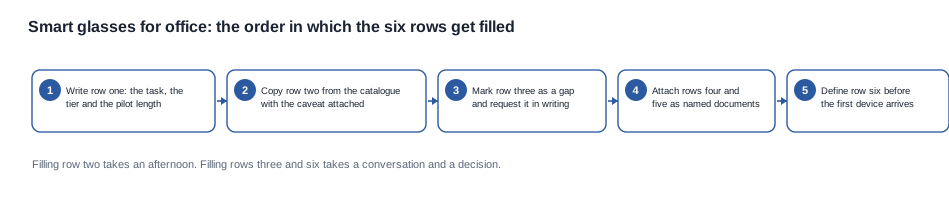
The gap rows should each name who will close them. A gap with no owner stays open, and an open gap on a document is a live risk that somebody will discover late. The realistic assignment for each one is: the supplier, in writing, as a deliverable against the order; the IT team, by measurement, as part of the sample session; or the business owner, by policy, as a decision that does not need a figure at all. Which one applies is usually obvious once the gap is written down as a question.
Three more rows that belong on row three in this category. The storage capacity and overwrite behaviour of the camera models, which decides whether a recording workload is workable at all. The low-light behaviour, which decides whether the camera tier suits the deployment's lighting. And the certification scope of the specific model, which our catalogue does not carry at the model level: the catalogue has a company-level export certification page whose content is images rather than text, and there is no per-model certification row anywhere, so the scope for a given model is a document to request. The certification checklist is the request list, and the EU compliance route sets out the framework.
One number on this row that is published, and one that is not. The MT6's 158 g is published, and it is the whole-unit weight including the cell and the camera and excluding the 1200 mAh folding case. No frame weight is published for any other model, so a specification that says "approximately 158 g" for the whole range is wrong twice: it extends a single published figure to twenty-seven models and it mislabels the basis of that figure.

Rows four to six, policy, management and the acceptance test
If the configuration includes a camera, the specification must reference an internal recording policy document, not merely state that one exists. In the EU the radio position runs through the Radio Equipment Directive (Directive 2014/53/EU) and the traceability position through GPSR (Regulation (EU) 2023/988, applicable since 13 December 2024); neither of those tells you whether your staff may be recorded, which is a matter for your own legal adviser.
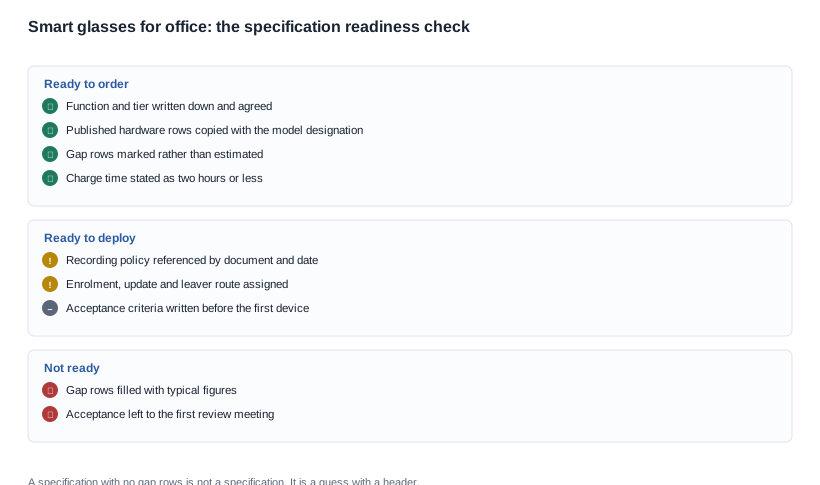
Management covers how devices are enrolled, who can update them, what happens to accounts and to data on leaver, and what the return process is. These are internal decisions, but they belong on the specification because they determine whether the deployment is repeatable at a second site. A deployment that cannot be re-deployed without one person explaining it is not a deployment, it is an arrangement, and an arrangement does not survive that person leaving.
The acceptance test defines what "working" means in two weeks: a named team's adoption, a measured complaint rate, a return count. Without it the deployment is judged on opinion at the first review meeting, and opinion at that stage tends to track novelty rather than usefulness. Writing the measure in week one, before anyone has an opinion, is the only way it survives contact with the first review.
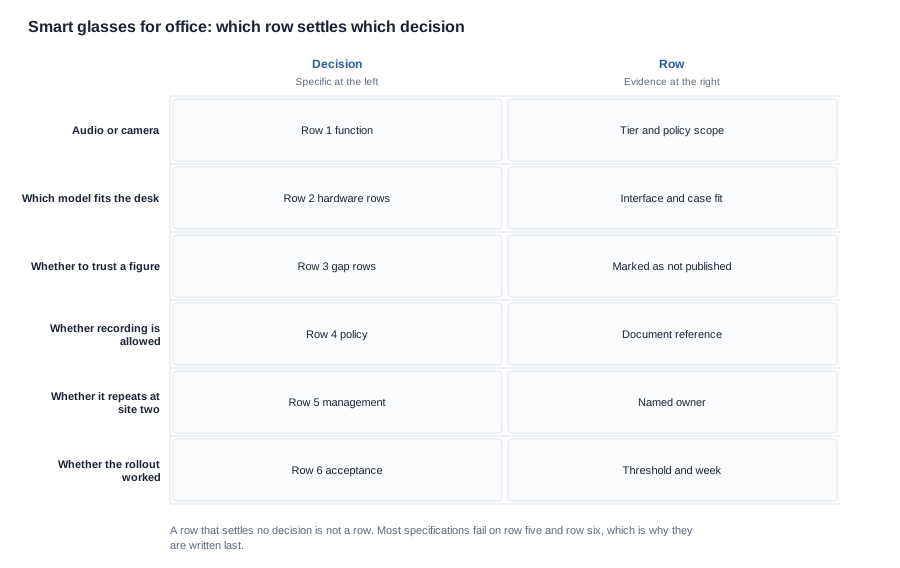
Why rows five and six are the ones that get skipped. Rows one to four are decisions somebody has to make, and decisions get made because someone is accountable for them. Rows five and six are maintenance, and maintenance belongs to nobody until it is written down. A specification without them has produced a pilot rather than a deployment, and a pilot that is presented as a deployment is the most common failure in this category.
What the acceptance test has to contain to be enforceable. Three things: the number, the condition it was measured under, and who will read it. "Adoption is good" is an opinion. "Twelve of the fifteen people in the pilot team used the device on at least three of the five working days in week two, measured from the desk-side check-in log" is a criterion, and it can be disputed, which is what makes it useful. The measurement article covers how to produce the log that makes such a criterion real.
Write the second review into the specification as well. The two-week criterion settles whether the pilot worked, and it settles nothing about whether the deployment should continue. A specification that names the third-month review, its inputs and the decision it produces is a specification that prevents the two most common outcomes, which are a rollout extended by inertia and a rollout cancelled by an anecdote. The inputs are the ones already on the sheet: the usage log, the complaint rate, the return count, and the number of support tickets that came from the gap rows rather than from the devices.
When to stop asking and start ordering
Send the template with the rows in place and ask for each one in writing. Most rows come back within a day. The ones that come back slowly are the gap rows, and that is informative rather than obstructive — a supplier who has not measured leakage has not measured leakage, and knowing that at specification stage is far cheaper than knowing it after deployment.
The point at which you stop asking is not when every row is filled. It is when the rows that determine the decision are filled and the remaining gaps do not change it. For an audio-only deployment with a charging point per team, leakage is the deciding row. For a camera deployment with a written recording policy, storage capacity is. Everything else is detail, and detail can follow the pilot.
The test for whether a gap still changes the decision. Put the gap in a sentence that begins "if this turns out to be X, then we would choose Y instead". If the sentence is complete and specific, the gap is still open and the order should wait. If the sentence cannot be completed, the gap is closed for practical purposes, and continuing to ask is a way of avoiding the order rather than of doing due diligence. This is the difference between a specification that is thorough and one that is stalled, and it is worth applying to every row before the purchase order is signed.
The commercial clauses that belong alongside the specification. The specification tells the supplier what you want; the contract terms tell the supplier what they have promised. The two that most often decide a first order are the acceptance criteria and the treatment of the gaps: what happens if the frame weight turns out to be unsuitable for the population, and who carries the cost of the returned units in that case. The MOQ and lead time page covers the quantity structure that the specification sits inside, and the warranty and returns page covers the two warranty clocks that the acceptance criteria feed into.
A specification that arrives complete gets a faster and a more useful quotation. It sounds obvious and it is not what happens in practice. A request that names the model designation, the configuration, the case option, the interface, the quantity structure and the delivery window can be quoted against a price tier and a lead time without a clarification cycle. A request that names a category gets a catalogue, and the catalogue has to be turned back into a specification by the buyer, which puts the work in the wrong place and delays the order by weeks. The supplier-side cost of a complete specification is lower, and so is the landed cost of the order that follows it.
What to send us. The filled rows one and two, the gap rows you have marked, the market and the deployment length. We will return the published rows that apply to the configurations you are considering, the case and interface options that exist for them, and the questions that only your own sample session can answer. The office deployment checklist is the operational version of this template, the budget considerations cover what the rows cost, and the published model data is on the Bluetooth audio glasses range.
Related reading
- What to expect in month one — what to expect in an office deployment
- Budget considerations by team — office budget considerations
- The operational version — office deployment checklist
- Bluetooth audio glasses range — the audio-only configuration
Send the six rows with the gaps marked and we will tell you which of them our documentation can close, which need your own measurement, and which are decisions that only your organisation can take.


