

Smart glasses for office: not inherited claims, but what the rows support
Most of the advantages and disadvantages that get stated about smart glasses for office use are not about the products at all. They are inherited from consumer marketing, from a competitor's brochure, or from a colleague's assumption — and several of them are false in a way that matters, because a deployment document written around them produces a purchase order that cannot be defended. This article takes the nine statements that come up most often in a procurement conversation, states what the catalogue actually says against each of them, and then gives the genuine advantages and disadvantages that are left once the unsupported ones are removed.
The pattern in the false statements is consistent, and it is worth naming before working through them. Almost all of them convert a published attribute into a promise. A resolution class becomes a quality ranking. An ingress marking becomes waterproofing. A published charge time becomes a duration. A catalogue attribute becomes a certification. The conversion is what breaks, and it breaks in the same direction every time: from something narrow and checkable into something broad and uncitable. A buyer who catches the conversion in the document can also catch it in the contract, because a warranty claim that rests on a converted attribute is a claim the supplier can decline.
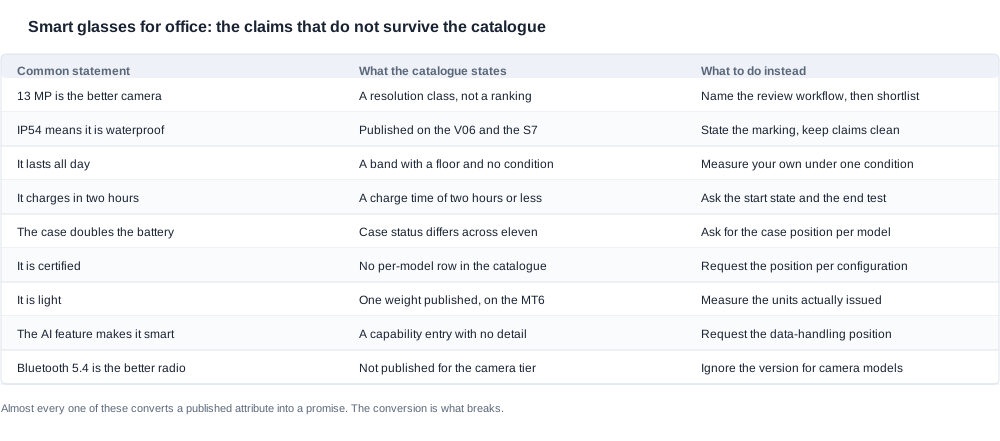
The nine statements in the table below are the ones to watch for. The third column is the practical one, because each of them has a replacement that can be written into a requirement and checked at receipt.
| Common statement | What the catalogue actually states | What to do instead |
|---|---|---|
| 13 MP is the better camera | A resolution class, not a ranking | Name the review workflow, then shortlist |
| IP54 means it is waterproof | Published on the V06 and the S7 | State the marking, keep it out of claims |
| It lasts all day | A band with a floor and no condition | Measure your own under one condition |
| It charges in two hours | A charge time of two hours or less | Ask the start state and the end criterion |
| The case doubles the battery | Case status differs across eleven models | Ask for the case position per model |
| It is certified | No per-model certification row exists | Request the position per configuration |
| It is light | One weight is published, on the MT6 | Measure the units you actually issue |
| The AI feature makes it smart | A capability entry with no detail | Request the data-handling position |
| Bluetooth 5.4 is the better radio | Not published for the camera tier | Ignore the version for camera models |
The statement that leads most often: 13 MP is simply better
It is not, and the reason is structural rather than a matter of taste. The 8 MP group is the MT6 and the V03, the V06 and the CY03, and the V03 Pro and the KY06, and the MT5 and the CY05. The 13 MP group is the L2 Utral and the S7, and the L1 Pro. Two of the three 13 MP models — the L1 Pro and the L2 Utral — publish a 290 mAh cell and an about-seven-hour runtime, which is the same cell and the same runtime as the 8 MP CY03 and the CY05. The third, the S7, is a 260 mAh sport camera model publishing 5~8 h and carrying the IP54 marking. So the step is not a step in a product hierarchy. It is a different module in a different product line, and the only published reason to prefer it is a workflow argument: a record reviewed months later is the situation in which the extra resolution class is doing work.
What the catalogue does not publish is the sensor, the field of view, the video resolution, the frame rate, the stabilisation figure and the low-light performance, for any model. A 13 MP record of a poorly lit room is a poorly lit room, and the pixel count is the one variable nobody can see. So the honest formulation is: the 13 MP group is a defensible choice when the record is read back later, and it is not a ranking. The imaging behaviour that a deployment document has to describe is at camera imaging.
The statement about water that appears in every kit instruction
The IP54 marking is published on two camera models only: the V06 and the S7. It is published as a catalogue attribute, no third-party test report behind it is published, and no ingress rating is published for the audio tier or for the other nine camera models. The digit covers a dust protection level and protection against splashing water. It does not cover immersion, and it does not cover a sustained downpour.
So the statement that has to be removed is "waterproof", and the statement that can be used is the marking itself, named as a catalogue attribute, on the two models that carry it. A deployment document that says the unit is waterproof on the strength of a published marking is making a claim the documentation cannot carry, and it is the kind of claim that gets discovered by whoever tested it. The digit reference is at IP ratings, and the product tiers are at AI camera glasses and bluetooth audio glasses.
The power claims that do not survive
It lasts all day
Every model in the range publishes a runtime, and the camera tier publishes three different bands. The V03 and the V03 Pro, and the S7 and the V06 publish 5~8 h. The KY06 and the MT5 publish 6~8 h. The CY03 and the CY05, the L1 Pro and the L2 Utral, and the MT6 publish about seven hours. A band is a range, and a band that opens at five hours has a five-hour floor in it — the floor is the number that decides whether a unit survives a morning, and it is the number nobody quotes.
Underneath the band there is a more important absence: no runtime in the range carries its test condition, and the standby draw, the cycle life rating and the degradation behaviour are not published either. So "all day" is not a claim the catalogue supports for any model, and the replacement is a measurement: a sample of the units actually issued, observed under one recorded condition, at a stated interval. The published bands are at battery life.
It charges in two hours
Twenty-six of the twenty-eight catalogue rows publish a charge time of two hours or less, and only the D17 and the ZH12 publish about one hour. A published charge time here is a ceiling rather than a duration, because the catalogue publishes no starting state of charge and no end criterion, so a figure of two hours or less cannot be converted into the length of a break and says nothing at all about how long a charging case takes to refill. The case cycle time is not published for any model.
The distinction matters more than it sounds, because a rota built on a ceiling is optimistic by construction, and a unit that is charged at the end of a shift on the assumption that it will be ready by the start of the next one is a unit that will fail at exactly the same time every morning. The replacement is a question: what does the charge start from, what counts as finished, and what is the case's own cycle time.
The case that is not always there
The case is where the tier splits most sharply, and a buyer who assumes a case across the camera tier will be wrong on more than half of it. Five models publish a case capacity — 1400 mAh on the CY05 and the L1 Pro, and the CY03, 900/1400 mAh on the L2 Utral, and a 1200 mAh foldable case on the MT6. Two models indicate a case with no published capacity, the KY06 and the MT5. Four models publish no case row at all, the V03 and the V03 Pro, and the S7 and the V06, and a buyer planning the tier on case availability has to put those four in a separate column.
So the statement that has to go is "the case doubles the battery", because a case adds a second cell rather than doubling a published figure, and the case is not present on every model in the tier. The replacement is a per-model question asked at the order stage, and it is also a transport-file question, because a case is a second lithium cell that has to be covered by the documentation for the configuration as shipped. The kit structure that follows from the case decision is set out in the office gear checklist.
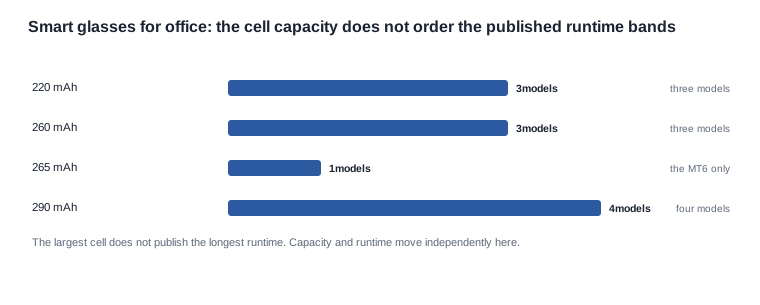
The chart above is the last of the power myths and the one with the widest commercial reach: a larger cell does not publish a longer runtime. The four camera models with 290 mAh cells publish about seven hours, while the three models with 220 mAh cells publish 5~8 h and 6~8 h, and the single 265 mAh model publishes about seven hours. Capacity and runtime move independently in this range, which means a buyer who reasons from the cell figure to the working day will be wrong in a way that no measurement of the published rows would have revealed.
The claims about the product itself that do not survive
It is certified
The catalogue presents a company-level export certification page whose content is imagery rather than wording, and that page shows ten patent certificates — eight appearance-design patents and two utility-model patents. The catalogue text contains no reference to CE, FCC or RoHS, and there is no per-model certification row anywhere in the range. So neither "the range is certified to those standards" nor "the range is not certified to anything" is a statement the catalogue supports. The accurate position is that a per-configuration position has to be requested in writing, and that a company-level statement does not answer the question.
For a buyer working into the European market, the framework to request against is the Radio Equipment Directive (EU) 2014/53/EU, which covers the radio path in these products. The electromagnetic compatibility directive (EU) 2014/32/EU is a separate instrument covering a different aspect of the product, and the two are confused often enough that a buyer who does not name the right one receives a document that does not cover the radio path. The list of documents to request per configuration is at the certification checklist.
It is light
One weight is published in the entire range: 158 g for the MT6, which is the glasses body including its 265 mAh cell and its camera and excluding the foldable charging case, and the case weight is not published. No other model publishes a unit weight, and no frame weight is published for any model in the range. So the statement "it is light" has no published basis for twenty-seven of the twenty-eight rows, and a buyer who needs a whole team to keep the same configuration in service has nothing to compare.
The replacement is a measurement on the units being issued, and the reason it matters is structural rather than cosmetic: a fleet in which some users are issued a heavier configuration will show a difference in how the units are actually used, and a deployment that fails on adoption is usually a deployment in which the configuration was not right for the person. The published rows behind this are the cell capacity, the charging interface and the case capacity per model, and the one weight figure that exists.
The AI feature makes it smart, and the Bluetooth version matters
Two separate claims, both of which need correcting, and they are the claims most often carried over from a consumer comparison.
On the AI feature: twenty of the twenty-eight catalogue rows carry an AI feature entry, which is a statement about a capability and not about an implementation. The catalogue publishes no implementation detail, no offline behaviour, no storage location, no data-handling model and no update mechanism for any of them. So the published position supports "this configuration carries an AI feature" and supports nothing further. What a buyer needs is a data-handling position for the exact configuration, and that is a document to request with the order. The boundary between an office configuration and a health claim is at the medical boundary reference.
On the Bluetooth version: the audio tier publishes 5.3 on the K01 and the K02 and 5.4 on the D11 and the D12, the YK12 and the LC-105-1, and the LC-105-2 and the G07, and the sport tier publishes 5.4 on the YKC02, the D17 and the ZH12. The camera tier publishes no Bluetooth version at all. So "5.4 is better" is a comparison that can be made inside the audio tier and cannot be made at all for a camera configuration, and a buyer who uses a radio version to rank camera models is using a figure that was never published for them.
The genuine pros and cons, and what they mean for a purchase order
What is left, once the nine statements are removed, is a set of advantages and disadvantages that are all narrow, all checkable and all usable. The table below is that set, with the consequence for a purchase order rather than a description of the product.
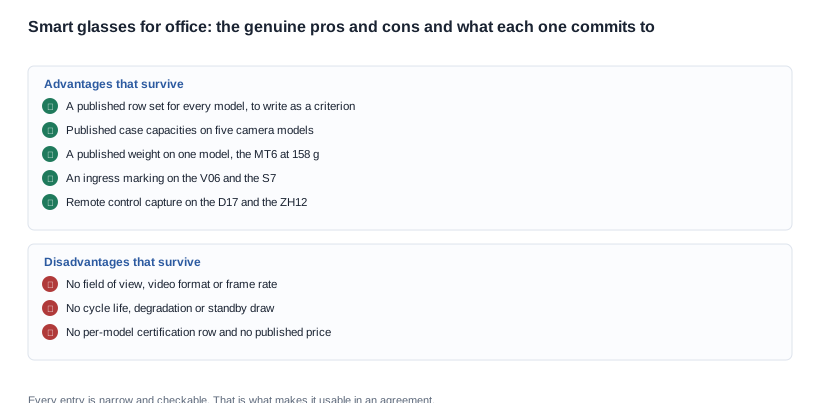

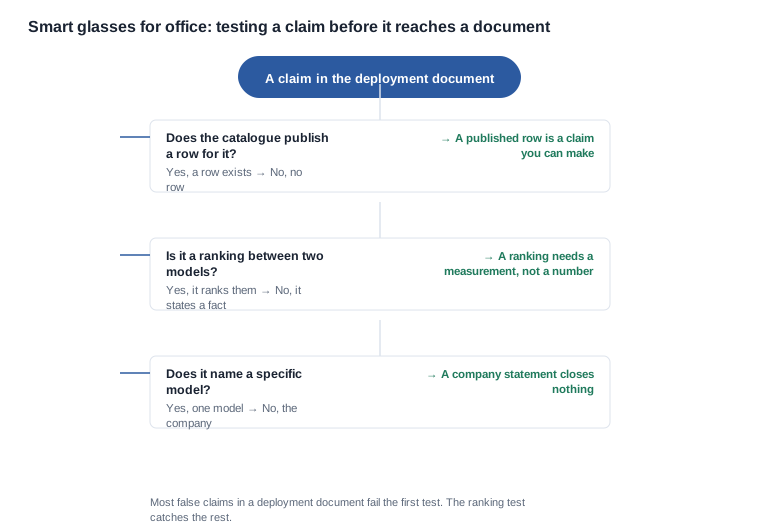
The two charts above are the working form of the correction. The checklist is the set of things that can actually be relied on, and the flow is the sequence that takes a claim out of a document and puts a check in its place. The rule underneath both is short: a claim that the catalogue does not support is replaced by a check that the receiving bay can run, and a claim that the catalogue does support is stated with the scope the catalogue gives it.
The advantage that is easy to miss: how many configurations you have to stock
One of the real advantages of this range is a published set of structural features that bear directly on how many configurations a buyer has to hold, and it is worth more attention than it usually gets because the alternative is a stock decision rather than a technical one.
The published features are these: a removable inner frame on the V06 and the S7, ultra-slim detachable temples on the G07, a slim temple with surround sound on the YK12, and the remote control capture published on the D17 and the ZH12. No model publishes a touch row, so a temple control surface is a question for the supplier rather than a stock line you can plan against. A team of twenty people issued a single model has to absorb a range of head sizes and a range of preferences, and every configuration the buyer has to hold is a configuration that has to be stocked, counted, charged and replaced. So the number of stock lines is a cost, and a published adjustment feature is a way of reducing it.
What the catalogue does not publish, and this is the limit of the advantage, is the adjustment range itself — how far the removable inner frame travels, what the detachable temples offer, and whether either of them is a factory option or a distributor option. So the feature narrows the question without closing it, and the closing question is a supply question rather than a product one: whether the adjustment arrives in the box, whether it is a separate stock line, and whether the range covers the team or only part of it.
The same question has a commercial edge, because a removable or detachable part is a second object to issue, to count and to lose, and an object that exists at a different level from the unit it adjusts. A buyer deciding between one adjustable configuration and two fixed ones is trading a stock line against a stock line, and the published features are the only part of that trade the catalogue informs.
The features and the published rows are set out per model in how to choose smart glasses for office, and the hardware that has to accompany the units is in the office gear checklist.
The distance between a published attribute and a promise, and the document to send us next
We publish what the catalogue states, and this article is about the distance between a stated attribute and a promise, so the form matters more than usual. For the camera tier that means the resolution class, the cell capacity, the charge time, the rated runtime, the charging interface where it is published, the charging case capacity where it is published, the structural features that are published, the colour counts, and the IP54 marking on the V06 and the S7 stated as a catalogue attribute. For the audio tier that means the Bluetooth version, the cell configuration, the charge time, the rated runtime, the charging mode, the surround sound published on the YK12 and the ultra-slim detachable temples published on the G07, with no touch row published for any model. For the sport tier that means the Bluetooth version, the cell configuration, the charge time, the rated runtime, the charging mode, the remote control capture and the surround sound published on the D17 and the ZH12.
We hold one position on claims, and it is narrower than it may look. We will not write "waterproof" on the strength of a published IP54 marking, we will not write "certified to CE, FCC or RoHS" on the strength of a company-level export page, we will not write "all day" on the strength of a runtime band, and we will not write "13 MP" as though it were a quality ranking. Each of those is a phrase a buyer can defend and a competitor can refute in one sentence with a catalogue. So we do not publish and will not estimate the frame material, the lens material, the coating, the hinge specification, the unit weight beyond the single 158 g whole-unit figure for the MT6, the field of view, the video specification, the storage and overwrite behaviour, the operating temperature range, the cycle life rating, the runtime test condition or the standby draw. Those are the rows a deployment has to measure for itself, and the measurement list is at the office test sequence.
Send us the document you are about to issue, the models it names and the claims it makes, and we will tell you which claims the published rows support, which ones have to be reworded, and which ones have to be replaced by a check at receipt. The gate structure that catches the specification gaps before the order is at the deployment gate checklist, the model selection logic is at how to choose smart glasses for office, and the scenario entry point is smart glasses for office.
Related reading
- The point where the scenario starts — smart glasses for office
- The rows we can confirm — battery life and camera imaging
- The claims boundary — the medical boundary
- The product family set — AI camera glasses and bluetooth audio glasses
Send us the document, the models and the claims, and we will tell you which claims the published rows support and which have to become a check at receipt.


