

The warranty that matters in an office is not the manufacturer's warranty. It is the one the organisation has already given — to its own staff, to a client, or to a reseller — and the relationship between the two is where the cost hides. A buyer who assumes they are the same discovers the gap when a unit comes back and the supplier considers it to be working perfectly. Six beliefs are worth correcting before that happens, and each one has a clause that settles it.
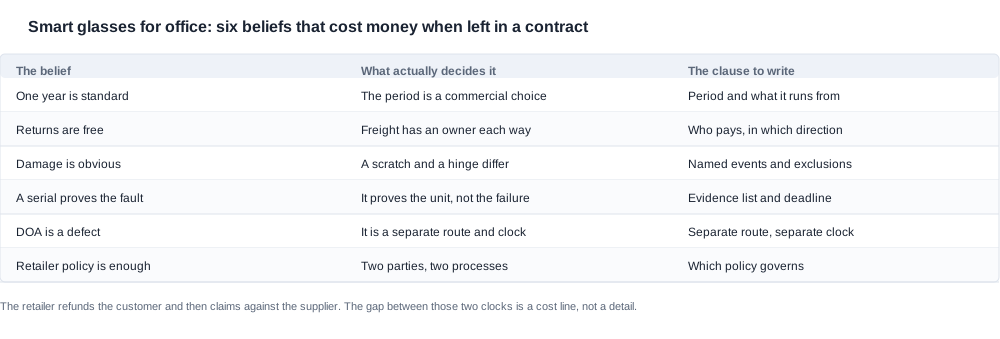
| The belief | What actually decides it | The clause to write |
|---|---|---|
| One year is standard | The period is a commercial choice | Period and what it runs from |
| Returns are free | Freight has an owner each way | Who pays, in which direction |
| Damage is obvious | A scratch and a hinge differ | Named events and exclusions |
| A serial proves the fault | It proves the unit, not the failure | Evidence list and deadline |
| DOA is a defect | It is a separate route and clock | Separate route, separate clock |
| Retailer policy is enough | Two parties, two processes | Which policy governs |
Smart glasses for office: not one warranty, but two separate clocks
A unit comes back. Two processes start. The organisation's own policy decides whether the user is refunded, replaced or left without, and when. The supplier's warranty decides whether the organisation is reimbursed, and how much the user actually gets back.
Those are two different processes with two different clocks, and the second one is where the money is. An organisation with a 30-day no-questions return policy and a supplier with a 45-day claim window has a fifteen-day gap in which the organisation has refunded and the supplier has not. That gap is a cost line, not an administrative detail, and it appears in the ledger as a number that is larger than anyone budgeted for.
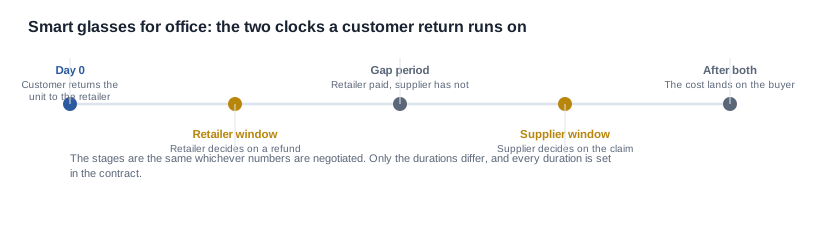
The stages above are the same whichever durations are negotiated; only the numbers differ. The consequence for the buyer is that the contract has to state two things, not one. It has to state the period the organisation gives its users, and it has to state the period within which the organisation may raise a claim against the supplier. The second has to be shorter than the first, or the claim route expires before the organisation has decided to use it.
Where the third party sits. Where a channel buyer is involved rather than an end user, a third clock appears between them: the retailer's published return policy, the buyer's claim window against the supplier, and the supplier's warranty. The structure is the same and the arithmetic is worse, because the retailer refunds immediately while the buyer is still assembling evidence. The field-work warranty comparison covers the same mechanism in a different deployment, and the contract terms page is where the three windows should be written against each other.
The trade-off to decide before the order, not after it. A generous user-facing policy with a short supplier claim window protects the user and strands the buyer. A tight claim window with a generous user policy protects the buyer and generates complaints. Neither is correct in general, and the right balance depends on the deployment: a device held at a desk in an office where a replacement is available within a day can carry a short claim window, while a device issued to a person who cannot work without it needs a spare-unit pool rather than a faster claim. What to ask is which of those two models the supplier supports, and the answer changes the total cost of the deployment more than the unit price does.
The clause to write is not a warranty period. It is a rule about which policy governs a return, a date by which the supplier must respond to a claim, and a stated position on freight in each direction. Those three together determine whether the gap between the clocks is a cost line or a rounding error, and they are the items most often left out of an order because they feel like administrative detail until the first quarter in which they matter.
How to assess the structure before you order. Three questions, asked of any supplier, tell you more than any published table would. What evidence does a claim need, and how long do I have to raise it? How long do you have to respond once I have? And what happens to the unit in between? The answers reveal whether the claim route is operational or notional. A supplier who answers all three with specific numbers has built a process, and the total cost of the deployment will reflect that. A supplier who answers with "we handle it case by case" has not, and the buyer who has not asked will learn it from the first batch that stalls. The questions to ask a supplier before you commit are the same ones we cover on the lead time page, applied to the claim route rather than to the production schedule.

Why the retailer policy and the supplier warranty are different instruments
They differ in three ways, and each difference produces a different failure if the contract does not acknowledge it.
Different parties, so different evidence. The organisation can see the unit, the fault and the user. The supplier can see the batch, the production date and its own test records. Neither has the other's evidence, which is why the claim route has to name what it requires. The moment a claim is assessed on evidence the supplier cannot obtain — because the fault happened in a corridor and nobody photographed it — the claim is decided by default rather than by record.
Different triggers. An internal policy triggers on the user's decision. A supplier warranty triggers on a defined event with a defined evidence condition. A unit that the user is unhappy with and a unit that has failed are different events, and a policy that treats them the same will generate claims that cannot be settled.
Different objectives. The organisation's policy is designed to keep a user working. The supplier's warranty is designed to define what a manufacturer is responsible for. Neither is dishonest, and the gap between them is where the money disappears.
Why this matters more in an office deployment than in a retail one. The office case has a device in the hands of a person rather than on a shelf, and a unit issued to a desk rather than to a user changes the ownership question. A device on a desk belongs to the organisation; a device issued to a person belongs to the organisation for the duration of the deployment but is in the person's custody, and the two produce different claims about what happened to it. The clause that settles this is not a warranty period either — it is a custody statement in the issuance record, and it costs one line.
A scratch, a cracked hinge and a cell that will not hold a charge
The exclusions clause is where office deployments lose money, because the ambiguity is expensive on both sides. A scratched lens, a cracked hinge, a device that will not connect after a software update, a device that will not hold a charge, and a device with a dead speaker are five different things, and a clause that says "normal wear and tear is not covered" gives the supplier a defence against all five.
The rewrite names the covered events and names the exclusions. Covered: manufacturing defect, component failure, cell failure. Excluded: physical damage, liquid ingress, unauthorised repair. And a cracked hinge is treated separately, because in an office a hinge failure is a fatigue failure and a scratch is a wear event, and the two have different causes, different evidence and different remedies.
The published data helps with one exclusion in particular. The catalogue publishes the IP54 marking on the V06 and the S7 as a catalogue annotation without a third-party test report number behind it, so a claim about liquid ingress has to be assessed against the marking rather than against an assumption that the device is sealed. The IP ratings page sets out what the marking does and does not mean, and the practical consequence for a claim is that the marking is evidence of a design specification, not evidence of a sealed unit in a particular incident.
The cell that will not hold a charge is the one that needs a history. A cell that fails inside the warranty period is a covered event. A cell that fails after two years of daily use is a question about how it was used. What distinguishes them is a record: the charge cycles, the runtime trend, the date of the first symptom. An organisation that keeps that record has a claim; an organisation that does not has an argument, and the argument is usually lost. The maintenance routine that produces the record is worth writing into the deployment for this reason alone, quite apart from its operational value.
A cracked hinge is the exclusion most often left undefined. It is a fatigue failure, it is common in a device that is put on and taken off several times a day, and it is easily confused with physical damage in a claim assessment. The clause should say explicitly which one it is, because an undefined hinge failure produces a dispute on every unit that shows one.

Dead on arrival is a separate route with a separate clock
A dead-on-arrival claim is about a unit that never worked. A defect claim is about a unit that stopped working. They need different evidence, they take different times, and they are decided by different people. Without the separation, a batch of units that arrive dead sits in the standard claim process, the standard evidence pile and the standard queue, and it consumes the whole first month of the deployment.
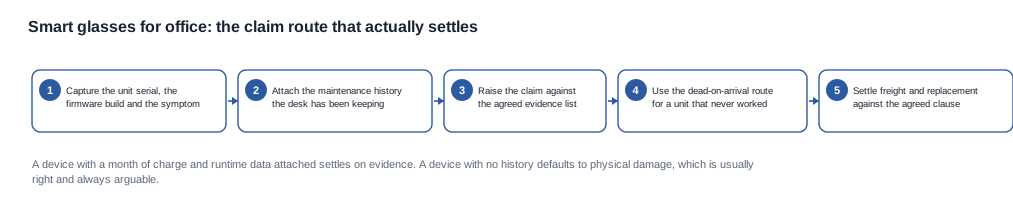
Why the separation is commercially necessary. A dead-on-arrival claim has a short evidence requirement: the unit, the batch, the fact that it did not function on receipt. A defect claim needs a history, and a history cannot be manufactured after the fact. A batch of forty units that arrive dead and are handled through the defect route will arrive at the supplier as forty claims with no history, and they will be assessed individually rather than as a batch, which is both slower and less favourable.
What a dead-on-arrival batch usually is. In this category it is usually one of three things: a packaging or transit problem, a cell or charging problem at the factory end, or a configuration mismatch between what was ordered and what was shipped. The third is the one that matters most, because it is a discrepancy between the purchase order and the delivered unit, and it is documented by the model designation on the unit against the model designation on the order. The office troubleshooting article covers the diagnostic side, and the office common problems page is where the fault names should be written down once.
The freight question has a lithium cell in it. A returned device with a lithium cell travels under the same transport rules as a new one, which means the packaging requirement applies to the return as well. Asking a customer to repack a used device properly is an instruction that has to be given in writing, and it has to be given in the return procedure rather than discovered by a customer. The battery transport route covers the framework, and the logistics page covers the freight structure that goes with it.
The spare-unit policy is the clause that decides whether a dead batch stops the deployment. A policy that says the supplier will supply replacements on receipt of the failed units is very different from one that says replacements are supplied after the claim is assessed, because the second version puts the unit count at zero in the meantime. For a deployment where the units are the only tool of the task, that difference is measured in days of work for every person waiting.
What the criteria for a settled claim look like. Four items, and each one is something the organisation can produce or the supplier can produce. The unit, identified by its serial. The batch, identified from the packaging or the unit. The fault, named from the agreed vocabulary. And the history, if the fault is not dead on arrival. A claim with all four is assessed on record, and a claim with one of them missing is assessed on assertion. The signs that a claim route is working rather than merely existing are simple: claims are answered inside the stated turnaround, the fault names in the data match, and the number of unresolved claims does not grow month on month. Those three measures are worth asking for, because a supplier that publishes them is a supplier whose process can be compared.

The clauses that make a claim settleable
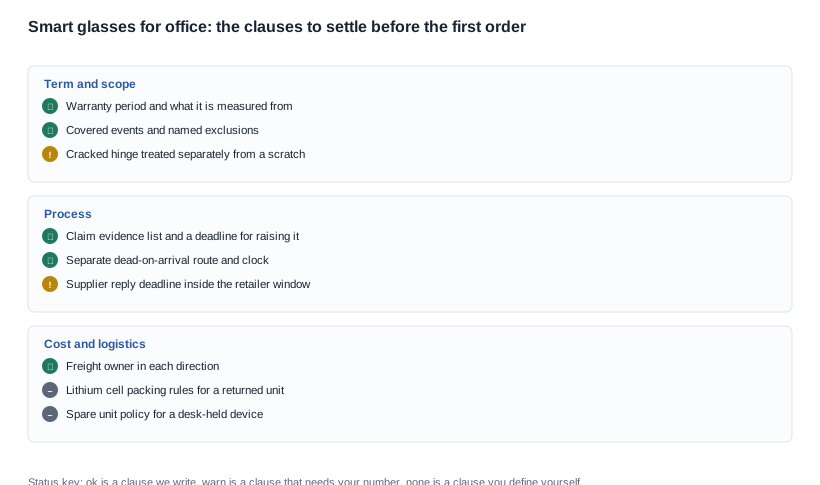
Eight clauses decide whether a claim settles. Each of them is cheap to write and expensive to omit.
The period and what it is measured from. One year is a convention rather than a physical fact. The period is measured from something — shipment, invoice, or first use — and the choice of that starting point is worth more than the number. A period measured from first use is easier to defend than one measured from the invoice, and a period measured from the invoice is often unenforceable in practice because the buyer cannot prove when the unit was put into service.
The covered events and the named exclusions. Manufacturing defect, component failure and cell failure as covered events; physical damage, liquid ingress and unauthorised repair as exclusions; the cracked hinge treated separately.
The evidence requirement and the deadline for raising a claim. The evidence is usually the unit serial, the firmware build, a description of the symptom, and — for a fleet — the log the maintenance routine has been keeping. The deadline has to be longer than the organisation's internal review cycle, which is longer than most people expect.
The supplier response deadline inside the organisation's own return window. This is the clause that closes the gap between the two clocks. A supplier permitted fifteen working days to respond to a claim against an organisation that refunds in thirty days is a supplier who is being paid to hold the organisation's cash for two weeks, and that is a commercial decision rather than an oversight.
The freight owner in each direction. Rarely free in either direction, and the return direction has a packaging requirement attached to it.
The separate dead-on-arrival route and its clock. A short window, a short evidence list, and a stated remedy.
The spare-unit policy for a desk-held device. Whether replacements are supplied on failure, on assessment, or not at all, and whether the organisation holds a small spare pool.
The naming of the receiving entity. A claim handled by a party it was not sent to is a claim that does not arrive, and the single most common cause of that is that the contracting entity, the shipping entity and the invoicing entity were not the same. Confirming it in the agreement costs nothing.
What we write into the contract and what we will not
Our warranty period, the covered events, the returns route, the return authorisation turnaround, the freight arrangement and the spare-unit policy are not published as a standing table. They are set in the contract for the specific order, because they depend on the configuration, the quantity and the destination, and a published table would be wrong for most of the orders it was read against. We will write the period, the covered events, the exclusions, the claim window, the evidence requirement, the turnaround, the freight arrangement and a separate dead-on-arrival route into the agreement, and we will confirm the receiving entity so that a claim is handled by the party it was sent to.
What a claims assessment depends on. The published specifications are the ones an assessment can actually use: the cell capacities and their cell counts, the charging interfaces, the case configurations, the ingress marking where the catalogue carries one, and the rated runtime figures with their stated caveats. The unit weight of every model except the single whole-unit figure published at 158 g for the MT6, the ingress test report numbers, the certification numbers and the acoustic figures are all not published, and a claim cannot be assessed against a figure nobody holds.
Why the marking matters for a claim. Two claims in this category look identical and are not. A unit that arrived with an ingress marking and later shows water ingress has a claim that can be assessed against the marking. A unit that arrived without one cannot be assessed at all, because there is no published figure to assess it against and no report number to check. This is a reason to confirm the marking on the model you are ordering in writing, before the order, rather than to discover the difference when a claim is in dispute.
The due-diligence version of the same point. A supplier who can state, per model and configuration, which documentation they hold and which they do not, is a supplier whose claim route will work. The certification scope of a specific model is one of those documents, and the catalogue we publish does not carry a per-model certification row at all, so it is something to request in writing and to check before the order rather than a fact to assume. The certification checklist is the request list, and the factory audit route is how a buyer confirms the capability rather than the promise.
The three things we will not put in an agreement. We will not put a figure we cannot evidence. We will not put a promise that a characteristic performs in a way we have not tested, including a claim about a protection level that the catalogue does not carry a test report for. And we will not put an acceptance figure for the organisation's own deployment — the adoption rate, the complaint rate and the return count are yours to set and yours to measure, and an agreement that names them in advance is an agreement about something that has not happened yet.
What we will do before the order. Take the configuration, the quantity, the destination, the deployment model and the expected duration, and tell you the warranty and returns structure we would propose for it, the evidence we would need from you, and the delivery route for a returned unit. The quality consistency page covers the batch record that supports a claim, and the published model data is on the AI camera glasses range and the sport smart glasses range.
Related reading
- Camera and audio smart glasses range
- Warranty and returns for field-work deployments
- Common problems in the office
- Troubleshooting for teams
Tell us the configuration, the quantity, the destination and the deployment length, and we will write the period, the covered events, the exclusions, the claim window and the freight arrangement into the agreement for that order rather than for a category.


