
If you take three things into an office evaluation, take the target market and the realistic annual volume, an honest description of where the device will actually be used, and the person who will carry it. The specification sheet settles the electrical rows — cell capacity, charge time, rated runtime, charging interface — and it settles them without you. What it cannot settle is whether the unit belongs in a meeting room at all, whether its data handling fits your rules, and whether the person carrying it will still have it on at four in the afternoon. Those three are why an office evaluation that only compares specification sheets produces a device that procurement liked and nobody uses. This is the working method for smart glasses for office procurement: the seven items to carry into the meeting, the documents that have to arrive with the quotation, the four ways an office evaluation misleads the buyer, and the commercial terms that are fixed before any negotiation starts.
Smart glasses for office: what a supplier demo is really for
A supplier demo is arranged around what the supplier wants to show you. The video plays, the translation runs, the assistant answers, the packaging is neat, and you leave with a good impression and no decision. That is not a supplier failing you; it is the natural output of a meeting where the agenda belongs to the seller.
The reader of this guide is a procurement manager, a channel buyer or a brand owner who has been invited to a demonstration and knows that the demonstration is not the evaluation. The task in front of them is a selection decision with three commercial sub-tasks hidden inside it: which configuration tier is worth a sample order, which documentation has to be settled before a deposit, and which claims the finished listing can carry without creating an expectation the product cannot meet. The fear behind it is specific and unglamorous — a rollout that is announced internally, stalls in week two on a policy question nobody asked, and leaves a small pile of units in a drawer.
What "office" actually covers. Office use is not one thing, and a buyer who treats it as one thing is the source of most of their own problems. A desk-based worker on two hours of calls a day has a completely different requirement from a site supervisor walking a floor for six hours, and a third again from somebody in a meeting room where a camera is not acceptable. The catalogue itself splits along this line. The eight audio models are published with open-ear Bluetooth behaviour, cell capacities from 55 mAh per side up to 100 mAh per side, rated runtimes between about six and about eight hours, and either a magnetic or a Type-C interface. The eleven camera models are published with sensor classes, cell capacities from 220 mAh to 290 mAh, and rated runtimes that fall into the five-to-eight-hour band, the six-to-eight-hour band and the roughly-seven-hour band.
Where the cost actually sits. In this category the unit price is rarely the reason a quotation goes wrong. The reason is the configuration: whether a charging case is in the box, whether the charging interface is magnetic or Type-C, and whether the audio or the camera row has been chosen at all. Each of those three changes the bill of materials, the declared shipping weight, the artwork, the transit file and the returns profile, and each of them is decided before the first unit exists. A buyer who arrives with a volume and a market and no configuration decision will receive quotations that differ by a wide margin for reasons that have nothing to do with margin at all.
Seven items to carry into the meeting, and the decision behind each
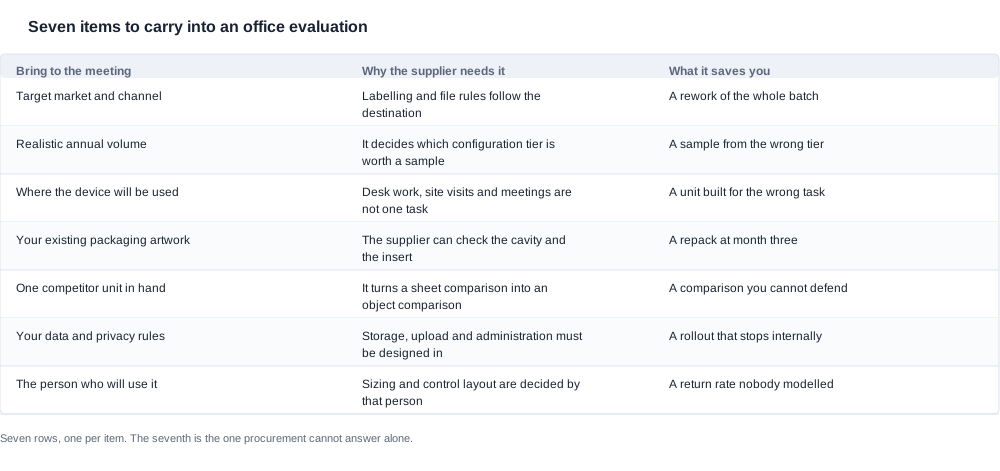
The seven items below are not a shopping list. Each one is a question you cannot answer from a datasheet, and each one exists because a specific commercial decision hangs on it. The table is the version you can hand to someone else; the paragraphs underneath explain why the seventh one cannot be delegated to procurement.
| Bring to the meeting | Why the supplier needs it | What it saves you |
|---|---|---|
| Target market and channel | Labelling and file rules follow the destination | A rework of the whole batch |
| Realistic annual volume | It decides which configuration tier is worth a sample | A sample from the wrong tier |
| Where the device will be used | Desk work, site visits and meetings are not one task | A unit built for the wrong task |
| Your existing packaging artwork | The supplier can check the cavity and the insert | A repack at month three |
| One competitor unit in hand | It turns a sheet comparison into an object comparison | A comparison you cannot defend |
| Your data and privacy rules | Storage, upload and administration must be designed in | A rollout that stops internally |
| The person who will use it | Sizing and control layout are decided by that person | A return rate nobody modelled |
Target market and channel. The destination determines the file set you will have to live with, and the file set is not a formality. It determines the labelling, the instructions, the language count on the carton and insert, the conformity documentation you will be asked for at the border, and whether the retailer who takes your units has a documentation request of their own. This matters more than it sounds because the catalogue itself does not carry a per-model certification row anywhere: the export certification page in the catalogue is a page of images rather than text, and the catalogue text contains no reference to CE, to FCC or to RoHS at all. In other words, the certification status of a specific model, for a specific destination, is a document you have to obtain in writing from the supplier — it is not something you can read out of the product pages. Buyers who arrive without a destination discover this at the deposit stage, which is the worst possible moment.
Realistic annual volume. Volume is not a negotiating posture in this category; it is a technical selector, because it decides which configuration tiers are even worth sampling. The minimum order quantity is not published per model in our documentation, so you will be told the threshold rather than read it. A brand planning a broad channel launch and a distributor trialling one hundred units are not evaluating the same product, and the same factory will offer them different configurations because the tooling and artwork amortise differently. Give the real number, including the number you would order in the first year and not the number you hope for in the third.
Where the device will be used. This is the item most often answered with a shrug, and it is the one that determines whether a camera row is even appropriate. Desk work, a warehouse floor and a meeting room are three different products. If any part of the deployment involves a space where recording is restricted by policy, then a camera model is a policy problem before it is a hardware problem — and corporate buyers write camera-device policies before they write budgets for them. A device that arrives without a written answer on storage, upload and administration will be stopped by whoever owns the data rules, and that stoppage is invisible in the quotation.
Your existing packaging artwork. If you already have artwork for this channel, show it at the evaluation rather than after the first shipment. The cavity has to hold the unit, the charging case if one is in the box, the documentation and the cable, and the insert has to carry whatever the quick-start guidance says. A device that arrives in your own box but does not sit in the cavity properly is a repack at your cost, and it is discovered at month three when the artwork is already printed. The reverse case matters too: telling the supplier your cavity dimensions lets them propose a configuration that fits, which is cheaper than designing around what they happen to ship.
One competitor unit in hand. Bringing a competitor device sounds adversarial and is not. It converts a comparison of two specification sheets into a comparison of two objects, and the two produce very different conclusions. Resolution class is a simple number to compare: eight of our camera models publish an 8-megapixel sensor class and three publish 13 megapixels. Sizing, control layout, case thickness, the way the unit sits on a face and the way it sounds in a quiet room are not simple numbers, and they are what actually determines whether a team keeps the device. Ask the supplier to put both units side by side and to comment on the difference. A supplier who is confident will explain the trade-off honestly, including where their own model is worse.
Your data and privacy rules. This is the item that is given to the supplier rather than shown to them, and it protects the date more than anything on the specification sheet. Where the files live, whether they are uploaded to a service, whether an administrator can reach them, and where the data physically sits are all unpublished for our models. You cannot answer those questions from a catalogue, and you cannot ask them meaningfully without telling the supplier what regime you work to. For a corporate or public-sector customer, that regime is already written. Your product has to satisfy it.
The person who will use it. Read that row twice. An office evaluation run entirely by procurement produces a device that procurement liked. How a frame sits on a face, whether the temple controls are reachable without turning your head, and whether the person has it on an hour later are not decisions a procurement manager can make on someone else's behalf — and they are the decisions that determine whether the unit comes back. Frame weight is unpublished for almost every model in our catalogue, and no bare frame weight is published for any model at all; the single published weight figure is 158 g for the MT6, and that is the weight of the MT6 glasses body including the 265 mAh cell and the camera, excluding the foldable charging case. So the honest conclusion is that sizing has to be established on a sample with the actual person, and the weight figure you may quote for that sample belongs to the MT6 alone.
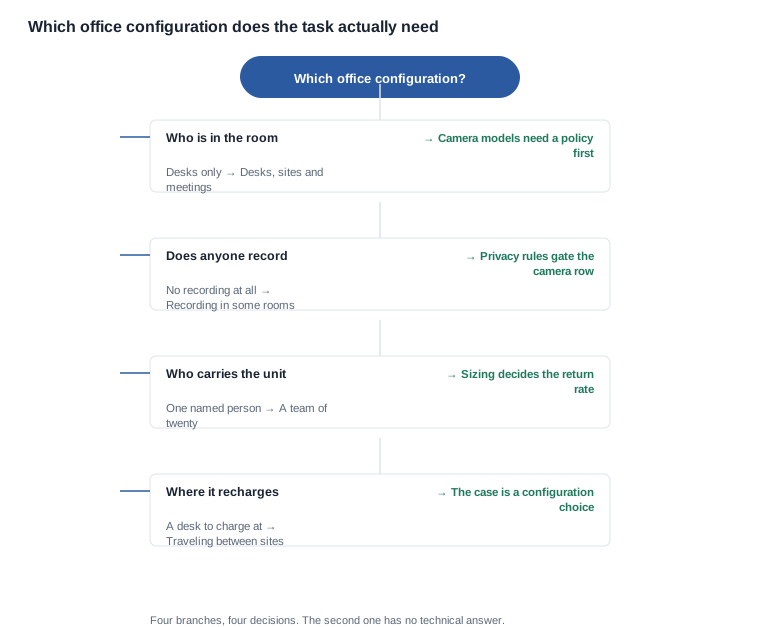
Why the environment question does more work than the sheet. Once you have described the environment honestly, the published rows start to select themselves. For a desk-based audio deployment, the published runtimes of about six to eight hours cover a working day with margin, and the interface decides whether the unit recharges from a cable the user already owns or needs a dock on the desk. For a supervisor on a floor, the camera models come into scope and the case decision becomes decisive: the catalogue publishes a 1400 mAh case on the CY03 and the L1 Pro, and the CY05, a choice of 900 or 1400 mAh on the L2 Utral, and a 1200 mAh foldable case on the MT6. The KY06 and the MT5 ship with a case whose capacity is not published, the V06 and the V03 Pro, and the V03 and the S7 have no charging-case row in the catalogue at all. Those are three different answers, not two, and the difference is a battery-transport obligation and a price-ladder decision at the same time, with the four that carry no row the group a buyer has to ask about first.

The documents that have to arrive with the quotation
Verification is where most office deals quietly fail, because the questions are asked verbally and the answers are interpreted generously. The order below is the sequence we would use, and each step has a completion condition that can be checked by someone other than the buyer.
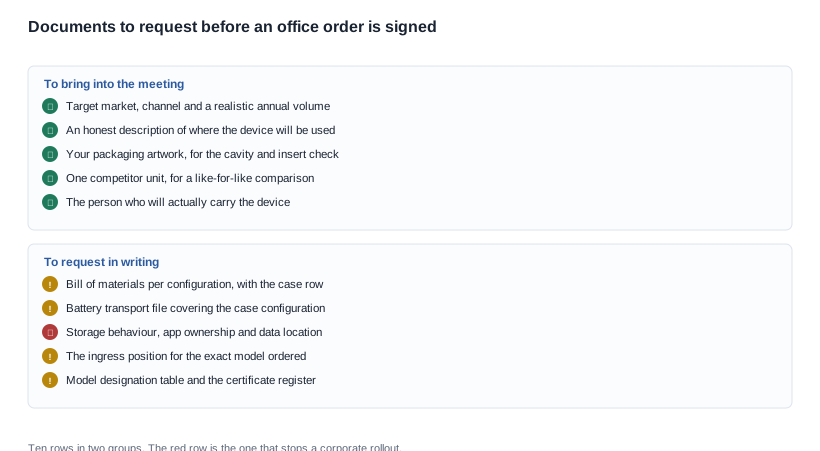
- Ask for the bill of materials per configuration, in writing. A verbal "what is in the box" is not a bill of materials. The document has to name the unit, the case if any, the cable or dock, the documentation and the packaging for each configuration you might order, because the packing station, the freight forwarder and the returns desk all need the same list.
- Ask for the battery transport documentation for that exact configuration. If a charging case is in the box, the configuration contains a second lithium cell and the file has to cover the configuration as shipped, not the device alone. The requirement is set out at battery transport; the narrow question for the supplier is whether the file covers the configuration you are actually ordering.
- Ask for the charging interface in writing for every model on the shortlist. Four of the camera models publish no charging-method row at all — the MT6, the L1 Pro and the CY05, and the CY03 have cell capacity, charge time, runtime and case capacity published, and no interface line. Their case capacities are published (1400 mAh for the first three, a 1200 mAh foldable case for the MT6), so "way of charging is not published" is not the same as "way of charging does not exist". Write the question down and require an answer per model.
- Ask for the storage, upload and data-location position in writing. This is the item that decides whether a camera model can go into a corporate environment at all, and it is the item most often answered with a description of a companion application rather than a commitment.
- Ask for the ingress position for the exact model. Two models in the whole catalogue carry an IP54 marking — the V06 and the S7 — and that marking is published as a catalogue attribute with no third-party test report behind it. For every other model, no ingress rating is published. The digit reading is at IP ratings. If your customer needs a documented rating, you need a report, and a report is a lead time, not a catalogue entry.
- Ask for the model designation table and check every certificate number in the issuing body's public register. The procedure is at certification checklist. Note what our catalogue does and does not carry: the export certification page holds ten patent certificates as images — eight appearance-design patents and two utility-model patents — and the catalogue text contains no CE, FCC or RoHS reference and no per-model certification row. That is the honest position, and it is why the register check is a step rather than a formality.
- Confirm the acceptance criteria before the first shipment, not after it. The incoming inspection criteria for the first article, the packing drop test, the labelling check and the documentation pack are all things a factory can agree to in advance. The clause language sits at contract terms, and the commercial structure of a first order is at pricing.
- Run the questions to ask list before the sample arrives, not after. The sample is for the things that cannot be answered on paper: sizing, control reach, how the unit behaves in the actual environment. The questions that can be answered on paper should be answered on paper, otherwise the sample visit becomes the entire evaluation and the buyer inherits a technical negotiation that the supplier should have had.

Four ways an office evaluation misleads the buyer
These four are the ones we see repeatedly in this scenario, and each of them has a prevention that costs nothing.
The demo that shows the wrong configuration. A demonstration unit is usually the configuration with the most visible features, which is rarely the configuration with the best total cost for your volume. The result is a positive impression attached to a unit you will not order. The prevention is to ask, before the demonstration starts, which model is in the box, what the configuration is, and which configuration the quotation will be based on.
The storage question answered with a feature description. "It syncs to the app" is not an answer to where footage is stored and who can reach it. A buyer who accepts a feature description as an answer to a governance question buys the device twice — once for the pilot and once for the policy review. The prevention is to require the answer in writing, and to read it against your own rules before you accept it.
The unit that was evaluated by the wrong person. This is the failure that produces the worst commercial outcome, because the purchase succeeds and the rollout does not. A procurement manager can judge the specification, the quotation and the packaging; only the person who will carry the device can judge whether the temple geometry suits them, whether the control is reachable, and whether they would have it on in hour four. The prevention is to send that person to the sample evaluation and to treat their objection as a finding rather than an opinion.
The package that does not suit the channel. The device works, the specification is right, and the unit arrives in a box that fails a retailer's presentation standard or in a cavity that does not hold it. Nothing in the evaluation caught this because the evaluation examined the device and not at the packaging. The prevention is to bring the artwork to the meeting, as the fourth item above, and to check the cavity before the artwork is printed rather than after.
A fifth pattern is worth naming because it is the one buyers mistake for a product defect: the expectation gap on a page you wrote. A listing that implies night capability, water resistance or a video resolution the catalogue does not publish is describing a product that does not exist, and the customer who buys on it is the customer who returns it. That one is fixed on the page, not in the product, and it is the subject of the ecommerce measurement article.
Where our published rows stop and your sample starts
It is worth being precise: we publish the rows a buyer can order from, and we will not fill the gaps with industry averages. For office deployments that means the resolution class, the cell capacities, the rated runtime bands, the charge times, the charging interface where it is published, the case capacities where they are published, the structural features that are published — the detachable temples on the G07 and the YK12, the removable inner frames on the V06 and the S7, the remote capture control on the D17 and the ZH12, the photochromic lenses and flexible temple on the V03 Pro — and the colour options.
What we do not publish, and will not estimate: the field of view, the video format, the frame rate, the storage capacity and transfer path, the low-light behaviour, the stabilisation behaviour, the per-model unit weight beyond the single 158 g whole-unit figure for the MT6, the runtime test conditions, the ingress test report numbers, and the per-model certification status. We will also not state that any product in our range is tested to IP54, because no test report is published behind that marking, and we will not extend it to any model beyond the two that carry it.
What is fixed before the negotiation and what is not. The sensor class, the cell capacity, the charge time, the runtime band and the charging interface are published facts; they are not a negotiating position and a supplier who treats them as one is telling you something about how the quotation was built. The certification cost and lead time, the tooling cost amortised across the first order, and the battery transport documentation are fixed in the same way — they are physics and compliance time, not commercial goodwill. What is genuinely open is the configuration, the packaging, the artwork, the payment structure, the shipment split, the warranty length, the sample order cost against the first order, the minimum order quantity tier, and whether two models can share a purchase order. Those are the four areas where the room actually is: configuration and packaging first, because they change the bill of materials; then the payment structure and the shipment split, because they change the factory's exposure; then the warranty and the sample cost, because they change your exposure; and the volume tiers last, because they are usually already priced.
A worked example. Take a European corporate reseller that has decided to list one audio model and one camera model under its own brand, for a channel that sells to office suppliers rather than to the public. The first decision is the interface, because it settles the kit: taking the Type-C route, the case becomes optional rather than mandatory, so the camera model is configured with a 1400 mAh case sold as a separate accessory and the audio model ships without one. The second decision is the camera row itself, because the customer list includes meeting-room work, and the storage answer has to exist in writing before that row can be listed at all. The third decision is the documentation: the transit file is the item that has to be settled before the order rather than after it, because it covers the case configuration. The outcome is two price points from one platform, a bill of materials you can explain line by line, a claim set the listing can carry without overreaching, and an evaluation that produced a decision instead of an impression.
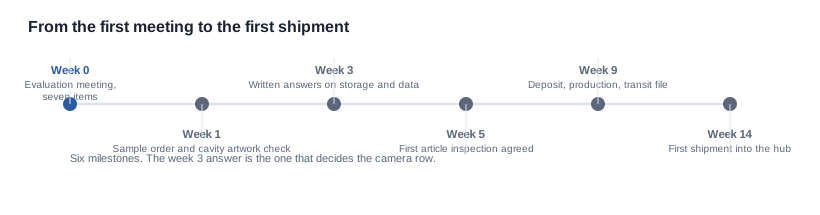
The sequence above is the seven-item method turned into dates, and it is worth reading as a plan rather than as a schedule: the week 3 answer is the one that decides whether a camera row survives, and everything after it depends on that answer being in writing.
What to send us next. Send the target market and channel, the realistic annual volume, a short description of where the device will be used, and whether a camera row is in scope at all. We will tell you which published rows cover that configuration, which questions have to be settled in writing before a purchase order, and where the published data stops. The office deployment guide sets out the constraints that matter in that environment, the camera range and the audio range list the per-model figures, the charging plan is at charging solutions, and the field-work material at the field work buying checklist and the field work model guide covers the deployment side of the same decisions.
Related reading
- The scenario's opening — smart glasses for office
- The published entries — battery life
- The alternative scenario — the field work glossary
- The measurement discipline — measuring results after launch
Tell us the market, the volume and where the device will be used, and we will return the published rows that cover it and the questions that have to be settled in writing first.


