Most buyers treat support as a single thing — a warranty — and then discover at month four that a warranty answers almost none of the problems outdoor use actually produces. The more useful way to look at it is as a cost structure: a set of problem families, each of which has one resource that resolves it, and each of which is either funded before launch or absorbed as a return. Only one of the families is a warranty claim.
That reframing changes what a buyer asks for. Instead of "what is your warranty", the question becomes "which of these five families am I carrying, and what does each one cost me per thousand units". A brand that answers that question before the first order can put a number against each family and decide which ones to fund, which ones to document, and which ones to decline.
Smart glasses for outdoor: support as a cost structure, not a promise
The five families, and the one that is a warranty claim
The first family is retention. A unit that rotates on a descent has not failed; it has been adjusted for the wrong wearer, and no warranty term will produce a unit that sits where it should. The second is endurance expectation: a unit that runs shorter on a cold morning is behaving correctly, because cell behaviour at low temperature is chemistry rather than a defect, and the resolution is a published reference rather than a repair.
The third family is firmware, and it is the most under-used support channel in the category. A unit that behaved correctly until an update is a support case rather than a hardware fault, and the single question that determines whether it is cheap or expensive is whether rollback is available. The fourth family is the interrupted charge — a contaminated contact on a magnetic interface — which is the cheapest problem in the category to resolve and the most common one, and which responds to a consumable rather than to a repair.
The fifth family is the largest and the least discussed: units that work and do not meet the expectation set at the point of sale. No support process fixes that, because nothing has failed. It is fixed upstream, by the claim set and by the wording on the product page, and it is the family that decides whether a channel's return rate is a support cost or a marketing cost.
What our own support terms do not publish
Four terms decide most of the support cost in an outdoor programme, and none of them is published in our catalogue: the warranty period, the service turnaround time, the spare-parts horizon and the firmware support window. They are not published because each of them depends on the configuration and the programme rather than on the product alone, and a single figure quoted as a standard would be wrong for most of the lines a channel actually sells.
The practical consequence is that a buyer cannot compute the support cost of a candidate model from the catalogue at all. What a buyer can do is put the four terms into the request, get written answers against a named model and a named quantity, and compare suppliers on the answers. A supplier who declines to answer those four in writing has told the buyer something useful, and it is more useful than a generic period quoted in a brochure.
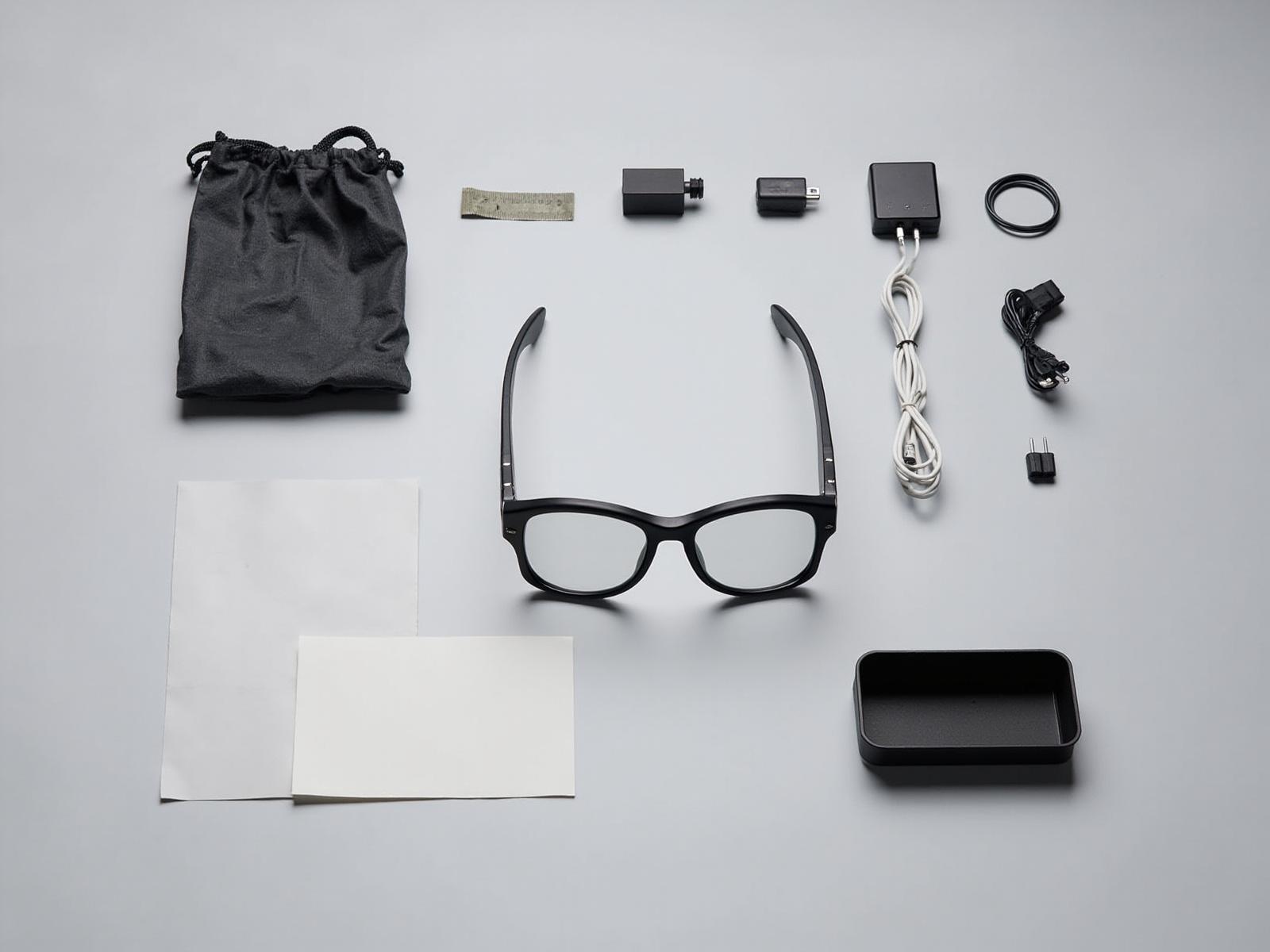
The resource that resolves each family, and what it carries
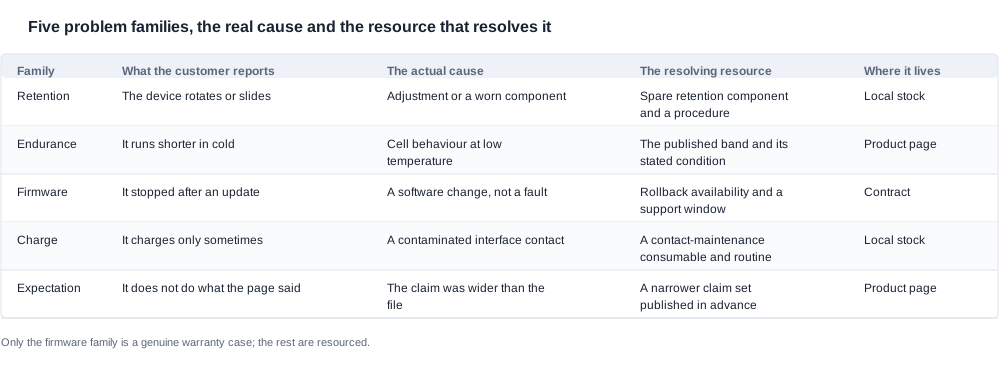
| Problem family | What the customer reports | The actual cause | The resource that resolves it | Where it has to live |
|---|---|---|---|---|
| Retention | The device rotates or slides | Adjustment or a degraded retention component | A spare retention component and a written procedure | Local stock |
| Endurance expectation | It runs shorter in cold | Cell behaviour at low temperature | The published rated-use figure and the stated condition | Product page |
| Firmware | It stopped working after an update | A software change, not a hardware fault | Rollback availability and a stated support window | Contract |
| Interrupted charge | It charges only sometimes | A contaminated contact on the interface | A contact-maintenance consumable and a routine | Local stock |
| Expectation gap | It does not do what the page said | The claim was wider than the documentation | A narrower claim set, published in advance | Product page |
The last column is the one that determines the cost. A resource that lives in the product page costs nothing to ship and cannot be delivered late. A resource that lives in local stock costs inventory and storage but resolves the problem in hours. A resource that lives in the contract costs nothing until it is needed and then has to be enforced.
Retention components are a consumable, not a replacement
The published structural fact that makes this family manageable is narrow but decisive. One frame fact does the work: an inner frame that detaches is published for the S7 and the V06, and the V06 is also published with an ergonomic frame design. Those are the only two models in the outdoor range where a part replacement rather than a whole-unit replacement is published as possible, and that single fact changes the economics of the family.
A channel that stocks one inner frame per unit has turned a warranty cost into an accessory sale and a repair into a five-minute swap. A channel that does not stock them converts every retention failure into a return, and a return costs the unit, the freight in both directions, the inspection and the resale discount. The difference between those two outcomes is the stocking decision, and it has to be made before the launch rather than discovered in the first month of returns.
There is a second, quieter reason to hold retention components locally. The population of units that need a different adjustment is predictable in advance, because it is a proportion of the population, while the population that has actually failed is not. Local stock converts a predictable proportion into a planned line item; a factory-shipped replacement converts it into a waiting period that the customer experiences.
Charging interfaces are a spare, and the interface is the part that matters
A spare cable is not a spare interface. The catalogue publishes three charging arrangements and the distinction matters more in a support context than it does in a product context: magnetic on seventeen entries, Type C on seven, and not published on four camera models — the MT6 and the CY05, and the L1 Pro and the CY03, where the catalogue gives the cell capacity, the charge time, the runtime and the case capacity but no charging-method row at all.
The consequence for support is that the spare-parts list has to be built per model and per interface, not per product family. The D17 and the ZH12 are Type C and publish a charge time of about one hour; the V06, the S7 and the YKC02 are magnetic; and the four camera models whose interface is not published cannot be given a correct spare at all until the interface is confirmed in writing. A support programme that stocks one cable per model because the models share a brand will run out of the right one in the first hard week of the season.
Contact hygiene is the cheapest support cost in the category
An intermittent charge on a magnetic interface is the most common fault a buyer will meet and the easiest to misdiagnose. The symptom reads as a failing cell, and a failing cell reads as a warranty claim, and the warranty claim is the most expensive possible route through a problem that a dry wipe resolves in seconds.
The consumable that resolves it is not in the catalogue and does not need to be. What the catalogue needs to support is the routine that keeps the contact free of obstruction, the instruction that the frame and the case are both rubbed down with a dry cloth before the fault is logged, and the decision rule that a unit whose contact has been rubbed down and that still refuses to charge is a different case from one that has not been. The diagnostic procedure is set out at outdoor troubleshooting, and the routine that prevents most of it is at outdoor maintenance.
A rollback clause is worth more than a spare unit
Firmware support is where the support cost of an outdoor programme either stays small or becomes unbounded, and the deciding factor is not the quality of the update but the availability of a way back. An update that degrades a unit and cannot be rolled back has effectively ended that unit's service life, and the only remedy left is a replacement — which means an unscheduled warranty claim, a return, a freight cost and a customer who concludes that the product is unreliable.
The clause is short: confirm whether rollback is available for the firmware version shipped with the ordered configuration, and confirm the support window during which a rollback stays available. Both answers have to be in writing and attached to the configuration rather than to the model, because a firmware baseline can change within a model's life.
Which models can be repaired by part and which are written off
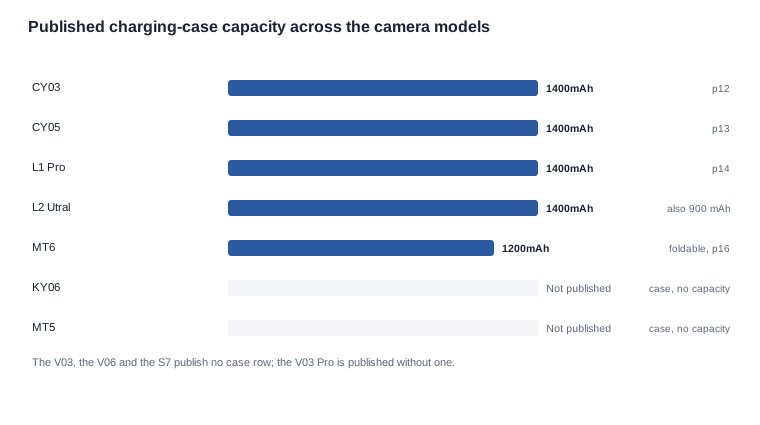
The case capacities above are the published ones. Five camera models state one: 1400 mAh each for the L1 Pro and the CY03, and the CY05, 900 and 1400 mAh for the L2 Utral, and 1200 mAh for the foldable case on the MT6. Two others, the KY06 and the MT5, publish that a case exists without stating its capacity. The V06 and the V03, and the S7 publish no charging-case row at all, and the V03 Pro is published explicitly as a configuration without a case.
That is three different states, not two, and a support programme that treats them as one will stock the wrong spare. A case is also the unit that carries the charging interface in many designs, which means the case is frequently the part that fails first and the part a customer is most likely to lose. Stocking a case in the published capacity is therefore one of the cheapest support investments available, and it is available for exactly five models.
The second structural fact is the detachable inner frame, published only on the V06 and the S7. Together with the case picture it produces a clear split in the range. The two models with the ingress marking and a detachable inner frame are the models a support programme can repair by part. The models with a published case capacity are the models a support programme can extend. The models with neither — the sport models, whose catalogue pages publish no charging-case row — are the models where a support programme has nothing to stock at all, and where the entire support cost sits in the endurance and firmware families.
The unit that costs the most to support is the one you cannot replace a part of
Exactly one model in the catalogue carries a published unit weight: the MT6, at 158 g for the eyewear with its cell and camera included and the foldable charging case excluded. Nothing else in the range has a weight published against it. That fact is normally treated as a fit question, and it is also a support question: without a weight, a channel cannot estimate how a replacement unit will sit on a different wearer, and it cannot judge whether a retention problem belongs to the device or to the adjustment.
The more direct support consequence is that the models with the most replaceable parts are also the models with the most documentation, and the models with the least documentation are the ones a channel is most tempted to substitute when stock runs short. Substitution is the quiet failure in this category, because the substituted model has a different cell, a different interface and a different runtime band, and the customer who receives it mid-season concludes that the product is inconsistent.
The support stack, and who owns each layer
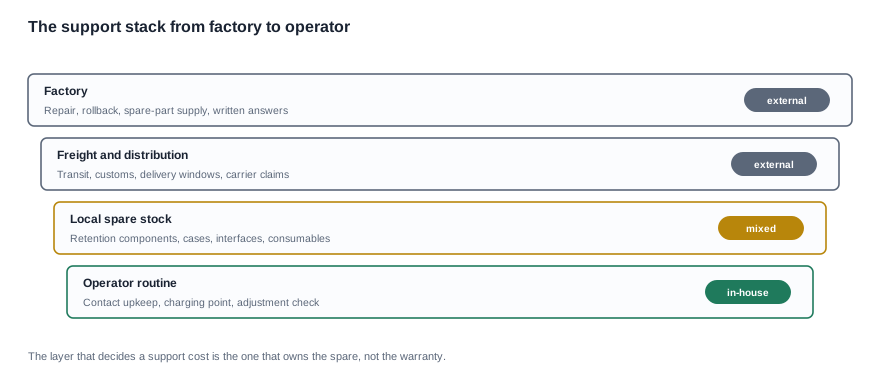
The stack above is the one a buyer is actually buying into, and the useful question is not what each layer does but which layer a given failure has to be solved at. A firmware rollback available at the factory is useless if the unit is in a customer's hand on a Tuesday and the freight route is four days; a local spare solves it in an afternoon.
The layer that is most often unfunded is local stock, because it looks like a working-capital decision rather than a support decision. It is neither. Local stock is the layer that determines whether the retention family and the interrupted-charge family cost a return or cost an hour, and those two families are together the majority of outdoor support contacts in this category. The layer that is most often over-specified is the warranty, because it is the term that is quoted in the sales conversation and the one that is written into the contract last.
What the operator layer actually needs
The bottom layer is the routine the operator follows, and in an outdoor deployment it is short. The interface is rubbed down before use and the frame is checked for seating. The unit is charged at a named point in the day rather than whenever there is a spare moment. And the contact is cleaned when the charge becomes intermittent, before the fault is reported.
Those four actions resolve or prevent the majority of the contacts a support desk receives, and they are worth writing into the customer-facing instruction rather than into a service manual, because a service manual is read after the failure. The outdoor pre-trip checklist is the format we would use, and the retention items that belong in the local stock list are covered at outdoor accessories.
The four support terms that have to be in the contract
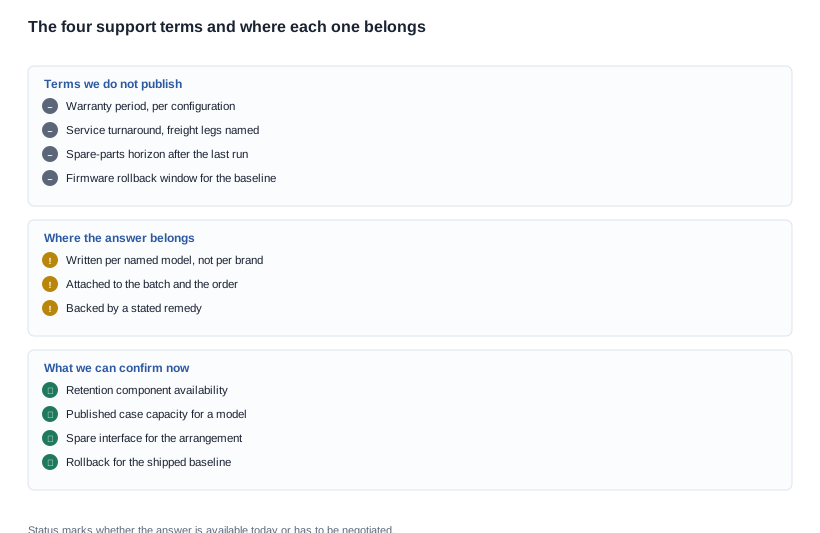
Because the four terms are not published, they have to be negotiated rather than read. The request that produces them is a single table with one row per term, one named model per row, and a written answer per cell.
- Warranty period. Ask it per configuration rather than per brand, and ask whether the period runs from delivery, from first use, or from a date the buyer records at the point of sale. For an outdoor channel, a period measured from first use handles the seasonal pattern better than one measured from a date.
- Service turnaround time. Ask for it as a committed number with the freight legs named separately, because the turnaround a buyer experiences is the sum of the two and the supplier only controls one of them.
- Spare-parts horizon. Ask how long the retention components, cases and interfaces for a configuration remain orderable after the last production run, and whether a last-time-buy is possible at the end of the run. This is the term that protects a channel's second year.
- Firmware support window. Ask how long a rollback remains available for the shipped configuration, and what happens to the support window if the baseline changes mid-programme.
The commercial context for these clauses is at payment terms and contract terms, and the clause language that ties a support term to a remedy is the same language used on the inspection criteria in the outdoor pilot.
The question that decides whether a support term is worth anything
A support term is only worth what the remedy behind it is, and the remedy is where the negotiation actually happens. Three questions settle it: what happens when the unit fails, what evidence is required to claim, and how long the claim takes to close. A term with no remedy attached is a statement of intent, and a statement of intent is not something to budget a support cost against.
The second question is the one buyers skip. A claim procedure that requires the customer to have kept the packaging, the accessories and the serial number transfers the cost of the claim to the customer, and a customer who cannot meet the requirement becomes a return rather than a claim. That is usually an unintended outcome, and it is expensive, because the return costs more than the repair it avoided.
What we publish about support, and what we will not quote
The working rule we apply: a support programme should be designed from the problem families rather than from a warranty period, and the catalogue is honest enough to support that design. Support work is organised by what breaks, so the outdoor rows are grouped by failure type rather than by product line. Power first: the cell capacities and the charge times, with the rated-use figures beside them because a band without a test condition predicts returns. Then the connection and control rows: the charging interfaces on the models where they are published, the radio versions the catalogue records, the remote shutter on the D17 and the ZH12. Then the physical rows: one ingress marking that two models in the range share, the four colour options on the V06, the detachable inner frames alongside the ergonomic frame on the V06 and the S7. And the two figures a support programme needs: the case capacities on the five models that publish them, and the single 158 g whole-unit weight figure for the MT6.
What we do not publish and will not estimate: warranty periods, service turnaround times, spare-parts horizons, firmware support windows, per-model unit weights beyond the MT6 figure, operating temperature ranges, ingress test reports, and any defect rate or failure rate for any configuration. We will not quote a support figure as a standard because each of them depends on the configuration and the volume rather than on the product alone.
What we will do is confirm, for a given configuration, whether a retention component exists, whether a charging case is published for that model and at what capacity, whether a spare interface can be supplied for the arrangement that model uses, and whether rollback is available for the firmware baseline that ships with it. Those four answers resolve most outdoor support questions before the programme opens rather than during it.
Where a problem is an adjustment rather than a failure, we will say so rather than processing a warranty claim against a unit that has not failed. That distinction is worth real money in this category, because the second family — endurance expectation in cold conditions — is the largest single source of contacts in an outdoor channel and it is resolved by a published reference rather than by a unit.
Models, seasonal profile and expected volumes
Send the models under consideration, the seasonal profile, the channels, the expected volumes and the markets, and we will return the published rows that apply, the support resources that exist for each model, the request list for the four terms that are not published, and the criteria to write into the purchase order. Where the product lines are published: sport smart glasses and AI camera glasses. This application belongs under outdoor.
Related reading
- The application this support model sits under — outdoor
- The catalogue the support model is drawn from — sport smart glasses
- The retention lesson from another segment — what to avoid with cycling smart glasses
- The fault triage procedure — outdoor troubleshooting
Send the models, the seasonal profile and the volumes, and we will return the support resources that exist and the request list for the terms we do not publish.