
Cycling is unforgiving of the wrong configuration in a way that office or travel use is not. A rider who discovers at speed that the temple slips, or that wind noise makes the audio useless, discovers it at speed, and the discovery happens on a road where the product's failure is the rider's problem. That is why the four checks below are worth running before a purchase order rather than after a return: three of them cost nothing but a written question, and the fourth costs one afternoon on a bicycle.
Each of the four is a rejection at the specification stage. None of them requires a different product to be developed, and none of them is a matter of taste. They are decisions that a procurement lead can take with a page of published rows in front of them, which is why they belong in a buying process rather than in a review queue.
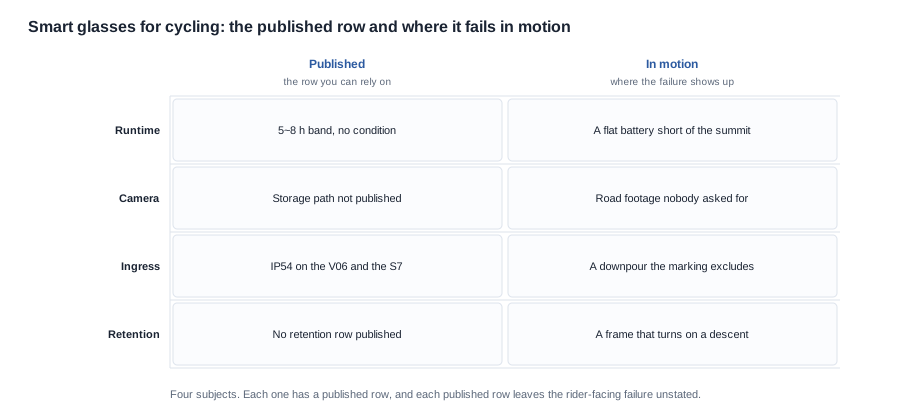
Smart glasses for cycling: the four rejections to make before the order
| Rejection | The published position | The question to put in writing |
|---|---|---|
| A runtime quoted without its condition | 5~8 h rated band, condition not published | What condition produces the rated figure |
| A camera model for ordinary road riding | Storage path and transfer method not published | Who holds the footage and for how long |
| Anything specified only as waterproof | IP54 marking on the V06 and the S7 only | The designation in writing, never the adjective |
| A frame with no stated retention feature | No retention row published for any model | What holds the frame on a moving head |
Why a bicycle makes these sharper than in other scenarios. Three environmental factors act on a cycling product at once, and each one attacks a different claim. Wind is broadband noise and it is loud at speed, so an open-ear audio product that sounds acceptable in a showroom is a different product on a road. Water arrives in two forms that are not the same event — sweat, which is salt and corrosive over time on a surface nobody has characterised, and rain, which arrives as a downpour rather than as a shower. And the head itself is moving, in a way that a static head never is, so a frame that stays in place on a desk can rotate on a descent.
What the four rejections have in common. Every one of them is a claim the buyer is about to make to a customer without holding the row behind it. That is a pattern, and it is worth naming, because the pattern is what a channel repeats: a specification quoted from a competitor's page, a runtime quoted without its condition, an ingress marking upgraded into an adjective, a fit described in words that nobody measured. The cycling application page carries the wider framework, and the outdoor checklist covers the wider kit.
What the four rejections are not. They are not arguments against the camera or audio classes as such. A camera configuration is a legitimate choice for a ride where the recording is the point, and an audio configuration is a legitimate choice for a ride where the ride is the point. The rejections are about the gap between the claim and the row, and that gap is what the four checks close.

A runtime you cannot trace is not a requirement
Every listing in this category publishes a runtime, and most of them publish it under conditions that no rider will reproduce. Volume, a specific codec, a specific screen state and a specific ambient temperature are all part of a real measurement, and a figure quoted without them is a laboratory result presented as a field expectation. On a bicycle the gap between the two is measured in a summit, not in a complaint.
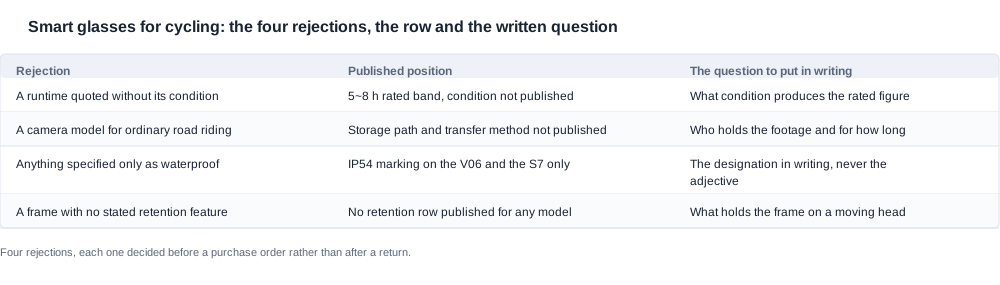
What our range actually publishes. For the camera models the published figures are a rated band: 5~8 h on the V03 and the V03 Pro, and the V06 and the S7, 6~8 h on the KY06 and the MT5, and about 7 h on the L1 Pro and the MT6, and the CY03 and the L2 Utral, and the CY05. For the audio models the published figures are about 8 h on the K02, the K01 and the LC-105-2, and the LC-105-1, about 7 h on the D11 and the D12, and about 6 h on the G07 and the YK12. Every one of those figures is a rated figure, and no runtime in this range carries a published test condition.
The rule a buyer should write into the requirement. A requirement is not "around 8 hours"; it is a rated figure with a condition attached and a workload named, and it is written so that a supplier can pass or fail it. The wording that works is the one that names the condition rather than assuming it: a rated figure under a stated workload, with the test condition to be provided in writing. If the supplier cannot name the condition, the requirement has become unfalsifiable, and a requirement that cannot fail is not a requirement.
Why a band is not a promise. A band of 5~8 h is a bound on a rated figure, and the gap between the lower and the upper end is the part a rider actually experiences. A channel that publishes the upper end of a band is publishing the best case from a set of measurements taken under a condition the reader will not have. The cost of that choice is not the claim, it is the return: the rider who planned a six-hour ride on a figure that was only ever true at eight, in a laboratory, with a different workload, comes back with the device flat at the bottom of a climb.
What to ask the supplier. Two questions, and they belong in the same email. Ask what condition produces the published rated figure for each model on the line, and ask whether the figure was measured with a camera running. A supplier that answers both has given you a number that can go in a requirement; a supplier that repeats the catalogue figure has given you nothing, and that answer is itself useful information about the depth of the documentation behind the row.
The commercial consequence of a conditionless requirement. A requirement written without a condition cannot be used to reject a shipment, and that is where the cost lands. The incoming inspection criteria are written against the requirement, the defect claim is written against the criteria, and the returns policy is written against the defect rate. A conditionless number at the top of that chain produces a weak dispute at the bottom of it, and the party that loses that dispute is the buyer, because the buyer is the party that wrote the conditionless number.
The camera question on a moving bicycle
A forward-facing camera on a moving bicycle in traffic raises questions about the footage, about where it is stored, and about whether anyone else is identifiable. Many riders discover they did not want that decision at all. This is not a legal argument dressed up as a technical one — the legal position differs by market and belongs with the buyer's own legal function — it is an operational argument that a product manager can make without any legal input at all.
What the catalogue leaves open. For the camera models the storage path, the transfer method, the video format, the frame rate, the field of view and the file size are all not published. That is not a criticism of the eleven camera models; it is the boundary of what a catalogue can carry. But it does mean that a buyer who lists a camera model for road riding is listing a device whose most consequential behaviour — what happens to the file, and who holds it — is not described anywhere they can point to.
The cost of the decision, stated in operational terms. Choosing a camera configuration for a ride where no recording is required adds three interfaces to the channel's support surface: the storage path, the transfer method and the file format. Each one is a support question that a rider can ask, and each one is a question the channel cannot answer from a published row. A channel that lists an audio configuration for the same ride removes all three, and the recording decision never has to be made by a customer at all.

The four questions to put in writing before a camera model is listed for road use. Each one is answerable, and none of them requires a legal determination to be made by the supplier:
- Where does the file live — on the device, in a paired handset, or in an account — and how does it leave the device?
- How long is it retained, and what happens to it when the device is reset or returned?
- Is the transfer method dependent on the paired handset, and what happens to the file when the handset is not present?
- What is the practical clip limit on a single recording, and how does the device behave when it is reached?
How to handle the determination that is not ours. The data-protection position for recording identifiable people on a public road is a determination for the buyer's own legal function, in each destination market, before the listing is published. The right way to write that into a procurement process is to name it as a gate rather than as a risk: no listing goes live for a camera model on a road-facing channel until the legal function has returned a position in writing. A catalogue cannot supply that, and a supplier's assurance that the product is "just a camera" is not a substitute for it.
What we will and will not say. We will state, for any configuration we quote, whether a camera is fitted and what the published rows are. We will not state that a camera configuration is intended for road riding or that it is not, and we will not support copy that implies a recording can be made without a decision about who holds the file. We publish the resolution class — 8 MP on eight of the eleven camera models and 13 MP on three — and the cell capacities from 220 mAh to 290 mAh, and we do not publish the storage path, the transfer method or the file format for any model.

Waterproof is an adjective, IP54 is a designation
A product page that uses the word casually sets an expectation that a downpour will test, usually on a bicycle, in the wrong season. The published position is narrower and entirely usable — it simply has to be stated as a designation rather than translated into an adjective.
The published position, exactly. The IP54 marking is published on the V06 and the S7, and on no other model in the range. The second digit of that marking describes protection against water splashing from any direction; the first is a dust protection level. It is not an immersion rating, it is not a water-jet rating, and it is not a downpour rating. No third-party test report number is published behind the marking, and the marking is a catalogue attribute rather than a certified result from a named test body.
What a buyer should write into the listing. One sentence, naming the designation and the models it covers: an IP54 marking on the two models that carry it, describing protection against splashing water and a dust protection level. The sentence is longer than the word "waterproof" and it converts better, because it tells a rider what the rating means before they have to ask — and because a rider who knows the difference will not test the claim in a way the marking cannot survive.
The instruction that matters more than the claim. A charging port is a deliberate opening in the frame, and a rider who does not know that will not think twice about charging a wet device. The kit instruction for a cycling channel should carry one line on this, and the line is worth more than any paragraph about the coating: dry the unit, and do not charge it while it is damp. A product page cannot deliver that instruction, and a product page that says "waterproof" actively discourages the behaviour that would prevent the fault.
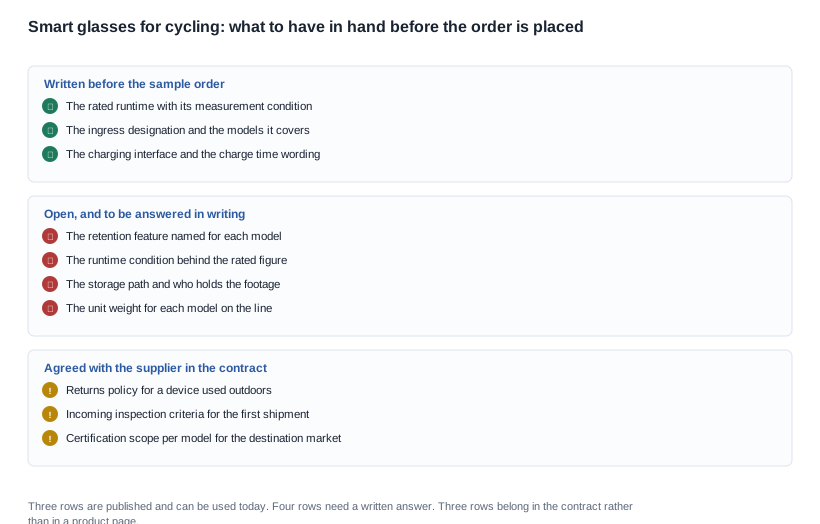
What to ask the supplier. Ask for the ingress position in writing, per model, and ask specifically whether the marking is a catalogue attribute or a tested result with a report number behind it. If it is a tested result, the report number and the standard it was tested to belong in the file, and the listing can then say so. If it is a catalogue attribute, the listing says the marking and the marking's meaning, and nothing more. Either answer is workable; what is not workable is the adjective.
The fact error worth naming. Several pages in this category describe five or more models as carrying an IP54 marking. In our catalogue two models carry it. A page that overstates the count is a page a customer can check, and the check happens to be a return and a review. This is a small correction with a large commercial effect, and it is exactly the kind of correction that a factory audit and an incoming inspection would catch before it reaches a listing rather than after.

Retention, and the row the catalogue does not publish
The failure mode on a bicycle is the frame moving, and the usual fix is a retention feature — a rear band, a strap, or a frame geometry that grips the head without adjustment. Most of the general-purpose frames in this category are designed for a stationary head, which is a different mechanical problem. If the specification is silent on retention, a buyer has to ask, because a frame that is comfortable over an hour of stillness can still rotate on a descent.
What we publish, and what that leaves open. No model in the range publishes a retention feature. What is published is a set of structural details on specific models: the V06 and the S7 publish a detachable inner frame, the G07 publishes ultra-slim detachable temples, the YK12 publishes slim detachable temples, and the V03 Pro publishes a flexible temple. Those are adjustable and removable features, and they are genuinely useful — a detachable temple lets one outer frame serve different head shapes, and a detachable inner frame changes the frame's internal geometry without replacing the whole product. None of them is a retention feature, and a channel that describes a detachable temple as a secure fit has made a claim the row does not carry.
The question that has to be asked. For each model on the line, ask what holds the frame on a moving head, in writing, and ask whether that mechanism is a band, a temple geometry, a nose-piece feature or nothing more than the general-purpose geometry of the frame. A written answer that names a mechanism is usable in a listing and usable in a test protocol. "Designed for active use" is not, and the difference is exactly the difference between a claim and a description.
The commercial weight of a silence. A buyer who never asks about retention has quietly decided to replace devices rather than parts, and has also quietly decided that the returns will be described as a fit problem rather than a retention problem. A detachable temple is a part that can be replaced; a frame that turns on a descent is a whole frame written off. The difference between the two is a spare-parts question, and it is a question worth asking a supplier before the first order rather than after the first hundred returns.
What the sample protocol has to include. The protocol has to contain a climb and a descent on a route the rider actually uses, with the frame position checked before and after, and it has to contain the conditions that make the answer meaningful: gloves, rain, a head that is wet, and a long enough session for the head to tire. The running troubleshooting article covers the same class of problem in a different activity, and the lens care article covers the sweat and spray side that a cycling channel has to answer in its kit.
What to test on the sample and what to fix in the contract
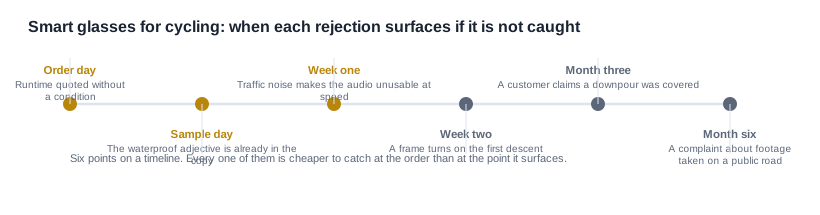
The four rejections are caught in one place, and the place is the sample programme. Not a desk demonstration, not a showroom unit, and not a model that is close to the one being listed. A sample of the exact configuration, ridden on a real route, in the conditions the channel's customers ride in, produces a defensible answer to all four at once.
The protocol. Six steps: state the ride profile and the clock time of the session, order a sample of the exact configuration, ride the same route twice — once dry and once in rain — record the audio at speed with traffic noise around it, check the frame position after every climb and descent, and log every finding against a written acceptance criterion. That last step is what makes the protocol worth running: an observation with no criterion attached is an opinion, and an opinion does not survive a returns conversation.
The commercial terms that decide whether the line works. A cycling channel sells to people who will use the product hard and return it for reasons that are not defects — a frame that moved, a claim that was read literally, a device that went flat on a climb. That makes the returns policy the most important commercial term in the channel, and it is the one most often written by default. Three terms are worth negotiating hard:
- The returns policy for outdoor use, and specifically whether a device that has been ridden in rain can be returned and under what condition. A channel that states the policy honestly loses fewer returns than one that states nothing and argues each one.
- The incoming inspection criteria for the first shipment, agreed before the container rather than after, covering the model designation on the unit, the charging interface, the case configuration and the published cell capacity.
- The certification scope per model for the destination market, which has to be a written answer from the supplier rather than an assumption from a company-level page. The certification checklist is where that request belongs, and the risk page covers how to frame it.
What is not negotiable. The tooling and the new tooling expense for private label packaging, the certification cost and its lead time, and the factory's committed lead time and production capacity. A buyer who presses on those three gets a commitment the factory cannot hold, and a late shipment on a cycling line is usually a lost season rather than a delay.
What we publish, and where we stop. For the cycling range we publish the rated runtimes, the resolution class, the charge times, the cell capacities, the charging interface per model, the structural features that are published, the colour counts, and the IP54 marking where it is published — on the V06 and the S7. We do not publish the unit weight beyond the single whole-unit figure of 158 g for the MT6, the field of view, the video specification, the runtime test condition, the standby draw, the cycle life rating or the operating temperature range, and we will not state that any product in our range is tested to IP54, because no test report is published behind that marking. We will not use the word waterproof for a unit whose designation is IP54, and we will not describe a detachable temple as a retention feature.
What to send us next. Send the models under consideration, the routes and conditions the channel's riders actually use, the destination market and the expected volume, and we will return the published rows that cover each model, the questions that have to be settled in writing before a purchase order, and the claim set a cycling listing can make without overreaching. For smart glasses for cycling, the deliverable is a short list of written answers and a test protocol that closes the four gaps.


