Most things reported as faults with smart glasses for running are not faults. They are four environmental behaviours that behave exactly like defects and resolve themselves once anyone knows which one is in front of them. The commercial consequence is larger than the technical one, because every symptom that is answered with a replacement instead of a reset is a unit through the reverse-logistics chain, a customer whose product no longer works, and a returns rate that makes the next order harder to justify. Triage is therefore a procurement instrument in this category, not a customer-service courtesy.
What the catalogue can and cannot contribute to a diagnosis. Our published configuration rows — cell capacity, charge time, rated use, charging method and case capacity — are the figures we will stand behind when a short runtime is reported, and we will ask what the conditions were before treating it as a fault. Unit weight is published for exactly one model in our range, the MT6 glasses body at 158 grams, including its battery and camera and excluding its foldable charging case, and it is not published for the others, so we will not quote a weight to explain away a pressure complaint. Frame weight, the microphone specification, the field of view and the operating temperature range are not published either, and a diagnosis that depends on any of them is a guess dressed as an answer.
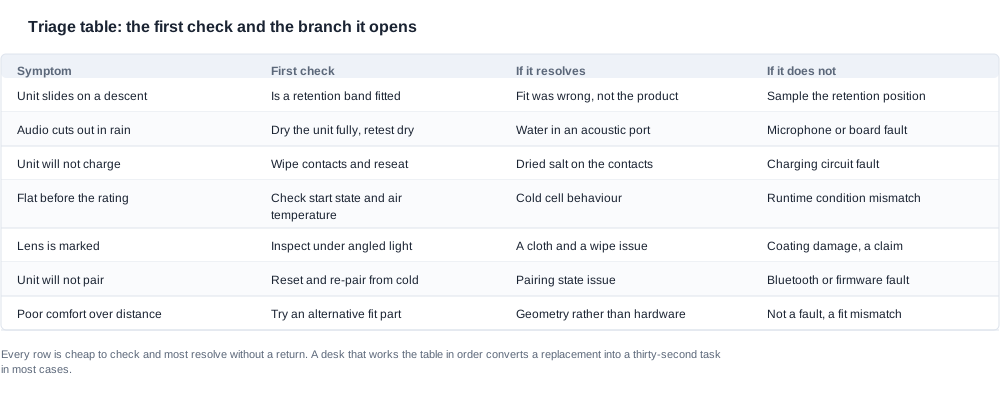
How the table above should be used. Every row is a cheap check that the customer can perform, and every row states both branches: what a resolution means and what a failure to resolve means. A desk working the table in order converts most cases into a thirty-second task rather than a return, and the second column is the reason that is possible — it is the first check, not the last one, so nothing is issued before it has been tried and recorded.
Smart glasses for running: four symptoms that resolve without a claim
The unit slides on a descent. This is retention rather than sizing. A frame that sits correctly at a desk will rotate on a descent, because the forces are different and because a stationary head does not test the geometry. Check whether the configuration has a retention feature at all — a rear band or a strap — before adjusting anything. A running frame without one is not a running frame, and no amount of temple adjustment changes that. If it does have one and the unit is still moving, the issue is how it is fitted rather than the product, and the cycling article covers the same retention logic in a different movement.
Audio cuts out in rain. Water on an acoustic port attenuates sound, and it will do so intermittently as the port wets and dries. It is indistinguishable from an electronic fault when it happens and reads like one in a report. The recovery is to let the unit dry fully — not just the visible surfaces, which can hold water at the port for hours — and then to retest it away from water. If it recurs in dry conditions, that is a different problem and a real one.
The unit will not charge after a run. Dried salt on exposed magnetic contacts produces an intermittent charge that reads as a fault and is cleared in thirty seconds with a dry cloth. On the models that publish a magnetic interface this is the single largest preventable category in the application, and on the models that publish Type-C the equivalent check is the port itself, where lint and pocket debris produce the same symptom. The prevention is a printed step in the box insert rather than a support article, and the outdoor charging article covers the cold variable that sits underneath it.
The unit runs flat before expected. Cell capacity falls in cold air and recovers when the cell warms, so a winter run that ends earlier than a summer run is the cell behaving correctly. Our published rated use figure is a bound under defined conditions rather than a continuous-playback promise, and the definition of those conditions is not published — which is exactly why the temperature has to be captured with the report. A unit that runs materially short of the rated figure in warm, dry conditions is a genuine fault worth raising; the same shortfall in cold air is not.
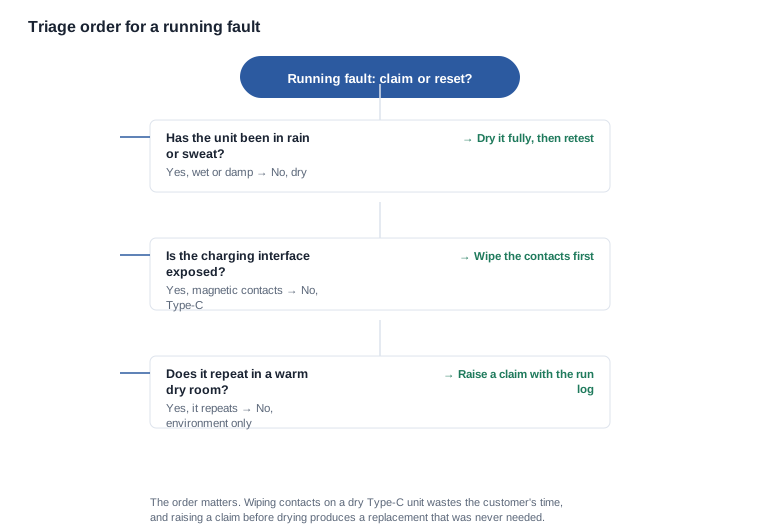
The order of the three questions matters more than the questions. Drying comes first because it is free and it resolves a large share of cases; a claim raised before a unit has dried produces a replacement that was never needed. The contact check comes second because it is the other cheap step, and it only applies where the interface is exposed. The repeat test comes third because it is the question that decides whether anything is actually wrong: a symptom that reproduces in a warm dry room is a different case from one that does not, and that is the line between a reset and a claim.
Three symptoms that do need a claim, and the evidence they require
A unit that reproduces its fault in a warm, dry room. That is a genuine fault by the test above, and it is the one case where a replacement is the correct answer. The evidence it needs is the model designation, the lot number, the stated symptom in the customer's own words, the start state, the air temperature, and a record that the first check from the table was performed rather than assumed. Six items, and none of them requires instrumentation.
A lens that is marked and stays marked. A smudge that lifts under angled light and a cloth is a wipe issue; a mark that persists is coating damage, and the coating is not published, so nobody can argue about whether the routine caused it. That makes it a claim, and it makes the lens cleaning article important beyond the routine itself: the procedure is the only control that exists, and a device whose surface has been treated with the wrong material cannot be un-done.
A unit that will not pair after a reset and a cold restart. Bluetooth faults do not resolve themselves, and the failure here is a real one. It is also the symptom most often reported with a lot of irrelevant detail, because a customer who cannot pair tends to describe everything that happened before. The claim needs the symptom, the reset steps that were tried and the result of each, and nothing else.

Why the fifth step is the one that gets skipped. Steps one to four are visible work and step five is filing, so step five is what happens when the desk is busy. Step five is the step that decides whether the case becomes a supplier notice or a closed record, and it is the step that produces the data a buyer needs to argue about a defect rate. A desk that never reaches step five produces a returns rate and no explanation of it.
The false-replacement rate and what it costs a channel
What the rate actually is. The false-replacement rate is the share of units returned that were replaced although the fault was environmental, a routine issue or a sizing mismatch. It is not a defect rate and it is not a returns rate — it is the part of the returns cost that a better process removes entirely. A channel that measures it can size the difference between two suppliers on something other than unit price, because a lower false-replacement rate shows up as a lower cost per hundred units in service rather than as a cheaper product.
Where it comes from in this application. Four sources, and all four are visible in the table above. A contact wipe that was never attempted. A drying step that was never attempted. A retention feature that was never offered in a configuration where the channel needed one. And a pressure complaint that was logged as a defect because nobody asked whether an alternative sizing component was available. Each of those is a process gap rather than a product defect, and each of them is closed by a document rather than by a hardware change.
The commercial arithmetic, stated carefully. We do not publish a returns rate, a false-replacement rate or a defect rate for any model or any channel, and we will not estimate one. What can be said without inventing a number is that the avoidable component of a running channel's returns cost is governed by a process the buyer controls in full, and that the process cost is a few minutes of support time against the cost of a unit, a return label, a freight movement and a replacement. Any buyer who wants the number should measure it on their own first shipment rather than ask for ours, because ours would be a number about a different channel.
Why it matters more than a discount. A price advantage of a few per cent on unit price is consumed by a single avoidable return on a small volume. That is the comparison a buyer should make in a category like this, and it is the reason the running section frames this as a channel-economics question rather than a product question.
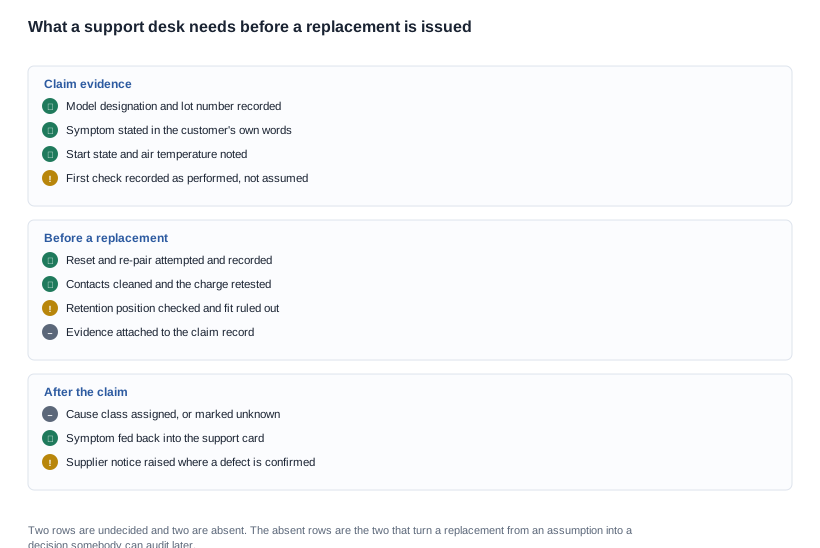
The checklist as a control rather than a form. Three groups and eleven rows. The claim-evidence group is about making the claim legible. The before-a-replacement group is about making sure the cheap checks were actually performed and recorded, which is the only way the false-replacement rate can be measured rather than guessed at. The after-the-claim group is about closing the loop: a cause class assigned or marked unknown, the symptom fed back into the support card, and a supplier notice raised where a defect is confirmed. Two rows are undecided and two are absent, and the absent rows are the ones that would turn a replacement from an assumption into a decision somebody can audit later.

Measuring the false-replacement rate on a first shipment
The measurement is a count, not a survey. The false-replacement rate can be read off the returns log of a single shipment without any customer research, because every returned unit carries a stated reason and the triage table already maps each stated reason to a cause class. The work is the classification, not the collection. A channel that classifies every return against the seven rows in the triage table produces a rate by the end of the first hundred returns, which is usually inside the first quarter of a running programme.
The four counters to keep, and why each one earns its place. The first counts cases closed with no return at all, which measures the triage process rather than the product. The second counts cases closed as environmental or a routine issue. The third counts cases closed as a sizing mismatch. The fourth counts cases that reached a genuine fault claim. The first three are the ones a buyer controls and can improve; the fourth is the one that describes the hardware. A channel that keeps only the fourth is measuring defects, and a channel that keeps only the first is measuring service quality without ever seeing the hardware.
What the numbers change. Two things, and both are commercial. The first is the size of the warranty provision: a provision sized on a blended returns number is wrong in one direction or the other depending on which of the three controllable classes is larger, and the four counters tell the buyer which direction. The second is the configuration decision for the second order: if the third counter is large, the answer is a different sizing component or a retention part rather than a different product, and that is a far cheaper fix than a supplier change.
The one caveat that keeps the measurement honest. A rate measured on a first shipment describes that shipment, that configuration and that season. It does not travel to the next order on its own, because a configuration change, a seasonal change or a supplier change invalidates it. The rate is worth putting in front of a supplier at the second order precisely because it is scoped, and a buyer who presents it as scoped gets a better answer than one who presents it as a general characteristic of the product.
What a supplier must publish, and what the commercial terms should carry
The six rows that determine whether a channel can triage at all.
- The charge-time ceiling, with the starting state, so a will-not-charge report is judged against a real condition.
- The rated use figure, with the test condition, so a runtime report is a measurement rather than an opinion.
- The charging interface, so the contact check is applied to the right models and skipped on the others.
- The unit weight, for the models where it is published, so a sizing complaint can be separated from a fault.
- The microphone specification, which is not published for any model in our range and which is the reason a wind-related audio report cannot be diagnosed from a document.
- The ingress position, so a wet unit can be distinguished from a sealed one and the drying step is applied correctly.
The honest position on the rows we do not publish. We publish the first four and the last. The microphone specification and the operating temperature range are not published, and we will not substitute a general figure for either. That means a channel cannot fully diagnose a wind-related audio report or a temperature-related runtime report from documentation alone, and it has to establish those two by sample testing instead. A buyer who is choosing between suppliers should ask each of them for the same six rows, because the supplier who answers all six removes more work from the support desk than the supplier who is a per cent cheaper.
The one row that makes the biggest difference and is the most often missing. The charging interface. It decides whether a will-not-charge report is a thirty-second contact treatment or a return, and it decides the accessory plan at the same time, because a magnetic interface puts the case inside the charging architecture rather than beside it. Of the running candidates in the catalogue, five publish magnetic charging and two publish Type-C, which means the support desk needs to know which model it is holding before it can advise anything at all.
Triage is a clause, not a courtesy. The cheapest way to make a support desk work the table above is to require it, and the requirement belongs in the purchase order and in the supplier agreement rather than in a quality manual nobody reads. Three clauses earn their place. The first requires the supplier to supply the six rows above for the quoted configuration before the first shipment, because a desk that cannot triage cannot be measured. The second defines the claim evidence required for a replacement, which removes the argument about whether a claim is complete. The third sets a defect-notice path: a confirmed defect raises a supplier notice against the lot, which is the only mechanism by which a single bad batch becomes visible before the next order rather than after it.
Why the defect-notice path is the clause that changes the economics. A channel that reports defects lot by lot learns something a channel that only handles returns never learns: that a batch of thirty units from one production run behaves differently from the previous run. That single observation is worth more than a discount, because it is the difference between a supplier relationship and a transaction. The lot number has to be on the packaging for it to work, which is another reason it appears on the device card.
What the buyer measures, and what it reports back. Four numbers, all of them from the buyer's own records rather than from any supplier claim: the share of cases closed without a return, the share closed as an environment or routine issue, the share closed as a sizing mismatch, and the share that reached a genuine fault claim. None of those numbers is published by us and none of them should be; they describe a channel, not a product. They are worth reporting to the supplier at the second order, because a supplier that can see the first three numbers understands that the fourth is the only one that is a defect, and that is the beginning of a working defect conversation rather than a returns argument.
The due-diligence question this section answers. Before a buyer signs a running programme, the checklist is whether the supplier can actually support a triage process. A supplier that publishes the charge-time ceiling with its starting state, the runtime band with its test condition, the charging interface, the published unit weight, the microphone specification and the ingress position removes most of the guesswork from the support desk before the first unit arrives. A supplier that publishes none of them will not refuse a claim; they will simply not be able to classify it, and the classification is what tells the buyer whether to renew.
The boundary of what we will diagnose in writing
The boundary we hold to. We will support a triage process with the published rows and we will not replace a diagnosis with an estimate. We will confirm whether a reported runtime shortfall is consistent with the published band once the start state, the air temperature and the workload are known. We will confirm whether a charge failure on a magnetically charging model is consistent with a contact issue. We will confirm which structural features exist for a given model — the detachable inner frame on the V06 and the S7, the remote shutter on the D17 and the ZH12 — so that a sizing or handling question is routed correctly. And we will say plainly when a question needs a sample or a measurement we have not made.
What we will not do is quote a unit weight for a model that does not publish one, describe the IP54 marking on the V06 and the S7 as waterproof, estimate a returns rate or a defect rate for a channel we have not worked with, or state a microphone or thermal behaviour that the catalogue does not carry. Those refusals are the reason a triage process built on our published rows can be relied on: every answer we give is one the buyer can check against a document.
What to send us. Send the model designation, the lot number, the stated symptom, the start state, the air temperature and the first check that was performed, and we will say which published row applies to the case, whether it is consistent with the symptom, and which of the two branches in the triage table it belongs to. The running channel context covers the rest of the kit, and the published model data is on the sport smart glasses range.
Related reading
- Cleaning lenses — the routine after every run
- Cycling what to avoid — retention in motion
- Outdoor charging — the cold variable explained
Send us the six details of a case and we will say which published row applies and which branch of the triage table it belongs to.