

Smart glasses for running: four mistakes that only surface after the first shipment
Smart glasses for running procurement tends to fail in one predictable place: the specification is written from the runner's preference instead of from the run profile, so the order arrives configured for a condition nobody works in. Four mistakes account for most of it. A camera model gets chosen for its resolution when the binding constraint was sweat and rain. A charge time of two hours or less gets read as a recharge window when it is in fact a ceiling on how long charging may take. A rated-use figure gets treated as a promise about one long session when no runtime in the range carries a published test condition. And a water-resistance claim gets written into a listing from an ingress marking that has no published test report behind it.
The correction is a single change of method. Write the run profile first — distance, session length, sweat, rain cover, sessions per day, and the recovery window between them — then map that profile onto the rows the catalogue actually publishes, and treat every row it leaves open as a question that belongs in the quotation rather than a gap that gets filled with a typical value. The sport models and the camera models carry those rows at sport smart glasses and AI camera glasses, and the selection logic sits upstream at how to choose smart glasses for running.
Who is buying, and what the buyer is actually deciding
The reader is a brand buyer, a channel buyer or an e-commerce selector deciding whether a running line gets a camera SKU at all. That is not a question about the product, because the product question is settled. It is a question about configuration, evidence and cost: which tier goes into the order, which rows of the specification have to be settled in writing before a purchase order, and which claims the listing is allowed to carry in the destination market. The fear behind it is a returns number nobody can explain. A camera that produces unusable frames in the rain comes back as "the video is bad", the complaint lands on the listing rather than on the hardware, and the returns rate reads as a product defect when it is a specification error.
The buyer is usually several steps from the person who runs. A running brand buys from a factory, sells through a channel, and the device ends up with a customer the buyer never meets. That distance is precisely why the run profile has to be written down rather than agreed verbally: the runner who leaves the device on a car seat at 18°C and the runner who wears it through a downpour in July are the same order unless somebody records the difference, and the recording is the buyer's job.
The run profile is the specification
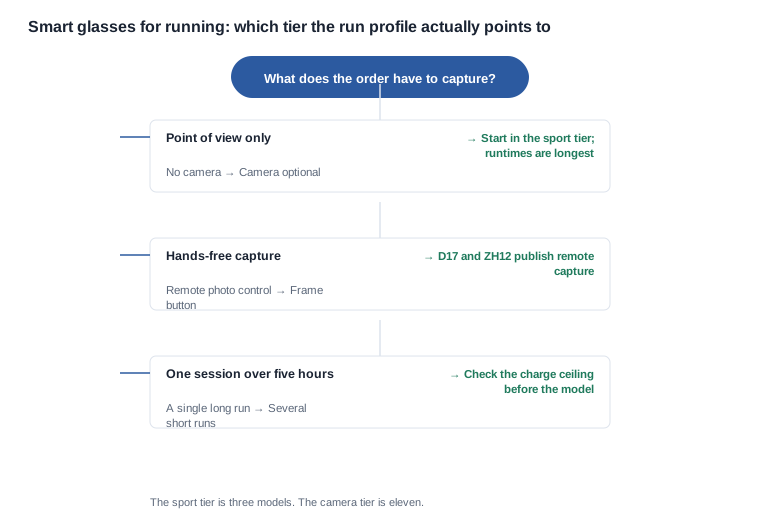
A run profile is six numbers and one decision. The numbers are the longest single session, the number of sessions in a week, the recovery window between two sessions, whether the device stays on between sessions, how much sweat the device sees, and how often the run happens in rain rather than in dry conditions. The decision is whether the device is a navigation and audio aid, a hands-free capture tool, or both — because that decision changes which rows of the catalogue matter and which ones are noise.
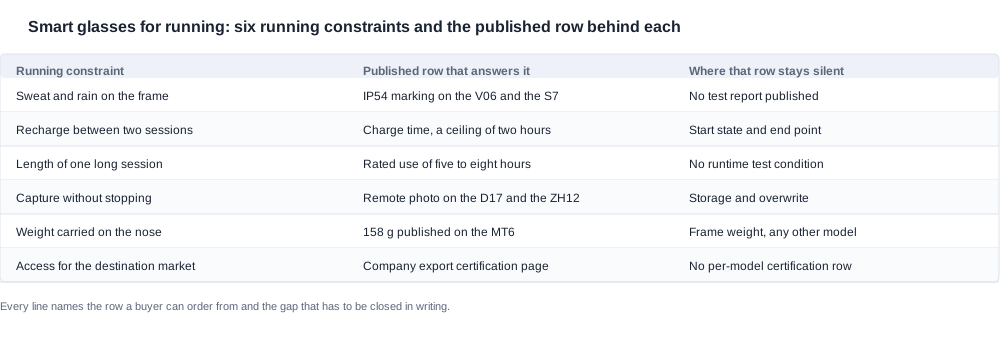
Read that way, three of the published rows stop being marketing and start being inputs. Rated use decides whether one session fits inside one charge. Charge time decides whether the device can live in a rotation of several units without a charging base. The ingress marking decides whether a wet-weather line can be sold at all without a claim the documentation cannot carry. Everything else — resolution class, colour count, temple geometry — is a preference, and a preference is a poor reason to open a purchase order.
Reading the published rows: ingress, charge ceiling and rated use
The catalogue publishes more than a marketing sheet usually does, and the three rows that decide a running order are among the published ones. What follows is what they say, what they do not say, and where a buyer gets them wrong.
Ingress: two models carry a marking, and a marking is not a report
Exactly two models in the range carry an ingress marking: the V06 and the S7, both of which publish IP54 alongside their camera. That is the whole of it. There is no third model with a rating, no audio model with a rating, and no per-model test report published behind the marking on either of these two. An IP54 marking, read as written, covers a dust protection level and protection against splashing water; it is not immersion, it is not a downpour held against the lens for an hour, and it is not a submersion test.
The mistake this produces is a listing claim. A product page that says "waterproof" is making a statement the documentation behind the marking does not make, and it is the statement that generates the returns. The defensible wording names the marking, names the models, and stops there. The more useful move for a buyer is to ask the supplier what evidence sits behind the marking for the exact configuration being ordered, because the marking is a catalogue attribute and the evidence, if it exists, is not in the catalogue. The digit reference is at IP ratings.
Charge time: a ceiling is not a recharge window
Every model in the range publishes a charge time. For twenty-six of them the published figure is a ceiling of two hours or less; the D17 and the ZH12 publish roughly one hour. That distribution matters more than the headline number, for two reasons.
The first is that "two hours or less" is a limit and not a measurement. It permits exactly two hours, so it cannot be restated as "under two hours" or "within two hours" — those are different assertions, and a listing built on the wrong one inherits a promise the row does not support. Any catalogue copy that converts the ceiling into a shorter window has changed the claim, not simplified it.
The second is that no published figure states the starting state or the ending state. There is no catalogue row that says what level the device is charged from, and no row that says what level counts as finished. A charge time without those two numbers cannot be converted into a mid-shift interruption figure, and it cannot be treated as a case turnaround time either. If the run profile has a recovery window of forty minutes, a two-hour-or-less ceiling says nothing about whether the device is usable in that window; the D17 and the ZH12, at roughly one hour, are the only two models where the published figure is even the right order of magnitude. The charging rows are collected at charging solutions.
Rated use: five to eight hours, with no test condition behind them
The camera models publish rated use figures that sit between five and eight hours. The V03 and the V03 Pro publish five to eight hours, the KY06 and the MT5 publish six to eight hours, the CY03 and the CY05, and the L2 Utral and the MT6, and the L1 Pro publish roughly seven hours, and the V06 and the S7 publish five to eight hours. The sport models publish roughly eight hours on the YKC02, roughly seven on the D17 and roughly eight on the ZH12.
Two warnings belong with those figures. First, none of them carries a published test condition. There is no catalogue row that states the volume level, the clip length, the ambient temperature or the duty cycle behind any of them, so a figure of five to eight hours cannot be turned into a promise about one long session with a camera running continuously — it is a rating, and a rating is a category, not a measurement of the buyer's use case. Second, the range is a range, not a point: a model published at five to eight hours can land at the bottom of that band in a real run, and the buyer who quotes the top of the band in a listing is quoting a ceiling of a ceiling. The published rows are at battery life.
The smaller rows that decide the order
Resolution class is the fourth row buyers reach for first and it is the least decisive. The range publishes 8 MP on eight camera models — the V03 Pro and the KY06, the MT5 and the V03, and the V06 and the CY05, and the MT6 and the CY03 — and 13 MP on three, the L1 Pro and the S7, and the L2 Utral. Between those two classes, the published frame rate, the video format, the field of view, the low-light behaviour and the storage behaviour are all unpublished for every model, so a resolution class buys a buyer very little until those are settled.
Two rows do more work in a running context than resolution does. The D17 and the ZH12 publish a remote photo control, which is the difference between a capture tool that interrupts a run and one that does not — and the running question of whether a capture button can be pressed mid-stride is settled by that row rather than by the camera. And the charging case, which determines whether a device can be recharged away from a socket, comes in three published states across the eleven camera models: five publish a case capacity, two publish a case without a capacity, and four have no case row at all — the V06 and the V03 Pro, and the S7 and the V03 — and a blank row there is an open question rather than an answer. The MT6 publishes a foldable 1200 mAh case, the CY05 and the CY03, and the L1 Pro publish 1400 mAh, and the L2 Utral publishes 900 or 1400 mAh as a configuration choice.
The evidence file to collect before the purchase order
The verification step in this category is concrete, because the object is a device and the documents are named. Each item below says what to ask for, and what makes the answer complete rather than merely present.
- Ask for the runtime figure with its test condition, per model. A rating without a condition cannot be checked, and a buyer who cannot check it will be told by a customer that it does not hold. A written statement of what was measured, and under what conditions, is the smallest useful answer.
- Ask for the evidence behind the ingress marking on the V06 and the S7, in the configuration being ordered. If the answer is that the marking is a catalogue attribute, that answer is legitimate and belongs in the evidence file as well.
- Ask for the charging case state per model, in writing, including for the models where the catalogue publishes no case row. Unpublished is a legitimate answer; silence is not, because silence reads as "included" to a packing list.
- Ask for the frame material, the lens material and the coating. Nothing in the published set describes them, and a lens that fogs or scratches changes the returns profile of a running line more than any resolution tier does.
- Ask for the per-model unit weight, excluding any case. The catalogue publishes a weight for one model only: 158 g for the MT6, which is the glasses body including its cell and camera and excluding the foldable charging case. No frame weight is published anywhere in the range, and the MT6 is not a children's model, so its figure cannot stand in for one.
- Ask for the storage, overwrite and transfer behaviour on the camera models. For a running line that records clips, this determines whether a session survives the next one, and it is unpublished for every model.
- Ask for the Bluetooth version on the camera models. The catalogue publishes radio versions for the audio models and the sport models, and publishes no Bluetooth row for the camera models at all — which is a question, not a defect.
- Ask for the model designation rule for the configuration you are ordering, and for the paperwork to carry the same designation. A running line with three configurations and one generic designation is a returns and warranty problem waiting for a customer.
- Look up every certificate number in the issuing body's public register, and check that the model named on the certificate is the model being ordered. One company-level export certification page appears in the catalogue, with images rather than text on it, and no CE, FCC or RoHS reference appears in the catalogue text. There is no per-model certification row anywhere, so a per-model conformity position is a document to request rather than a line to read off. The checklist is at certification checklist.
- Run the returns check on the first shipment. The question is specific: of the units that came back, how many were returned for unusable frames or a claim the listing could not support, and how many of those had the configuration and the paperwork the evidence file names. That ratio is the cheapest measurement in the category and it decides whether the listing wording survives the second order.
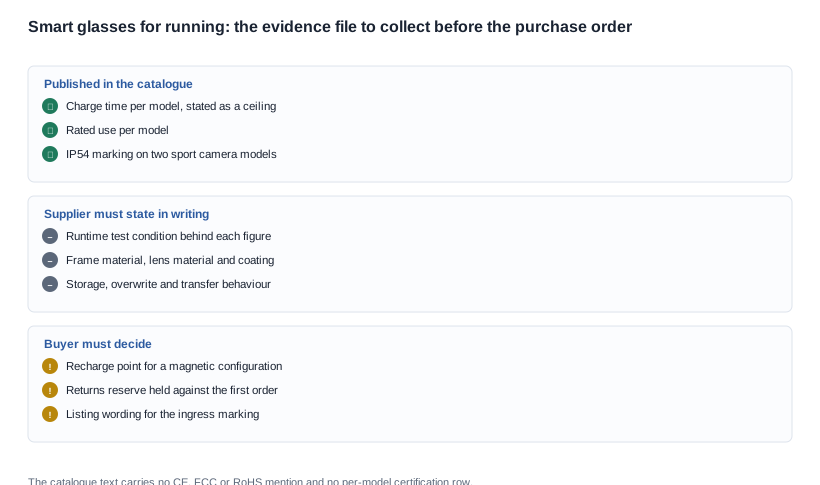
Documents to request before a deposit. The runtime test conditions, the ingress evidence for the two models that carry a marking, the per-model charging case position, the frame and lens material statement, the per-model unit weight, the storage and overwrite behaviour, the radio position on the camera models, the model designation table, the certificate register and the agreed incoming inspection criteria. Clause language is published at contract terms, and the commercial structure of a first order is published at pricing.

Where a running order goes wrong
A configuration chosen for resolution while the returns came from rain. The symptom is a cluster of "the video is unusable" tickets in the wet season. The root cause is a listing claim the ingress marking cannot support, applied to a model that carries no marking at all. Prevention is to write the claim from the marking and the model list, and to keep the two separate in the copy.
A charge ceiling read as a recharge window. The symptom is devices that cannot be turned around between two sessions. The root cause is treating two hours or less as "under two hours" and then building a rotation on a forty-minute recovery. Prevention is to time an actual recharge on the buyer's own cable and dock during the sample stage, because no published figure can settle it.
A rating written into a listing as a session length. The symptom is a customer expectation of eight hours of continuous capture. The root cause is quoting the top of a five-to-eight-hour band without a test condition. Prevention is to publish the band rather than a number, and to let the band be the claim.
A case assumed because a competitor ships one. The symptom is a packing list that contradicts the invoice. The root cause is that the catalogue publishes four different case states across the eleven camera models and the assumption was made from a competitor's listing. Prevention is the per-model case position in the evidence file.
A camera configuration with no storage answer. The symptom is a session that overwrites itself, or a clip that never reaches a phone. The root cause is that storage, overwrite and transfer are unpublished for every camera model, so the configuration was ordered without the question being asked. Prevention is item six in the file above, asked before the order rather than discovered after it.
A weight quoted from the wrong model. The symptom is a specification sheet that repeats 158 g across the range. The root cause is that one published weight exists and it belongs to a single camera model whose figure excludes its foldable case. Prevention is asking for the per-model figure and marking the ones the catalogue does not publish as unpublished.
What can move in the commercial terms
A running order has more room than most buyers expect, and less than they assume. It helps to separate the terms that are settled by the product from the terms that are settled by the relationship.
Settled by the product, and therefore not a negotiation target. The cell configuration and the cell capacity per model, the charging interface per model and therefore the charge ceiling, the rated-use band, the resolution class, the case architecture, and the structural features the catalogue publishes — the detachable inner frame on the V06 and the S7, the remote capture control on the D17 and the ZH12, the surround sound and long battery life on the YKC02. The cost and the lead time of conformity testing cannot be compressed by a better negotiation, and neither can the nature of a mould charge, which is a one-time cost that belongs in a separate quoted line rather than folded into the unit price.
Open to negotiation, in the order the money sits.
- The pilot quantity against the run quantity. On a running line the opening order is seldom the volume order, and the pilot tranche of it is where the widest price gap sits, because the supplier carries that part of the order itself, and the risk on it does not belong to the buyer.
- The split between two configurations. A configuration with a published charging case and one without can be split across two purchase orders, and the split lets the pilot absorb the configuration with the least published evidence about it.
- The consumable and protection line. A protective film applied at the factory is, on a product whose main failure mode is a scratched or fogged lens, the cheapest reduction in the return rate available anywhere in the bill of materials. Whether it ships, and whether it is applied at the factory, is negotiable; whether the coating is compatible with it is not, and that is a question for the supplier.
- Packaging and logo changes between runs. Cheap to change before the artwork is printed, expensive afterwards, and the running line is the one most likely to be reprinted when the model designation changes.
- The documentation set as a deliverable with a date. Runtime test conditions, the per-model case position, the per-model weight and the conformity file are deliverables, and attaching a date to them converts an open question into an obligation.
Minimum order quantity tiers, whether two configurations can share a purchase order, the payment milestones and the split of the first run into two deliveries against a staged payment are all negotiable in principle. The point to hold is that the pilot quantity and the documentation set are the two levers that protect the buyer's second order, and both cost nothing to ask for.

A worked example. Take a running brand opening a camera SKU for a European channel, with a target of two thousand units in the first year and a pilot of one hundred and fifty. The run profile is written first: forty-minute sessions, two runs a day, sweat exposure in summer, an estimated one run in four in rain, and a recovery window of about five hours because the device lives in a bag between sessions. That profile makes rated use the decisive row and makes the charge ceiling a secondary question, because the device is not recharged between sessions in a normal day. The ingress row then becomes the listing constraint: the brand wants a wet-weather line, and only two models carry a marking, so the choice narrows to the V06 or the S7, and the S7's 13 MP class is worth nothing until the video rows are settled, so the S7 becomes the candidate and the V06 becomes the fallback. The evidence file is then issued: runtime test conditions, the ingress evidence, the case position, the weight, the storage behaviour and the conformity file. The commercial ask is a pilot at a hundred and fifty with the documentation set dated, and the run quantity released against the first shipment's returns ratio. The outcome is a configuration chosen from a profile rather than from a preference, and a listing whose water wording matches the marking.
What the catalogue settles, and what it leaves to be asked
It is worth being precise: we publish the rows a buyer can order from, and we will not fill the gaps with typical values. For the running range that means the charge times, the resolution class, the rated runtimes, the cell capacities, the charging interface per model, the structural features that are published, the colour counts, the case capacities where a case row exists, and the IP54 marking on the two models that carry it, stated as a catalogue attribute.
What we do not publish and will not estimate: the frame material, the lens material, the coating, the hinge specification, the per-model unit weight beyond the single 158 g whole-unit figure for the MT6, the field of view, the video specification, the storage and overwrite behaviour, the operating temperature range, the cycle life rating, the runtime test condition, the standby draw, and the Bluetooth version on the camera models. We do not describe any product in our range as tested to IP54, because our published catalogue carries no test report behind that marking, and we do not carry the rating across to the audio models or the sport models, where no rating is published at all. We will not write "under two hours" for a published ceiling of two hours or less, because those are different claims.
What we will do: take the run profile, the destination market, the target price band and the volume, and tell you which configurations exist, which published rows apply to each, which rows have to be settled in writing before a purchase order, and which claims a listing can carry without overreaching. The scenario entry point is smart glasses for running, the sport tier is at sport smart glasses, the camera tier is at AI camera glasses, and the charging plan is at charging for running.
What to send us next. Send the run profile, the destination market, the volume split between pilot and run, and whether the device is a navigation aid, a capture tool or both, and we will return the configuration shortlist with the published rows attached, the rows that have to be closed in writing, and the listing wording those rows can support. The comparison method is at comparing models for running, the sweat and water question is at how they handle sweat, the capture question is at is there a shutter button, and the charging method for a ride is at charging for cycling.
Related reading
- The point where the scenario starts — smart glasses for running
- The product family set — sport smart glasses and AI camera glasses
- The rows we can confirm — battery life and IP ratings
- The selection method — how to choose smart glasses for running
Send the run profile and the destination market, and we will return the configuration shortlist with the published rows and the gaps that have to be closed in writing.


