

Almost every listing in this category contains one of two sentences: "sweatproof", or "IP-rated". Neither is a specification. The first is a marketing claim with no test behind it, and the second is a number that means something narrower than the word people attach to it.
The published position in our own range makes the point neatly. Two models in the entire range — the V06 and the S7 — carry an IP54 marking, and no third-party test report number is published for either. Every other model carries no ingress marking at all, and that includes the three models the catalogue names for sport: the YKC02, the D17 and the ZH12. So the model named for sport has no published splash rating, and the two models with a published splash rating are camera models.
That is an awkward fact for anyone writing a listing, and it is exactly why the honest answer to how do they handle sweat faq has to be built in three parts: what an IP54 marking actually covers, what it says nothing about, and which three mechanisms actually decide whether sweat becomes a fault.
There is a second reason the question keeps coming back in the form it comes back. It is usually asked as "is it sweatproof?", which is a yes-or-no question about a product, when it is actually three separate questions about a supply chain: does the model carry a published ingress marking, what does that marking cover, and what happens to the charging interface and the skin contact after ninety minutes of use. Only the first of those can be answered from a catalogue. The other two need a document and a wet test, and a listing that answers the third with the first is how unsupported claims reach a box.
This page is written for the buyer specifying a product for a sweaty environment — a running channel, a cycling range, a site-wear range for staff working outdoors — and it is arranged in the order that closes the gaps fastest.
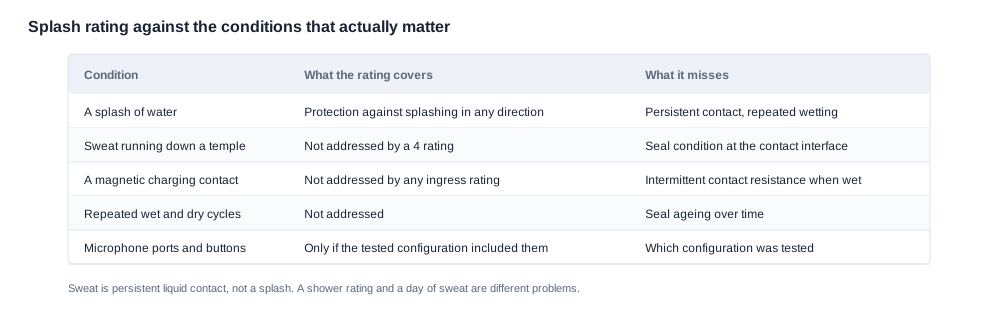
How do they handle sweat: the three things that decide it
Sweat is not a splash. It is persistent liquid contact, at body temperature, running down a surface that has a seal in it, for hours. A product designed to survive a shower is not automatically a product designed to survive a full training block, and a rating obtained by a splash test says less about sweat than the number suggests.
Three mechanisms decide the outcome, and none of them is the rating itself.
The first is where the enclosure is actually closed. Every product has a fixed number of places where the housing is opened: the temple split, the charging interface, the button aperture, the microphone ports, the case contacts. The charging interface is the one that catches people out, because it is a deliberate opening in the product and it is also the place a wearer's hand goes most often. On a frame with magnetic charging contacts in the temple, that contact sits against a sweaty hand for the whole session.
The second is what happens to that interface when it is wet. A magnetic contact with a wet face is a connection with a variable contact resistance. The symptom is not a failure — it is intermittent charging, which the customer experiences as a product that will not charge properly, and which arrives in the support queue as a hardware complaint rather than as a moisture complaint.
The third is the skin-contact material and whether it can be replaced. Whether the surface against the forehead absorbs moisture, and whether the part that touches the skin comes off so it can be cleaned, is the difference between a five-minute service event and a whole-unit replacement. In our published data, seal material is not published for any model in the range.
There is a fourth factor that sits behind all three and is captured by no ingress test at all: seal ageing. A seal that has been wetted and dried repeatedly is a different condition from a seal that has been splashed once, and the repeated-wetting case is the one that produces a failure in week three rather than in week one.
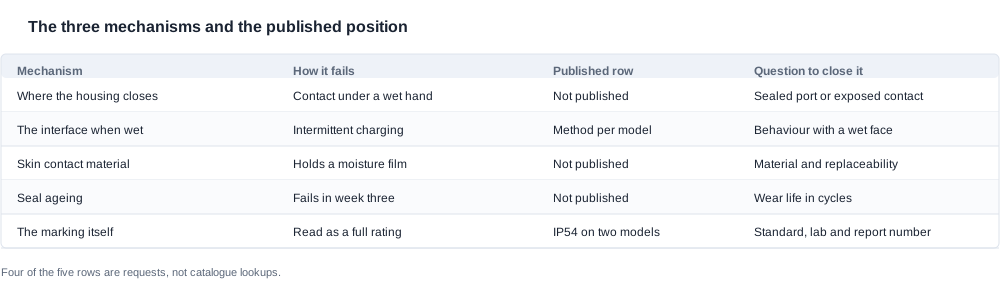
The table above is the version we would hand to a buyer who needs to write a specification. Read the right-hand column carefully: every one of those gaps is closable with a request and a wet test, and none of them is closable with a catalogue.
How do you read the marking without reading more into it
The second digit of an IP rating describes protection against water. A 4 means protection against water splashing in any direction. It is not a shower rating, not a jet rating and not an immersion rating — those are 5, 6 and 7 respectively, with 8 reserved for continuous immersion under stated conditions.
The first digit is a separate scale, about solids, and the two digits are not comparable with each other. A product can be immersion-rated and not dust-rated, and the claim that an "IP54" product is "IP5-something in dust" is a misreading of the numbering.
So for the V06 and the S7, the defensible statement is: the model carries a published IP54 marking, which describes protection against water splashing in any direction. The indefensible statements are "waterproof", "sweatproof", "water resistant", "rain-capable" and "splash-proof for cycling". None of them is the marking, and each of them is a promise that the marking cannot carry.
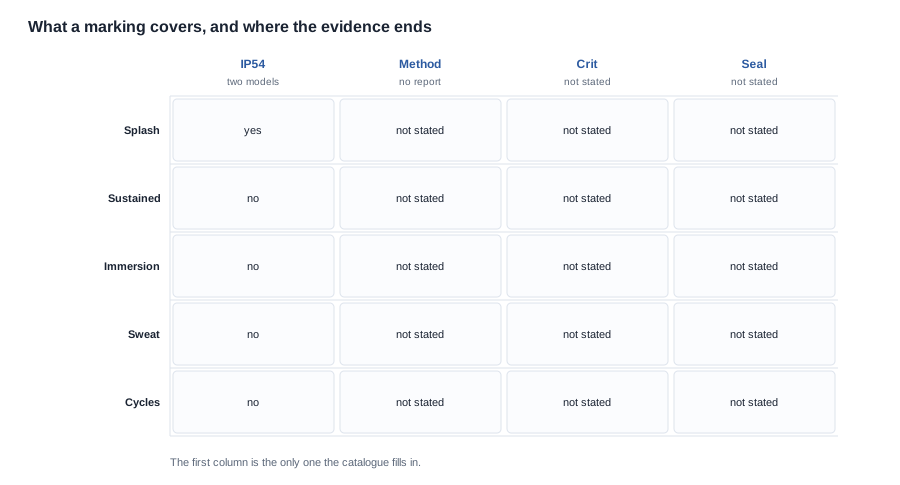
The matrix above is the version of the same point in table form, and it is worth reading as the standing template for any ingress claim in a listing. Almost every cell says the same thing, and that is the finding: the published position is a marking without a report, a test method that is not stated, and a configuration that is not described.
There is a second reason to be careful with the marking, and it is specific to sweat. A marking is a summary of a test, and the report is the evidence. Without the report, a buyer cannot see the standard and edition, the assembly configuration, the exposure duration, the powered state, or the failure criterion. A splash exposure with a weak failure criterion and a splash exposure with a strict one are the same number and very different products.
So the request that closes the gap is a short list: the standard and its edition, the laboratory, the report number, the tested configuration including which parts were fitted, the exposure condition and duration, and the failure criterion. Any supplier that cannot answer the failure criterion question has not run a formal test, and that is worth knowing before you write a listing rather than after.
We will also name what is absent rather than let it be inferred. For every model other than the V06 and the S7, no ingress claim is published. That is the absence of a claim, not a judgement about the product, and it is the position we can defend. We will not describe a splash-protected product as waterproof, and we will not infer that a model without a marking cannot handle sweat — we will say that no ingress claim is published for it.
How do the sport models compare on the rows that matter
The matrix below compares the five models that a sport buyer will be looking at, against the three published rows that bear on a wet environment. It is deliberately short, because there are only three rows available.
Two observations follow immediately, and both are the kind of thing a buyer discovers late if they read the catalogue in product order rather than in model order.
The first is that the ingress marking sits on camera models, not on the models named for sport. The V06 and the S7 carry IP54; the YKC02, the D17 and the ZH12 carry no published marking. A buyer who assumed the sport line was the protected line has the relationship exactly backwards, and it is worth noticing that the V06 and the S7 also have no charging case row at all, while a camera workflow for a long outdoor session was already leaning on the case for the published runtime.
The second is that the fast-charge row also sits on the sport models. The D17 and the ZH12 publish a charge time of about one hour, and they are the only two models in the entire range that do. Everything else publishes two hours or less as a ceiling. For a product that gets rinsed, wiped and re-worn inside a session, that is not a minor row.
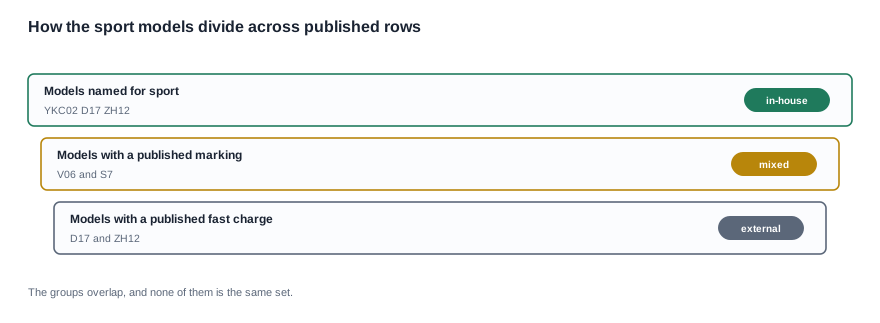
What the comparison does not settle is the question that matters most to a sport buyer. Between them, the published rows tell you that one model has a splash marking and another has a fast charge. They tell you nothing about how either behaves after ninety minutes of sweat, because no seal material, no test report, no seal service life and no weight is published for the sport models. The MT6's 158 g is the only weight in the whole range, and the MT6 is a camera model with a 1200 mAh foldable case rather than a sport model.
The design features that do bear on sweat are published on a different axis. The V06 and the S7 publish a detachable inner frame, which is the published answer to the skin-contact question: the part that touches the skin comes off and can be cleaned. The D17 and the ZH12 publish a remote shutter, which means the wearer does not have to touch the temple during a session at all — a contact-avoidance measure that happens to be published as a convenience feature. Both of those are real, and both are worth more in a wet session than a splash marking with no report behind it.
A worked comparison makes the point concrete. A running brand has two plausible routes into the sport channel. The first is the D17, which publishes a remote shutter, surround audio and a charge time of about one hour — the fastest charge in the entire range — and carries no published ingress marking. The second is the S7, which publishes an IP54 marking and a detachable inner frame, alongside a camera, with no charging case row at all and a charge time that falls under the two-hour ceiling.
The first route gives a customer who runs three times a week a product that charges between sessions and never needs touching mid-run. The second gives a customer who gets caught in weather a product with a documented splash marking and a skin-contact part that can be cleaned. A buyer who chose on the packaging would take the marking; a buyer who chose on the session length would take the charge time; a buyer who chose on the maintenance path would take the detachable inner frame. There is no single correct answer in the published data, which is why the right move is to ask the four questions and let the answers decide which model goes on the shortlist — and, for the one that makes it, to establish the wet behaviour on a sample before the artwork is written.
The trade-off runs the other way too, and it is worth naming before a shortlist is scored. The models with the published markings are camera models, and camera models in this range publish cells between 220 and 290 mAh with a rated runtime of about five to eight hours and no test condition stated. A camera is a different energy proposition from an audio-only sport model, and a buyer who treats the marking as the whole of the value decision has compared two products on the one row they happen to share.
How do you establish the sweat behaviour before the product is listed
Because the published data stops at the marking, the buyer has to produce the rest. The sequence below is what we recommend, and each step is designed to catch something the previous step cannot.

- Send the evidence request first. The standard, the laboratory, the report number, the tested configuration, and the failure criterion — five items, one message, per model. Do this before the sample, because the answer may change whether you need the sample.
- Establish the charging interface. Ask whether the charging interface in the frame is a sealed port or an exposed contact, and whether it sits under the wearer's hand during use. This is the sweat-specific question that no rating answers.
- Wet the contact deliberately. Seat the frame with the contact wet and observe what the customer observes. Two minutes, and it is the failure that reaches the support desk most often.
- Run a repeated wet-and-dry cycle. Not a single splash. Wet, wear, dry, repeat, across several cycles. This is the condition that seal ageing produces and that a splash test does not.
- Check the skin-contact material. Look at the surface against the forehead and note whether it holds a moisture film or drains.
- Run a full session in the actual discipline, then inspect the interface and the seal line immediately afterwards. The sport smart glasses for running and sport smart glasses for cycling pages cover what the wearer is actually doing during those hours.
- Decide the listing boundary before the copy is written. The IP54 marking on the V06 and the S7, the charging method, the cell, the charge time, the runtime and the remote shutter row are published rows. The seal material, the report, the interface wear life, the weight and any sweat-specific test are not.
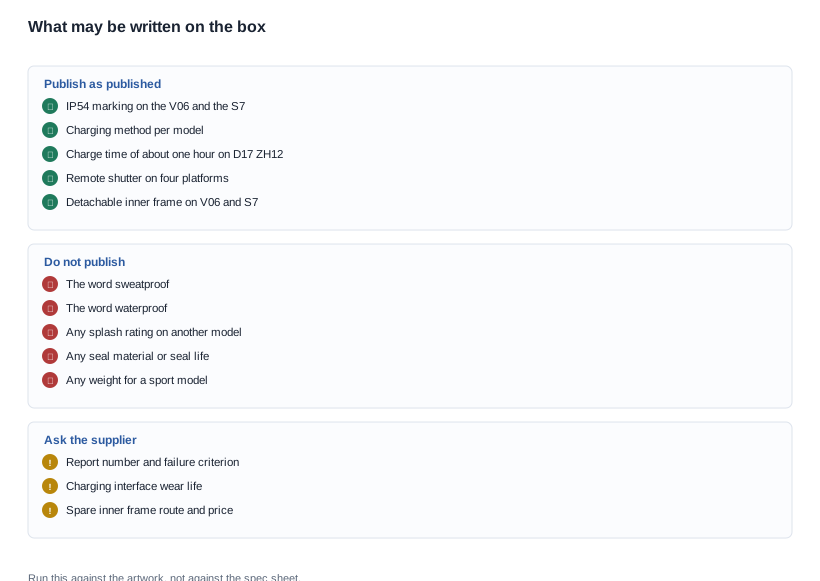
The checklist above is the pre-publication pass, and it is worth running against the artwork rather than against the spec sheet, because artwork is where the unsupported words live.
How do the sweat rows turn into a return rate
A sweat claim that cannot be defended is a return rate you have chosen. In a sport channel the return rate is the dominant cost line, and the three rows that drive it — the marking, the interface and the seal — are all closable with one request and one wet test.
That gives the negotiation a sharper focus than a unit price does. The terms worth spending time on are these:
- The spare parts set and its minimum order quantities — the charging contact, the seal, the inner frame, the temple. This line decides whether a moisture failure is a five-minute fix or a whole-unit replacement, and it is usually the cheapest line on the quotation with the largest effect on your return rate.
- Unit price and volume tiers, with the break points written down.
- Packaging specification, including whether the inner frame and its spares are in the box.
- Delivery splitting, so a pilot can ship separately.
- Payment nodes against inspection.
- The warranty period with a stated response, and what the response is when the failure is a moisture symptom rather than a broken component.
- Return terms for a sport channel, and the condition in which a returned unit arrives.
- The terms of a pilot order.
Quotable rather than negotiable, because they follow a process rather than a conversation: certification cost and certification lead time, and tooling, which is frequently amortised across a first order while certification is charged per product family. Ask which one you are being quoted, because the two are often bundled into a single line that hides which is which.
The trade-off is the one a buyer should name before signing: a product with a defensible ingress position and a replaceable seal costs more to specify and to stock than one without them, and returns it costs less. A buyer who negotiates the price down to the last cent and then writes "sweatproof" on the box has simply bought the return rate at a discount rate.
For the due diligence that belongs behind the shortlist, run the published rows first, then the wet test, then the spares line — in that order, so that the questions you take into negotiation are the ones the evidence actually raised. Which one you shortlist should follow the row that closes hardest, and in a wet channel the row that closes hardest is rarely the rating.
How do you describe the exposure instead of claiming protection
There is a way to write a listing that satisfies a customer without making a claim nobody can defend, and it is worth learning because it costs nothing and removes most of the risk.
Describe the condition rather than the verdict. "Rated IP54 for protection against splashing in any direction" is a statement of fact about a marking, and the customer can read it exactly as written. "Waterproof" is a verdict about a set of conditions nobody specified. "Sweat-resistant" is a verdict about a liquid nobody defined. The first survives a customer complaint and the other two do not.
Describe the maintenance path, not the material. If the model publishes a detachable inner frame, the listing can say that the skin-contact part is removable for cleaning — that is a published row, and it answers the real customer question, which is what happens to the unit after three months of training. If the seal material is not published, the listing cannot say what the gasket is made of, and it does not need to.
Describe the exposure the customer will actually have. For a cycling channel, the honest sentence names the conditions: rain and sweat, with the product worn for a two-hour session. That tells the customer the real usage and lets them make their own decision, and it does not commit you to a rating you do not hold. It also makes the support conversation easier, because both sides know what was claimed.
The practical test for a listing sentence is simple and worth applying before anything goes to artwork. Ask whether a customer who tested the product in the worst realistic condition could say you described it accurately. If they could, the sentence is fine. If they could only say the description overstated the product, the sentence has to change, regardless of how it sounds on a shelf.
The same rule applies to the retail description. If a listing says "sweatproof" in the bullet points and the technical table below it says "IP54", the stronger claim is the one the customer reads, and the weaker one does nothing to protect you.
The published position, in full
We publish the IP54 marking exactly as the catalogue states it, on the two models that carry it, and we publish no ingress claim for any other model and for any charging case. The sport smart glasses page is the range reference, and IP ratings for smart glasses covers what a marking can and cannot be stretched to mean.
We will not convert IP54 into "sweatproof" or "sweat resistant", because the marking describes protection against splashing and the word the customer will read on the box is not that. We will not infer that a model without a marking cannot handle sweat, and we will not quote a seal material, a seal service life or a frame weight for a model where the catalogue publishes none.
What we will do is tell you which figures are published, which are not published, and what evidence you would need to request. Send us the model and the discipline, and we will say which of the two the requirement actually is.
What to do next.
- Request the marking evidence and the interface type in one message.
- Wet the charging contact on a sample and run a repeated wet-and-dry cycle.
- Check the skin-contact material and note whether it holds a film.
- Run a full session in the discipline and inspect the interface and the seal line afterwards.
- Put the marking, the interface and the seal position into the agreement, and keep the box wording at the level of the evidence.
Related reading
- The range these models belong to — sport smart glasses range
- What a marking does and does not establish — IP ratings for smart glasses
- The running use case — sport smart glasses for running
- The cycling use case — sport smart glasses for cycling
Tell us the model and the discipline, and we will say which figures are published and which are not.


